

A surety’s view of your bond capacity depends on more than a balance-sheet figure. It also depends on how clearly your financial records connect to active project performance. Understanding construction bonding financial requirements can be challenging because sureties may weigh financial strength, project obligations, and reporting detail differently.
It’s reasonable to ask which statements and schedules to prepare, especially if tight cash flow or limited working capital could affect your ability to take on new work. Sureties typically look at the broader picture, including liquidity, profitability, debt, working capital, and current and completed projects. Clear, consistent records help explain that picture, though they can’t guarantee bond approval or a particular capacity.
This guide explains the financial factors sureties commonly review, why requirements vary, and how to organize records for a more informed conversation with a surety or construction finance partner. You’ll also learn how timely bookkeeping and work-in-progress reporting bring contract status, costs, billings, and estimated outcomes into clearer view, connecting project performance with your company’s overall financial position.
Key Takeaways
- Construction bonding financial requirements vary by surety and project. Financial qualification is one part of a broader underwriting review.
- Look beyond headline figures to understand how liquidity, debt, profitability, and cash-flow trends fit together.
- Organize financial statements and supporting records before a bonding review. Treat any document list as a guide, not a universal checklist.
- Consistent job-cost updates, AP/AR tracking, and WIP reporting connect project results with the company’s overall financial picture.
- Recurring construction-focused bookkeeping can make financial records easier to assemble and discuss, but it doesn’t guarantee bond approval or capacity.
What construction bonding financial requirements typically mean for contractors
Construction bonding financial requirements aren’t a single pass-or-fail test. They’re part of a surety’s broader assessment of whether a contractor can meet the obligations tied to a particular project and bond. Understanding the parties and the bond’s purpose helps clarify what the financial review is intended to support.
How surety bonds work in construction contracts
A construction surety bond is a contractual assurance involving three parties: the contractor, known as the principal; the project owner or other party protected by the bond, known as the obligee; and the surety, which backs the contractor’s stated obligation under the bond’s terms. This Surety bond overview explains the basic structure and common uses. A bond isn’t ordinary insurance: if the surety responds to a valid claim, it may seek reimbursement from the contractor under the applicable agreements.
The bond doesn’t remove the contractor’s responsibility to perform. It gives the obligee a defined form of recourse if a covered obligation isn’t met. The bond type determines the obligation being supported:
- Bid bond: Supports the contractor’s bid commitments, such as entering the contract and providing required bonds if selected.
- Performance bond: Addresses the contractor’s obligation to perform the work according to the contract.
- Payment bond: Provides protection related to payment obligations to covered subcontractors and suppliers, as set out in the bond.
Because these bonds serve different purposes, a contractor’s financial review may relate to several obligations across a project.
Why financial requirements are not one fixed threshold
Sureties consider financial qualification alongside other underwriting factors. A contractor’s project experience, current workload, financial condition, and the scale and complexity of the proposed work can all shape the review. Even strong financial statements may prompt questions about how the contractor will manage existing commitments while taking on another project.
General underwriting considerations differ from contract-specific eligibility rules. A public agency or private owner may specify which bonds are required, along with conditions tied to the contract and applicable rules. Requirements vary by jurisdiction, project, and bond type. A threshold or financial ratio cited in one context shouldn’t be treated as a universal standard.
Prepare a clear, consistent financial picture and understand the obligations tied to the opportunity. The construction bonding financial requirements for one contract may differ from those for another.
Which financial factors can influence construction bond qualification
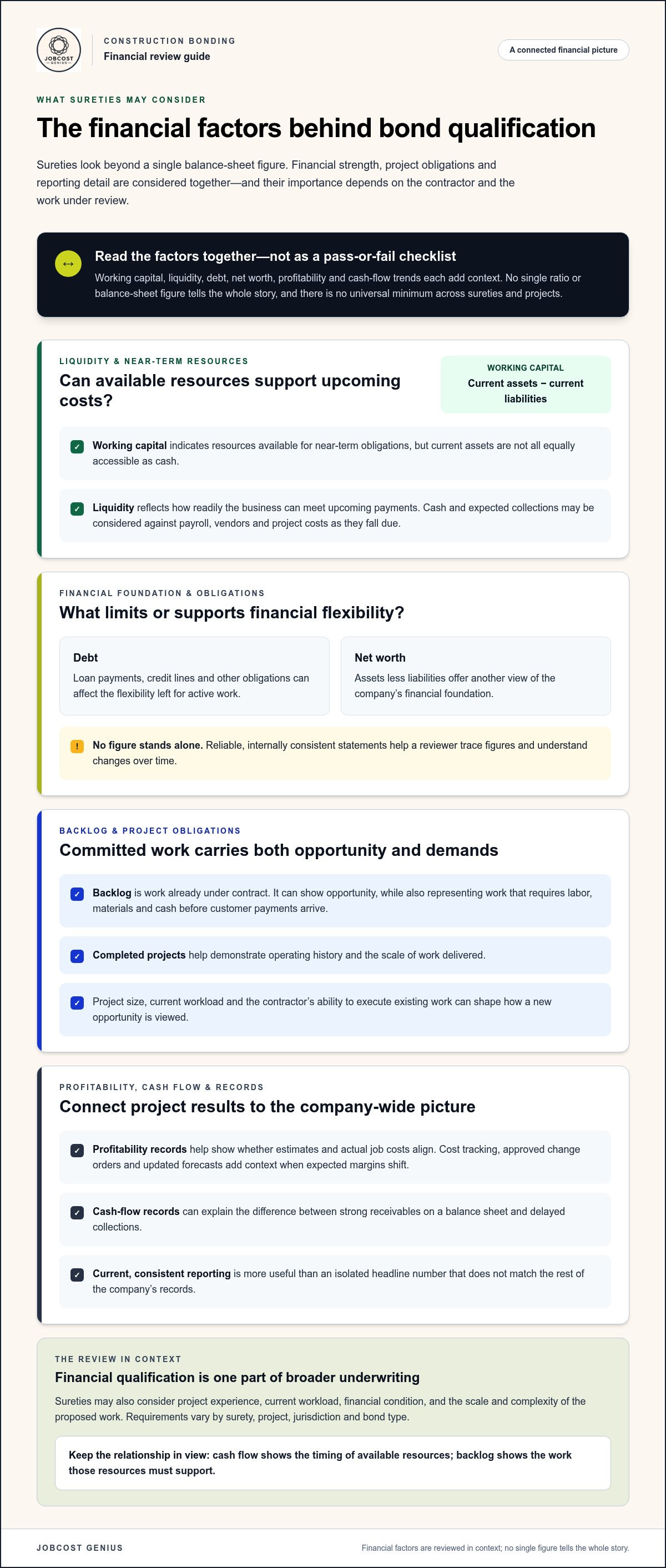
Sureties assess financial strength as a connected picture, not a checklist where one strong figure settles the question. Construction bonding financial requirements may involve working capital, liquidity, debt, net worth, profitability, and cash-flow trends. The importance of each factor depends on the contractor’s circumstances and the work under review.
How working capital, liquidity, and debt can shape a review
Working capital is the difference between current assets and current liabilities. It indicates resources available for near-term obligations, though not every current asset is equally accessible as cash. Liquidity looks more broadly at how readily a business can meet upcoming payments. A surety may consider whether cash and expected collections can support payroll, vendors, and project costs as they fall due.
Debt adds context. Loan payments, credit lines, and other obligations can affect how much financial flexibility remains for active work. Net worth, which reflects assets less liabilities, offers another view of the company’s financial foundation. No single ratio or balance-sheet figure tells the whole story, and contractors shouldn’t assume a universal minimum applies across sureties and projects.
Reliable, internally consistent statements let a reviewer trace figures and understand changes over time. For example, if a balance sheet shows strong receivables but collections are delayed, cash-flow records can help explain the difference. Current reporting is more useful than an isolated headline number that doesn’t match the rest of the company’s records.
Why backlog, profitability, and cash flow matter together
Backlog shows work already under contract, while completed projects help demonstrate operating history and the scale of work the company has delivered. Both need context. A large backlog can indicate opportunity, but it also represents obligations that require labor, materials, and cash before customer payments arrive. Project size and the contractor’s ability to execute existing work can shape how a new opportunity is viewed.
Profitability records help show whether estimates and actual job costs align. Cost tracking, approved change orders, and updated forecasts provide context when a project’s expected margin shifts. The SBA Surety Bond Guarantee Program is another resource for eligible small businesses seeking surety bonds.
Current cash flow and backlog only make sense together: one shows the timing of available resources, while the other shows the work those resources must support. No single metric guarantees approval. The assessment depends on the full business picture, and consistent construction financial reporting can make that picture clearer. Explore construction bookkeeping and reporting support to keep company and project records organized.
What documents should contractors prepare for a bonding review?
A well-organized file helps a reviewer understand how company finances connect to active projects. No single document checklist applies to every surety or contract, so use the records below as examples. The specific request may depend on the bond, project, and review process. These records can also help you answer questions about construction bonding financial requirements with consistent supporting information.
Company financial records to organize
Start with the latest available company financial statements and the schedules that support them. Depending on the review, a surety may request statements prepared internally or compiled, reviewed, or audited by an accountant. These formats offer different levels of assurance, and no one format applies in every case. Label the reporting period and preparation method clearly.
Possible records include:
- Balance sheets, income statements, and cash-flow information, supported by reconciliations that tie account balances to the accounting records.
- Bank information, such as account details or statements, if requested.
- Schedules of debt, equipment, receivables, and payables, showing relevant balances and obligations.
- Tax-related records and ownership details, when requested as part of the review.
Before sharing the file, check that schedules agree with the financial statements. A debt schedule, for example, should reconcile to liabilities in the books, and receivables detail should align with the reported balance. Explain timing differences or other material changes rather than leaving figures unexplained. The SBA Surety Bond Guarantee Program page is a government resource for contractors exploring the program and its requirements.
Project and work-in-progress records to assemble
Company statements show the overall financial position; project schedules help explain the work behind it. A contract schedule can organize each job’s original amount, approved changes, billings, costs to date, and estimated outcome. Together, these details show how project performance contributes to revenue, receivables, and current obligations.
Prepare a current backlog or project list, job-cost reports, and WIP schedules when relevant to the review. WIP reporting brings contract status, costs, billings, and estimated financial outcomes into one view. For a deeper explanation of the schedule and its role, see WIP Reporting for Construction: The Definitive 2026 Guide.
Reconcile project schedules to the general ledger before submitting them. Consistent dates, job identifiers, and cost totals make it easier to trace project activity to company-wide statements.
How to improve bonding readiness with consistent construction financial reporting
Bonding preparation is easier when financial records are maintained routinely, rather than assembled under deadline. A dependable monthly process helps keep company statements, project costs, and cash activity aligned. It won’t determine a surety’s decision, but it can make the information behind construction bonding financial requirements clearer and easier to discuss.
Build a repeatable monthly close and job-cost review
Reconcile bank accounts and balance-sheet accounts, then review transactions for errors or missing entries. Once the books are current, compare actual job costs with budgets and forecasts. Investigate unexplained variances and correct source records before relying on summary reports. This sequence helps prevent project schedules and company statements from telling different stories.
Track accounts payable and receivable consistently. Current payables show upcoming obligations, while receivables tracking provides visibility into amounts billed and collections still due. Document estimate revisions, approved change orders, and forecast changes so the reason for a margin or cost shift is clear. Reviewing these items regularly helps distinguish a project issue from a timing difference or outdated estimate.
Use WIP reporting to explain project status clearly
A work-in-progress schedule brings contract value, costs to date, billings, and estimated completion into a project-level view. Reviewing these figures together can help identify jobs where costs are advancing faster than billings, estimates have changed, or the expected outcome needs updating. The schedule is one part of the reporting picture, not a replacement for complete financial statements or the surety’s own judgment.
Reliable job records make capacity discussions clearer by showing how active work, costs, billings, and forecasts connect. That clarity depends on current information and consistent project-level tracking, not simply producing a WIP report for a review.
For broader accounting foundations, see 2026 Construction Accounting Guide for Small Firms. To establish more consistent financial reporting, explore construction bookkeeping and WIP reporting support.
How construction bookkeeping support fits into a bonding preparation plan
Gathering records only when a bonding review begins can create extra work: transactions need categorizing, account balances need reconciling, and project schedules may need updating before they tell a consistent story. Recurring construction-focused bookkeeping gives contractors a steadier view of company finances and job performance. That visibility can support preparation for construction bonding financial requirements, but organized records don’t guarantee approval or a specific bond capacity.
What ongoing financial oversight can help contractors maintain
Monthly bookkeeping can include transaction categorization, bank reconciliations, and financial statements. Regularly updated records help contractors see whether balances tie out and identify issues before they become last-minute questions. Construction-specific accounts payable and receivable tracking adds detail on vendor obligations, customer billings, and collections.
Work-in-progress reporting adds a project-level view by organizing contract status, costs, billings, and estimated outcomes. Monthly statements, AP/AR records, and WIP reports together connect job activity to the company’s overall financial position. Procore Financials integration is also available for contractors using that system. These tools improve financial visibility; the surety remains responsible for its own underwriting assessment.
Choose a practical next step for your company
Start with what you have. Bring current financial statements together with project schedules, job-cost information, and a list of unresolved reconciliation items. Note where project estimates or balances need explanation, then work through those gaps so the records are easier to follow. For broader cash-planning practices, see Construction Cash Flow Management: Strategies for Sustainable Growth in 2026.
Ongoing bookkeeping and reporting can make preparation more orderly than rebuilding the financial picture from scattered records for each review. JobCost Genius provides construction-focused financial reporting, including monthly statements, AP/AR management, WIP reporting, and Procore Financials integration. Explore JobCost Genius financial reporting support to build a clearer, more consistent view of company and project performance.
Build a clearer foundation for your next bonding review
Construction bonding financial requirements vary, so a single ratio or balance-sheet figure can’t tell the whole story. Sureties may consider financial statements alongside working capital, cash flow, debt, project backlog, and the contractor’s ability to manage active work. The clearest preparation starts with records that agree: reconciled company accounts, current job costs, organized supporting schedules, and WIP reporting that connects contract activity to financial results.
Make reporting a regular practice, not a scramble before a review. Monthly financial statements and timely AP/AR tracking help maintain visibility into company balances, obligations, and collections. WIP reports add project-level context. These records can support a more informed discussion with a surety, but they don’t guarantee approval or a particular bond capacity.
JobCost Genius was founded by professionals with over 20 years of industry experience and provides construction-focused financial reporting, including monthly statements, WIP reporting, AP/AR management, and Procore Financials integration. Explore JobCost Genius construction bookkeeping and financial reporting support to build a clearer, more consistent record of company and project performance.
Frequently Asked Questions
Is there a universal minimum net worth for construction bonding?
No. There’s no single net-worth threshold that applies to every contractor or bond. A surety may consider net worth alongside working capital, liquidity, debt, profitability, experience, backlog, and the project’s demands. Construction bonding financial requirements for one application may differ from another based on the bond type, contract, and underwriting approach. Current financial statements and project records provide a more useful starting point than a general rule of thumb.
What financial statements do sureties typically request from contractors?
Sureties may request balance sheets, income statements, cash-flow information, and schedules supporting the reported figures. Depending on the review, they may also ask for bank and debt details, accounts receivable and payable information, tax-related records, or project schedules. Requirements vary, so treat this as a preparation guide rather than a universal checklist. Keep figures consistent across records, and identify whether statements are internally prepared or independently reviewed.
Can a small construction company qualify for a surety bond?
Yes, a small construction company may qualify, but company size alone doesn’t determine the outcome. A surety may assess the business’s financial condition, management experience, completed work, active backlog, project complexity, and the bond requested. Accurate bookkeeping and clear job records can help explain the company’s position and operating history. Qualification and bonding capacity remain subject to the surety’s underwriting assessment and the specific contract requirements.
How does a WIP schedule affect construction bonding?
A work-in-progress schedule can show contract values, costs incurred, billings, and estimated project outcomes. It gives a reviewer project-level context that company-wide financial statements may not provide by themselves. For the schedule to be useful, its inputs should be current, supportable, and consistent with the accounting records. WIP reporting helps explain project performance, but it doesn’t independently establish bond eligibility or guarantee a particular bonding capacity.
Does a contractor need audited financial statements to obtain a bond?
Not in every situation. The requested financial statement format can depend on the surety, bond size, contract, and contractor’s circumstances. Some reviews may use internally prepared statements; others may request statements compiled, reviewed, or audited by an accounting professional. Don’t assume one format will suit every application. Read the applicable document request carefully, and make sure the statements and supporting schedules are complete, current, and consistent.
What happens if a contractor’s cash flow or working capital is weak?
Weak cash flow or working capital may raise questions about the company’s ability to meet near-term obligations, but it doesn’t determine an underwriting outcome on its own. A surety may also consider debt, receivables, backlog, profitability, and the demands of active projects. Contractors can make their financial position easier to assess by reconciling accounts, updating forecasts, and documenting project costs, billings, and collections.
Do federal construction projects have different bonding requirements?
Yes. Federal projects may have requirements that differ from those for state, local, or private work. The applicable rules depend on the contract, project type, and governing requirements, so a federal threshold shouldn’t be applied automatically to every construction job. Review the contract documents and current authoritative government guidance for the specific opportunity. Also distinguish project bonding requirements from a surety’s separate financial underwriting review of the contractor.


