

What if a certified payroll report could do more than satisfy a compliance requirement? Accurate labor data can also show what a project is truly costing. Manual WH-347 entry, changing prevailing wage rates, and incomplete records can make errors more likely and delay the resolution of contract issues. Certified payroll reporting services can help bring these details into a consistent process.
Payroll accuracy matters, but managing federal and state requirements while keeping projects moving takes a reliable workflow. This 2026 guide explains how Davis-Bacon compliance works, what to watch for in prevailing wage and fringe benefit calculations, and how to reduce reporting gaps.
You’ll also learn how specialized reporting support can connect payroll data to job costing and project visibility. Founded by professionals with more than 20 years of construction industry experience, JobCost Genius treats compliance as part of sound financial management, not just paperwork. The goal is organized reporting, clearer labor costs, and a more confident view of project performance.
Key Takeaways
- Understand how prevailing wage determinations, worker classifications, and fringe benefits shape accurate certified payroll reporting.
- Build a reliable reporting routine by tracking employee hours, classifications, and benefits as work happens.
- See how certified payroll reporting services can add oversight to reporting workflows and reduce manual data-entry demands.
- Compare software and managed support, and understand why accurate source data and review matter for compliance.
- Connect payroll data to WIP reporting and labor burden analysis for a clearer view of project costs and performance.
What is Certified Payroll Reporting in 2026?
On covered public works projects, contractors generally submit certified payroll records for each week of work. Form WH-347 is the U.S. Department of Labor’s federal form for reporting employee hours, work classifications, wages, and fringe benefits. The form itself is optional, but the payroll information it requests is required. Contractors may use another format if it includes the required details.
Certification distinguishes these records from standard payroll. A regular payroll register shows what the company processed. Certified payroll also provides a worker-by-worker account of work performed and a signed statement that the information is accurate and wage requirements have been met. It creates a documented basis for review, not just a record of payment.
In 2026, reporting is becoming more digitally transparent. The revised WH-347, effective January 15, 2025, includes fringe benefit details on the main form and calls for workers to be identified as “journeyworker” or “registered apprentice.” As of October 1, 2026, it is the only valid WH-347 version for federal reporting. Electronic submission requirements are also expanding in some jurisdictions, making clean, consistent records increasingly important.
The Davis-Bacon and Related Acts (DBRA) Framework
The Davis-Bacon Act is the federal law at the center of prevailing-wage requirements for covered government construction work. The Davis-Bacon and Related Acts (DBRA) require contractors and subcontractors on covered federal or federally assisted construction projects to pay applicable prevailing wages and meet reporting obligations. These requirements shape the labor costs contractors need to account for when bidding.
The Davis-Bacon Act generally applies to federal construction contracts exceeding $2,000. The Department of Labor sets prevailing wage determinations based on the project’s county, type of construction, and worker classification. Rates include a base wage and fringe benefit amount. Using a rate for the wrong location or assigning an incorrect classification can affect pay and reporting accuracy.
Consequences of Non-Compliance and Reporting Errors
Missing or inconsistent records can prompt questions during agency reviews or audits. Common warning signs include payroll that doesn’t match time records, incomplete classifications, fringe benefit calculations that don’t align with the applicable determination, and late or missing submissions. Review requirements vary by project and jurisdiction, so organized source records are essential.
Errors can lead to back-wage obligations or contract funds being withheld while issues are resolved. Serious violations can also result in debarment from future federally funded work. There’s a business impact, too. If labor hours, classifications, or fringe costs are recorded incorrectly, project costs and margins may be misstated. The profit and loss statement can then give a misleading picture of performance, weakening decisions about labor, cash flow, and bids.
Well-managed certified payroll reporting services help keep compliance records aligned with payroll and project costs, turning a demanding reporting obligation into a clearer view of labor performance.
How to File Certified Payroll Reports: A Step-by-Step Process
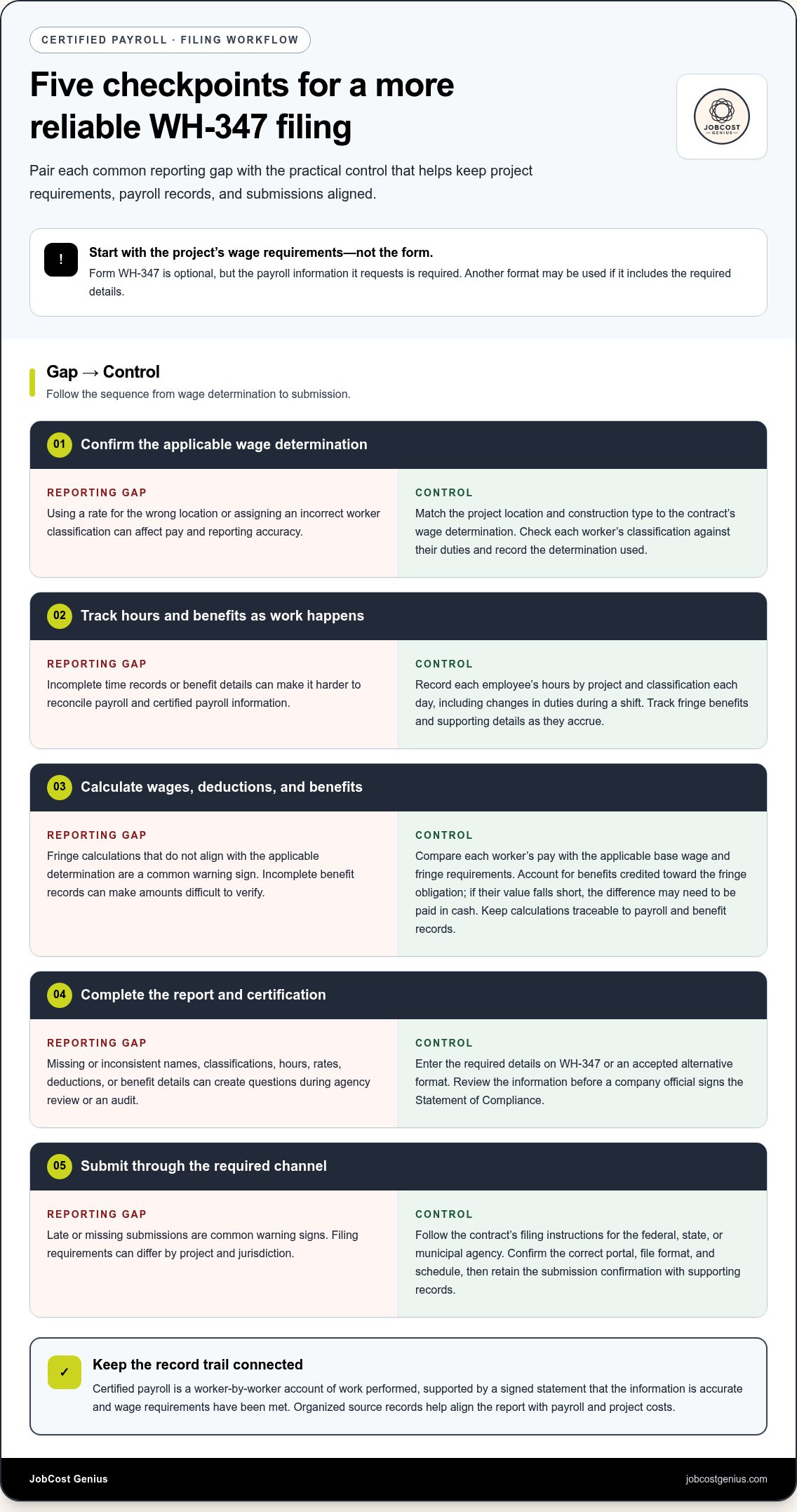
A reliable filing process starts before anyone opens Form WH-347. Create a consistent path from the project’s wage requirements to time records, calculations, certification, and submission. This makes it easier to catch mismatches while there’s still time to correct the underlying payroll data.
- Confirm the applicable wage determination. Match the project location and type of construction to the wage determination specified in the contract. Check each worker’s classification against their duties, and record which determination you used so payroll can be reviewed against the same source.
- Track hours and benefits daily. Record each employee’s hours by project and work classification, including changes in duties during a shift. Track fringe benefits and supporting details as they accrue instead of reconstructing them at the end of the pay period.
- Calculate gross pay, deductions, and net pay. Compare each worker’s pay with the applicable base wage and fringe requirements. Account for benefits credited toward the fringe obligation. If the benefit value falls short, the difference may need to be paid in cash. Keep calculations traceable to payroll and benefit records.
- Complete the report and certification. Enter the required payroll details on Form WH-347 or an accepted alternative format. Review names, classifications, hours, rates, deductions, and benefit information before a company official signs the Statement of Compliance.
- Submit through the required channel. Follow the contract’s instructions for filing with the federal, state, or municipal agency. Confirm the correct portal, file format, and reporting schedule for the project, then retain the submission confirmation with the supporting records.
Essential Components of Form WH-347
Classification should reflect the work performed, not simply an employee’s job title. Apprentice classifications may also be subject to program requirements and applicable ratios, so confirm the project’s governing terms before reporting apprentice hours. For fringe benefits, distinguish contributions to bona fide third-party plans from cash paid in lieu, and retain records supporting the amounts claimed. The Statement of Compliance is a formal certification, not a routine checkbox. The signing official should review the report’s accuracy before attesting to it.
Managing 1099 Workers on Public Works Projects
A 1099 label alone doesn’t settle whether a worker is properly classified as an independent contractor. Public works arrangements can receive close scrutiny, so document the work relationship and apply the relevant legal and contract requirements instead of relying only on how a worker is paid. Prime contractors should also establish a process to collect and review subcontractor payroll records, since subcontractor reporting gaps can affect project compliance. For additional context, see managing 1099 workers in construction.
For firms coordinating payroll with project costs, Cornell Law School’s legal definition of the Davis-Bacon Act offers useful context for the wage requirements behind these records. Specialized certified payroll reporting services can help organize the workflow, while construction bookkeeping support connects accurate labor records to clearer project financials. Explore construction payroll and bookkeeping support as part of a more structured reporting process.
Software vs. Managed Services: Choosing the Right Reporting Path
Payroll software can speed up calculations and organize reporting, but it can’t determine whether the information entered is correct. If field hours are assigned to the wrong project, a worker’s classification is inaccurate, or fringe benefit data is incomplete, automation can carry those errors into the report. The principle is simple: inaccurate inputs produce inaccurate outputs.
Software may suit a contractor with a straightforward workflow and staff who can maintain accurate records and resolve exceptions. Firms managing multiple projects, classifications, subcontractors, or reporting requirements may benefit from expert oversight. Managed support adds construction-specific review and helps connect payroll details to project records instead of treating each report as an isolated task.
Compare the full workload, not just the software subscription. Consider the staff time needed to gather field data, correct mistakes, prepare reports, and respond to questions. Then weigh that workload against the cost of tools or specialized support. The right approach should improve control and visibility without creating another disconnected system.
Assess how your technology stack handles data from the field through payroll and accounting. Procore, QuickBooks, and Sage 300 CRE may each play a role, but the key question is whether project, employee, and cost information stays consistent as it moves between systems. JobCost Genius specializes in Procore Financials integration services, helping bridge field activity and office financial workflows.
Procore Financials and Field-to-Office Sync
Field teams capture time and job details; office teams use that information to process payroll, monitor costs, and prepare compliance reports. When records require repeated manual entry, duplicate work increases the chance of mismatched hours or job codes. A connected workflow can reduce rekeying, but staff still need to review exceptions and confirm that source data is complete and assigned correctly.
The Role of Construction-Specific Payroll Expertise
A construction payroll specialist understands how job costing, work classifications, prevailing wage requirements, and fringe benefits intersect. General payroll expertise is valuable, but construction projects add project-level tracking that a generalist workflow may not address. A construction-focused partner can help organize those details and connect reporting with bookkeeping and project performance. Learn more about the distinction in this guide to construction bookkeeping versus generalist support.
For complex operations, certified payroll reporting services can combine structured systems with knowledgeable review. That approach takes the process beyond report production toward more reliable labor data and clearer financial oversight.
The Strategic Advantage: Linking Payroll to Job Costing and WIP
Certified payroll data can serve two purposes: documenting compliance and showing where project labor costs are accumulating. When hours, classifications, and wages are coded to the right jobs and cost categories, they give project managers and finance teams a more reliable view of work completed and costs incurred.
That information feeds Work in Progress (WIP) reporting. WIP compares a project’s costs and progress with its contract value, helping identify whether recognized revenue is keeping pace with the work performed. Payroll is one source of labor cost data, but it should be considered alongside other project costs and contract information, not treated as a complete measure of progress on its own.
Labor Burden and Project Profitability
An employee’s base hourly wage isn’t the full cost of their time on a job. Labor burden can include employer payroll taxes, insurance, and fringe benefits, along with other applicable labor costs. If job costing captures wages but omits related costs, the project may appear more profitable than it is. That gap can quietly erode margin on public contracts.
Assigning labor and associated costs to the correct project helps teams compare actual performance with estimates. For example, if a crew’s hours are posted to the wrong job or classification, reported costs may understate one project’s labor and overstate another’s. Correcting the coding gives managers a sounder basis for reviewing WIP and investigating possible underbilling or overbilling. It also creates more useful historical cost data for future estimates and bids.
WIP Reporting: A Construction Health Check
WIP reporting brings project costs, billings, and progress into a single view. Accurate payroll supports that picture by grounding labor costs in recorded hours and job assignments. In percentage-of-completion accounting, reliable cost information can help inform the measurement of progress, while the method and other project inputs determine how that progress is assessed. A mismatch between payroll records and job-cost reports is a signal to investigate before it distorts decisions about cash flow, remaining costs, or expected profit.
Regular reviews can uncover patterns such as recurring labor overruns, hours consistently posted to the wrong cost code, or billings that aren’t keeping pace with documented project progress. These findings can improve current project oversight and future bid assumptions. For a deeper look at how this reporting works, explore WIP reporting for construction companies.
With specialized WIP reporting and labor burden analysis, JobCost Genius connects compliance records to the financial performance of each job. Explore construction WIP reporting support to bring payroll and project financials into clearer alignment.
Scaling with JobCost Genius: Specialized Compliance Services
As a construction firm grows, payroll reporting affects more than filing a form. It connects to bookkeeping, job costs, and the information leaders use to assess project performance. JobCost Genius provides construction-focused payroll management and certified payroll reporting services, bringing industry-specific support to a process that can otherwise consume substantial administrative time.
Founded by professionals with more than 20 years of construction industry experience, JobCost Genius helps firms organize financial information and build clearer visibility into their operations. The practical aim is to reduce administrative friction and give owners more confidence in the numbers behind their projects.
Tiered Plans for Construction Firms
JobCost Genius offers Starter, Growth, and Premium plans. The Starter Plan provides a foundation for firms building more structured bookkeeping and compliance processes. Growth and Premium plans give businesses options as their operations and reporting needs develop. The right fit depends on the firm’s workflows, project complexity, and financial oversight needs.
Specialized construction bookkeeping is an investment in reliable information. Accurate payroll and job-cost records can help leaders understand where labor costs are landing and make better-informed decisions about project performance. WIP reporting and labor burden analysis can add context, turning financial records into useful management tools rather than month-end paperwork alone.
Build a Stronger Compliance Infrastructure
A more controlled process starts with understanding how information moves through your business. Review where time and payroll data originate, how project costs are assigned, who checks reports, and how records are retained. These steps can surface gaps and clarify what needs to change as you move to a managed construction bookkeeping and payroll process.
As workflows evolve, JobCost Genius supports firms with specialized construction bookkeeping, payroll management, WIP reporting, and Procore Financials integration. These services help create more connected records and financial clarity without treating compliance as an isolated task. Firms can match support to their stage of growth through the Starter, Growth, and Premium plans.
Ready to spend less time coordinating reporting and more time focused on your projects? Explore certified payroll reporting support from JobCost Genius.
Build a More Confident Payroll and Project Finance Process
Certified payroll compliance depends on accurate records, consistent review, and a clear process for meeting project reporting requirements. That information can also strengthen financial oversight. Connect payroll data to job costing and WIP reporting to better understand labor costs, spot project variances, and make more informed decisions about future bids.
Specialized certified payroll reporting services can reduce administrative strain while bringing compliance and project financials into sharper focus. JobCost Genius combines construction-focused payroll management and bookkeeping with Procore Financials integration, WIP reporting, and labor burden analysis. Founded by professionals with more than 20 years of construction industry experience, the firm supports contractors across the country and helps them move from reporting pressure toward greater financial clarity.
Ready to establish a stronger compliance process for your construction business? Explore certified payroll reporting support from JobCost Genius and take the next step toward organized reporting and confident project oversight.
Frequently Asked Questions
What is the difference between prevailing wage and certified payroll?
Prevailing wage is the required wage and fringe benefit level for covered work, based on the applicable project determination, location, construction type, and worker classification. Certified payroll is the record contractors use to report employee hours, classifications, wages, and benefits, along with a signed compliance statement. In short, prevailing wage sets the pay standard; certified payroll documents whether the contractor followed it.
Do I need to submit certified payroll reports if I have no work performed that week?
Follow the contract and agency instructions for weeks with no covered work. Some projects require a “no work” or “no payroll” report to maintain a continuous record, while others specify a different procedure. Don’t assume that no work means no reporting duty. Check the project’s reporting schedule and retain documentation showing the work status for that period.
Can I use standard QuickBooks for certified payroll reporting?
QuickBooks can help process payroll and maintain employee and wage records, but standard payroll functions may not produce every project-specific detail required for certified reporting or submit reports through an agency portal. Check that your workflow captures hours by project and classification, fringe benefit information, and required certification data. Certified payroll reporting services can add construction-specific review and help connect payroll records with job costs.
How long must I retain certified payroll records for federal projects?
For federal projects, retain certified payroll records for at least three years after the project is completed. Keep submitted reports together with supporting time records, payroll details, benefit documentation, and submission confirmations. Organized files make it easier to respond to an audit or resolve a discrepancy. Contract terms or other applicable requirements may call for a longer retention period, so review the project documentation.
What happens if I misclassify a worker on a certified payroll report?
A worker reported under the wrong classification may appear to have received the correct rate even when the applicable rate for their actual duties is higher. The discrepancy can lead to questions, corrections, or potential back-wage obligations. Depending on the facts and severity, other consequences may include withheld contract funds or debarment from public work. Keep classifications tied to duties performed, and correct errors promptly using the project’s reporting process.
Are fringe benefits included in the prevailing wage calculation?
Yes. Prevailing wage generally includes both a base hourly wage and a fringe benefit amount. Qualifying benefits provided through a plan may count toward the fringe requirement; if the value provided falls short, the difference may need to be paid in cash. Track benefit contributions and cash payments clearly, then compare them with the project’s applicable wage determination to support accurate payroll reporting.
How does certified payroll impact my WIP (Work in Progress) reports?
Certified payroll records can provide detailed labor hours and wage costs by project, giving WIP reporting a stronger basis for tracking job costs. If hours or labor costs are assigned to the wrong project, WIP may understate costs on one job and overstate them on another. Reviewing payroll alongside billings, contract value, and other costs helps identify variances and supports a more reliable view of project performance.
What is a WH-347 form and who is required to sign it?
WH-347 is the U.S. Department of Labor’s federal form for reporting certified payroll information. Using the form is optional, but contractors must provide the payroll information it requests, whether on WH-347 or an accepted alternative. The Statement of Compliance must be signed by a company official or other authorized person who can attest to the report’s accuracy. For federal reporting after October 1, 2026, use the revised version of WH-347.


