

A jobsite crossing a state line can change more than a crew’s location. It can affect payroll and tax requirements, while incomplete timecards can leave hours, classifications, or job costs unclear. That’s why multi-state construction payroll help needs to connect compliance tasks with the labor details behind each project.
If work locations are creating new questions or payroll corrections are taking time away from project oversight, start by tightening the information you collect. Your records should show where employees worked, how many hours they logged, their classifications, and the pay details attached to each job.
This 2026 guide explains the risks contractors should assess, how to build a consistent jobsite-based payroll workflow, and what to ask when evaluating specialized support. It also covers how organized payroll records can feed construction bookkeeping and job-cost reporting, so you can better understand labor costs by project. JobCost Genius brings more than 20 years of industry experience to construction-focused payroll and financial oversight. The right scope of support, however, depends on your workflow and needs.
Key Takeaways
- Review payroll obligations by jobsite, since work location, employee residence, and project circumstances can affect which rules apply.
- Compare internal processing, general payroll support, and construction-focused help based on the oversight and reporting your workflow requires.
- Use a repeatable pre-payroll process to verify jurisdictions, assign responsibilities, and reconcile payroll with project labor costs.
- Evaluate multi-state construction payroll help by confirming the state-related tasks and scope included before choosing support.
- Look for a solution that connects construction payroll records with bookkeeping and job-cost reporting needs.
Why multi-state construction payroll needs a jobsite-level process
A crew may start the week at one project and finish at another. Payroll records still need to show where each hour was worked and which job should carry the labor cost. When a contractor takes on an out-of-state project or recurring cross-border work, a process built around one office or jobsite can leave important details unclear.
Multi-state construction payroll is the processing of pay for workers or work locations connected to more than one jurisdiction, with jobsite-level data supporting payroll accuracy and project labor visibility. Applicable requirements can depend on the worker, where the work is performed, and relevant state rules. Don’t assume every out-of-state assignment triggers the same registration, withholding, or reporting duties. Verify the specifics for your circumstances.
When does a construction company need multi-state payroll support?
A new out-of-state project, crews traveling between jobs, or recurring work near a state line can prompt a review of payroll procedures. An employee might log hours at several jobsites during one pay period, creating records tied to different projects and potentially different jurisdictions. Keep each location and shift distinct so the payroll reviewer has the information needed to assess the situation. The assignment alone doesn’t establish every obligation, so confirm what applies before processing.
Why jobsite details matter beyond the paycheck
Missing location details can make it harder to review which rules may apply. Missing hours, worker classification, or project codes can also lead to payroll corrections and leave labor costs assigned to the wrong job. For public works, check whether project-specific wage rules apply. Prevailing wage requirements are one area contractors may need to understand and verify for the project.
Complete labor records serve two purposes: they support payroll review and give bookkeeping a clearer basis for tracking project costs. When hours and pay are consistently associated with the right job, monthly reporting can better reflect labor by project and support visibility into profitability. For a broader look at how financial records fit together, see construction accounting for small firms.
Payroll processing support can help organize and process payroll information, but it isn’t automatically legal or tax advice, and it doesn’t mean income tax filing is included. Before engaging multi-state construction payroll help, confirm which state-related tasks are in scope and which compliance decisions require guidance from a qualified professional. Construction-focused providers such as JobCost Genius connect payroll management with financial oversight, but discuss and confirm specific state coverage and responsibilities.
How multi-state construction payroll requirements change across jobsites
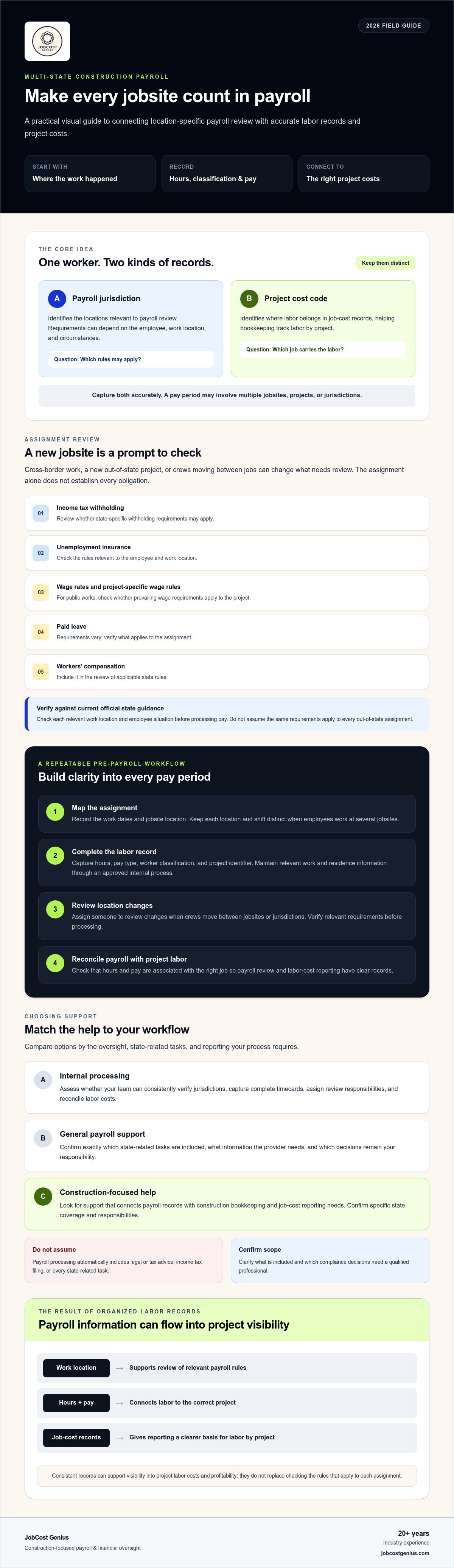
A jobsite change can affect more than the project code on a timecard. Depending on the worker’s residence, where and how long they work, and the employer’s activity, contractors may need to review state rules for income tax withholding, unemployment insurance, wage rates, paid leave, and workers’ compensation. Details vary. Treat each new assignment as a prompt to check the applicable requirements, not as proof that every obligation automatically applies.
Verify payroll rules against current official state guidance for each relevant work location and employee situation before processing pay. This keeps decisions grounded in the rules that apply instead of assumptions carried over from another jobsite.
Keep two records distinct. Payroll jurisdiction identifies the locations relevant to payroll review. Project cost codes identify where labor belongs in the company’s job-cost records. A worker’s hours may connect to one jurisdictional review and multiple projects, or to multiple jurisdictions during a pay period. Capture both accurately so compliance review and labor-cost reporting can answer their separate questions.
Which payroll details should contractors capture for every assignment?
Use a consistent record for each work period. Capture work dates, jobsite location, hours, pay type, classification, and project identifier. Maintain relevant employee work and residence information through an approved internal process, with access limited as appropriate. Assign someone to review changes when crews move between jobsites or jurisdictions, and set a clear deadline for receiving updates before payroll is processed.
How do prevailing wage and worker classification affect the process?
Routine multi-state payroll review is not the same as meeting specialized public-project requirements. A project may have prevailing-wage or certified-reporting obligations, so confirm the contract and applicable rules before work begins. For federal construction contracts, the U.S. Department of Labor provides information about the Davis-Bacon and Related Acts. These requirements aren’t automatic features of every construction job. For a deeper look, read the prevailing wage payroll guide.
Worker classification also deserves careful review. Don’t rely on a contract label or a worker’s title alone. Assess the applicable criteria and seek qualified guidance when the facts are unclear. Well-maintained records help reviewers understand the actual work and pay details.
When evaluating multi-state construction payroll help, ask how the provider handles job and jurisdiction data, and confirm which state-related tasks are included. To discuss how construction payroll and financial records may fit together, explore JobCost Genius’s construction-focused support.
How to compare multi-state construction payroll help options
A standard payroll tool may calculate pay based on the information entered, but it can’t make incomplete jobsite records reliable. Contractors still need a process for capturing locations, hours, classifications, and project codes, then reviewing exceptions before payroll runs. Compare options by how well they support that workflow, not only by whether they can issue paychecks.
Use this framework to compare internal processing, general payroll support, and construction-focused help. Capabilities vary, so confirm the details with each provider.
| Evaluation area | What to assess |
|---|---|
| Construction experience | Can the team work with jobs, labor classifications, and project cost coding? |
| Jurisdiction setup | Who identifies relevant work locations and verifies state-specific setup? |
| Time-data review | How are missing hours, jobsite changes, and exceptions flagged and resolved? |
| Reporting | Can payroll records support project-level labor visibility and reconciliation with bookkeeping? |
| Support and ownership | Who answers process questions, approves payroll, and owns each compliance task? |
Internal teams may have close access to project details, but they need clear ownership and enough capacity to review them consistently. General payroll support may handle routine processing, while the contractor remains responsible for providing complete construction inputs. Construction-focused support may better understand job-cost records, but confirm the exact scope. No provider or tool should be treated as a guarantee of compliance. The employer should verify its responsibilities and retain appropriate review controls.
What should a construction payroll support checklist include?
Ask how the process handles jobsite changes, missing time, pay classifications, and exceptions before approval. Get written confirmation of which registrations, calculations, filings, and reports are included, and which remain your responsibility. Check how payroll data can be reconciled with bookkeeping and job-cost records. A useful answer explains the handoff and who resolves mismatches.
When is specialized construction payroll help worth evaluating?
Consider a review when cross-state projects recur, crews grow, payroll corrections repeat, or no one is sure who owns key tasks. Track the time your team spends collecting, correcting, approving, and reconciling payroll information. That record can show where the process strains without assuming a particular provider will produce savings.
As you assess multi-state construction payroll help, ask providers to walk through your actual workflow and identify what they do, what your team does, and what requires separate professional guidance. JobCost Genius provides construction-focused payroll management alongside bookkeeping and financial reporting. Confirm the specific multi-state scope and responsibilities before deciding whether it fits.
Build a repeatable multi-state construction payroll workflow
A consistent process gives each person a clear handoff, from project setup through payroll reconciliation. It also creates a record of how payroll decisions were reviewed, instead of relying on memory when crews move between jobsites.
What should happen before the first out-of-state payroll?
Before work begins, confirm the project location, expected work pattern, affected worker details, and the person responsible for payroll coordination. Review registration and withholding questions against current official state guidance or with a qualified advisor. Set up project codes and timecard approval steps before the first hours are submitted, so labor can be tracked correctly from the start.
What should the recurring payroll review include?
Use the same checkpoints each pay cycle, even when the crew or location changes. Assign owners for collecting employee, jobsite, time, and project-cost information, and document how exceptions move from review to resolution.
- 1. Confirm project and jurisdiction details. Check active jobsites, expected work locations, and changes since the previous cycle. Route new or changed circumstances for review.
- 2. Validate time and job records. Compare submitted hours with approved timecards and jobsite records. Confirm dates, pay details, classifications, and project coding are complete and consistent.
- 3. Resolve exceptions before processing. Identify missing time, unusual location changes, and conflicting records. Record who reviewed each issue, what was corrected, and who approved the update.
- 4. Review payroll outputs. Have the assigned reviewer check payroll results and applicable state-specific outputs against approved source information. Confirm responsibility for each required task rather than assuming it is covered.
- 5. Reconcile and retain records. After processing, reconcile payroll totals with bookkeeping and job-cost reports. Keep payroll records and decision notes under the company’s approved retention policy.
This final step connects labor tracking to financial planning. Consistent job coding helps owners see how payroll affects project costs and supports a clearer view of cash timing. For related planning practices, see construction cash flow management.
A written workflow makes it easier to spot missing information and identify who needs to act before payroll is finalized. If you’re evaluating multi-state construction payroll help, discuss your handoffs, review steps, and reporting needs with JobCost Genius about construction payroll support, and confirm the specific scope before assigning responsibilities.
Choose construction payroll help that connects compliance with job costs
The right support should fit how your company manages crews, jobsites, payroll responsibilities, and financial reporting. Paycheck processing is only one part of the decision. Look for a clear process for handling payroll information and connecting complete labor records to project costs, while confirming exactly which state-related tasks are included. Your company remains responsible for understanding and meeting its obligations.
JobCost Genius provides construction-focused payroll management and financial support. Its team brings more than 20 years of industry experience, but that experience shouldn’t be mistaken for a particular compliance outcome or confirmed coverage in every state. Discuss your locations and workflow, then verify the specific registrations, calculations, filings, and reports included in the scope. JobCost Genius doesn’t provide income tax filing or on-site administrative staffing.
What information should you prepare before requesting payroll help?
A focused scope discussion starts with the details of your operation. Prepare:
- Current and planned work locations, crew size, pay cycles, and who owns payroll tasks.
- Sample timecards, job codes, payroll reports, and examples of recurring corrections or missing information.
- A list of the systems you use and the reports you need to review labor by project.
These materials can help surface handoff gaps, such as timecards that lack job codes or changes in work location that aren’t reaching the payroll reviewer. If you rely on software connections, ask which integrations are supported and confirm compatibility before assuming your systems can exchange data.
How can payroll support strengthen financial oversight?
Consistent labor coding gives bookkeeping a more dependable basis for assigning payroll to the right project. That can help owners review project costs alongside company-level financial reports, rather than treating payroll as a separate record that must be interpreted later. Payroll information can also contribute to a clearer view of cash requirements when reviewed with other financial activity, including payables and receivables workflows.
JobCost Genius’s construction-focused payroll and financial support is intended to fit into an organized financial workflow. Confirm the specific services and responsibilities for your needs, including how payroll information will be used in bookkeeping and reporting. This keeps expectations grounded in your actual process.
For a practical next step, bring your locations, sample records, current systems, and reporting priorities to a scope discussion. Discuss construction payroll support with JobCost Genius and confirm whether the proposed scope fits your company’s workflow.
Make payroll a stronger part of project oversight
Reliable multi-state construction payroll help starts with a consistent record of where crews worked, the hours and classifications involved, and the project each labor cost belongs to. Verify which rules and responsibilities apply to each work situation, then use a repeatable review and reconciliation process to keep payroll and job-cost information aligned.
The right support should fit your construction workflow, not just process pay. JobCost Genius brings construction-focused payroll management, bookkeeping, and financial reporting together. Its professionals have more than 20 years of industry experience. Confirm the specific state-related tasks, reporting needs, and responsibilities included in any proposed scope before deciding.
Bring your jobsite details, timecards, job codes, and recurring payroll questions to start a practical conversation. Discuss construction payroll support for your workflow and explore what may fit your operation. With clear ownership and complete labor records, you can build a steadier process and stronger project-level financial visibility.
Frequently Asked Questions
What is multi-state construction payroll?
Multi-state construction payroll means processing pay for workers or jobsites connected to more than one state or other jurisdiction. A contractor may need to track where employees performed work, their hours, pay details, classifications, and the projects those hours belong to. These records help the payroll team review applicable requirements and give bookkeeping a sound basis for assigning labor costs to projects.
When does a construction company need to register for payroll in another state?
A new project or employees performing work in another state may prompt the company to review registration requirements, but there isn’t one rule that applies to every assignment. The answer can depend on the company’s activities, the employee’s work location and circumstances, and state-specific rules. Before the first payroll, check current official state guidance or consult a qualified advisor about applicable registrations and withholding responsibilities.
How do construction companies handle payroll when employees work in multiple states?
Track each employee’s work dates and hours by jobsite and jurisdiction, then review pay details against the applicable rules for those locations. Keep project cost codes separate from payroll jurisdiction records: one identifies where labor costs belong, while the other supports payroll review. Assign someone to approve location changes and resolve incomplete or conflicting time records before payroll is processed.
Can an employee owe payroll taxes in more than one state?
An employee’s work and residence locations can affect state income tax withholding, and more than one state may be relevant during a pay period. Reciprocity agreements may affect withholding for eligible employees, but they generally require the employee to submit the appropriate exemption form and don’t cover every tax or local requirement. Distinguish employee income tax from employer payroll tax responsibilities, and verify the specific situation with current state guidance or a qualified tax professional.
What happens if a construction crew works across state lines during one pay period?
Record the dates, hours, and jobsite for each portion of the crew’s work, rather than grouping all hours under one location. The payroll reviewer can then assess which jurisdictional rules may apply to each assignment and whether any records need clarification. Keep project codes accurate as well, so payroll can be reconciled with labor costs by job. Don’t assume crossing a state line creates identical obligations for every worker.
Does multi-state construction payroll include prevailing wage and certified payroll reporting?
Not automatically. Prevailing-wage and certified-reporting duties are specialized requirements that depend on the project and applicable rules, not simply on whether work crosses state lines. For covered federally funded construction contracts over $2,000, weekly certified payroll reporting on Form WH-347 is required. Contractors should confirm project requirements and verify whether a payroll provider includes certified reporting in its written scope.
How can a contractor choose multi-state construction payroll help?
Compare providers on construction experience, handling of jobsite changes and timecard exceptions, task ownership, and how payroll records can support project-cost reporting. Confirm in writing which state-related registrations, calculations, filings, and reports are included. JobCost Genius provides construction-focused payroll management alongside bookkeeping and financial reporting. Discuss your workflow and confirm the exact multi-state scope. No provider should be assumed to take over every employer responsibility.


