

A project can meet its schedule and still finish with less profit than the estimate predicted. That gap often grows when labor, materials, or production delays aren’t reflected in job costs soon enough to guide a decision. Improving construction project profitability starts with connecting the estimate to what’s happening in the field and what the financial reports show. If reports don’t clearly identify which jobs are earning or losing money, it’s difficult to act before a margin leak grows.
Profit depends on tracking project costs as work progresses and reviewing financial information consistently, not just checking results when a job closes. This guide explains how to identify project-level causes of shrinking margins, use reliable job-cost information to make timely decisions, and build a repeatable review process across projects. It also explains how work-in-progress reporting can clarify project status and support better decisions, while leaving operational control in your hands.
Key Takeaways
- A full schedule or healthy backlog doesn’t confirm that individual jobs are profitable. Compare each project’s expected result with its financial performance.
- Use job costing and WIP reporting to spot emerging changes in labor, materials, subcontractor, and equipment costs.
- Treat cost variances as signals to investigate, not automatic proof of poor performance. Compare actual costs with the estimate and check for changes in schedule or scope.
- Improving construction project profitability calls for a repeatable review: update records, investigate variances, assign actions, and review results again.
- Consistent monthly bookkeeping can support clearer project decisions, but it must work alongside timely action from project managers.
Why Improving Construction Project Profitability Starts Before the Job Begins
A project can finish on schedule and bring in the full contract revenue yet produce less profit than expected. The gap can start before work begins, when an estimate relies on assumptions that don’t match the project’s actual scope, labor needs, or costs. Revenue, backlog, and a busy schedule show activity, not whether each job is making money.
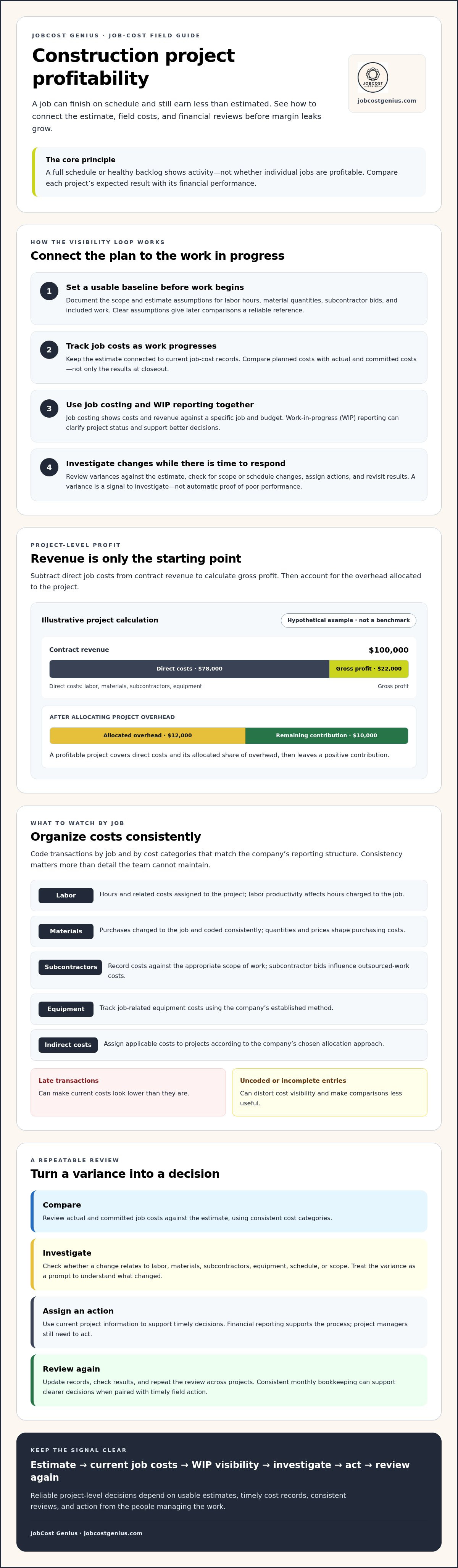
For a practical project-level view, subtract direct job costs from contract revenue to calculate gross profit, then account for the overhead allocated to that project. Direct costs can include labor, materials, subcontractors, and equipment. Overhead allocation assigns an appropriate share of company operating expenses to the work. Use consistent cost categories and a clear allocation method so comparisons across jobs are meaningful.
A profitable project does more than generate revenue: it covers its direct costs and allocated share of overhead, then leaves a positive contribution. This distinction helps owners assess job performance before a busy schedule creates a false sense of financial security. The principles of Project cost management, including estimating, budgeting, and control, provide a useful framework for connecting planned costs to actual results.
What determines whether a construction project is profitable?
Profit depends on how the work is scoped and delivered. Labor productivity affects hours charged to the job; material quantities and prices shape purchasing costs; subcontractor bids influence the cost of outsourced work; and schedule changes can affect labor, equipment, and coordination needs. For example, a hypothetical project might earn $100,000 in contract revenue, incur $78,000 in direct costs, and show $22,000 in gross profit. If $12,000 in overhead is allocated to it, the remaining contribution is $10,000. These figures illustrate the calculation, not an industry benchmark.
Why a strong estimate is only the starting point
An estimate sets the baseline for later comparisons. Its reliability depends on assumptions about labor hours, material quantities, subcontractor bids, and the work included in the contract. If the scope is unclear or exclusions aren’t documented, added work or unmet expectations can put the margin at risk. Record the assumptions behind the estimate, then compare actual costs with that baseline as the job progresses. This gives the team a reference for investigating variances and making decisions before final results are available.
Improving construction project profitability begins with a usable estimate, but it depends on checking that estimate against project performance. Clear scope and documented assumptions make those comparisons more useful.
How Job Costing and WIP Reporting Reveal Profit Changes During a Project
An estimate sets the baseline, but job costing shows how a project is performing as work moves forward. It tracks revenue and costs against a specific job and its budget, helping owners compare planned costs with actual and committed costs. This makes it easier to notice when labor hours, material purchases, subcontractor charges, or equipment expenses begin to differ from the plan.
That visibility is most useful when it starts early. The Buildr discussion of how to track project profitability during preconstruction reinforces the value of carrying financial assumptions into project monitoring. To improve construction project profitability, keep estimates connected to current job-cost records so a variance can be investigated while there’s still time to respond.
Which project costs should contractors track?
Organize transactions by job and by cost-code categories that match your company’s reporting structure. Common categories include:
- Labor: Hours and related costs assigned to the project.
- Materials: Purchases charged to the job, coded consistently.
- Subcontractors: Costs recorded against the appropriate scope of work.
- Equipment: Job-related equipment costs, using the company’s established method.
- Applicable indirect costs: Costs assigned to projects according to the company’s chosen allocation approach.
Consistency matters more than adding detail no one can maintain. Late transactions can make current costs look lower than they are. Uncoded or incomplete entries can distort comparisons between the estimate and actual performance, or make it hard to identify the source of a variance.
A project variance becomes actionable when costs are coded promptly to the right job and category, because the team can see what changed and investigate why.
How WIP reporting adds context to job costs
Job-cost reports show accumulated costs, but they don’t always tell the whole story of project status. A work-in-progress (WIP) report brings together information such as contract value, costs incurred, billings to date, and estimated costs to complete. Reviewing these together can help identify whether the project’s expected financial outcome or billing position has shifted.
A WIP report is only as reliable as the records and estimates behind it. Missing costs can understate spending, while outdated estimates to complete can make projected results misleading. Use the report as a management tool, then confirm variances with the project team before deciding what action to take. For more detail, see this construction WIP reporting guide. Construction-focused financial reporting, including WIP reporting, can support clearer reviews. Learn more about JobCost Genius’s construction financial reporting.
How to Find the Margin Leaks That Reduce Construction Project Profit
A variance is a signal to investigate, not automatic proof that a project team performed poorly. Compare estimated and actual costs by category, then ask what changed in the work, assumptions, or timing. This turns financial reports into useful questions instead of a reason to jump to blame. For a broader perspective on how job-costing details can help teams identify revenue leaks, see TopBuilder’s discussion of construction profit margins.
What do labor, material, and schedule variances signal?
Start with the cost category that moved, then check the conditions behind it. Labor hours above the estimate may reflect productivity assumptions, rework, limited site access, or sequencing changes. Higher material costs may stem from revised quantities, purchasing choices, waste, or price assumptions. A delayed schedule can extend labor and equipment use, shift subcontractor timing, and increase the time project overhead remains tied to the job. These are investigation paths, not conclusions.
Use a simple diagnostic table to guide the review. Any thresholds for escalation should be labeled as internal company targets, not industry-wide benchmarks.
| Warning sign | Possible cause | Next question to investigate |
|---|---|---|
| Labor hours exceed plan | Rework, access, sequencing, or estimate assumptions | Which task or phase used more hours, and why? |
| Material costs rise | Quantity changes, purchasing, waste, or pricing | Did the scope or required quantity change? |
| Subcontractor costs shift | Scope changes, timing, or revised work | Does the latest commitment match the approved scope? |
| Schedule slips | Coordination, access, or sequencing delays | What added time or resource use should be reflected? |
Are change orders and billing gaps hiding project risk?
Changed scope can add both revenue and cost, but only if teams document the change, track its approval status, and update the project’s cost outlook. Otherwise, work may proceed while the financial record still reflects the original scope. Review pending changes alongside incurred costs and remaining work, and make sure the estimate reflects what the team now expects to deliver.
Completed work awaiting billing can also obscure project status. The cost may already appear in job records while the related billing hasn’t been submitted or collected, affecting visibility into cash timing. Keep billing status clear and investigate items that remain unbilled. For related practices, see this construction cash flow guide.
Regular financial reviews can help owners see these issues clearly while project teams retain responsibility for operational decisions. Learn how construction financial reporting can support that visibility.
A Repeatable Review Process for Improving Construction Project Profitability
A useful review turns project records into decisions, then checks whether those decisions changed the picture. Use the same sequence across jobs: update records, compare budget with actual and committed costs, investigate variances, assign actions, and review again. This consistent structure makes it easier to spot unresolved issues and compare project performance without assuming every job needs the same response.
Set the review cadence according to project size, complexity, and how quickly costs or scope are changing. A complex job with active changes may need more frequent attention than a smaller, stable project. Monitor both leading and lagging indicators. Labor hours used, open commitments, and estimated costs to complete can signal emerging pressure; final project margin shows the result after the opportunity to adjust has passed.
Regular variance reviews turn project records into management decisions by showing what changed, who will respond, and when the result will be checked.
How should contractors run a useful project review?
Bring the project manager, operations lead, and finance contact into the review with clear responsibilities. The project manager can explain field conditions and remaining work; operations can assess staffing and coordination; finance can confirm recorded costs, billings, and unresolved transactions. Together, review cost-to-complete assumptions, commitments, change documentation, and billing status. This helps separate a real cost concern from a timing or recordkeeping issue.
Close each review with a written action log. For every follow-up, record the action, owner, due date, and result at the next review. If an item remains unresolved, carry it forward with an updated status rather than letting it disappear from view.
Which decisions can protect the remaining project margin?
Once the team understands a variance, evaluate practical options before changing the plan. Check whether purchasing can be adjusted, work can be resequenced, staffing can be better aligned with upcoming tasks, or subcontractor coordination can reduce avoidable disruption. Assess each option against scope, schedule, quality, and updated cost expectations. A response should address the cause, not simply shift costs elsewhere.
Escalate scope and schedule changes through documented approval and cost-update processes so the project outlook reflects authorized work. After closeout, compare actual results with the original assumptions and note what should inform future estimates. Treat those lessons as reference points, not a universal template, because project conditions and scope differ. A consistent financial review process can support improving construction project profitability while owners and project teams retain operational control.
For construction-focused bookkeeping and WIP reporting that can support clearer financial reviews, explore JobCost Genius services.
Build a Reliable Financial System to Sustain Construction Project Profitability
Project decisions are only as dependable as the information behind them. A reliable financial system connects the estimate to field updates, job costs, and financial reports, so owners and project leaders can review performance using records that tell a consistent story. Improving construction project profitability isn’t a bookkeeping task alone. Accurate financial information can highlight where attention is needed, but project managers still need to assess conditions and act.
Consistent monthly bookkeeping helps maintain a clear view of company and project finances. Construction-focused reporting can organize financial activity around jobs and support management reviews. WIP reporting adds a view of project status and estimated outcomes. A Procore Financials integration may be relevant for companies using Procore and seeking connected financial information. These tools support visibility; they don’t correct cost overruns or replace operational decisions.
What should a contractor expect from dependable financial reporting?
Look for a process that records and categorizes transactions consistently, reconciles accounts, and produces monthly financial statements. Construction-focused records should make it easier to review job costs alongside broader financial performance. Agree on who supplies project updates, resolves unclear transactions, and reviews reports so information doesn’t stall between field operations and bookkeeping.
Bookkeeping, tax preparation support, and income tax return filing are distinct responsibilities. Don’t assume one includes another. Confirm which work is covered and who handles any tax-related responsibilities separately.
When can specialized bookkeeping support make sense?
Consider whether internal processes are keeping pace with the company’s workload. Delayed reconciliations, inconsistent job-cost coding, or limited capacity to produce useful reports can make it harder to review projects with confidence. The right scope depends on company size, accounting systems, project mix, and the responsibilities already assigned internally. Clarify those needs before choosing support.
JobCost Genius provides construction-focused bookkeeping and financial reporting, including WIP reporting and Procore Financials integration. These services can support clearer financial reviews while owners and project teams retain operational control. To assess whether that support fits your systems and reporting needs, explore construction bookkeeping and reporting support.
Make Financial Clarity Part of Every Project
Improving construction project profitability takes more than reviewing the final numbers. It starts with estimates that reflect the planned work, continues with current job-cost information, and depends on a consistent process for investigating variances and following through on decisions. Reliable financial records help owners see project performance clearly, while operational teams decide how to respond.
Construction-focused bookkeeping and reporting can support that process. JobCost Genius professionals bring more than 20 years of industry experience, with offerings that include WIP reporting and Procore Financials integration. These tools can strengthen financial visibility, but they don’t replace project-level management or guarantee a particular profit outcome.
If you’re assessing how your current records support project reviews, explore construction bookkeeping and financial reporting support. A clearer, repeatable review process can help you make informed decisions and approach each project with greater confidence.
Frequently Asked Questions
How can a construction company improve project profitability?
Compare each project’s estimate with current costs and updated expectations for the remaining work. Track labor, materials, subcontractors, schedule changes, and scope changes consistently, then investigate variances while work is active. Assign an owner to each follow-up and check whether the action addressed the issue. Improving construction project profitability also means reviewing completed-job results to refine future estimates. No single tactic guarantees higher profit; outcomes depend on project conditions and execution.
What is the difference between project revenue and project profit?
Project revenue is the amount earned for work performed, while project profit is what remains after applicable project costs are accounted for. Billing records show amounts invoiced, which may not align with revenue earned at a particular point in the job. For example, a project can have substantial revenue but weak profit if labor, materials, subcontractor charges, or other costs exceed expectations. Use consistent cost categories and accounting practices to compare results accurately.
How does job costing help improve construction profitability?
Job costing organizes project revenue and costs by job, allowing contractors to compare actual performance with the estimate. Prompt transaction recording and consistent cost coding help teams spot and investigate variances while work is underway. For example, coding labor to the correct job and cost category makes it easier to identify where hours differ from the plan. Job costing doesn’t fix operational problems by itself; it gives decision-makers clearer information for choosing what to investigate.
How often should contractors review project costs?
Set review frequency according to a project’s size, duration, complexity, and pace of change. A job with shifting scope or active cost pressures may need closer attention than a stable, straightforward project. Choose a consistent cadence that allows the team to respond while meaningful work remains. At each review, refresh cost-to-complete assumptions and document decisions. Avoid treating a single weekly or monthly schedule as the right rule for every contractor or project.
What does a WIP report show for a construction project?
A work-in-progress (WIP) report typically brings together contract information, costs incurred, billings, and estimates that help show project status or expected outcomes. The exact fields and accounting treatment can vary, so confirm the reporting method with an appropriate accounting professional. A WIP report depends on accurate source records and current project estimates. It can support financial review, but it can’t correct missing transactions or outdated assumptions on its own.
Can construction bookkeeping improve project profitability?
Construction bookkeeping can support better project decisions by providing more consistent financial information, such as categorized transactions, reconciliations, and job-cost visibility. Owners and project leaders can use those records to review variances, billing activity, and cash timing. The records don’t control field execution, pricing, or project outcomes. Bookkeeping is most useful as part of a process that connects accurate financial information with timely operational review and action by the people managing the work.
What are common signs that a construction project is losing margin?
Potential warning signs include labor hours running above the estimate, material costs departing from assumptions, unapproved scope changes, schedule delays, or transactions that remain uncoded. Each signal needs context before the team concludes that profit is declining. Compare actual and committed costs with the budget, update estimates for remaining work, and ask project staff about the cause. Review billing status too, since completed work awaiting billing can make the project’s financial position harder to interpret.


