

What if your accounting system is accurate, but its numbers arrive too late to protect a project’s margin? Construction financial management best practices 2026 are about more than recording transactions. They’re about seeing job performance clearly enough to act before a small variance becomes a costly surprise.
Reliable profit reporting depends on accurate work-in-progress (WIP) tracking. Yet slow AIA billing and retention can strain cash flow, while disconnected field and accounting systems leave teams working from different numbers. Those gaps make it harder to plan for labor and materials with confidence.
This guide covers 10 practical ways to strengthen financial control, improve job-cost visibility, and make reporting more useful. You’ll learn how regular WIP reviews, connected project data, disciplined billing workflows, and consistent financial processes can help you spot issues earlier and make better decisions as your firm grows.
Key Takeaways
- Apply construction financial management best practices 2026 by organizing financial processes around project performance, not just company-wide totals.
- Connect field and accounting data to reduce manual entry and give your team a more consistent view of job costs.
- Use WIP reporting and accrual accounting to assess project health and identify margin concerns that cash-basis reports may miss.
- Strengthen cash flow planning by managing the timing of customer payments, retention, vendor invoices, and payables.
- Review whether your back-office needs call for a Starter Plan or more advanced Growth or Premium support as your firm scales.
Why Construction Financial Management Requires a Specialized Approach in 2026
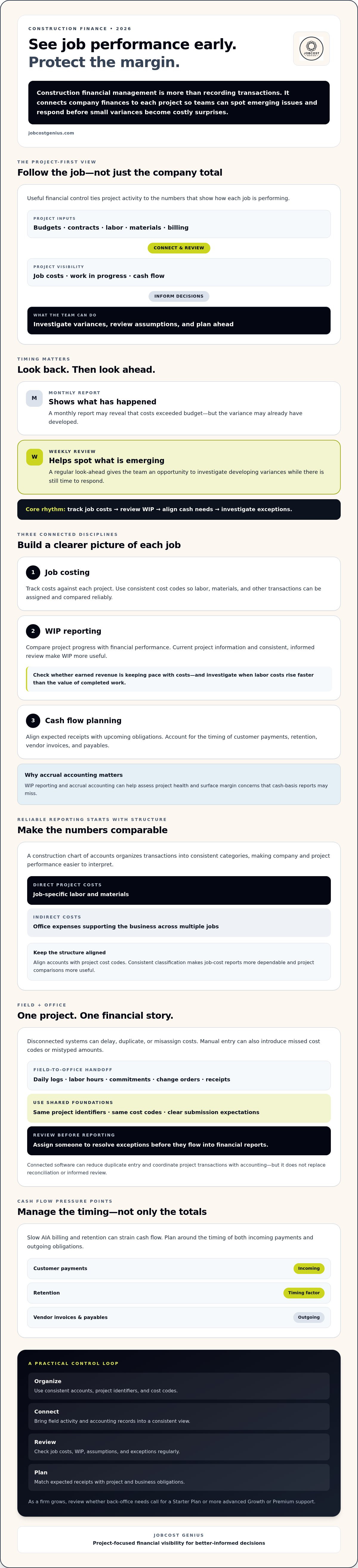
Construction financial management is a project-first accounting approach. It connects company finances to each job’s budgets, contracts, labor, materials, and billing activity. This fits within the broader discipline of project management, where cost control and resource allocation influence project outcomes. For contractors, financial data should do more than document what happened. It should help the team understand what may happen next.
That’s why construction financial management best practices 2026 shift attention from monthly look-backs to regular look-aheads. A monthly report may show that costs exceeded budget. A weekly review can help the team investigate emerging variances while there’s still time to respond. The core disciplines work together: job costing tracks costs against each project, WIP reporting compares progress with financial performance, and cash flow planning aligns expected receipts with upcoming obligations.
The Generalist vs. Specialist Gap
A standard profit and loss statement shows company-wide income and expenses, but it may not reveal which project is driving a margin change or whether earned revenue is keeping pace with costs. A generalist process can miss construction details such as cost codes, committed costs, retainage, and the timing of work completed versus work billed. Project-level schedules can also help contractors prepare clear financial information when banks or surety partners request a closer look at job performance. If you are evaluating comprehensive commercial policies to protect your operations, check out AllCover Insurance Brokers.
Specialized oversight connects those details and makes variances easier to investigate. For example, if labor costs are rising faster than the value of completed work, a timely WIP review can prompt the team to check production, estimates, and cost coding before the difference grows. Software can organize and transfer information, but people still need to review assumptions, resolve discrepancies, and interpret the numbers. WIP reporting is most useful when it reflects current project information and receives consistent, informed review.
Foundational Strength: The Construction Chart of Accounts
The construction chart of accounts organizes transactions into consistent categories, making company and project performance easier to interpret.
Structure matters. Separate direct project costs, such as job-specific labor and materials, from indirect costs, such as office expenses that support the business across multiple jobs. Then align the account structure with project cost codes so transactions can be assigned and compared consistently. If teams classify similar expenses differently, job-cost reports become harder to trust and project comparisons lose value.
A well-organized chart of accounts won’t fix incomplete field data on its own. It does give the office a dependable framework for reviewing costs, preparing WIP schedules, and spotting exceptions. Disciplined coding and informed review turn construction financial management best practices 2026 into a practical operating rhythm, not just a month-end reporting task.
Integrating Field and Office Data: The 2026 Tech Stack Best Practices
Field activity and accounting records need to tell the same financial story. When project management and accounting systems operate in silos, costs can be delayed, duplicated, or assigned to the wrong job. Manual data entry creates another risk: a missed cost code or mistyped amount can distort budget tracking and reporting. A connected tech stack helps information move between teams, but software alone can’t ensure that data is complete or interpreted correctly.
Build a consistent handoff between the field and office. Set clear expectations for submitting daily logs, labor hours, commitments, change orders, and receipts. Use the same project identifiers and cost codes across systems, and assign someone to review exceptions before they flow into financial reports. These construction financial management best practices 2026 make job data useful for routine decisions, not just month-end reconciliation. The Construction Financial Management Association (CFMA) is another resource for construction finance professionals seeking industry-specific guidance.
Procore Financials and QuickBooks: A Modern Standard
A well-configured Procore Financials and QuickBooks workflow can reduce duplicate entry by coordinating how project transactions move into accounting. Explore Procore financials integration services to understand the field-to-office connection. The goal is not to replace reconciliation. It’s to make project costs and commitments visible sooner, rather than relying only on monthly bank reconciliation to spot discrepancies.
Before launch, align project names, cost codes, transaction types, and approval steps. Train field teams to submit complete records, including the job, cost category, date, and supporting documentation. The office can then review exceptions and maintain records for consistent financial reporting and compliance.
Modernizing Legacy Systems Like Sage 300 CRE
Legacy platforms such as Sage 300 CRE may remain central to a firm’s accounting, even as teams adopt cloud-based project tools. The challenge is connecting systems without disrupting established workflows or losing access to historical records. Start by documenting which system holds the authoritative data for each item. Then map fields and cost codes, test representative transactions, and retain a controlled archive before changing processes.
Integration takes more than technical setup. Someone must validate data mappings, investigate mismatches, and explain how changes affect reports. Firms with more complex technology needs can assess whether the Growth or Premium Plan fits their oversight requirements. For guidance on aligning project and accounting workflows, review construction financial management support from JobCost Genius.
Protecting Margins with Accurate WIP Reporting and Accrual Accounting
A work-in-progress (WIP) report is a project health check. It compares costs incurred and progress toward completion with revenue earned and billings issued. Reviewed consistently, it can reveal margin changes and billing imbalances that a company-wide profit and loss statement may not show. WIP data also helps align reported project revenue and costs with the work performed.
Cash-basis accounting records transactions when cash moves. That timing can hide project performance: a customer payment may arrive this month for work completed earlier, while current labor and material costs remain unpaid. Accrual accounting helps match revenue and expenses to the period in which the work and costs occurred. For reliable WIP, estimates, cost records, and billing information must be current and consistent.
Identifying and Fixing Overbilling and Underbilling
Overbilling occurs when billings exceed earned revenue; underbilling occurs when earned revenue exceeds billings. Neither condition alone proves a project is in trouble, but both deserve review. Overbilling can provide cash now while creating a future billing gap as work continues. Don’t treat that cash as profit or use it to cover another job’s costs without understanding the obligations tied to it.
To investigate an imbalance, confirm the contract value and approved changes, compare progress estimates with cost-to-date, and check that invoices and cost transactions are assigned to the right job and period. Discuss differences with the project manager, then correct source records or revise estimates when current information supports a change. A practical guide to fixing overbilling on WIP reports can help structure that review. Underbilling may point to delayed invoicing, missed change orders, or costs advancing faster than billing, each of which can pressure cash flow.
Accrual Accounting: The Contractor’s Best Friend
Build a monthly WIP review into the close process. Have accounting and project managers examine estimated costs to complete, committed costs, progress, billings, and margin changes together. Record the reason for material variances and assign follow-up actions. This gives the team a shared explanation of project performance, rather than a report that merely flags a number.
Accrual-based statements and reconciled WIP schedules can provide banks, bonding partners, and auditors with a clearer view of financial position, though each may have its own reporting requirements. The Construction Financial Management Association (CFMA) offers construction finance resources for firms building these practices. A Starter Plan may suit a simpler reporting need; as project volume or reporting complexity grows, firms can evaluate whether Growth or Premium better supports their needs. Specialized WIP reporting helps make construction financial management best practices 2026 a repeatable process grounded in project facts.
Strategic Cash Flow Management: Beyond Basic Bookkeeping
Cash flow depends on timing as much as profitability. Contractors often pay labor, suppliers, and subcontractors before customer payments arrive. A project can show a healthy projected margin and still strain the company’s cash if billing is delayed, invoices go unprocessed, or retention remains outstanding. A rolling cash forecast helps compare expected receipts with scheduled payments so you can spot a shortfall early.
Keep accounts payable organized with a consistent workflow: code each invoice to the correct job and cost category, match it to supporting documentation, route it for approval, and schedule payment according to the due date and cash plan. Reconcile vendor statements and investigate duplicate or disputed invoices before they distort job costs. Specialized construction bookkeeping services can help coordinate records and billing workflows, but faster payment cycles still depend on complete documentation and timely follow-up.
Optimizing Accounts Receivable and AIA Billing
Standardize AIA billing applications using G702 and G703 forms. Keep project details, approved change orders, schedule-of-values updates, and supporting records consistent. Check each application against the contract and work completed before submission. Accurate, complete billing reduces avoidable questions from owners and general contractors. A billing calendar helps the team track submission dates, approvals, and expected payment timing.
Retention tracking helps monitor withheld contract funds and follow them through release, so the team can recover cash tied to the job and protect the final 5% to 10% of expected profit margin where that amount is at risk. For each project, track the retained balance, release conditions, responsible party, and follow-up date. Don’t treat submitted invoices as collected cash. Review aging receivables and assign clear next steps for overdue items.
Managing Labor Burden and Payroll Compliance
Job labor costs should reflect more than base wages. Include applicable payroll taxes, benefits, and insurance in your labor-cost assumptions, and compare actual costs with the estimates used to price and manage the work. Accurate labor coding also helps keep job-cost reports and cash forecasts grounded in project activity.
For projects with prevailing wage requirements, maintain a reliable process for capturing worker classifications, hours, wage details, and required payroll records. This prevailing wage payroll guide can help contractors review the workflow. Assess worker classification carefully as well: whether a worker should be treated as a 1099 contractor or W-2 employee depends on the working relationship and applicable rules, so confirm uncertain cases with a qualified advisor.
These construction financial management best practices 2026 connect billing, payables, retention, and payroll to one cash plan. For specialized construction bookkeeping and payroll support, explore JobCost Genius’ construction financial services.
Scaling Your Back Office: The Case for Specialized Outsourced Financials
As a construction firm grows, more projects bring more transactions, cost codes, payroll details, and reporting demands. If the owner still has to chase receipts, resolve job-cost questions, or assemble reports manually, financial administration can pull attention away from field operations and business development. Specialized outsourced financial support can establish consistent processes and give leadership clearer information for decisions.
Evaluate the cost and benefit based on the work your team needs covered, the time currently spent on bookkeeping, and whether reports arrive in time to guide decisions. This guide to outsourced bookkeeping for construction firms can help frame that assessment. The value isn’t simply fewer hours spent on transaction entry. It also includes project-level reporting, including WIP, that helps owners understand performance across active jobs.
The Roadmap to Financial Maturity
Financial maturity means progressing from recording transactions to using reliable reports to manage the business. A practical monthly CEO dashboard might bring together the income statement, balance sheet, cash position, receivables and payables, and WIP findings. Review changes against prior periods, then identify what needs action, such as a margin variance or delayed customer payment.
Build overhead benchmarks from your own historical results and consistent account categories. Track how indirect costs change as revenue and project volume change, then investigate shifts rather than relying on a universal “healthy” percentage. For audit readiness, keep reconciliations current, retain transaction support, and make sure project records agree with financial reports. Organized documentation reduces last-minute scrambling, though it can’t guarantee an audit outcome.
Choosing the Right Partner for 2026
A general bookkeeping workflow may handle transactions but lack the construction-specific WIP review or Procore Financials integration a growing firm needs. Ask prospective providers how they handle project coding, data handoffs, reporting review, and historical records. A good fit should match your systems and reporting requirements, not just your transaction volume.
Compare plan scope, responsibilities, and billing terms before choosing a provider. A fixed monthly fee, where offered, can make back-office costs easier to plan, but confirm what work is included and how added complexity is handled. JobCost Genius offers Starter, Growth, and Premium Plans. Firms needing more advanced technology support can assess the Growth and Premium options. These construction financial management best practices 2026 help owners scale with stronger financial visibility while keeping attention on operations. Explore JobCost Genius plans to find your fit.
Construction Financial Management Best Practices 2026: Build a Clearer Financial View
Strong construction financial management best practices 2026 start with financial information that’s timely, project-specific, and useful for decisions. Consistent WIP reporting helps you assess job health, while connected field and office data reduces gaps between project activity and accounting records. A disciplined approach to billing, payables, and cash forecasting can also help you plan with greater confidence.
The right level of financial oversight should grow with your firm. JobCost Genius provides specialized bookkeeping and financial reporting for construction companies, including WIP reporting and Procore Financials integration support for firms that need a better connection between project and accounting data. Clearer, more consistent reporting can help owners spend less time trying to interpret disconnected numbers and more time leading operations.
Ready to strengthen your financial foundation? Contact JobCost Genius to discuss the right bookkeeping and reporting support for your firm.
Frequently Asked Questions
What is the most common financial mistake construction companies make?
A frequent mistake is relying on company-wide cash balances or a standard profit and loss statement to judge whether each job is profitable. Those summaries can miss costs not yet paid, revenue earned but not billed, or expenses assigned to the wrong project. Review job-level costs and billing alongside company reports, and investigate unexplained variances before using the numbers to make hiring, purchasing, or bidding decisions.
How does WIP reporting improve project profitability?
WIP reporting helps teams compare project progress, costs incurred, estimated costs to complete, and billings. That comparison can reveal an estimate that needs updating or a billing imbalance that deserves follow-up. Review the figures with project managers, confirm questionable inputs against current job records, and document the reason for changes. These construction financial management best practices 2026 help decision-makers respond to emerging issues with clearer project information.
Can I use a general bookkeeper for my construction business?
You can, if the bookkeeper understands construction job costing and can maintain reliable project-level records. Ask how they handle cost codes, committed costs, WIP schedules, retainage, and differences between work completed and work billed. A bookkeeper who only categorizes company transactions may not provide the detail needed to assess individual jobs. Evaluate the reporting you receive and whether it answers the operational and financing questions your firm faces.
Why is Procore financials integration important for contractors?
Procore Financials integration can connect project information with accounting records, reducing duplicate entry and helping teams maintain consistent job data. Its value depends on correct setup: align project identifiers, cost codes, and transaction workflows, then review exceptions rather than assuming every transfer is accurate. Contractors should also define what field staff must submit and who checks it. JobCost Genius offers Procore Financials Integration for construction firms.
What is the difference between cash and accrual accounting in construction?
Cash accounting records income and expenses when money changes hands; accrual accounting records them when earned or incurred, even if payment happens later. For example, a contractor may have completed billable work while the customer payment is still outstanding. Cash reports can make that period look different from the project’s operating performance. Accrual records, supported by job-level information, help compare revenue and costs in the relevant period.
How often should a construction company review its financial statements?
Review company financial statements at least monthly after reconciling accounts and checking that transactions are coded to the right period and projects. Use the review to examine cash, receivables, payables, expenses, and changes from prior periods. Don’t wait for month-end to monitor active job concerns: project managers can discuss significant cost or billing changes during regular project reviews. Set a consistent schedule that fits the firm’s workload and reporting needs.
How do I calculate the labor burden for my field team?
Start with each employee’s wage cost, then add applicable employer payroll taxes, benefits, and insurance costs. Divide the added employment costs by the wage amount to calculate a burden rate, or combine the costs to estimate a fully burdened labor cost per hour. Use figures from your actual payroll and benefit records, and apply them consistently in estimates and job costing. Confirm current requirements with a qualified payroll or accounting professional.
What are the benefits of outsourcing construction bookkeeping services?
Outsourcing can give a construction firm access to bookkeeping processes built around project records, reduce the administrative load on owners, and support more consistent financial reporting. Compare the provider’s construction experience, WIP reporting approach, software integration capabilities, deliverables, and plan terms before deciding. JobCost Genius provides specialized construction bookkeeping, including WIP reporting, and offers Starter, Growth, and Premium Plans. Choose support that matches your reporting needs and systems.


