

A job can look profitable simply because late costs and scope changes haven’t made it into the numbers yet. Learning how to track profitability on construction jobs means bringing accounting records, payroll, invoices, and field updates into one current, job-level view. When information is scattered or delayed, a healthy-looking margin can change before the team has a chance to investigate.
You need more than a record of what’s already been spent. A reliable process compares estimated costs with actual costs, accounts for commitments, and updates the forecast as work progresses. This gives you a clearer view of each project’s expected margin and helps surface changes early enough to respond.
This guide covers practical steps for setting up consistent job-cost categories, capturing labor and other costs, tracking scope changes, and comparing estimates with actuals and forecasts. You’ll also learn how regular job-level reviews and WIP reporting can support a steady process without creating unnecessary administrative work.
Key Takeaways
- Distinguish job profit from company-wide profit and cash on hand by comparing each job’s revenue with the costs assigned to its work.
- Use consistent cost codes to compare estimates with actual costs across labor, materials, subcontractors, equipment, and other direct expenses.
- Learn how to track profitability on construction jobs by reviewing the budget, actual costs, commitments, and expected remaining costs together.
- Set a repeatable weekly and monthly routine for updating job data, checking forecasts, and assigning follow-up actions.
- Use reliable job-cost information to guide project decisions, while treating WIP reporting as a separate company-level reporting layer.
How to Track Profitability on Construction Jobs: Start with the Right Numbers
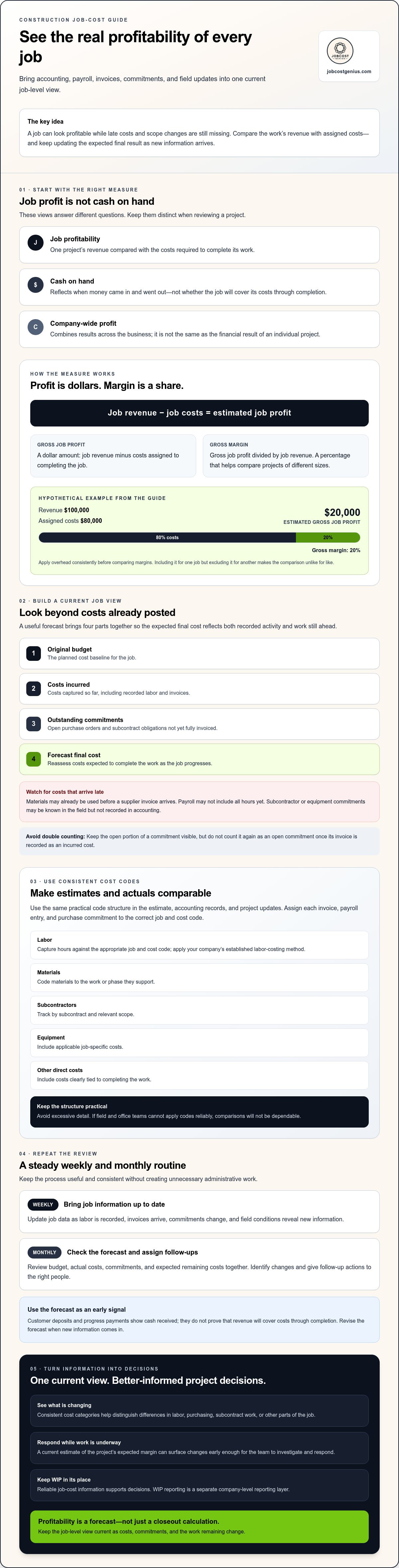
A job can show a positive bank balance and still be headed for a loss. Cash on hand reflects when money came in and went out. Company-wide profit combines results across the business. Job profitability focuses on one project: its revenue compared with the costs required to complete the work. To understand how to track profitability on construction jobs, bring together the original budget, costs incurred, outstanding commitments, and forecast final cost in a job-level view.
That view changes as work progresses. Profitability isn’t just a closeout calculation. It’s an estimate to update as labor is recorded, invoices arrive, commitments change, and the team reassesses the work remaining. Consistent construction accounting principles provide a framework for organizing costs and revenue, but every report depends on complete, current job data.
What does job profitability measure?
Gross job profit is job revenue minus the costs assigned to completing the job. Gross margin expresses that profit as a share of revenue: gross job profit divided by job revenue. Profit is a dollar amount; margin is a percentage that helps compare projects of different sizes.
Job revenue − job costs = estimated job profit. For example, if a hypothetical job has $100,000 in revenue and $80,000 in assigned costs, estimated gross job profit is $20,000 and gross margin is 20%. Apply overhead consistently before comparing margins. If one job includes allocated overhead and another excludes it, the comparison won’t be like for like.
Why can a job look profitable when it is not?
Current results may be incomplete. A supplier invoice might arrive after the materials have been used. Payroll may not yet reflect all the hours worked on a job. The project team may know about subcontractor or equipment commitments that haven’t been recorded in the accounting system. Until these items are captured, reported costs can look lower than the costs the job is likely to incur.
Customer deposits and progress payments don’t prove that a job is profitable. They show cash received, not whether the project’s revenue will cover costs through completion. Compare recorded costs with the work remaining and open commitments, then revise the forecast when new information comes in.
Job profitability is a forecast of a project’s financial result, based on current revenue and cost information, not just the cash received or expenses posted so far.
Which Construction Job Costs and Revenue Should You Track?
A job-level report is useful only when costs and revenue are classified consistently. Use the same cost-code structure in the estimate, accounting records, and project updates so you can compare planned amounts with actual transactions. The Construction Financial Management Association provides industry-focused education and resources for construction financial professionals, including information relevant to financial controls and job-cost practices.
How should contractors organize job costs?
Set up a practical code structure before work begins and keep it consistent through closeout. Assign each invoice, payroll entry, and purchase commitment to the correct job and cost code. Avoid excessive detail. If field and office teams can’t apply codes reliably, the comparisons won’t be dependable. Keep direct costs distinct, including:
- Labor, using your company’s established method for assigning labor cost
- Materials, coded to the work or phase they support
- Subcontractors, tracked by subcontract and relevant scope
- Equipment, including applicable job-specific costs
- Other direct costs that can be clearly tied to completing the work
Consistent categories help you see whether a cost difference comes from labor, purchasing, subcontract work, or another part of the job. They also give future estimates a more useful reference point.
How should labor, commitments, and changes enter the picture?
Capture labor hours against the appropriate job and cost code, then apply your company’s established labor-costing method. Track purchase orders and subcontract commitments alongside costs that have been invoiced or paid. Keep the open portion of each commitment visible, but don’t count it twice when an invoice is recorded as an incurred cost.
This distinction helps reveal obligations that may not yet appear in the books. For example, a subcontract may be underway before the related invoice is submitted. The job view should show both incurred costs and remaining commitments, with the open balance adjusted as costs are recorded.
Track revenue with the same discipline. Include contract revenue and approved change orders in the job’s revenue view. Record pending changes separately, with their status and supporting documentation. Don’t treat unapproved scope as earned revenue in the forecast simply because work has started or the team expects approval. This keeps the reported position grounded in confirmed contract information.
To apply how to track profitability on construction jobs consistently, clarify coding responsibilities between the field and office. Review exceptions such as uncoded invoices and unrecorded commitments. Construction-focused bookkeeping can help keep job-level records organized. Learn more about construction bookkeeping and financial reporting.
How to Compare Estimated, Actual, and Forecast Job Costs
A useful job-cost report compares the original budget with costs already incurred, open commitments, and the amount the team expects to spend before completion. This turns a cost variance into a question to investigate, rather than an automatic verdict that the job is over budget.
What should a job-cost report compare?
| Measure | What it shows |
|---|---|
| Budget | The estimated cost for the job or cost category. |
| Actual cost | Costs incurred and recorded to date. |
| Open commitments | Unspent portions of purchase orders and subcontracts that remain obligations. |
| Cost to complete | Expected remaining costs, including open commitments and work not yet committed. |
| Forecast final cost | Actual costs to date plus expected remaining costs. |
Check that open commitments aren’t counted twice. When a committed amount becomes an actual cost, reduce the open balance and include the cost in actuals. The forecast should represent the expected total cost to finish, not simply add every report line together.
Forecast final cost is more informative than paid costs alone because it accounts for both what the job has used and what it’s still expected to require.
How do cost changes affect expected margin?
Consider a hypothetical job with $240,000 in approved revenue and an original estimated cost of $190,000. Its estimated profit is $50,000, or about 20.8% of revenue. At a review point, suppose actual costs are $92,000, open commitments are $48,000, and the team expects another $57,000 in uncommitted costs. Forecast final cost is $197,000. Expected profit becomes $43,000, with a forecast margin of about 17.9%.
The $7,000 difference from the original cost estimate deserves investigation. Check whether labor is taking more hours than planned, material costs have changed, or subcontract scope has expanded. Update the cost to complete using current information, compare the revised forecast margin with the estimate, and document the main cause.
Not every gap signals a true overrun. A delayed invoice can make actual costs look temporarily low, while a commitment captures the expected obligation. Before assigning corrective action, confirm whether the variance reflects timing, coding, or a genuine increase in expected cost. A consistent process for how to track profitability on construction jobs makes those differences visible while there’s still time to respond.
A Repeatable Weekly and Monthly Process for Tracking Job Profit
A dependable process makes job reporting part of normal project and bookkeeping routines, rather than a separate month-end scramble. Assign clear owners: field staff provide progress and labor updates, bookkeeping staff code and reconcile transactions, and project managers review remaining work and forecast assumptions. Set a weekly review for active jobs and a monthly close to reconcile the full record.
What should happen during a weekly job review?
Follow a consistent sequence so you can identify missing information before interpreting the margin:
- 1. Gather updates. Collect labor hours, new invoices, purchase orders, subcontract commitments, progress notes, and approved scope changes.
- 2. Check the records. Match transactions to the correct job and cost code. Look for missing support, late entries, duplicates, disputed items, and miscoded costs.
- 3. Compare the current position. Review costs and job progress against the latest estimate and forecast. Ask project staff whether the work remaining, labor needs, or material requirements have changed.
- 4. Assign follow-up. Give each material variance or data gap an owner and due date. Record the next step, such as confirming an invoice, correcting a code, or revising the cost-to-complete estimate.
Don’t treat an incomplete report as a reliable signal. Resolve errors where possible, and clearly flag items still under review. This helps prevent timing issues and data-entry problems from being mistaken for a change in expected job performance.
What belongs in the monthly profitability close?
At month-end, reconcile job transactions to the bookkeeping records and investigate uncoded, duplicated, late, or disputed items. Then review forecast assumptions with the project staff who understand the work still required. Update the forecast when the evidence supports a change, and document why it moved. This helps management distinguish new information from a reporting correction.
Profit and cash flow answer different questions. Job profitability estimates whether revenue will cover the costs of completing the work. Cash flow tracks when money is expected to come in and go out. A profitable forecast doesn’t guarantee cash will arrive before obligations are due. For that separate planning view, see construction cash flow management.
For broader bookkeeping foundations, refer to this construction accounting guide for small firms. If you need help keeping construction records and reporting organized, explore JobCost Genius bookkeeping and WIP reporting.
Turn Job-Cost Tracking into Better Decisions and Reliable Reporting
Job-cost data is most useful when it informs decisions. If labor hours are trending above plan, a project manager can review crew assignments or productivity assumptions. If materials are driving a variance, the team can check purchasing plans and remaining quantities. Documented scope changes can prompt a conversation about approval and updated expectations. Records from completed jobs can also help estimators refine future bids.
Keep project-level tracking distinct from company-level reporting. Job-cost tracking helps the team manage an individual project’s costs and forecast. Work in Progress (WIP) reporting provides a broader view of project performance for company reporting. It complements routine job-cost reviews rather than replacing them. For more on that distinction, read the WIP reporting guide.
When is a spreadsheet enough, and when is a system needed?
A spreadsheet can be an accessible starting point for a straightforward process, but someone must update it, maintain formulas, and control versions. As active jobs, users, cost codes, or reporting needs increase, manual updates can become harder to reconcile and keep consistent. Assess whether your current process lets the right people enter, review, and retrieve reliable information. No single platform fits every contractor. Accurate source data and regular review matter whatever the tool.
Software can organize records and make reporting more repeatable, but it can’t correct incomplete field updates, miscoded invoices, or outdated forecasts on its own. Before changing systems, define who supplies and reviews each input. The goal is a dependable flow of information, not another layer of administration.
How can specialized bookkeeping strengthen job visibility?
As transaction volume or reporting complexity grows, internal processes may struggle to keep job records current and reconciled. Consistent construction-focused bookkeeping can support reliable job-cost views and monthly financial reporting, giving managers a clearer basis for reviewing project performance. JobCost Genius offers bookkeeping, payroll, accounts payable and receivable management, WIP reporting, and Procore Financials Integration.
For a practical process for how to track profitability on construction jobs, keep your tools, coding practices, and review cadence aligned with how your team works. If you’re assessing whether outside support fits your reporting needs, explore construction financial reporting support.
Make Job Profitability Part of Your Regular Review
Reliable job profitability tracking depends on consistent cost codes, current transaction records, and a forecast that reflects both costs incurred and work still to come. Reviewing those figures on a set cadence helps you spot meaningful changes, investigate variances, and make better project decisions before closeout.
The practical answer to how to track profitability on construction jobs is to build a repeatable process your team can maintain. Keep job-level tracking distinct from company-wide reporting, and use WIP reporting as a related view of overall project performance. Accurate source data and thoughtful review remain essential, whatever tools you use.
JobCost Genius provides construction-focused bookkeeping and financial reporting, including WIP reporting, and was founded by professionals with over 20 years of industry experience. Procore Financials Integration is also an offering. Explore construction bookkeeping and reporting support to assess whether these services fit your business.
Frequently Asked Questions
How do you calculate profitability on a construction job?
Subtract the job’s total costs from its recognized contract revenue to estimate job profit. Divide that profit by revenue to calculate gross margin as a percentage. For an active project, use forecast final costs, not just amounts paid so far. Include costs incurred and expected remaining costs, and apply overhead consistently before comparing margins. This is a core step in how to track profitability on construction jobs accurately.
What costs should be included in construction job costing?
Include the direct costs required to complete the work, such as labor, materials, subcontractors, equipment, and other applicable project expenses. Track purchase orders and subcontract commitments alongside costs already incurred so future obligations remain visible. Use consistent cost codes, and assign invoices, payroll entries, and field updates to the correct job. Apply the same classification approach across projects to make comparisons useful.
How often should contractors review job profitability?
Review active-job costs and forecast changes regularly, often with a weekly operational check and a more complete monthly financial review. Adjust the cadence to fit project duration, transaction volume, and how quickly costs change. A review only helps if the source data is current. Assign an owner and due date to each material variance or data issue, and document follow-up actions rather than leaving them buried in a report.
Why does a construction job look profitable but still lose money?
A job can look profitable if costs are missing, delayed, misclassified, or not updated for the work left to complete. Open purchase orders, subcontract commitments, labor, and scope changes may not appear in paid transactions yet. Compare actual costs with commitments and forecast cost to complete. Then reconcile the records and confirm project assumptions. A reported margin is dependable only when it reflects complete, current information.
What is the difference between job costing and WIP reporting?
Job costing organizes revenue and costs by project so teams can monitor each job’s financial performance. Work-in-progress reporting brings project information into a broader accounting view, including contract progress and financial position. The two are related but not interchangeable: job-cost records provide important inputs, while WIP reporting connects project status with company-level financial reporting. Regular job-cost tracking remains necessary alongside WIP reporting.
Can accounting software track construction job profitability automatically?
Software can organize transactions, cost codes, and reports, but it can’t make incomplete or incorrectly coded information reliable by itself. Teams still need clear processes for entering labor, invoices, commitments, and approved changes, then reviewing forecasts against current project information. Evaluate software based on your workflows, reporting needs, and integrations. Automation can support financial oversight, but it doesn’t replace accurate source data or informed review.
What should I do when actual costs exceed the job budget?
First confirm the variance is real by checking cost codes, missing credits, invoice timing, labor entries, and open commitments. Identify the affected cost category and cause, then update the forecast to complete and assess the expected margin impact. Assign an owner and next action. If scope or contract value may change, document the issue and review it through your company’s approval process before updating revenue assumptions.


