

Why does your profit and loss statement show a record surplus when your operating account barely covers Friday's payroll? For commercial and residential contractors, standard financial reports routinely distort reality because traditional accounting treats project-based construction like static retail. Implementing specialized monthly bookkeeping for builders bridges this critical operational gap, replacing passive historical data entry with active, job-level cost control.
You already know the frustration of watching projected margins evaporate when unexpected subcontractor invoices surface late, or when untracked retainage skews your working capital. In this 2026 profit guide, you'll discover how specialized monthly bookkeeping keeps construction projects profitable, prevents cash flow surprises, and streamlines contractor job costing across every phase of your operations. Ahead, we'll unpack the core workflows, work-in-progress schedules, and field-to-office syncs you need to establish complete financial clarity.
Key Takeaways
- Learn why standard cash-basis accounting distorts project performance and creates artificial profit spikes that jeopardize working capital.
- Discover how a structured close process and dedicated monthly bookkeeping for builders ensure real-time cost control across all active jobs.
- Identify the core monthly deliverables required to evaluate project health, including WIP schedules that pinpoint overbillings and underbillings.
- Evaluate the operational trade-offs between an expensive in-house hire, a generalist virtual assistant, and a specialized construction finance team.
- See how syncing field management platforms directly with your general ledger protects margins and eliminates costly year-end write-downs.
Why Standard Bookkeeping Fails Custom Home Builders and General Contractors
Standard business bookkeeping fails the construction industry because it handles financial records at the company level rather than the project level. When a generalist records framing packages, concrete pours, or trade contractor payouts, they typically dump these expenses into broad operating expense categories. This practice obscures individual job performance. Without granular tracking, owners can't see which projects generate healthy returns and which ones quietly drain working capital.
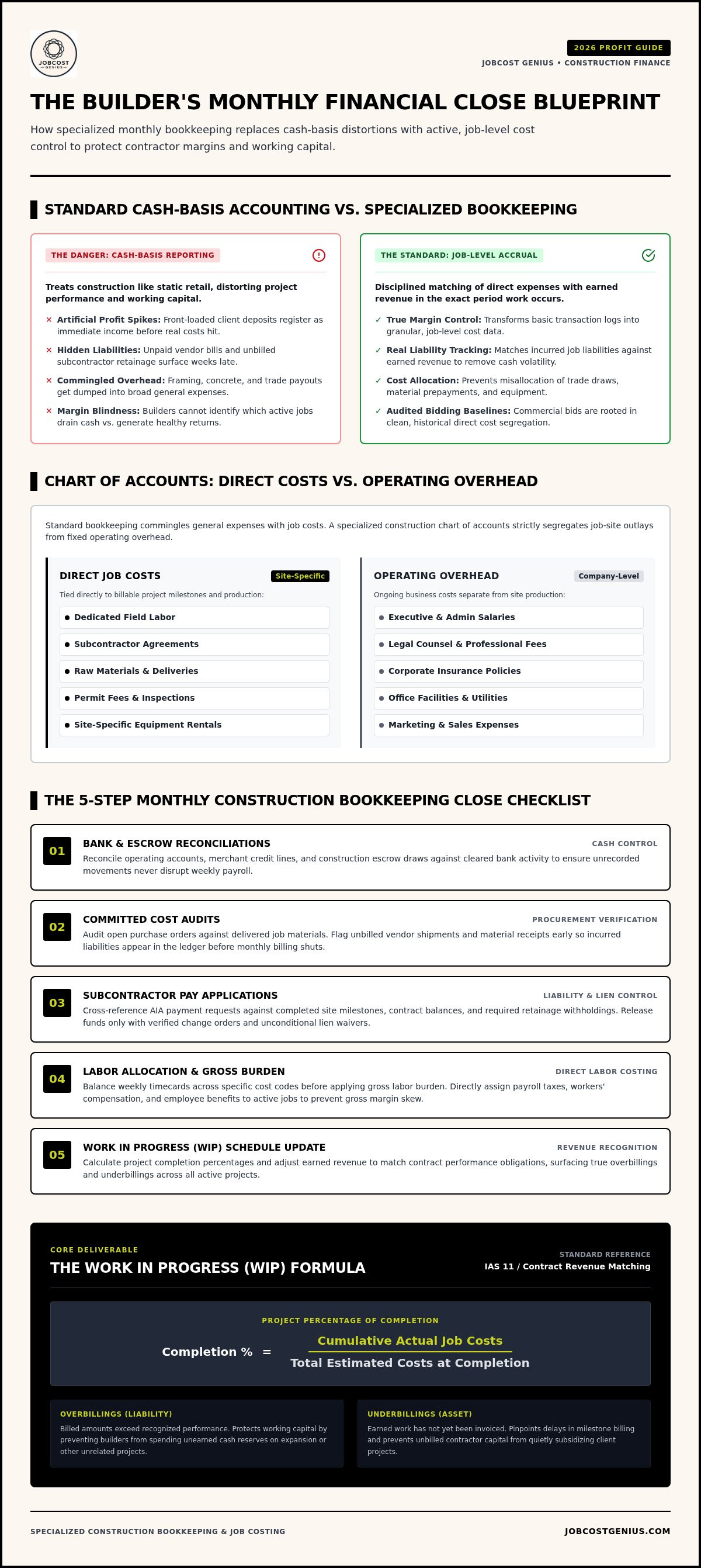
Specialized monthly bookkeeping for builders is defined as the disciplined accounting process of matching direct project expenses with earned contract revenue in the exact period work occurs. By applying recognized job costing principles, this method transforms basic transaction logs into actionable job-level data. Without it, generalist bookkeepers routinely misallocate trade contractor draws, material prepayments, and equipment allocations across unrelated jobs, leaving builders blind to true project margins.
The Pitfalls of Cash-Basis Reporting on Active Job Sites
Cash-basis accounting produces dangerous financial illusions. Front-loaded client deposits register as instant income, creating artificial profit spikes that tempt builders to expand before real costs hit. Weeks later, unpaid vendor bills and unbilled subcontractor retainage surface, triggering sudden cash crunches on active sites. Applying accrual accounting principles eliminates this volatility by matching incurred job liabilities against earned revenue. Explore these foundational principles in our 2026 construction accounting guide for small firms.
Direct Costs vs. Overhead: The Construction Chart of Accounts
A standard chart of accounts commingles company overhead with site-level direct costs. To maintain clear visibility, contractors require a specialized structure that separates operating expenses from direct cost codes:
- Direct Job Costs: Dedicated field labor, subcontracts, raw materials, permit fees, and site-specific equipment rentals.
- Operating Overhead: Executive salaries, legal counsel, insurance policies, office facilities, and marketing.
Clean cost segregation establishes reliable historical baselines. It prevents overhead from distorting gross project margins and forms the bedrock of credible commercial bidding. Implementing structured monthly bookkeeping for builders guarantees that every estimate is rooted in audited, real-world job costs.
The 5-Step Monthly Construction Bookkeeping Close Checklist
Closing the books without a disciplined checklist invites cumulative errors and sudden margin erosion. Construction accounting demands rigid verification steps that simple service firms never encounter. A systematic month-end routine ensures that ledger entries accurately reflect active job-site progress every thirty days, protecting working capital against hidden liabilities.
Executing structured monthly bookkeeping for builders requires a consistent, sequential workflow across five vital stages:
Step 1 & 2: Bank Reconciliations and Committed Cost Audits
Reconcile operating accounts, merchant credit lines, and construction escrow draws against cleared activity. Concurrently, audit open purchase orders against delivered job materials. Flagging unbilled vendor shipments and material receipts before finalizing the monthly ledger captures committed costs early, ensuring liabilities don't go missing before billing cycles close.
Step 3 & 4: Subcontractor Pay Applications and Labor Allocation
Cross-reference AIA payment requests against completed job milestones, contract values, and required retainage withholdings. Never release funds without verifying executed change orders and collecting unconditional lien waivers. Next, balance weekly timecards across specific cost codes before applying gross labor burden. Factoring payroll taxes, workers' compensation, and benefits directly into job costs prevents direct margin distortion.
Step 5: Updating the Work in Progress (WIP) Schedule
Calculate project completion percentages by dividing cumulative actual job costs by total estimated costs at completion. Recognized international accounting standards for construction establish that revenue must match performance obligations rather than simple invoice timing. Adjust monthly billings for overbillings (billings in excess of costs) and underbillings (costs in excess of billings) directly on the balance sheet. Explore our comprehensive breakdown of these percentage-of-completion calculations in our guide to WIP reporting for construction companies.
Maintaining this five-step sequence turns volatile numbers into actionable operational intelligence. Builders seeking to eliminate month-end closing bottlenecks can explore how JobCost Genius delivers specialized construction accounting infrastructure across every active project.
Core Financial Deliverables Every Builder Needs Each Month
Relying solely on a standard profit and loss statement leaves contractors vulnerable to hidden cash crunches. Construction projects involve fluid milestones, extended payment terms, and withheld funds that standard accounting packages fail to represent accurately. Without custom reporting, active jobs appear profitable on paper while bleeding operating cash in real time.
Specialized monthly bookkeeping for builders delivers a structured reporting package designed around industry realities. Every month, contractors require three foundational deliverables to maintain financial control:
- WIP-Adjusted Balance Sheet: Reflects contract assets and liabilities under formal financial reporting standards for contractors, balancing recognized revenue with actual billing.
- Job-Cost Summary Reports: Details committed costs, actual spend, and variances across specific CSI phase codes.
- Segregated Accounts Receivable Aging: Separates standard progress billings from retainage receivables to clarify true, collectible working capital.
The Work in Progress (WIP) Schedule and Revenue Adjustments
The WIP schedule serves as the operational anchor of construction reporting. It calculates earned revenue by evaluating actual costs incurred against total estimated budgets. When billings exceed earned revenue, overbillings emerge as balance-sheet liabilities, representing cash received for work not yet performed. Conversely, underbillings reveal earned revenue that hasn't been billed, exposing unbilled field activity that strains liquid cash. Surety agents and commercial lenders examine these schedules thoroughly before extending bonding capacity or credit lines.
Job Cost Variance and Profit Fade Reports
Profit fade reports identify margin decay long before a project wraps up. When rough carpentry or concrete placement consistently exceeds initial bids, variance reports alert project managers while budgets can still be recovered. Evaluating variances across recurring floor plans or commercial build-outs isolates chronic estimating errors and unapproved change orders. For targeted techniques on protecting active working balances, explore our guide on construction cash flow management.
Consolidated monthly financial packages eliminate operational blind spots. Establishing professional monthly bookkeeping for builders gives leadership teams the visibility required to protect project margins and scale with confidence.
Comparing Builder Bookkeeping Models: In-House vs. Generalist vs. Specialized
Choosing the right accounting framework directly dictates a contractor's bottom line. Builders typically weigh three operational models: recruiting an internal employee, retaining a generalist bookkeeping service, or partnering with a dedicated construction accounting firm. Each path introduces distinct overhead requirements, operational risks, and reporting outcomes.
Specialized monthly bookkeeping for builders bridges the gap between basic data entry and executive-level financial management, establishing reliable project oversight without corporate payroll overhead.
The Hidden Costs of In-House Construction Bookkeeping Staff
Hiring an internal bookkeeper carries heavy fixed overhead. Beyond base salaries, employers cover payroll taxes, medical benefits, specialized software licenses, and dedicated office equipment. Worse, administrative turnover destabilizes job costing. When an office manager departs unexpectedly, custom spreadsheet workflows stall and unbilled vendor invoices slip through the cracks. Single-person back offices also lack separation of duties, leaving businesses vulnerable to misallocated disbursements or unchecked billing errors.
Why Generalist Bookkeeping Services Struggle in Construction
Generic virtual bookkeepers often treat construction firms like standard retail businesses. They lack familiarity with critical mechanics like milestone billing, statutory retainage rules, and construction lien waivers. These knowledge gaps create severe distortions:
- Tax Miscalculations: Misclassifying front-loaded client deposits as earned revenue, which inflates current tax liabilities.
- Distorted Banking Ratios: Failing to track retainage receivables and payables separately, compromising working capital figures presented to surety underwriters.
- Uncontrolled Change Orders: Neglecting to reconcile out-of-scope field authorizations against executed contracts, leading to unbilled work.
Specialized construction accounting firms eliminate these blind spots from day one. Rather than enduring a six-month training curve, contractors gain immediate access to standardized workflows that keep field and office records in sync. Compare operational models further in our guide to outsourced bookkeeping for construction firms.
To secure accurate job costing and steady back-office support, explore how JobCost Genius can streamline your company's monthly financials.
Implementing a Scalable Monthly Financial Workflow with JobCost Genius
JobCost Genius provides specialized monthly recurring bookkeeping and financial reporting built exclusively for contractors nationwide. Founded by professionals with over 20 years of construction finance experience, we operate as an outsourced strategic finance partner rather than a detached data entry service. Our structured workflows eliminate chaotic paper trails, prevent surprise write-downs at project completion, and convert raw field data into decision-ready executive intelligence every month.
Establishing scalable monthly bookkeeping for builders requires modern software alignment and service tiers tailored to your operational complexity.
Bridging the Field-to-Office Software Divide
Manual data entry creates friction between project managers and the back office. When teams re-enter vendor bills, job budgets, and change orders across disconnected platforms, critical figures inevitably fall out of sync. Direct integrations bridge this divide by harmonizing operational data between your field software and the general ledger. Review our technical implementation framework in our guide to Procore financials integration services.
Selecting the Right Partnership Level for Your Volume
Contractors require financial workflows that adapt as their active backlog expands. JobCost Genius structures monthly support across three focused tiers:
- Starter Plan: Designed for emerging builders who need fully reconciled general ledgers, reliable month-end closes, and core job-cost tracking.
- Growth Plan: Built for expanding operations requiring full accounts payable and receivable management, payroll administration, and specialized WIP reporting.
- Premium Plan: Tailored for regional commercial and custom builders needing comprehensive tech integrations, advanced financial oversight, and multi-entity consolidation.
Next Steps to Financial Clarity on Every Project
Transitioning to an institutional-grade financial workflow begins with three structured actions:
- Audit Existing Accounts: Restructure your chart of accounts to cleanly separate direct job costs from company overhead.
- Enforce Monthly Cut-Offs: Set strict monthly deadlines for project managers to submit field receipts and approved subcontractor payment applications.
- Engage Specialized Support: Partner with a team that speaks construction finance fluently and understands the mechanics of retainage, draw schedules, and earned revenue.
Reliable monthly bookkeeping for builders delivers the control you need to protect job margins. With structured reporting and verified job costs in place, you can bid competitively, manage working capital effectively, and scale your contracting business on solid ground.
Take Control of Your Construction Margins
Predictable cash flow shouldn't depend on guesswork or incomplete month-end numbers. Moving beyond generic cash-basis accounting provides genuine visibility into active job costs, halts profit fade, and isolates overbillings before they jeopardize liquid working capital. Dedicated monthly bookkeeping for builders transforms fragmented field expenses into reliable operational intelligence, empowering your team to bid projects competitively and protect hard-earned margins.
Founded by professionals with over 20 years of hands-on construction accounting experience, JobCost Genius provides the structured WIP reporting and seamless field-to-office data synchronization required to scale without surprises. You don't have to manage project commitments, change order tracking, and complex draw schedules alone. Schedule a Construction Financial Assessment with JobCost Genius today, and build your contracting business on verified financial certainty.
Frequently Asked Questions
Why is monthly bookkeeping for builders different from standard small business bookkeeping?
Monthly bookkeeping for builders differs because it tracks finances at the individual project level rather than treating the company as a single retail entity. It manages job costing, progress billing schedules, retainage tracking, and Work in Progress (WIP) reconciliations. Standard accounting groups expenses into generic overhead categories, hiding whether specific jobs are generating profits or quietly draining your working capital.
How does a monthly Work in Progress (WIP) schedule protect builder profit margins?
A monthly WIP schedule protects builder profit margins by aligning billed revenue directly with actual progress and costs incurred. It pinpoints overbillings and underbillings across all active jobs. Overbillings identify future liabilities for cash collected early, while underbillings show unbilled field work draining liquid reserves. This visibility lets builders catch cost variances and halt profit fade before jobs wrap up.
Can my regular CPA or tax preparer handle monthly construction bookkeeping?
Most general CPAs focus on annual compliance and tax strategy rather than daily construction job costing and month-end closes. They typically lack the dedicated bandwidth to audit monthly AIA payment applications, track retainage, or maintain WIP schedules. A specialized construction finance partner manages your ongoing monthly books and delivers clean, organized financial records directly to your CPA or small business accounting team like ASAP Solutions for annual tax preparation support.
What financial software works best with specialized construction bookkeeping services?
Cloud accounting platforms like QuickBooks Online paired directly with robust construction management systems like Procore provide the best results. This combination enables automated field-to-office synchronization for project budgets, purchase orders, and change orders. Eliminating manual spreadsheet reentry ensures that field project managers and back-office accounting specialists operate from identical, verified job-cost figures throughout every project phase.
How do specialized monthly bookkeepers manage subcontractor retainage and progress billings?
Specialized bookkeepers isolate retainage into separate balance sheet accounts rather than mixing it with standard accounts payable and receivable. Every progress billing or pay application is cross-referenced against completed site milestones, executed change orders, and required lien waivers. This segregation ensures you always know your exact collectible receivables and pending liabilities as project phases reach substantial completion.
What documentation do builders need to submit to complete the monthly accounting close?
Builders need to provide approved subcontractor pay applications, vendor material invoices, merchant statements, and updated project completion estimates. Supplying executed client change orders and weekly field timecards coded to specific CSI phase codes is also essential. Establishing a firm monthly cut-off date for these records ensures your back-office team can reconcile accounts quickly and generate accurate monthly financial statements.
How does accurate monthly bookkeeping improve a contractor's bonding and lending capacity?
Accurate monthly bookkeeping for builders provides surety underwriters and commercial lenders with verified proof that your active projects are solvent and properly managed. Bonding agents require accrual-basis balance sheets and formal WIP schedules to calculate your true working capital. Consistent reporting demonstrates that your business controls job costs, which directly expands bonding limits and credit capacity for larger contracts.


