

A project can look profitable on paper while labor overruns, late invoices, and unrecorded change orders quietly erode its margin. Job cost accounting for specialty contractors helps answer the question that matters: are costs tracking to the estimate while there’s still time to respond?
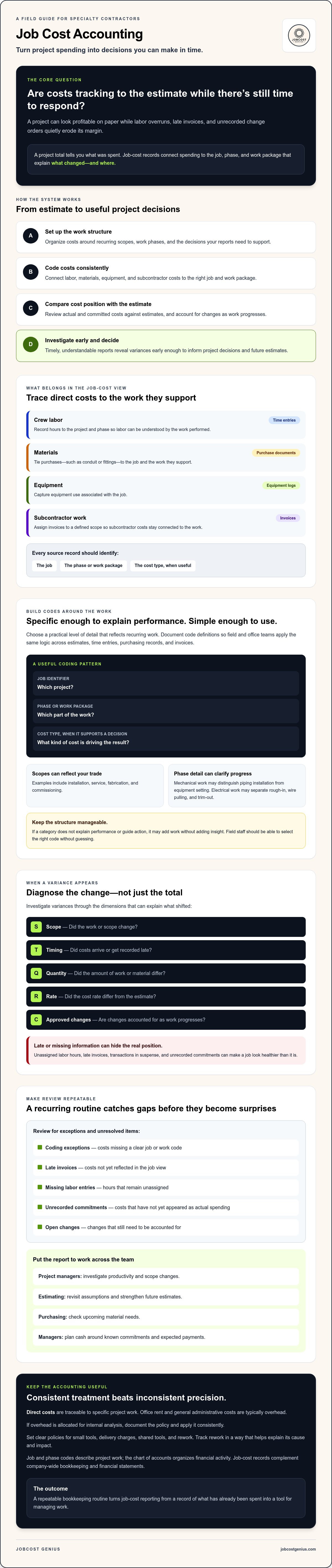
That answer is hard to find when labor hours, material purchases, equipment use, and subcontractor invoices follow separate workflows or use inconsistent job and phase codes. A project total alone won’t explain a margin change. Costs need to be tied to defined work so you can identify what changed and where.
This guide explains how to assign direct costs consistently, compare actual and committed costs with estimates, and account for changes as work progresses. You’ll also learn how timely, understandable reports can reveal variances early and inform project decisions and future estimates. With a repeatable bookkeeping routine, job-cost reporting becomes a tool for managing work, not just a record of what’s already been spent.
Key Takeaways
- Build a job-cost structure around recurring scopes, work phases, and the decisions your reports need to support.
- Use consistent coding to connect labor, materials, equipment, and subcontractor costs to the right job and work package.
- With job cost accounting for specialty contractors, investigate variances by scope, timing, quantity, rate, and approved changes.
- Set a recurring review routine to catch coding exceptions, late invoices, missing labor entries, unrecorded commitments, and open changes.
What Job Cost Accounting Means for Specialty Contractors
Job cost accounting for specialty contractors connects project spending to the work that generated it. Rather than viewing costs only as company-wide totals, a contractor can see what a particular job, phase, or work package is consuming. The Job costing method tracks costs by job. Specialty contractors make that information more useful by organizing it around their scopes, crews, and delivery methods.
Job cost accounting assigns a project’s costs to the job and work categories that explain how the work was performed. It complements general bookkeeping and financial statements, which show the company’s overall financial position and activity. Those records answer, “What did the business spend?” Job-cost records add, “Which project and type of work drove that spending?” Both views matter, but they support different decisions.
A mechanical contractor might distinguish piping installation from equipment setting. An electrical contractor may separate rough-in, wire pulling, and trim-out. A single project total can hide which scope is tracking to estimate and which is not. Choose a level of detail that reflects recurring work and helps managers make decisions, rather than adopting a generic code list.
Which Costs Belong to a Specialty Contractor’s Job?
Common direct costs include crew labor recorded to the project and phase, materials such as conduit or fittings, equipment used on the job, and subcontractor work tied to a defined scope. Source records may include time entries, purchase documents, equipment logs, and subcontractor invoices. Each record should provide enough information to identify the job and the work it supports.
Not every expense should be assigned directly to a job. Office rent and general administrative costs are typically overhead, while direct costs are traceable to specific project work. If overhead is allocated for internal analysis, document the policy and apply it consistently rather than assuming one method fits every contractor.
Small tools, delivery charges, and rework also need clear treatment. A tool purchased for one project may be coded there under company policy, while shared tools may be treated differently. Delivery charges can follow the material or job they support. Track rework in a way that helps the contractor understand its cause and impact. Consistent policy matters more than inconsistent attempts at precision.
Why Job-Level Visibility Matters Before Closeout
Cost reports are only as useful as their timing and coding. If labor hours remain unassigned, invoices arrive late, or transactions sit in suspense, reported costs can make a job look healthier than it is. By the time those costs appear, the crew may have moved on and the opportunity to respond may have passed.
Timely visibility supports practical choices. Estimating can revisit assumptions, project managers can investigate productivity or scope changes, purchasing can check upcoming material needs, and managers can plan cash around known commitments and expected payments. Regular bookkeeping and consistent cost coding bring separate field and office records together into a usable view of project performance.
Build a Job Cost Structure Around Scope, Phases, and Cost Types
A useful cost structure starts with the work your crews repeat and the questions managers need answered. For a specialty contractor, that might mean separating installation from fabrication, service calls from new construction, or commissioning from startup. The goal isn’t to create the longest code list. It’s to show where labor and other costs are accumulating while keeping coding practical for field and office teams.
Organize each transaction with a consistent job identifier, a phase or work-package label, and a cost type when that distinction supports decisions. For example, a piping installation phase could separate labor, materials, equipment, and subcontractor costs. If a category doesn’t help explain performance or guide action, it may add work without adding insight. Document code definitions so employees apply them consistently across estimates, time entries, purchasing records, and invoices.
Choose Cost Codes That Match the Work
Map codes to repeatable scopes such as installation, service, fabrication, or commissioning, as relevant to your business. Add cost-type distinctions where they help managers identify what’s driving a result. Keep the structure manageable: field staff should be able to select the right code without guessing, and office staff should apply the same logic when reviewing transactions.
Job and phase codes describe project work, while the chart of accounts organizes financial activity. For account-level guidance, see the published article Building a Construction Chart of Accounts. Construction managers also prepare estimates, budgets, and monitor budget matters as part of their work, as outlined in the U.S. Bureau of Labor Statistics’ duties of construction managers. Clear codes give project leaders a practical basis for that oversight.
Set Up Estimates and Budgets for Meaningful Comparisons
Build the estimate and project budget using the same job, phase, and cost-type structure you’ll use to record actual transactions. If the estimate groups all installation labor together but actual hours are coded by separate work packages, managers can’t make a clean comparison without reclassifying or combining data. Inconsistent categories can make a variance look like an overrun or hide one inside a broader total.
Before work begins, record the assumptions behind the budget. Identify allowances, exclusions, and the scope each amount covers. When a change is approved, update the project budget in a traceable way so the original baseline and revised scope don’t get confused. This lets teams compare like with like and investigate differences rather than debate what the numbers represent.
A consistent structure takes coordination across estimating, field reporting, purchasing, and bookkeeping. To review how recurring bookkeeping and financial reporting can support consistent cost coding, learn about construction bookkeeping support.
Capture Labor, Materials, Equipment, and Subcontractor Costs Consistently
Accurate job cost accounting for specialty contractors depends on a repeatable path from the source record to the project report. Each entry needs enough information to identify the job, phase or work package, cost type, and relevant approval. The person who first records a cost may not be the person who reviews and enters it, so clarify responsibilities and handoffs.
The capture map below pairs each cost type with useful source records and a typical review responsibility. Assign roles to fit your organization, and use the same coding rules across projects.
- Labor: Time records identify the employee, date, job, phase, and hours worked. A supervisor reviews the entry for accuracy and coding before it moves through the established payroll and accounting process.
- Materials: Purchase orders, receipts, and vendor invoices connect materials to the job and work package. Purchasing or project staff can confirm the intended job and scope; accounting reviews the invoice and coding.
- Equipment: Equipment-use records identify the job and period of use. The responsible field or equipment manager checks the record, while accounting applies the company’s consistent cost treatment.
- Subcontractors: Agreements, invoices, and approval records tie subcontractor charges to the contracted scope. The project manager verifies the work and coding before accounting records the invoice.
Record Labor Hours and Fully Loaded Labor Costs
Use the contractor’s established timekeeping process to capture the employee, date, job, phase, and hours worked. Correct missed or misassigned entries promptly, documenting the reason and approval. If labor burden is included in job costs, apply a documented company method consistently. For detailed calculations, refer to the published guide “Calculating Labor Burden for Accurate Job Costing.”
Code Purchasing, Equipment, and Subcontractor Transactions
Match purchase orders to receipts and invoices, and check that equipment records and subcontractor charges identify the right job and scope. Before posting, look for missing codes, possible duplicate entries, incorrect cost types, and incomplete approvals. Correct errors through a documented process so the record shows what changed and why. These practical controls support sound job costing concepts by keeping source documents connected to recorded costs.
Timing also matters. An approved purchase order or subcontract agreement represents a commitment, not necessarily a posted cost. Track committed amounts separately from costs recorded in the accounts, and update them as invoices arrive or commitments change. Treating both measures as the same can make a project appear under budget or over budget for the wrong reason.
Use Job Cost Reports to Find Variances Before They Become Surprises
A job-cost report is most useful when it shows more than what has already been posted. Compare four clearly defined measures: budget, the current approved plan; actual cost, costs recorded to date; committed cost, obligations not yet recorded as actual costs; and forecast, the expected total cost at completion. Keep those definitions consistent from one review to the next so the team can interpret changes accurately.
Here’s a simple report layout, with no benchmark figures assumed:
- Job, phase, and cost type
- Current budget
- Actual cost to date
- Open committed cost
- Forecast at completion
- Variance, explanation, owner, and next action
Job-cost reporting and WIP reporting are related, but they answer different questions. Job-cost detail helps explain how costs are tracking within specific scopes and cost categories. WIP reporting presents a broader view of project financial status across work in progress. For more on that distinction, see the guide “WIP Reporting for Construction.”
Read Actual Costs and Forecasts in Context
Actual costs to date don’t show the whole expected result. A project may have uncompleted work, open purchase or subcontract commitments, schedule changes, or approved scope changes that affect the final forecast. Review what remains to be done alongside costs already posted, then update the estimate of total cost using current project information.
Timely cost coding gives project teams clearer visibility into where each job stands and what needs attention.
Investigate Variances and Assign Follow-Up
Start with the affected job phase and cost type, then work through the cause:
- Validate the entry: Check the job, phase, cost type, source record, and posting period.
- Compare the estimate: Review the original assumptions, quantities, and expected rates.
- Confirm scope: Determine whether the work changed and whether the change was approved and included in the budget.
- Assign an owner: Give a specific person a follow-up action and a date for review.
A late invoice may create a timing difference that resolves once recorded. Repeated labor overruns, purchasing differences, or estimating misses may point to a pattern that needs a different response. Document the explanation, correction, and decision so the next review can check whether the action worked. This is where job cost accounting for specialty contractors supports project decisions, not just month-end reporting.
For information about connecting consistent bookkeeping with useful project reporting, review JobCost Genius reporting support.
Create a Repeatable Job Cost Review and Strengthen the Process
A dependable review turns job-cost information into a routine for field and office teams. Set a recurring monthly review, with project staff confirming work, scope, and outstanding commitments while accounting staff reconcile transactions and prepare reports. Assign one person to coordinate the review so open questions don’t get stuck between departments.
Use a Monthly Job Cost Review Checklist
Work through the same checks each cycle. Record exceptions and assign an owner and follow-up date when an item needs action.
- Coding exceptions: Find transactions missing a job, phase, or cost type, and resolve unclear coding with the responsible reviewer.
- Late invoices: Check for invoices related to completed work or received materials that haven’t been recorded, and follow up on missing documentation.
- Labor entries: Review missing, incomplete, or unusual time entries with the appropriate supervisor before relying on the job report.
- Commitments: Confirm open purchase and subcontract commitments still reflect expected costs, and update them when they change.
- Open changes: Identify scope changes awaiting review or approval, and keep them distinct from approved budget changes.
- Variances: Review budget-to-actual movement and forecast changes. Assign an owner and follow-up date to every material variance that requires action.
Close each review by recording decisions, corrections, and unresolved items. At the next meeting, check whether assigned actions were completed and whether they changed the project outlook. This keeps the routine useful beyond reconciliation.
When to Add Specialized Bookkeeping or Reporting Support
Consider added support if cost codes are applied inconsistently, the monthly close is delayed, project margins are difficult to explain, or the team lacks capacity to keep reports current. Those signs can point to a process problem, not just a reporting problem. Clear responsibilities and recurring bookkeeping help keep financial records organized enough for useful job-cost and project reporting.
JobCost Genius provides construction bookkeeping and financial reporting services, including recurring record keeping, AP/AR management, payroll processing, and WIP reporting. For more context on the role of outsourced support, see the guide Outsourced Bookkeeping for Construction. Firms evaluating job cost accounting for specialty contractors can also learn about construction bookkeeping and reporting support.
Make Every Job-Cost Review More Useful
Strong job cost accounting for specialty contractors depends on a structure that reflects your scopes, consistent coding from source records through accounting, and regular reviews of budgets, actuals, commitments, and forecasts. Together, these practices help explain where costs are moving and give your team a clearer basis for project decisions.
Accurate, recurring bookkeeping supports that process by keeping project records organized and reports useful. JobCost Genius provides construction-focused bookkeeping, WIP reporting, and Procore Financials integration support. The company was founded by professionals with over 20 years of industry experience.
If your team wants to improve cost coding or get clearer project reporting, contact JobCost Genius to discuss construction bookkeeping and reporting support. A consistent process can bring more clarity to each review and help your team make informed decisions as work progresses.
Frequently Asked Questions
What is job cost accounting for specialty contractors?
Job cost accounting for specialty contractors assigns project expenses to individual jobs and useful cost categories, such as labor, materials, equipment, and subcontractors. Costs can also be grouped by phase or work package when that detail helps explain project performance. Contractors use the information to compare estimates with costs incurred, investigate differences, and refine future planning. Consistent coding and timely records are essential for making those comparisons meaningful.
How do specialty contractors set up job cost codes?
Start with the scopes your company performs repeatedly and the project questions managers need answered. Create a consistent structure for job identifiers, phases or work packages, and cost types. Include enough detail to reveal meaningful differences, but avoid so many codes that field and office staff struggle to use them consistently. Document what each code means, then review the structure as your services and reporting needs change.
Which costs should be included in a contractor’s job costing?
Common direct project costs include labor, materials, equipment, and subcontracted work. The useful level of detail depends on the contractor’s scope and accounting policies. Define how your company treats small tools, delivery charges, rework, and overhead, then apply those rules consistently. Overhead should not be treated as a direct project cost unless your documented accounting method supports that classification. Clear policies help make comparisons between jobs more reliable.
How often should specialty contractors review job costs?
Review costs often enough to identify issues while there’s still time to respond. A recurring monthly financial review can provide a consistent checkpoint, with more frequent project checks when the work, risk, or reporting needs call for them. Include late invoices, labor records, open commitments, and approved changes. Choose a cadence your team can maintain, and document who prepares the information, reviews it, and follows up on exceptions.
What is the difference between job costing and WIP reporting?
Job costing organizes project expenses and compares them with budgets or estimates. Work-in-progress reporting uses project information to assess performance and financial position over time, based on the company’s accounting method and reporting requirements. The two are connected but answer different questions. Job-cost data can inform WIP analysis, but it doesn’t replace a properly prepared WIP report. Keep each report’s purpose and underlying definitions clear when reviewing project results.
Can accounting software handle job cost accounting for a specialty contractor?
Accounting software can support job, phase, and cost-category tracking when it’s configured for your workflow and users enter complete, consistent information. Features and integrations vary, so confirm a tool’s capabilities before relying on a particular process. Software won’t resolve unclear coding rules or missing records by itself. Set clear ownership for data entry and review, address exceptions, and verify reported costs against source transactions to maintain dependable job-level information.
How can a contractor identify a job cost variance?
Compare budgeted or estimated amounts with actual costs for the same job and category, and include committed costs when tracked. First confirm that transactions are coded correctly and check for recent invoices, labor records, and approved scope changes. Then investigate whether the difference reflects timing, quantity, rates, productivity, purchasing, or estimating assumptions. Assign an owner and follow-up date to issues that need action, then review whether the response changed the project outlook.


