

What if your company reports a profit, but cash is still tight and one project seems to be draining the others? That gap can make understanding a contractor's income statement feel harder than it should. The statement matters, but its bottom line doesn’t tell the whole story on its own.
It’s reasonable to find financial terms confusing or wonder whether reported income reflects the money available to pay bills. Construction accounting adds another layer: job costs and revenue may be recorded at different times, so project progress and cost classification can affect reported profit. A company-wide result can also hide which jobs are performing well and which need attention.
This guide explains the main income statement lines, how construction-specific accounting and work-in-progress (WIP) context shape the numbers, and why profit isn’t the same as cash flow. You’ll also learn what to compare across periods and projects, and what questions to ask before making decisions based on a single report.
Key Takeaways
- Follow the statement from revenue through job costs and gross profit to overhead and net income to see how each line contributes to the result.
- Understanding a contractor's income statement means looking beyond company-wide profit and checking how costs and performance vary by job.
- Use job-cost reports and WIP schedules to understand how project progress, estimates, and revenue timing can shape reported results.
- Build a monthly review habit: confirm the reporting period and basis, then compare results with prior periods, budget, and available job-level information.
- When records are inconsistent or variances remain unexplained, construction-focused bookkeeping and WIP reporting can help clarify the numbers.
What a Contractor’s Income Statement Shows, and What It Leaves Out
An income statement summarizes a company’s revenue, expenses, and resulting profit or loss over a defined period, such as a month, quarter, or year. The Income statement is one view of financial performance, not a complete picture of a contractor’s finances.
A balance sheet serves a different purpose: it shows the company’s financial position at a specific point in time, including assets, liabilities, and equity. The income statement covers activity across a period. That distinction matters in construction, where a project can span multiple reporting periods. Revenue and costs recorded in one month may relate to work that began earlier or won’t be completed until later. As a result, a monthly profit figure may not reflect the final outcome of each active job.
The statement also presents company-level performance. It can show whether the business as a whole earned a profit, but it won’t reveal every job’s complete financial status on its own. For that, examine job-level reports and, where applicable, work-in-progress information.
What are the main parts of a contractor’s income statement?
Account names and presentation can vary between accounting systems, but these core terms help you follow the flow:
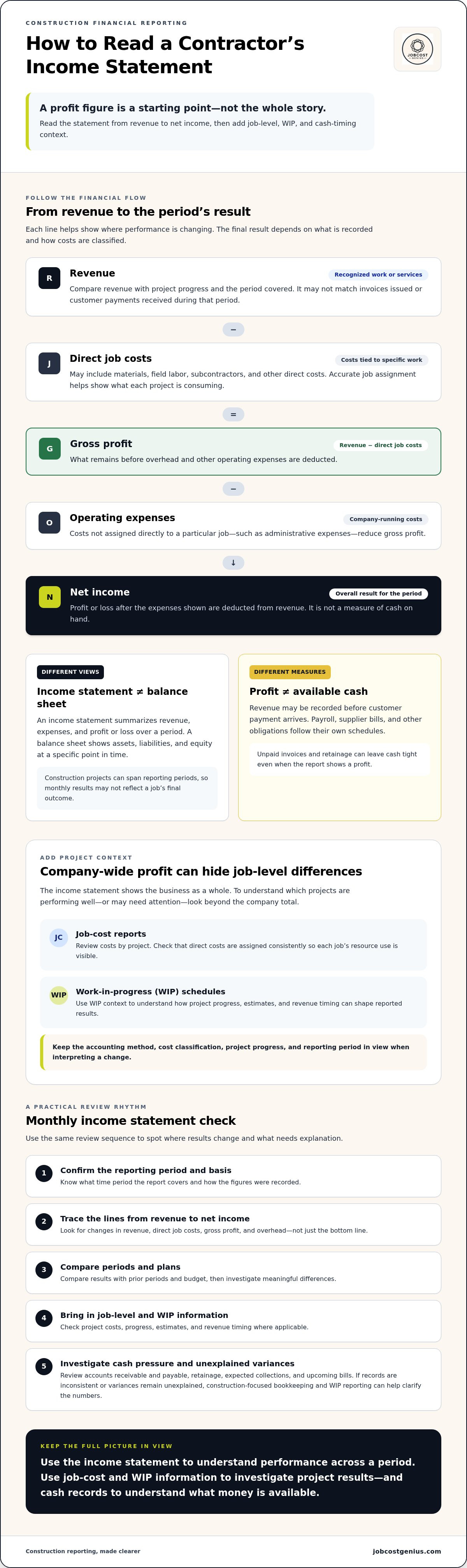
- Revenue is income recognized from work performed or services provided. Compare it with project progress and the period covered by the report.
- Direct job costs are expenses tied to performing specific work. They may include materials, field labor, subcontractors, and other direct costs. Accurate job assignment helps show what a project is consuming.
- Gross profit is revenue minus direct job costs. It indicates what remains before overhead and other operating expenses are deducted.
- Operating expenses are costs of running the company that aren’t assigned directly to a particular job. They reduce gross profit and may include administrative expenses.
- Net income is the profit or loss remaining after the expenses shown on the statement are deducted from revenue. It’s the overall result for that reporting period, not a measure of cash on hand.
This sequence helps you spot where a change may be occurring: revenue, job costs, or overhead. It’s a useful starting point for understanding a contractor's income statement, but the figures still need context from project records.
Why can a profitable contractor still feel short on cash?
Accounting profit and available cash aren’t the same. A contractor may record revenue before collecting the related customer payment, while payroll, suppliers, and other obligations come due on their own schedules. Retainage can also delay access to part of the amount billed.
Hypothetical example: A report shows a profit for the month, but a large customer invoice remains unpaid and some billed funds are held as retainage. Meanwhile, payroll and supplier bills are due. The reported profit doesn’t mean enough cash has arrived to cover those obligations.
To investigate the gap, review accounts receivable and payable, retainage, and the timing of expected collections and upcoming bills. These details help explain cash pressure without treating the income statement’s profit figure as spendable cash.
How to Read Revenue, Job Costs, Gross Profit, and Overhead
Read the statement from top to bottom. Revenue is reduced by direct job costs to calculate gross profit. Operating expenses and any other expenses shown below that line are then deducted to arrive at net income. This sequence helps you locate where a change in reported performance is occurring, rather than focusing only on the final result.
Gross profit is revenue less the direct costs assigned to that revenue. Job costs may include materials, field labor, subcontractors, and other costs directly connected to work performed. The chart of accounts and the contractor’s accounting practices determine how individual transactions are classified. For example, an expense might be assigned to a specific job or recorded as overhead, depending on its nature and the company’s consistent coding approach.
How should contractors interpret revenue on the statement?
Revenue recorded for a period depends on the accounting method used and the circumstances of the contract. It isn’t necessarily the same as invoices issued during that period or customer payments received. An invoice may be issued before or after revenue is recognized, and cash collection can happen on a different schedule. If the timing or method is unclear, ask your accounting professional to explain how revenue is recorded for your contracts and what documentation supports the reported amounts.
What do gross profit and overhead reveal?
Gross profit reflects what remains after the direct job costs assigned to revenue are deducted. Net income goes further: it accounts for overhead and other expenses included on the statement. Overhead represents company operating costs that aren’t assigned directly to a particular job. A strong gross profit can therefore coexist with lower net income if overhead is substantial.
Consistent coding makes comparisons more useful. If similar expenses shift between job costs and overhead from month to month, apparent changes in gross profit may reflect classification differences rather than a real change in project performance. Review unusual movements and confirm that comparable costs are categorized consistently before drawing conclusions.
For example, if reported revenue rises but gross profit falls, check whether direct job costs increased, whether costs were assigned to the right jobs, and whether revenue and costs relate to the same work and reporting period. Then consider overhead to understand how much of the gross profit remains as net income. This step-by-step review brings more clarity to understanding a contractor's income statement without treating a single line as the whole story.
If you need a more consistent construction-focused view of monthly results, JobCost Genius bookkeeping and financial reporting may be worth exploring.
Why a Contractor’s Income Statement Needs Job-Cost and WIP Context
An income statement shows company-wide performance for a defined period, but it can’t tell you on its own whether each active project is on schedule or within its cost expectations. To understand what’s driving the company result, compare it with job-cost reports and a work-in-progress (WIP) schedule. Each report answers a different question.
WIP adds project-level context to financial statements; it doesn’t replace them. Use the reports together: the income statement shows the overall result, while job-cost and WIP information help explain how project activity contributes to it.
What question does each construction report answer?
| Report | What it helps answer |
|---|---|
| Income statement | How did the company perform during this reporting period? |
| Job-cost report | What costs have been assigned to a particular job, and how do they compare with its budget or estimate? |
| WIP schedule | How do project progress, costs, and billing relate across active contracts? |
The income statement gives the company-wide view. Job-cost reports break costs down by project, helping you investigate which jobs are driving cost changes. A WIP schedule adds context about project progress and billing, which can help explain why revenue and costs appear in a particular period.
How do timing and cost changes affect reported profit?
Construction work often crosses reporting periods. The timing of revenue recognition depends on the accounting method and contract circumstances, while costs can be entered after the work occurs. Estimates may also change as a project advances. These factors can make one month look stronger or weaker than the project’s overall performance suggests.
Illustrative example: A contractor’s income statement shows $120,000 in revenue and $90,000 in direct costs for a month, for $30,000 in gross profit. These figures are hypothetical. If a $15,000 subcontractor cost for work completed that month is recorded in the following period, the first month appears more profitable and the next month less profitable than if the cost had been recorded in the correct period. A revised estimate may also change the expected cost or margin for the job, affecting how its progress is understood.
When comparing periods, check for late cost entries and changes to project estimates. Then compare the statement with job-level records and WIP details before deciding whether a profit movement signals a real change in performance. For a fuller explanation of project status, consult a dedicated WIP reporting guide. This combined view makes understanding a contractor's income statement more useful when making decisions about active work.
A Monthly Checklist for Reviewing a Contractor’s Income Statement
A consistent review process helps separate meaningful changes from timing issues or bookkeeping corrections. Use this checklist each month, and bring unanswered questions to the person responsible for the books.
Which checks should come before interpreting the numbers?
- Confirm the period and reporting basis. Check the start and end dates, and confirm whether the statement uses the accounting basis your company expects. Comparisons are less useful if reports cover different periods or use different bases.
- Check whether the records are complete. Ask whether transactions for the period have been entered and whether relevant reconciliations or adjustments are finished. Incomplete records can make results look unusually high or low.
- Review account and period coding. Check that revenue and costs appear in the intended accounts and reporting periods. Pay particular attention to costs assigned to jobs, since miscoding can affect both company results and job-level comparisons.
- Identify items that affect comparability. Ask whether significant estimates changed, corrections were made, or unusual transactions occurred. Note these before comparing results with another month or the budget.
What questions help explain a change in profit?
Once the report is ready to review, compare it with the prior period and budget. Then use available job-cost reports and WIP information to investigate changes that may be tied to specific projects. A variance is a prompt to ask questions, not proof that something is wrong.
- Locate the movement. Did revenue, direct costs, or overhead change? If direct costs shifted, check whether materials, field labor, or subcontractor costs explain the difference.
- Connect the company result to jobs. Ask whether the change comes from particular projects, revised estimates, or the timing of recorded revenue and costs. Compare company-level movements with relevant job-cost reports and WIP context.
- Document what remains unresolved. Record the question, who will investigate it, and the next action. Confirm any proposed correction with the person responsible for the books, and check the updated report when the issue is resolved.
For example, if gross profit declines, first verify that the period is complete and coding is consistent. Then check whether job costs increased or whether a project estimate or timing difference explains the movement. This disciplined sequence makes understanding a contractor's income statement more practical and repeatable from month to month.
For support with construction-focused bookkeeping and financial reporting, explore JobCost Genius reporting support.
Turn Income Statement Clarity Into Better Construction Financial Reporting
A contractor’s income statement is most useful when you read it alongside job costs, reporting timing, and WIP information. The company-wide result tells you how the business performed during a period; project-level reports help explain what contributed to that result. Understanding a contractor's income statement means considering both views before acting on a profit figure.
Consistent reporting makes that review more reliable. If financial statements arrive late, expense classifications shift between periods, or variances remain unexplained, it may be time to discuss the bookkeeping process with someone familiar with construction accounting. These are signals to investigate, not proof that a specific problem exists. Construction-focused bookkeeping support can help organize records and produce regular financial reports, giving you a clearer basis for follow-up questions and decisions.
When should a contractor get help reviewing financial statements?
Consider seeking support if monthly closes are repeatedly delayed, similar transactions are classified inconsistently, or changes in profit can’t be reconciled with job activity. Bring specific examples and ask how transactions are recorded, how project costs are assigned, and what information supports reported revenue. A specialist can help organize records and prepare regular reports, but no reporting process can guarantee a particular profit, compliance result, or financial outcome.
What information should you prepare for a financial review?
Gather recent income statements and balance sheets, along with job-cost reports and WIP schedules if available. Be ready to describe your current accounting processes and note questions about when revenue or costs are recorded. A focused review of these materials can make it easier to identify missing context and determine which variances need follow-up.
JobCost Genius provides specialized bookkeeping and financial reporting for construction companies. Its services include monthly bookkeeping with financial statements and WIP reporting. These may be relevant next steps if you need a more consistent process for reviewing company and project results. Bring your questions and reports so you can assess what support fits your reporting needs.
Use the framework in this guide to review your numbers first. If you’d like to explore construction-focused bookkeeping or WIP reporting, learn more about JobCost Genius and consider how its services align with your needs.
Build a Clearer Picture of Your Construction Finances
Understanding a contractor's income statement means reading beyond the net income line. Revenue, direct job costs, and overhead show how the company performed during a period, while job-cost reports and WIP information help explain project-level progress and timing. Regular comparisons can make it easier to spot changes, ask focused questions, and avoid decisions based on a single figure.
If late reporting, inconsistent classifications, or unexplained variances keep getting in the way, consider whether construction-focused bookkeeping support could help organize your records. JobCost Genius provides monthly bookkeeping that includes financial statement production, along with WIP reporting. The firm was founded by professionals with over 20 years of industry experience.
Explore construction-focused bookkeeping and financial reporting with JobCost Genius to learn more about its services and discuss your reporting needs. With consistent reports and project context, you can approach your numbers with greater clarity and confidence.
Frequently Asked Questions
What is an income statement for a contractor?
A contractor’s income statement reports revenue, expenses, and resulting profit or loss over a defined period, such as a month or year. It helps you assess company-wide financial performance during that timeframe. Unlike a balance sheet, which shows assets, liabilities, and equity on a specific date, an income statement tracks activity across a period. It doesn’t show available cash or provide the full financial status of each job.
How do you read a contractor’s income statement?
Read it from revenue down through direct job costs, gross profit, operating expenses, and net income. Check the reporting period and accounting basis first, then consider whether transactions are complete and consistently classified. Understanding a contractor's income statement also means asking what’s behind notable changes: compare results with prior periods, budget, and available job-cost or WIP reports. Those comparisons can help distinguish business-wide trends from project timing or recording differences.
What is the difference between gross profit and net income for a contractor?
Gross profit is revenue less the direct costs assigned to that revenue, such as job-related materials, field labor, or subcontractor costs. Net income is what remains after overhead and other expenses shown on the statement are also deducted. Gross profit helps you assess the relationship between revenue and direct job costs; net income reflects the company’s overall result for the reporting period. Neither figure alone explains cash available to pay bills.
Why does my contractor income statement show a profit when cash is tight?
Profit and cash balance measure different things. Revenue may be recorded before a customer pays, while payroll, supplier invoices, and other obligations may fall due sooner. Retainage can also delay access to part of billed amounts. Review accounts receivable, accounts payable, retainage, and expected payment dates to investigate the gap. A profitable period on the statement doesn’t necessarily mean the business has enough cash on hand for immediate obligations.
Should job costs appear on a contractor’s income statement?
Often, direct job costs appear as expenses beneath revenue, allowing the statement to show gross profit. These costs may include materials, field labor, subcontractors, and other costs assigned to specific work. Account names and presentation vary with the company’s chart of accounts and accounting practices. Check whether costs are classified consistently and assigned to the intended jobs. Job-cost reports can provide a more detailed breakdown than the company-wide income statement.
Can an income statement tell me whether every construction project is profitable?
No. An income statement summarizes performance for the company as a whole, so profitable work can mask a job with rising costs, and a project’s timing can affect results for a particular period. Review job-cost reports for costs assigned to individual projects and WIP schedules for project progress and billing context. Together, these reports help you investigate project status, but the income statement alone can’t confirm whether every active job is on track.
How often should a contractor review an income statement?
Reviewing an income statement monthly gives you a regular view of performance and a chance to investigate changes while the period is still recent. First confirm the report covers the intended dates and that records are ready for review. Compare results with prior periods, budget, and relevant job-level information. If the books aren’t finalized or a variance is unexplained, document the question and follow up with the person responsible for the records.


