

Why does your bank account often feel empty even when your project reports show a healthy profit? For many contractors, this disconnect isn't caused by a lack of hard work. It's usually the result of using general bookkeeping methods that fail to address the specific complexities of construction accounting for small firms. Between managing 100% bonus depreciation on equipment and tracking the July 2026 IRS mileage rate of 76 cents per mile, standard spreadsheets quickly become a liability rather than an asset.
We understand that bidding can feel like a guessing game when you lack clear visibility into your true labor burden and material costs. You need a financial system that replaces administrative overwhelm with organized clarity and foundational strength. This guide will show you how to move beyond basic data entry to a strategic framework that protects your margins and fuels sustainable growth. We'll cover how specialized WIP reporting and professional financial statements provide the predictable cash flow you need to secure bonding, manage OSHA compliance costs, and win larger contracts with total confidence.
Key Takeaways
- Understand why traditional P&L statements often mask cash flow issues and how WIP reporting identifies underbillings before they impact your liquidity.
- Implement precise job costing as the foundation of construction accounting for small firms to ensure every material and labor dollar is tracked to a specific project.
- Evaluate the "software trap" to determine if your firm needs a specialized service partner rather than just another subscription to manage complex financial workflows.
- Calculate your comprehensive labor burden, including insurance and benefits, to eliminate the guesswork from your bidding process and protect your project margins.
- Gain the financial visibility required to secure bonding and bank loans, allowing you to scale your operations from a position of organized strength.
Why General Accounting Fails Small Construction Firms
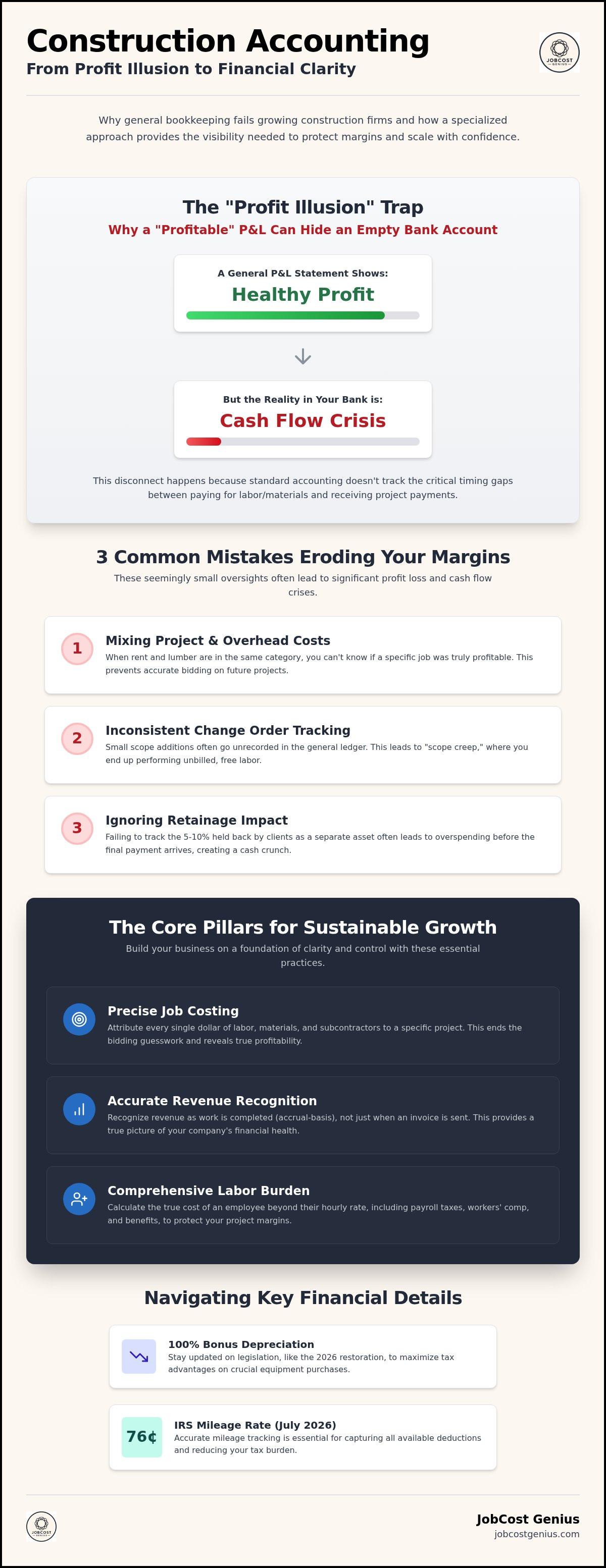
Standard bookkeeping works for coffee shops and law firms, but it often fails the unique needs of a jobsite. Construction accounting is a specialized form of project-based financial management. It tracks costs and revenue by each individual job rather than treating the business as a single bucket of money. Without this granularity, owners fall victim to the "Profit Illusion." This happens when your Profit and Loss statement shows a healthy surplus, yet your bank account is nearly empty. The mismatch occurs because general accounting doesn't account for the timing gaps between when you spend money on labor and when you finally get paid for a milestone.
The risks are high for those who rely on generalist bookkeepers. A generalist might understand debits and credits, but they often struggle with the nuances of construction accounting for small firms. They might miss "overbilling," which is when you invoice for more work than you've actually performed. While this provides temporary cash flow, it creates a future liability that can sink a firm if the cash isn't managed with discipline. They are also less likely to stay updated on industry-specific legislation, such as the 2026 restoration of 100% bonus depreciation for equipment. Managing long-term contracts, tracking retainage, and adjusting for fluctuating material costs requires a level of detail that standard bookkeeping simply wasn't designed to handle.
The Problem with Cash-Basis Accounting for Contractors
Many new contractors use cash-basis accounting because it's intuitive. You record income when it hits the bank and expenses when you pay them. However, this creates "rollercoaster" financial reports that make it impossible to plan. One month looks like a massive win because you collected three deposits; the next month looks like a failure because you're paying for the actual materials. Moving to accrual-based accounting allows you to match costs to the revenue they generated. It provides a true picture of project health instead of just a snapshot of your current bank balance.
Common Bookkeeping Mistakes in Small Firms
Even experienced contractors fall into traps that erode their bottom line. These mistakes often stem from a lack of industry-specific structure:
- Failing to separate project costs from overhead: If your rent and your lumber are in the same category, you'll never know if a specific job was actually profitable.
- Inconsistent change order tracking: Small additions to a scope of work often go unrecorded in the general ledger. This leads to "scope creep" where you're performing free labor.
- Ignoring retainage impact: If you don't track the 5% or 10% held back by clients as a separate asset, you'll likely overspend before the final check arrives.
Transitioning from administrative overwhelm to financial clarity starts with recognizing these gaps. Our Starter Plan is designed to address these foundational needs, ensuring that your books reflect the reality of the field and provide a stable platform for growth.
The Core Pillars of Construction-Specific Financials
Moving beyond the "Profit Illusion" requires a structural shift in how you view your data. You must transition from tracking "company money" to tracking "project money." This granular focus is the bedrock of construction accounting for small firms. Success in this industry isn't just about having the right software; it's about the logic you apply to your financial workflows. Without these pillars, your books are just a historical record of where your money went, rather than a map of where your business is going.
Job costing is the first essential pillar. It's the practice of attributing every single dollar spent on labor, materials, and subcontractors to a specific project. When you know exactly what a kitchen remodel or a foundation pour costs in real-time, your bidding stops being a guessing game. Hand-in-hand with this is revenue recognition. In construction, you haven't "earned" your money just because you sent an invoice. You earn it as you complete the work. This distinction is critical for maintaining a healthy balance sheet and is a core principle advocated by the Construction Financial Management Association (CFMA).
Calculating your true labor burden is equally vital. An employee's hourly rate is only a fraction of their actual cost to the firm. You must account for payroll taxes, workers' comp insurance, and benefits to understand your project margins. For example, a worker earning $30 per hour might actually cost the company $45 per hour once all burdens are applied. Failing to include this 50% markup in your estimates will quickly erode your profitability.
Demystifying WIP (Work in Progress) Reporting
WIP reports act as an early warning system for "project fade," where profit margins slowly disappear as a job nears completion. By calculating the percentage of completion, you can see if you are overbilled or underbilled. If you've spent 60% of your budget but only completed 40% of the work, the WIP report highlights the crisis before your cash runs out. WIP reporting serves as the essential bridge between project costs and recognized revenue.
The Importance of a Construction Chart of Accounts
Your Chart of Accounts (COA) shouldn't be a generic list of expenses. It needs to mirror your project estimate phases to provide meaningful data. Standardizing your cost codes allows you to perform cross-project analysis and identify trends in your performance. If you consistently go over budget on "Site Prep," your COA will highlight that specific leak. For more details on setting up this structure, you can reference our guide on Building a Construction Chart of Accounts: A Pro Guide. Establishing these pillars on your own is a heavy lift while managing a jobsite. If you're ready to move from administrative overwhelm to organized clarity, our Starter Plan provides the professional oversight needed to protect your margins.
Choosing Between Generic Software and Specialized Services
Software is a tool, not a strategy. Many contractors fall into the "Software Trap," believing that a subscription to Sage or Procore will automatically fix their financial visibility. In reality, expensive platforms often highlight existing process failures rather than solving them. Effective construction accounting for small firms requires an expert operator who understands the logic behind the data entry. Without that industry-specific oversight, you're simply paying for a more expensive way to produce inaccurate reports that don't reflect the reality of your jobsite.
Deciding between hiring an in-house controller and outsourcing is a pivotal moment for a growing firm. A qualified full-time controller often commands a six-figure salary; this is a significant overhead burden for a firm still scaling its operations. Conversely, a generalist bookkeeper may be affordable but often lacks the specialized knowledge to handle complex WIP reporting or Procore Financials Integration. Choosing a specialized service provider offers a middle ground. You gain access to seasoned industry veterans who act as strategic partners, providing the high-level oversight of a controller at a price point that fits a small business budget.
When to Outgrow QuickBooks Online
QuickBooks Online is the standard entry point, but it has clear limitations as your project volume increases. You know you've outgrown it when you spend more time in manual Excel spreadsheets than in your accounting software. Basic platforms struggle to track multi-stage job costing or automate the 100% bonus depreciation available for equipment in 2026. Specialized services bridge this gap by implementing a Procore Financials Integration. This ensures that field data, such as daily logs and change orders, syncs seamlessly with your office books, eliminating double-entry and reducing human error across your entire organization.
The Hybrid Approach: Expert Services + Modern Tech
The most effective model for modern contractors is the hybrid approach. This combines cutting-edge tech stacks with expert human oversight. Our Starter Plan is designed to move you from simple record keeping to proactive financial management. We don't just record what happened; we provide the visibility needed to make strategic decisions. This transition transforms your accounting department from a back-office expense into a foundational strength. By leveraging specialized expertise, you gain the confidence to bid on larger projects, knowing your margins are protected by professional oversight.
Managing Payroll Compliance and Labor Burden
Payroll in the construction industry is significantly more complex than in most other sectors. When your crew moves between different municipalities or states, your tax withholding and reporting requirements change with the jobsite. This jurisdictional complexity is a primary reason why general payroll services often fail. For those managing construction accounting for small firms, the challenge isn't just paying employees; it's ensuring that every hour worked is compliant with local labor laws and prevailing wage requirements. Failing to track these nuances can lead to costly penalties, especially with OSHA's 2026 maximum penalty for serious violations reaching $16,550 per occurrence.
Subcontractor management adds another layer of administrative weight. You must maintain an organized system for tracking W-9s and Certificates of Insurance (COIs) to protect your firm from liability. If a subcontractor's insurance expires while they are on your site, your own workers' comp policy will likely bear the cost during your next audit. Maintaining a rigorous compliance folder for every sub is a foundational requirement for any firm looking to scale. This meticulousness ensures that you aren't blindsided by unexpected expenses that your project estimates didn't cover.
The Hidden Costs of Construction Labor
Your project margins are often eroded not by materials, but by "burden." Labor burden includes every dollar spent on a worker beyond their gross wages, such as payroll taxes, workers' comp, and benefits. It also must account for non-productive time like mobilization, safety meetings, and equipment maintenance. Labor burden is the most overlooked variable in small firm bidding because it represents the difference between a project's estimated cost and its actual cash drain. Accurate tracking is even more vital in 2026, as you must now account for the $12,500 federal income tax exemption on overtime income introduced by the One Big Beautiful Bill Act (OBBBA).
Subcontractor Compliance and Payment Cycles
Managing the flow of pay applications and lien waivers is essential for maintaining healthy cash flow. You need a structured workflow that ensures you only release payments once you've received the necessary compliance documents. This protects you from double-payment risks and ensures you stay in compliance with prompt payment acts. For firms taking on government contracts, the requirements are even stricter. You can learn more about these specific needs in our guide on Certified Payroll Reporting Services for Federal Jobs.
Navigating these complexities while trying to manage a jobsite is a recipe for administrative overwhelm. Our Starter Plan provides the expert oversight needed to manage your labor burden and subcontractor compliance with total confidence. We act as your strategic partner, ensuring that your payroll and compliance workflows are as disciplined as your field operations.
Scaling Your Small Firm with JobCost Genius
Scaling a firm requires an infrastructure that supports larger project volumes without increasing your administrative burden. Many owners find themselves trapped in a cycle of administrative overwhelm, spending their evenings reconciling accounts instead of planning their next move. Effective construction accounting for small firms provides the escape hatch from this cycle. By implementing a structured financial system, you transition from simply "working in the business" to strategically "working on the business." This shift transforms your back office from a source of stress into a foundational strength that supports operational excellence.
This growth is powered by visibility. Specialized WIP reporting gives you the confidence to bid on larger, more complex contracts because you finally understand your true capacity and cash position. You no longer have to worry if a new project will sink your liquidity; you'll have the data to prove it won't. When you can present professional financial statements to banks or bonding agents, you open doors that were previously closed to your firm. This clarity allows you to make bold, data-driven decisions that protect your margins while you expand.
From Starter to Premium: Growth-Focused Support
Our tiered service model is designed to grow alongside your business. The Starter Plan focuses on establishing a clean, industry-specific foundation, ensuring your job costing and basic reporting are accurate from day one. As your revenue increases and your needs become more complex, you can seamlessly scale into our Growth and Premium plans. These higher tiers offer advanced Procore Financials Integration and deeper strategic oversight for multi-million dollar project portfolios. Every plan is backed by our team's 20+ years of industry experience, providing the stability and meticulousness your firm deserves as it reaches new heights.
Next Steps for Financial Clarity
There's no better time to audit your current bookkeeping process than right now. If your current system doesn't provide a clear, project-level P&L or predictable cash flow, it's holding you back from your full potential. We invite you to take the first step toward organized calm with a specialized construction financial health check. This assessment identifies the gaps in your current workflows and provides a clear roadmap for improvement. Don't let administrative friction cap your growth. Get your specialized construction bookkeeping quote today and start building your firm on a foundation of professional financial excellence.
Take Command of Your Project Profitability
General bookkeeping often leaves contractors guessing about their true cash position. By implementing specialized WIP reporting and accurate job costing, you eliminate the "Profit Illusion" and gain a clear view of your project-level P&L. Understanding your full labor burden and maintaining subcontractor compliance isn't just about avoiding penalties; it's about protecting the margins that fuel your growth. These pillars ensure that every bid you submit is backed by historical data rather than intuition.
Mastering construction accounting for small firms requires more than just a software subscription. It demands a strategic partner who understands the nuances of the field. With over 20 years of industry experience, our team provides the specialized WIP and Procore support needed to transform your financial workflows into a foundational strength. Whether you're just starting out or ready to scale, our tiered plans start at $800/month to ensure professional oversight is always within reach.
Schedule a Financial Strategy Session with JobCost Genius today to replace administrative overwhelm with organized calm. You've built your reputation on quality work; let's build your books on a foundation of total financial clarity.
Frequently Asked Questions
What is the difference between construction accounting and regular accounting?
Construction accounting is specialized because it tracks financials on a project-by-project basis rather than just by monthly or quarterly time periods. Regular accounting tracks general overhead and total revenue, but it often misses the nuances of retainage, progress billing, and specialized job costing. For those managing construction accounting for small firms, this granularity is the only way to see which specific jobs are generating profit and which are losing money.
Why do small construction firms need WIP (Work in Progress) reporting?
Small firms need WIP reporting to bridge the gap between their project costs and recognized revenue. This report identifies if you've billed for more work than you've completed, known as overbilling, or if you've done work you hasn't yet been invoiced, known as underbilling. Without this visibility, your Profit and Loss statement can show a false sense of security while your actual cash reserves are dwindling behind the scenes.
How much should a small construction firm spend on bookkeeping services?
The amount a firm should spend depends on the complexity of its projects and the level of oversight required to protect its margins. Investing in professional services should be viewed as a strategic cost that prevents expensive bidding errors and compliance penalties. Many firms find that tiered service plans are the most effective way to scale their financial support as their revenue grows without overcommitting to a full-time salary.
Can I use QuickBooks for construction accounting?
You can use QuickBooks, but it often requires specialized configuration to meet the unique demands of the industry. While it's a solid entry point, standard setups lack the robust job-costing features found in dedicated construction platforms. To make it effective, many contractors utilize integrations like Procore Financials to ensure their field data flows correctly into their accounting records and mirrors their project phases.
What is labor burden and why does it matter for my bids?
Labor burden is the total cost of an employee, including their hourly wages, payroll taxes, workers' comp insurance, and benefits. It matters for your bids because failing to account for these "hidden" costs means you're underestimating your true project expenses. If your burden isn't accurately calculated, you might win the contract but lose money on every hour your crew spends on the jobsite.
How does Procore integration help with my company financials?
Procore integration creates a seamless link between your field operations and your office financials. This eliminates the need for double-entry and ensures that change orders or daily logs are reflected in your books in real-time. It provides the financial clarity needed to make quick decisions on a jobsite without waiting for a manual month-end report to be compiled by your staff.
What are the risks of underbilling on a construction project?
Underbilling creates a significant cash flow risk because it means you're effectively financing the project for your client. When you spend money on labor and materials but don't invoice for that progress immediately, you're forced to use your own capital to cover those costs. This can lead to dangerous gaps that prevent you from meeting your own payroll or vendor obligations during the project lifecycle.
Do I need a specialized construction bookkeeper if I already have a CPA?
Yes, because a bookkeeper and a CPA perform different but complementary functions in your business. A CPA typically focuses on high-level tax strategy and annual filings, while a specialized bookkeeper manages the daily job costing and WIP reporting. Having an industry-specific expert handle your day-to-day records ensures your CPA has accurate, project-level data to work with when it is time for tax season.


