

Why does your profit and loss statement show a healthy surplus while your bank account is struggling to cover next week's payroll? It's a frustrating paradox that many contractors face when their financial data doesn't mirror the reality of their job sites. You've likely felt the sting of inaccurate project costing or the shock of a surprise tax bill because your numbers didn't account for the nuances of the industry. Understanding the difference between a construction bookkeeper vs general bookkeeper is the first step toward reclaiming control over your bottom line and protecting your project margins.
You deserve a financial partner who understands that revenue isn't profit until the project is closed and the retention is paid. We agree that managing high-revenue projects shouldn't feel like a constant gamble with your cash flow. This article will show you how specialized financial management protects your margins and ensures your business remains audit-ready. You'll discover how moving beyond basic data entry to leverage accurate WIP reports and clean job costing can transform your administrative overwhelm into predictable, organized calm. We will break down why specialists are the key to maintaining a foundation of financial clarity and long-term stability.
Key Takeaways
- Learn why specialized WIP reporting is the only way to accurately track project margins and prevent unexpected cash flow gaps.
- Discover the critical differences between a construction bookkeeper vs general bookkeeper and how each approach impacts your long-term profitability.
- Identify the hidden financial risks of using generalist services, including expensive cleanup projects and increased audit exposure.
- Understand how integrating Procore Financials with your accounting system bridges the gap between field operations and office management.
- Gain the financial clarity needed to scale your business by moving from basic data entry to proactive, specialized oversight.
Beyond the Basics: Why Construction Accounting is a Different Animal
Standard bookkeeping is designed for "point-of-sale" businesses. In a retail or service environment, a transaction is simple: a customer pays for a product, and the sale is recorded immediately. Construction doesn't follow this linear path. Projects involve long-term contracts, complex progress billings, and accruals that can span several fiscal quarters. When comparing a construction bookkeeper vs general bookkeeper, the primary difference lies in how they interpret these cycles. A generalist often lacks the framework to handle retention, where a portion of your payment is withheld until the project reaches substantial completion. This delay creates a gap between the work performed and the cash received, which can lead to disastrous reporting errors if not managed with industry-specific expertise.
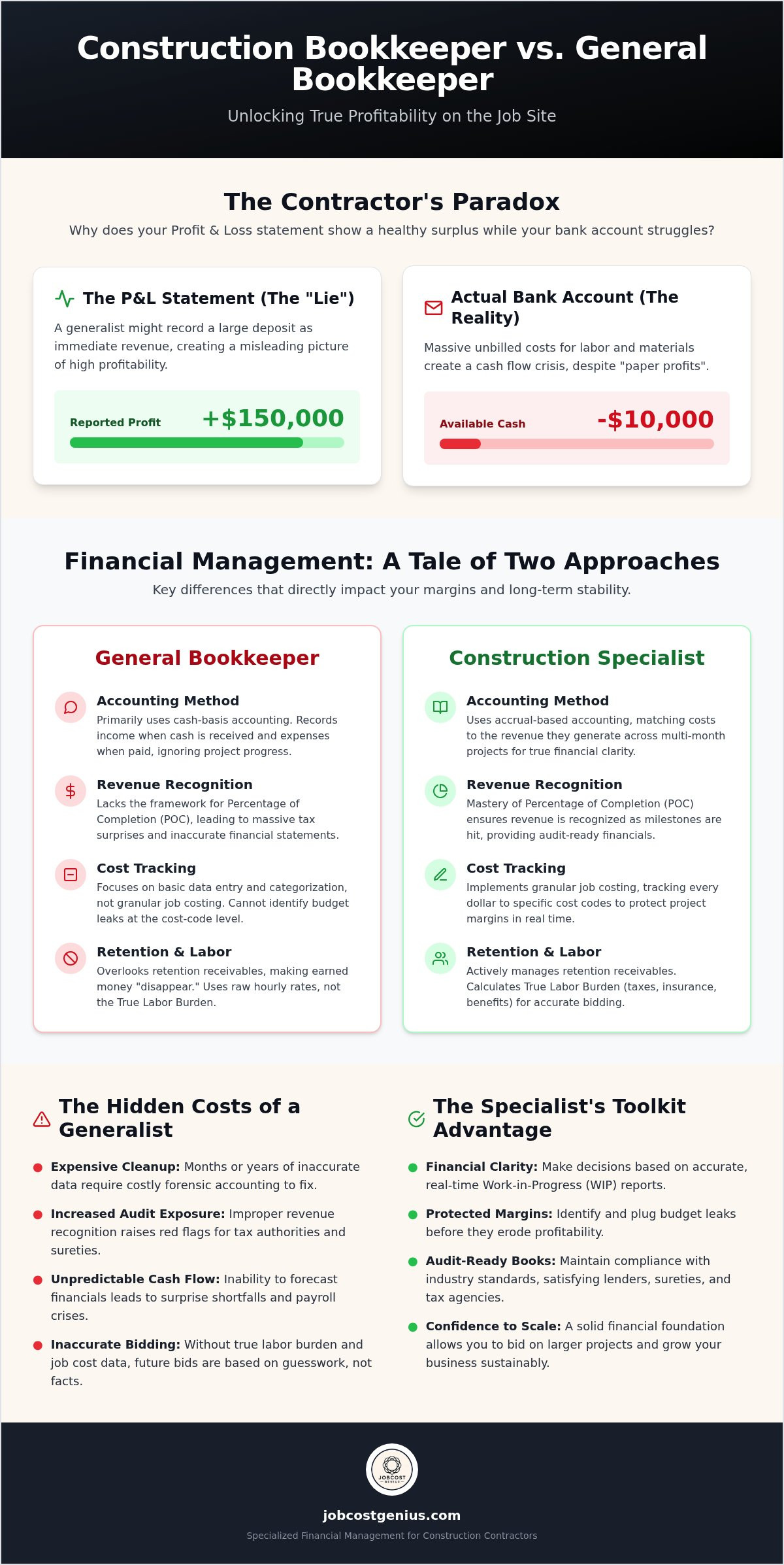
Many contractors fall victim to what we call the "P&L Lie." This happens when your profit and loss statement shows a healthy surplus, yet you are struggling to find the cash for next week's payroll. This disconnect occurs because a generalist might record a large mobilization deposit as immediate revenue while the associated costs haven't hit the books yet. Conversely, you might have incurred massive labor and material costs that haven't been billed to the client. A specialized construction bookkeeper aligns field reality with office data. They ensure your financial statements reflect the actual progress of the work, providing an "organized calm" that allows you to make decisions based on facts rather than a misleading bank balance.
The Concept of Revenue Recognition
The way income is recorded can make or break your business. Generalists often record income only when the check arrives, which is known as cash-basis accounting. This approach is dangerous in construction because it ignores earned revenue that hasn't been invoiced. Specialized Construction accounting relies on more sophisticated methods like the Percentage of Completion (POC) or the Completed Contract method. Using POC ensures that revenue is recognized as you hit project milestones. Without this precision, you risk massive year-end tax surprises. You might find yourself owing taxes on a large deposit for a project that won't even start until the following year.
The Complexity of Multi-Month Projects
Managing costs that span multiple months or years requires a disciplined approach to accruals. Cash-basis accounting fails the modern contractor because it doesn't match costs to the revenue they generated. If you buy $50,000 in steel in October but don't bill the client until January, your October financials will show a massive loss that isn't real. Percentage of Completion (POC) accounting is the industry standard for firms that need to provide accurate financials to sureties or lenders; it's often a requirement for firms exceeding specific revenue thresholds. Choosing a construction bookkeeper vs general bookkeeper ensures your ledger accounts for these timing differences, keeping your financials audit-ready and your cash flow predictable.
The Specialist’s Toolkit: Critical Construction Workflows a Generalist Misses
A generalist sees a ledger; a specialist sees a job site. When weighing the value of a construction bookkeeper vs general bookkeeper, you're choosing between basic data entry and strategic financial management. Generalists typically focus on balancing the books at the end of the month. A construction specialist, however, uses a specific set of tools designed to protect your margins in real time. The primary distinction between a construction bookkeeper vs general bookkeeper is the ability to manage technical workflows that directly impact your ability to bid, build, and grow profitably.
Specialized management involves several critical layers that a generalist might overlook:
- Granular Job Costing: Tracking every nail, labor hour, and subcontractor dollar to specific cost codes. This allows you to identify budget leaks before they drain your profit.
- Retention Management: Ensuring the 5% to 10% held back by owners is tracked as a separate receivable. This prevents earned money from "disappearing" from your financial outlook.
- True Labor Burden: Calculating the full cost of employment, including taxes, workers' comp, and benefits, rather than just using a raw hourly rate.
WIP Reports and Over/Under Billing
WIP (Work in Progress) reporting is the heartbeat of your financial health. It identifies overbilling, which is essentially borrowing from the future, before it creates a cash crisis. Conversely, it highlights underbilling, which forces you to use your own working capital to finance an owner's project. JobCost Genius creates essential visibility into project health by providing monthly WIP updates that align your billings with actual costs incurred. This proactive approach transforms your data into a roadmap for cash flow stability.
Certified Payroll and Compliance
Compliance in this industry is a minefield that requires meticulous record-keeping. Navigating the Davis-Bacon Act or prevailing wage reports is often beyond the scope of a standard bookkeeper. Organizations like the Construction Financial Management Association (CFMA) establish the professional standards for these complex workflows. Specialists manage the nuances of union versus non-union payroll and handle the 1099 compliance for a rotating roster of subcontractors. This expertise ensures your firm remains audit-ready and compliant with state and federal regulations, protecting you from costly penalties.
Financial Accuracy Comparison: Generalist vs. Specialist
Comparing a construction bookkeeper vs general bookkeeper reveals a fundamental difference in technical depth and strategic value. A generalist typically operates with a standard chart of accounts designed for basic overhead and retail-style transactions. They focus on recording what happened in the past to ensure the bank statement matches the ledger. A construction specialist operates like a fractional controller. They provide the foresight required to navigate high-stakes projects and long-term contracts. This distinction becomes clear when you examine how daily tasks are executed within a growing construction firm.
A generalist records transactions; a specialist manages risk. This shift in perspective is what protects your margins from the "death by a thousand cuts" that occurs when small expenses aren't tracked against specific budgets. The specialist doesn't just work for you; they act as a disciplined guardian of your project's financial integrity.
Day-to-Day Workflow Differences
The difference is in the granular details of every transaction. A general bookkeeper might see a receipt from a local hardware store and simply categorize it as a "Supplies" expense. This entry satisfies the bank reconciliation but tells you nothing about which project is actually consuming your capital. A specialist tags that same receipt to Job #204, Phase 03-300. This level of precision is the only way to achieve clean job costing and accurate profit analysis.
Compliance and risk mitigation are another major fork in the road. When a bill arrives from a subcontractor, a generalist simply processes the payment to keep the vendor happy. A construction specialist pauses. They verify that insurance certificates are current and that signed lien waivers are in hand before any funds are released. They don't just reconcile bank statements. They reconcile budget-to-actuals to ensure your estimates were accurate and that your field teams are staying within their projected margins.
Strategic Reporting Capabilities
Strategic insight separates a data entry clerk from a true financial partner. Can your current bookkeeper tell you the "burn rate" on a specific project? Most generalists lack the framework to provide this data. A specialist analyzes your project milestones to forecast cash flow weeks or months in advance. This allows you to spot potential gaps before they threaten your operations or your ability to cover payroll. For those looking to refine their foundational setup, learning about building a construction chart of accounts is a critical next step in achieving financial clarity.
Software knowledge also varies significantly between the two roles. While most generalists are proficient in standard versions of QuickBooks, a specialist understands the nuances of industry-specific platforms or the power of Procore Financials integration. They ensure that field data flows seamlessly into your accounting system without the errors associated with manual double-entry. This integration creates a single source of truth for both your project managers and your office staff, fostering an environment of organized calm.
The Hidden Costs of Hiring a General Bookkeeper
Hiring a generalist might seem like a strategic cost-saving measure on the surface. Lower hourly rates are attractive to a business owner watching every penny. However, the true cost of a construction bookkeeper vs general bookkeeper often surfaces during year-end reviews, tax season, or loan applications. A generalist who doesn't understand the industry can leave a trail of financial wreckage that costs thousands to repair. These "cleanup" projects frequently exceed the annual cost of hiring a specialist from the start, turning a perceived bargain into a significant financial burden.
Beyond the immediate cleanup costs, generalists often miss the subtle profit leaks that happen in the field. When change orders aren't tracked or unbilled extras are forgotten, your project margins shrink. A specialist ensures every dollar spent is accounted for and every earned cent is invoiced. This level of oversight is the difference between a business that merely survives and one that generates consistent, predictable wealth.
Audit and Compliance Risks
Inaccurate record-keeping is a magnet for regulatory scrutiny. General bookkeepers often lack the training to distinguish between employees and independent contractors according to strict industry guidelines. This misclassification can lead to massive back-tax liabilities and penalties from the IRS. Similarly, workers' compensation audits can yield expensive surprises if labor isn't categorized correctly by trade or risk level. Commingling job costs across different projects can lead to disallowed expenses in an audit, as the lack of a clear paper trail makes it impossible to prove the necessity of specific project spending. These errors don't just cost money; they damage your reputation with state agencies and insurance providers.
The Impact on Scaling and Growth
Moving from a "Starter" phase to a "Growth" phase requires a foundation of financial clarity. Banks and bonding companies reject loan applications from contractors with "messy" generalist books because they cannot verify the firm's true financial health. They demand WIP schedules and job costing reports that a standard bookkeeper simply cannot produce. Specialized reporting allows for more competitive and accurate bidding because you finally have a clear picture of your historical performance. You stop guessing at your overhead and start projecting with confidence.
If you're ready to stop the profit leaks and professionalize your back office with a partner who understands your trade, explore how our Growth Plan can stabilize your financial infrastructure and support your next stage of expansion.
Scaling with Confidence: The JobCost Genius Advantage
Deciding between a construction bookkeeper vs general bookkeeper is a pivotal moment for any growing firm. It marks the transition from simply surviving to strategically scaling. JobCost Genius provides the organized calm necessary to manage that growth without losing control of your margins. We don't just record history; we help you build a profitable future. Our team acts as a disciplined guide, ensuring your financial infrastructure is as resilient as the projects you deliver. This specialized oversight transforms administrative overwhelm into a state of financial clarity.
We offer a clear path to becoming a "Genius" contractor through tiered service levels. Whether you're establishing a foundation with our Starter Plan or require the advanced oversight of our Growth or Premium Plan, our services evolve alongside your revenue. This scalability ensures you always have the right level of expertise without overpaying for unnecessary overhead. You gain a partner who understands the high-stakes nature of your industry and is deeply invested in your operational success.
Modern Tech Integration
Manual data entry is a primary source of financial leakage and human error. We eliminate this friction by leveraging Procore Financials Integration and Buildertrend sync. By connecting your field management software directly to your accounting system, we ensure that project managers have real-time visibility into project profitability. You no longer have to wait weeks for a report to see if a job is slipping. We handle the technical heavy lifting of software implementation, creating a seamless field-to-office data flow that saves time and improves accuracy.
Getting Started with Specialized Oversight
Our onboarding process is designed to bring immediate order to your financials. We begin by cleaning up historical data to ensure your starting point is accurate and audit-ready. During the first 90 days, we focus on establishing the workflows that protect your future margins. This includes setting up WIP Reporting and refining your job costing categories. This proactive approach ensures that every project is tracked with meticulous detail from mobilization to closeout.
Transitioning to specialized management is the most effective way to protect your profits and prepare for larger contracts. You deserve a back office that works as hard as your field crews. Ready for financial clarity? Explore our specialized construction bookkeeping plans.
Secure Your Profit Margins with Specialized Financial Oversight
Managing a construction firm requires more than just balancing a checkbook. It requires a deep understanding of long-term contracts, retention, and the nuances of revenue recognition. You've seen how specialized workflows like WIP reporting and granular job costing prevent the "P&L Lie" from draining your cash flow. Choosing between a construction bookkeeper vs general bookkeeper is ultimately a choice between reactive data entry and proactive financial leadership. A specialist doesn't just record what you spent; they track what you've earned relative to your actual project progress.
JobCost Genius offers the expert oversight you need to scale with confidence. With specialized WIP reporting and Procore Financials integration support, we provide the organized calm that allows you to focus on the field. Our tiered plans ensure your back office infrastructure grows with your revenue. You don't have to navigate complex financial cycles alone. Scale Your Firm with Expert Construction Bookkeeping and gain the clarity your business deserves. Your path to a more predictable and profitable operation starts with the right financial partner.
Frequently Asked Questions
Can a general bookkeeper learn construction accounting?
Yes, but it requires significant training in industry-specific standards like the Percentage of Completion method and complex job costing. Most generalists lack the specialized framework needed to handle retention or multi-month accruals correctly. Relying on a generalist to learn on the job often results in expensive reporting errors that hurt your bottom line.
What is the biggest mistake general bookkeepers make in construction?
The most frequent error is recording revenue on a cash basis rather than matching it to actual project progress. This mismatch creates a misleading profit and loss statement that doesn't reflect your true margins. When comparing a construction bookkeeper vs general bookkeeper, the specialist's ability to recognize revenue earned versus cash received is the most critical distinction for tax accuracy.
How much does a specialized construction bookkeeper cost?
Specialized services are priced according to the complexity of your projects and the depth of reporting your firm requires. We offer tiered options including the Starter Plan, Growth Plan, and Premium Plan to fit different stages of business growth. While specialized expertise carries a different price point than basic data entry, it prevents the high-cost cleanup projects caused by generalist mistakes.
Do I need a construction bookkeeper if I use QuickBooks?
QuickBooks is a powerful tool, but it doesn't inherently understand construction logic without expert configuration. A specialist sets up your software to track specific cost codes, retention, and labor burden for every job. Without this professional structure, your software will likely produce inaccurate data that fails to support your bidding or bonding needs.
What is WIP reporting and why is it essential?
WIP (Work in Progress) reporting is a financial schedule that identifies whether you are overbilled or underbilled on your active projects. It's essential because it bridges the gap between your job site reality and your office financials. This reporting allows you to identify profit fade early and ensures your cash flow remains predictable throughout the project lifecycle.
How does specialized bookkeeping help with my bonding capacity?
Sureties and lenders demand high-quality financial statements, including detailed WIP schedules, to verify your firm's stability. Generalists often provide reports that lack the technical depth required by industry underwriters. A specialist ensures your financials are audit-ready and "bankable," which is the primary factor in increasing your bonding capacity and securing larger contracts.
Can JobCost Genius help with my existing Procore setup?
We provide expert Procore Financials Integration support to ensure your field data flows seamlessly into your accounting system. If your current setup is disconnected or producing errors, we can optimize the integration to eliminate manual double-entry. This process provides your project managers with real-time budget visibility while maintaining the integrity of your office books.
What happens if my current books are a mess?
We begin our partnership with a focused cleanup phase to correct historical errors and stabilize your ledger. Our team reconciles project budgets, fixes misclassified expenses, and establishes a clean chart of accounts. This process is designed to move you from administrative overwhelm to a state of organized calm and foundational strength within your first 90 days.


