

Software integration is a high-stakes financial strategy, not just a technical checkbox for your IT department. Most firms invest in Procore to gain clarity, yet their teams remain trapped in a cycle of double data entry and manual reconciliations. It's frustrating to manage project costs when your WIP reports are consistently outdated because field updates haven't reached the office. We understand that this administrative overwhelm is more than a nuisance; it's a direct threat to your project profitability. You deserve a system that works as hard as your field crews do.
This guide demonstrates how professional Procore financials integration services transform fragmented field data into accurate, real-time financial oversight. You'll learn how to establish a single source of truth that automates data flow between the field and the office. We'll also cover how this structured approach leads to clean, audit-ready financial statements and the precise visibility required to scale your business with confidence. By the end of this article, you'll see how a disciplined integration strategy moves your firm from data chaos to organized financial clarity.
Key Takeaways
- Eliminate the high cost of data silos by aligning field teams and office accountants under a single version of project profit.
- Navigate the complexities of bi-directional sync to keep budgets, commitments, and change orders synchronized with your accounting software.
- Understand why professional Procore financials integration services provide the necessary oversight to move beyond basic technical syncs toward true financial integrity.
- Implement a strategic roadmap that defines your system of record and ensures your chart of accounts is compatible for a seamless ERP connection.
- Leverage specialized WIP reporting and expert financial gatekeeping to transform your project data into audit-ready financial statements.
The Real Cost of Financial Data Silos in Construction
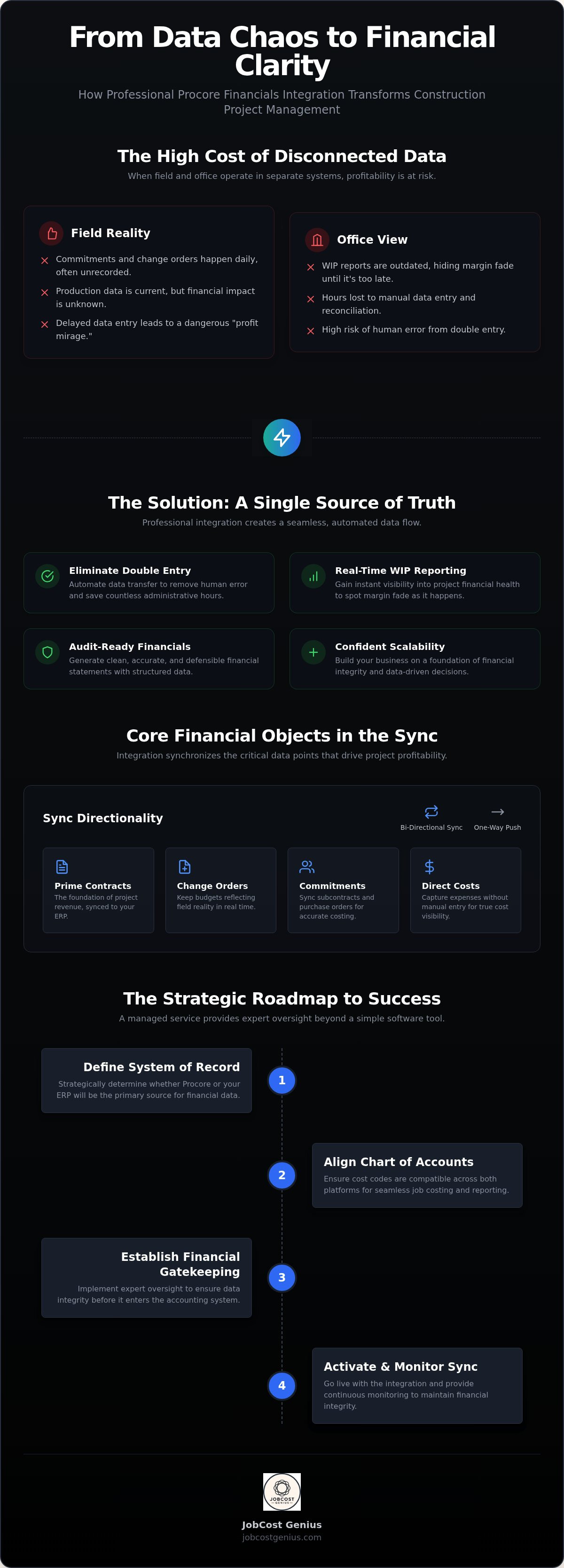
Construction projects move faster than spreadsheets can track manually. When field teams and office accountants operate in silos, they effectively work from two different sets of books. The field sees production and daily logs; the office sees invoices and payroll. Without professional Procore financials integration services, these two perspectives rarely align in real time. This disconnect creates a dangerous "profit mirage." A project might appear healthy on-site, but it could be hemorrhaging cash due to unrecorded commitments or delayed change orders that haven't reached the accounting department.
Double data entry is the primary culprit behind this lag. When an AP clerk has to manually re-enter data from Procore's construction management platform into an ERP, the risk of human error skyrockets. A single transposed digit can ruin a budget. Beyond errors, the sheer volume of labor hours lost to administrative tasks is staggering. This time should be spent on high-value analysis, not clerical duplication. Fragmented data leads directly to delayed WIP reporting for construction companies, making it impossible to spot margin fade until the damage is irreversible.
Fragmented Data and Project Risk
Waiting until the end of the month for financial reports is a recipe for project failure. By the time a report reveals a cost overrun, the opportunity to course-correct has usually passed. Stale data makes change order management nearly impossible. If you aren't tracking field commitments in real time, you're essentially flying blind. Professional Procore financials integration services help create a proactive financial culture. Instead of reacting to past losses, your team can use current data to forecast cash flow and protect your bottom line before expenses spiral out of control.
The Burden of Manual Reconciliation
Administrative overwhelm is a very real threat to your back-office team's morale. Chasing field staff for invoice approvals or missing receipts is a draining, low-value activity. This friction often leads to burnout and high turnover in accounting departments. Generalist bookkeepers often struggle with these software syncs because they don't understand the nuance of construction-specific job costing. They might know how to balance a ledger, but they don't necessarily understand how a field commitment translates to an office liability. Specialized oversight ensures that the technical sync respects the unique rules of construction accounting.
Understanding Procore Financials Integration: What Actually Syncs?
Successful Procore financials integration services rely on more than just a technical connection. It requires a strategic decision between a bi-directional sync and a one-way push. A bi-directional flow ensures that when a Project Manager updates a commitment in the field, it reflects in the ERP; conversely, office-level adjustments flow back to the project team. One-way pushes are often preferred by controllers who want to maintain strict accounting gatekeeping. Choosing the right direction depends on your firm's specific workflow and the complexity of your project portfolio.
Prime Contracts and Change Orders are the backbone of project revenue. When these objects sync effectively, the budget reflects field reality immediately. This prevents the common issue where field teams approve work that hasn't been officially budgeted in the accounting office. Commitments and subcontracts are similarly synchronized to ensure vendor payments match the work performed. Direct costs, such as equipment rentals or material purchases, are captured without manual entry. This level of accuracy is critical, as research indicates the industry faces $15.8 billion in annual interoperability costs due to inadequate data exchange.
Core Financial Objects in the Sync
Estimates created during the pre-construction phase transform into active budgets within your accounting software. This transition is governed by cost codes, which serve as the DNA of your construction chart of accounts. Maintaining this consistency across both platforms is vital for accurate job costing. Our Premium Plan is specifically designed to handle these enterprise-level complexities, providing the technical oversight needed to manage subcontracts and purchase orders across both platforms without data degradation.
The Field-to-Office Invoice Workflow
Automating the approval process for subcontractor invoices removes the manual bottleneck of physical paperwork. When a subcontractor submits an invoice in Procore, the system automatically verifies it against the remaining commitment balance. This digital flow includes lien waiver tracking and compliance verification, which significantly reduces the payment cycle. By integrating AP and AR management, you ensure that every dollar spent is visible and authorized. If you are struggling to maintain this level of detail, specialized integration support can help you bridge the technical gap between your field operations and office accounting.
Software Tool vs. Managed Service: Why Integration Alone Isn’t Enough
A technical connection is only as good as the data it carries. Many firms mistakenly believe that clicking a sync button solves their visibility problems. In reality, a technical sync without professional oversight often just moves bad data faster. This is the "Garbage In, Garbage Out" trap. If a field superintendent selects the wrong cost code on a daily log, that error flows directly into your ERP, distorting your financial reports. Professional Procore financials integration services provide the human oversight necessary to catch these errors before they compromise your general ledger.
Choosing between a software consultant and a construction-specialized financial partner is a critical business decision. A generalist consultant might get the software pipes connected, but they rarely understand the deep accounting implications of a misaligned subcontract or an unmapped cost item. Managed services transform technical features into comprehensive construction business financial oversight. This partnership ensures that your technology serves your bottom line rather than creating more administrative work for your office staff. It turns a software expense into a strategic asset.
The Role of the Financial Gatekeeper
Your Procore environment needs a disciplined gatekeeper to maintain data integrity. This role involves auditing field entries before they are pushed to your accounting software. We focus on standardizing cost code usage across all active projects, ensuring that your reporting remains consistent and comparable. This oversight is especially vital for labor burden and payroll data. Without precise management, syncing labor hours can result in inaccurate job costing that hides the true cost of production. A dedicated expert ensures these numbers align perfectly, every single time.
Beyond the Technical Setup
Integrated data must drive high-level strategic decisions to be truly valuable. It isn't enough to just see the numbers; you need to understand what they mean for your future cash flow and project selection. Generalist firms often fail at this level because they lack the industry knowledge required to manage complex construction tech stacks. They don't understand the nuances of retainage or the impact of pending change orders on a WIP report. Monthly record-keeping paired with specialized software expertise provides the organized calm you need to scale your firm. We act as a reliable guide, turning raw data into professional confidence.
Implementation Roadmap: Setting Up Your Procore ERP Sync for Success
Setting up a seamless data flow requires a disciplined, step-by-step strategy. It isn't enough to simply install a plugin and hope for the best. Professional Procore financials integration services focus on aligning your business logic before the first piece of data ever moves. This methodical approach ensures that your office and field teams speak the same financial language from day one. A successful implementation typically follows a structured five-step progression.
- Step 1: Audit your current chart of accounts for cost code compatibility.
- Step 2: Define your "System of Record" for every financial data point to prevent conflicting updates.
- Step 3: Map Procore cost codes to specific ERP categories for consistent reporting.
- Step 4: Establish strict field-entry protocols and multi-level approval workflows.
- Step 5: Perform a controlled trial sync and reconcile the first month’s statements to verify accuracy.
Phase 1: Pre-Integration Audit
Cleaning up legacy data in your accounting software is a non-negotiable prerequisite. If your current ledger is cluttered with inactive vendors or redundant cost codes, the sync will only amplify that disorder. We identify "problem" cost codes that traditionally cause reporting friction, such as generic "miscellaneous" categories that hide margin fade. This phase also ensures that your accrual accounting for contractors is properly configured. Without this foundational strength, your real-time data will never be truly audit-ready.
Phase 2: Workflow Standardization
Technical settings are only half the battle; your people must be aligned with the new system. Training field staff on the financial impact of their Procore entries is essential for data integrity. Superintendents need to understand that a wrong entry isn't just a typo; it's a potential financial liability. We help you set up automated alerts for budget overruns or unapproved change orders to keep projects on track. Creating a recurring schedule for data reconciliation and WIP review turns your software into a reliable strategic guide. If you're ready to move from administrative overwhelm to financial clarity, our team can guide your Procore implementation strategy today.
How JobCost Genius Optimizes Your Procore Financial Ecosystem
JobCost Genius bridges the gap between software capability and financial reality. While many providers offer a simple technical connection, we provide a comprehensive financial strategy. Our Procore financials integration services ensure that every data point serves your bottom line rather than just populating a spreadsheet. We move beyond the basic "Connect" button to provide the expert oversight needed for true financial integrity. This approach transforms your software from a digital filing cabinet into a powerful engine for project profitability.
Standard Procore templates often lack the specific nuance required for sophisticated construction accounting. We develop customized reporting that provides actionable WIP and cash flow analysis tailored to your firm's unique needs. This directly addresses the common industry pain of inaccurate WIP reports caused by delayed field updates. By syncing field commitments to office AP and AR, we protect your project margins from unexpected fade. Our team ensures that your financial statements are always clean, accurate, and ready for an audit at a moment's notice.
For contractors managing complex or multi-entity tech stacks, our Premium Plan offers the necessary scalability and enterprise-level support. This plan is designed for firms that require rigorous financial oversight across multiple projects and platforms. We provide end-to-end support that includes payroll processing and tax preparation support within your integrated system. This ensures that your financial infrastructure remains robust and compliant as your business grows. You don't have to worry about the technical debt that often comes with scaling a construction firm.
Strategic Financial Oversight
We provide the organized calm necessary to scale a construction business with confidence. Our team handles the technical heavy lifting of AP, AR, and payroll management, which allows your leadership to focus on project execution and business development. Leveraging over 20 years of industry experience, we act as a reliable guide through the complexities of construction-specific job costing. We don't just manage your data; we protect your project margins. This expert-led approach ensures that your field entries are audited before they ever impact your general ledger.
Next Steps for Your Firm
Transitioning from administrative overwhelm to meticulous financial clarity is a strategic choice that pays dividends. Modernizing your legacy systems with professional help reduces the risk of manual errors and increases overall operational efficiency. Now is the time to ensure your technology investments are delivering a tangible return. You deserve a partner who understands the high-stakes nature of the construction industry. Contact JobCost Genius for Procore integration support to bridge the gap between your field data and office accounting today.
Establish Your Financial Foundation
Bridging the gap between field operations and office accounting is a strategic necessity for modern contractors. By eliminating data silos and implementing a disciplined sync roadmap, you protect your margins from the hidden costs of manual reconciliation. You've seen that a technical connection alone isn't enough; it requires the meticulous oversight of a partner who understands construction-specific job costing. Professional Procore financials integration services move your firm beyond administrative overwhelm into a state of organized calm.
JobCost Genius brings over 20 years of industry experience to your tech stack. We provide specialized WIP reporting expertise alongside comprehensive AP/AR and payroll management to ensure your data is always audit-ready. Get Expert Help with Your Procore Financials Integration to transform your project data into a reliable source of truth. You have the tools to build great projects. Now, it's time to build a financial infrastructure that is just as strong and scalable as the structures you build every day.
Frequently Asked Questions
Does Procore Financials work with QuickBooks Online and Desktop?
Yes, Procore Financials supports robust integrations with both QuickBooks Online and QuickBooks Desktop. These connections allow for the seamless transfer of project data, such as commitments and prime contracts, directly into your accounting ledger. Using professional Procore financials integration services ensures that the mapping between your QuickBooks chart of accounts and Procore cost codes remains consistent, preventing the data fragmentation that often plagues manual entry workflows.
How long does a typical Procore financials integration take to implement?
A typical implementation ranges from 30 to 90 days, depending on the complexity of your ERP and the current state of your data. The timeline includes auditing your chart of accounts, mapping cost codes, and establishing approval workflows. Firms with clean legacy data often see faster results, while those requiring extensive data cleanup should plan for a more deliberate, phased approach to ensure long-term stability and reporting accuracy.
Can I sync my existing Sage 300 CRE data with Procore?
Yes, Sage 300 CRE is one of the most robust bi-directional integrations available for the platform. This connection synchronizes critical financial objects like subcontracts, purchase orders, and direct costs between the field and the office. It eliminates the need for double data entry and provides controllers with real-time visibility into job costing. Our team specializes in managing these complex enterprise-level syncs to protect your project margins and ensure data integrity.
What is the most common mistake contractors make during ERP integration?
The most common mistake is failing to clean legacy data before initiating the first sync. Implementing Procore financials integration services without a pre-integration audit often results in a "garbage in, garbage out" scenario where incorrect cost codes or duplicate vendors clutter both systems. You must define a clear system of record for every data point to avoid conflicting updates and maintain the integrity of your financial reporting.
Do I still need a bookkeeper if I have Procore financials integration?
Yes, you still need professional financial oversight to act as a gatekeeper for the integrated data. While the software automates the transfer of information, it doesn't replace the need for auditing field entries or reconciling monthly statements. A construction-specialized financial partner ensures that the technical sync aligns with accounting principles and that your WIP reports remain accurate, actionable, and audit-ready at all times.
Can Procore handle certified payroll and prevailing wage reporting?
Procore tracks the labor hours and worker classifications required for certified payroll, but the actual reporting is typically handled within your integrated ERP or a specialized payroll module. The integration simplifies this process by ensuring that field-captured timecards flow directly into your accounting system with the correct cost codes. This reduces the administrative burden of managing prevailing wage requirements on complex public works projects and improves payroll accuracy.
What happens if data is entered incorrectly in Procore but already synced to the ERP?
If incorrect data syncs to your ERP, you must identify the designated system of record to perform the correction. Most integrations allow you to unlink or void the transaction in the ERP and re-sync the corrected entry from Procore. This emphasizes the importance of established approval workflows; catching errors before the sync prevents the need for manual adjustments and protects the accuracy of your general ledger and financial statements.


