

What if a WIP report is accurate on paper but wrong at the source? Common errors in WIP reporting often start upstream, with job-cost inputs, inconsistent cutoff dates, or estimates that no longer reflect field conditions. When reported job profit doesn’t match what project teams see or what cash flow suggests, the variance can be difficult to explain and even harder to act on.
A WIP report is only as reliable as the costs, billings, and cost-to-complete estimates behind it. This article explains how errors such as missed change orders, inaccurate labor rates, and unreconciled balances can distort WIP results. You’ll also learn a repeatable review process for tracing variances to their source and improving confidence in project forecasts and financial decisions. With accurate records and a disciplined review, WIP reporting becomes a more useful tool for managing project performance.
Key Takeaways
- Use WIP as a connected view of project costs, billings, earned revenue, and estimated completion, not as a standalone profit figure.
- Common errors in WIP reporting can stem from misclassified costs, missing invoices or payroll, and change orders that haven’t made it into the records.
- Separate normal overbilling or underbilling timing differences from mistakes in the underlying costs, billings, or progress estimates.
- Follow a consistent review sequence and trace material variances to source documents before making project decisions.
- Software can improve visibility, but reliable reports also depend on disciplined bookkeeping, accurate cutoff, and reviewed assumptions.
Common errors in WIP reporting and the warning signs contractors should notice
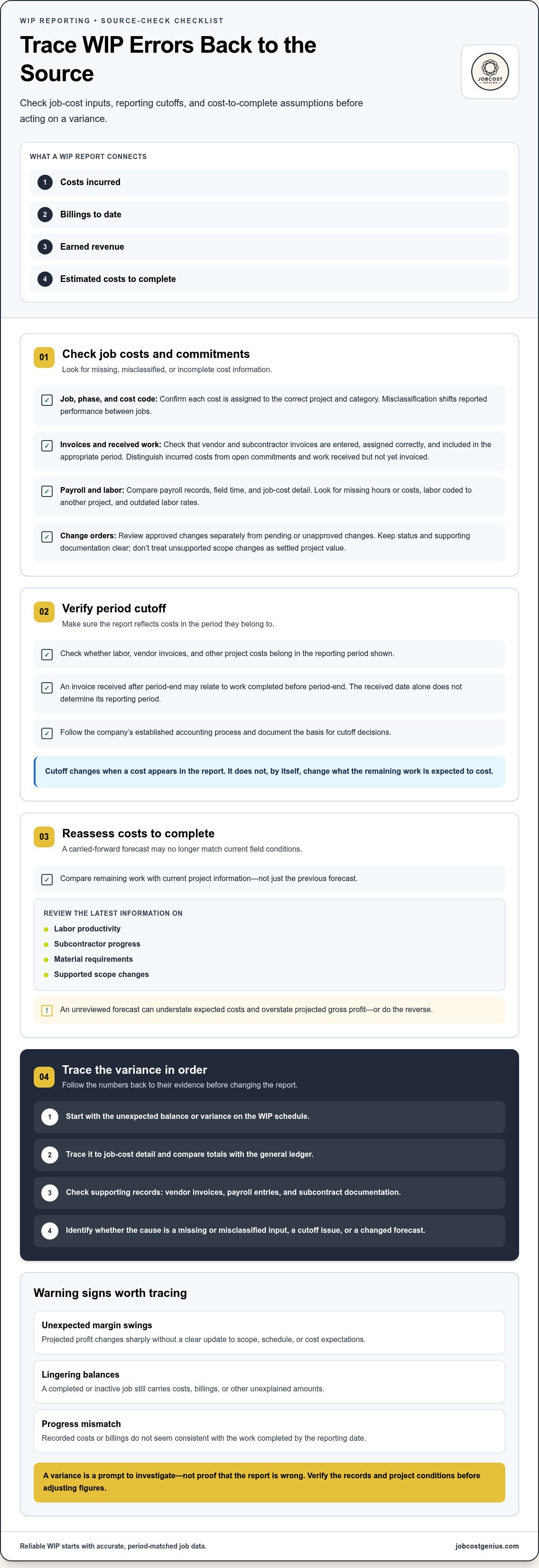
A work-in-progress (WIP) report is a snapshot of active jobs that connects costs incurred, billings to date, earned revenue, and estimated costs to complete. This view helps contractors assess project performance and the work remaining. For a foundational overview of Work in Process (WIP) accounting, see how the concept tracks work that is not yet complete. In construction, the report is only as useful as the job data and assumptions behind it.
Inaccurate inputs can make a profitable job look weak or hide a margin problem until later. They can also distort backlog visibility and decisions about staffing, purchasing, and cash needs. A variance deserves investigation, but it isn’t automatically an error. It may reflect timing, an incorrect input, or a genuine change in project conditions.
What a questionable WIP report looks like
Watch for unexpected changes in estimated costs or gross profit between reporting periods, especially when the project team hasn’t reported a corresponding change. Completed or inactive jobs with unexplained balances also warrant review. So do costs and billings that don’t seem consistent with the work performed by the reporting date. These signs don’t prove the report is wrong, but they point to assumptions or entries worth tracing to their source.
- Margin swings: A job’s projected profit changes sharply without a clear update to scope, schedule, or cost expectations.
- Lingering balances: A finished job still carries costs, billings, or other amounts that haven’t been explained or cleared.
- Progress mismatch: The billing position or recorded costs don’t seem consistent with the work completed by the reporting date.
Why small bookkeeping inconsistencies can mislead
A cost coded to the wrong job, phase, or cost code shifts reported performance between projects. Missing subcontractor invoices or labor entries can leave current job costs incomplete, making a job appear more profitable than the available information supports. Even small items can add up, changing reported margins and obscuring where attention is needed.
WIP reliability depends on accurate, period-matched job data. A report can be internally consistent and still mislead if costs, billings, and estimates reflect different cutoff dates. Treat unexpected variances as a reason to check the underlying records and project conditions, not as proof of a problem or grounds to adjust figures without support. This helps focus review on the issues that can improve financial clarity.
How job-cost inputs, estimates, and cutoff mistakes create WIP errors
A WIP report can only reflect the information feeding it. A cost assigned to the wrong job, phase, or cost code shifts performance between projects. A transaction recorded in the wrong accounting period can also change the apparent cost-to-date and margin at the reporting date. These common errors in WIP reporting often begin with routine entry and review steps, not with the report calculation itself.
Trace an unexpected balance from the WIP schedule to job-cost detail, then to supporting records such as vendor invoices, payroll entries, and subcontract documentation. Compare job-cost totals with the general ledger and investigate differences rather than assuming they are harmless. Also distinguish costs already incurred from open subcontract commitments and work received but not yet invoiced. Whatever method you use to represent commitments, apply it consistently.
Incorrect job costs and incomplete commitments
Review whether subcontract commitments and received work are reflected in the appropriate records. Check whether invoices have been entered, assigned to the right job, and included in the correct period. Review change orders separately: approved scope changes may affect the contract and forecast, while pending or unapproved changes shouldn’t be treated as settled project value without support. Keep each change’s status and source documentation clear so WIP assumptions can be reviewed.
Payroll needs the same attention. If labor hours or costs are missing, coded to another project, or based on outdated rates, reported job costs may not reflect the work performed. Compare payroll records, field time, and job-cost detail to locate gaps before they carry into the next report.
Period cutoff and outdated cost-to-complete estimates
At each reporting date, check whether labor, vendor invoices, and project costs belong in the period shown. An invoice received after period-end may relate to work completed before it; the date received alone doesn’t determine how it should appear. Follow the company’s established accounting process and document the basis for cutoff decisions.
Then reassess estimated costs to complete against current production conditions. Compare the remaining work with the latest project information, including labor productivity, subcontractor progress, material requirements, and supported scope changes. A forecast carried forward without review can understate expected costs and overstate projected gross profit, or do the reverse.
A cutoff issue changes when a cost appears; a changed forecast reflects new information about what the remaining work will require. Identify which applies before adjusting the report. For contractors seeking a consistent process across job-cost records and WIP reporting, construction-focused financial reporting support can bring those review steps together.
Are WIP overbilling and underbilling always reporting errors?
No. Overbilling and underbilling describe the relationship between billings and earned revenue at a reporting date. They don’t, by themselves, prove that the WIP report is wrong or that a project is performing poorly. A billing schedule may call for invoices ahead of or behind the work completed, creating a timing difference that is valid when the underlying figures and assumptions are supported.
Review billing position alongside project progress, contract value, costs to date, and the forecast of remaining costs. Under current construction accounting terminology, billings ahead of earned revenue are generally presented as a contract liability, while earned revenue ahead of billings is generally a contract asset. The appropriate treatment can depend on the applicable accounting guidance and contract facts, so don’t draw conclusions from the label alone.
When a WIP variance may reflect timing
A billing milestone may occur before a project reaches the corresponding level of progress, or work may be performed before the next scheduled invoice. In either case, billing and earned revenue can differ temporarily. Check the WIP reporting date, billing schedule, approved contract information, and transactions recorded after period-end. Later activity can help explain timing, but it doesn’t automatically change what belonged in the report at the original date.
Document the reason for the difference and track it through subsequent reporting. Consistent follow-up helps distinguish a normal billing pattern from a balance that remains unexplained or grows unexpectedly. For a deeper discussion of fixing overbilling on WIP reports, review the billing position alongside the project’s supporting records.
When the variance points to an underlying error
Investigate if the contract value includes unsupported scope, an approved change order is missing, or costs to date don’t agree with job-cost records. Also check whether progress and earned revenue inputs reflect the reporting date and the project’s actual status. A billing imbalance can be a clue, but the root cause may sit in contract data, cost coding, or the forecast rather than in billing itself.
Before changing earned revenue or projected costs, trace the variance to source documentation and confirm the basis for the adjustment. Common errors in WIP reporting can make underbilling appear larger or smaller than it is, affecting project forecasts and management’s view of cash needs. To understand underbilling risks, examine how the billing position relates to progress and the cost forecast, not just the invoice total.
A repeatable review process for catching WIP reporting errors
A consistent review turns an unexplained WIP variance into a question that can be answered and tracked. Work through the report in the same order each close, from the reporting date and contract information to costs, billings, estimates, and reconciliation. For foundational calculations and report interpretation, see this WIP reporting guide for construction.
A practical WIP error-check sequence
Use this sequence to find where the figures stop agreeing. Apply the company’s established accounting method and document assumptions consistently.
- Set the reporting date. Confirm the cutoff and check that job activity, payroll, invoices, and billing data are included in the appropriate period.
- Validate contract information. Compare contract value with supporting documents and identify approved changes separately from pending scope.
- Check costs and billings. Compare job-cost detail and billing records with the general ledger and source documentation. Trace material differences to their origin.
- Review estimates and calculations. Confirm that cost-to-complete estimates reflect current project information, then recalculate key inputs using documented assumptions.
- Compare periods. Look for unusual shifts in margin, costs, or billing position. Ask what changed and whether the movement is supported by project activity or corrected data.
Don’t stop at identifying a variance. For each unresolved item, record an owner, a clear explanation, the corrective action, and a follow-up date. Reconcile WIP totals to accounting records and retain supporting documents for adjustments so the review can be understood and repeated.
Prevent the same reporting errors next period
Set consistent deadlines for field updates, payroll, vendor invoices, and subcontractor information. Use a documented close checklist to show what has been received, reviewed, and still needs follow-up. When you make an adjustment, preserve the evidence and note its effect so it doesn’t become an unexplained change in the next report.
Consistent close procedures make WIP results more comparable from one reporting period to the next. They also make recurring common errors in WIP reporting easier to spot because reviewers can distinguish a genuine project change from a process breakdown. JobCost Genius provides construction-focused WIP reporting support to help organize these reviews and the records behind them. Explore JobCost Genius WIP reporting.
Build more reliable WIP reports with construction-focused financial oversight
Reliable WIP reporting is built on disciplined bookkeeping, timely job-cost records, and estimates reviewed against current project conditions. Software can bring costs and billings into view, but visibility alone won’t catch a miscoded transaction, missed cutoff, or assumption that no longer fits the job. A dependable process validates the information before it informs a management decision.
This matters beyond the report itself. Accurate job data helps owners interpret project performance and understand how WIP connects to cash visibility and planning. For related guidance, explore these construction cash flow management strategies.
What to expect from a construction-focused WIP workflow
A practical workflow reviews job costs, billings, estimates, and supporting records together. It also documents why a variance changed, what information supports the explanation, and whether follow-up is needed. Clear notes help owners and project leaders understand what a report is signaling instead of treating a number as self-explanatory. Consistent monthly bookkeeping gives those reviews a dependable foundation.
Construction-focused WIP reporting support brings project-level information and accounting records into a more consistent process. It gives contractors a structured way to examine variances, maintain useful job-cost visibility, and make financial reports easier to interpret. For more on the reporting foundations behind that process, see this WIP reporting guide for construction.
Turn report concerns into a practical next step
Start by documenting recurring issues. Note which jobs are affected, the source records involved, and whether the cause appears to be coding, timing, incomplete information, or a forecast that needs review. This record helps reveal patterns and gives the next reporting review a clear place to begin. Addressing common errors in WIP reporting is easier when each concern is tied to evidence and an owner for follow-up.
JobCost Genius provides construction-focused bookkeeping and WIP reporting support to help contractors strengthen consistency across project and company financial oversight. If recurring report concerns make job performance harder to interpret, explore construction-focused financial support.
Make WIP reporting a stronger management tool
Reliable WIP reporting starts with dependable job-cost records, consistent cutoff practices, and estimates that reflect current project conditions. Common errors in WIP reporting often trace back to those underlying inputs, so investigate unusual variances against source records before changing a forecast or drawing conclusions about job performance. A repeatable review helps turn unclear differences into practical next steps.
Construction-focused bookkeeping and financial reporting can support that discipline. JobCost Genius provides WIP reporting and Procore Financials integration, backed by professionals with over 20 years of industry experience. These services help contractors build consistency between project information and financial records, giving owners a clearer foundation for decisions.
To strengthen your reporting process, explore JobCost Genius’s construction-focused WIP reporting support. Accurate inputs and a steady review routine give you a clearer basis for project forecasts and ongoing financial oversight.
Frequently Asked Questions
What are the most common errors in WIP reporting?
Common errors include inaccurate cost-to-complete estimates, costs coded to the wrong job or period, missing labor or subcontractor costs, and change orders that aren’t reflected correctly. A WIP report can also be unreliable if its totals don’t reconcile to the general ledger or if billings, costs, and estimates use inconsistent cutoff dates. Review each variance against source records to determine whether it comes from data, timing, or changed project conditions.
How do you know if a WIP report is inaccurate?
Look for unexplained changes in projected gross profit, estimated costs, or job balances between reporting periods. A completed job with a lingering balance, or billings and costs that don’t fit the project’s reported progress, also deserves review. These signs don’t prove the report is wrong. Compare the figures with contract records, job-cost detail, billing data, and current project estimates to identify the cause.
Is overbilling on a WIP report always an error?
No. Overbilling means billings exceed earned revenue at the reporting date, but that difference can result from a billing schedule that gets ahead of project progress. Compare the balance with the contract, billing terms, work performed, and reporting cutoff. If those records support the difference, it may be a timing position rather than a reporting error. Unsupported contract values or incorrect earned-revenue inputs need further investigation.
Can underbilling make a contractor look less profitable?
Underbilling means earned revenue exceeds billings at the reporting date; it doesn’t automatically mean a job is less profitable. Profitability depends on earned revenue and the costs and estimates used in the WIP calculation, not simply on how much has been invoiced. However, inaccurate costs, progress inputs, or contract values can distort both the reported billing position and projected margin. Review those inputs before drawing conclusions about job performance.
How often should contractors review WIP reports?
Review WIP reports on a consistent schedule aligned with the company’s financial close, commonly monthly, and keep the cutoff and review steps consistent each cycle. A major scope change, new cost information, or an unexpected margin movement may warrant attention before the next scheduled review. Regular reviews help identify stale estimates and unresolved variances while project details are still available to explain them.
What should be reconciled before issuing a WIP report?
Reconcile WIP totals to the general ledger and compare job-cost detail with supporting transaction records. Check contract values and approved changes, billings, payroll, vendor and subcontractor costs, reporting cutoff, and current estimates to complete. Investigate differences rather than adjusting figures without support. Keep documentation for corrections and note any variance that needs follow-up, including who owns the next action.
Can accounting software prevent WIP reporting errors?
Software can organize job-cost and billing data, support consistent workflows, and make unusual balances easier to spot. It can’t ensure every transaction is coded to the right job, entered in the correct period, or supported by a current estimate. Those checks still depend on disciplined bookkeeping and review. Integrated financial workflows can help keep project and accounting records aligned, but people must validate the inputs and reporting assumptions.


