

Why does your profit and loss statement show a healthy margin while your bank balance continues to dwindle? This disconnect is the most dangerous blind spot in the industry, and it often leads to a foundation built on false profits. Inaccurate WIP reporting for construction companies is usually the culprit. You've likely felt the frustration of finishing a project only to find that your projected gains vanished into thin air. It's an exhausting cycle that makes securing bonding for larger jobs feel nearly impossible.
Mastering these mechanics is the only way to bridge the gap and gain true financial clarity across every active job. By implementing a disciplined reporting structure, you can transform administrative overwhelm into organized calm and better decision-making data. This guide provides the definitive 2026 framework for accurate project tracking. We'll explore the essential components of Work-In-Progress reporting, how to identify margin erosion early, and the steps you can take to increase your bonding capacity for a more profitable future.
Key Takeaways
- Understand how WIP reporting bridges the gap between cash-based billing and your actual project progress to reveal true profitability.
- Master the mechanics of WIP reporting for construction companies by tracking total contract amounts and estimated costs at completion with surgical precision.
- Identify the silent profit killers of overbilling and underbilling before they drain your cash flow or create unexpected liabilities.
- Standardize your construction chart of accounts and implement rigorous job costing to ensure every labor hour and material invoice is accurately captured.
- Learn why specialized financial oversight provides the organized calm needed to increase your bonding capacity and scale your business with confidence.
What is WIP Reporting for Construction Companies?
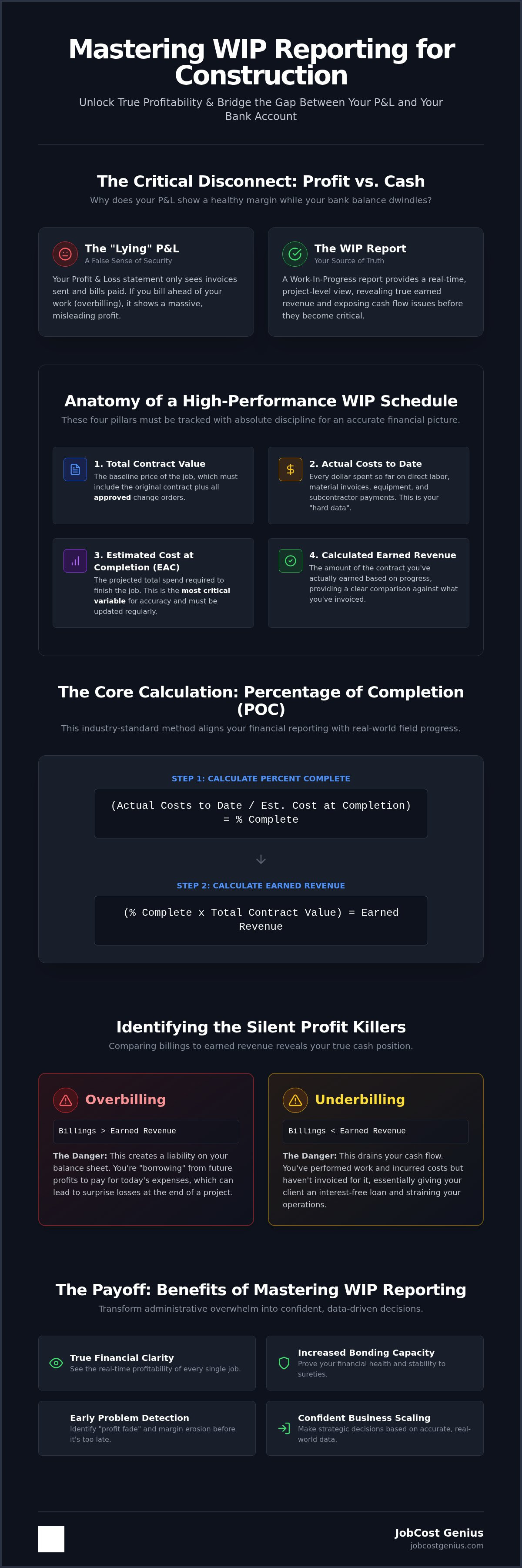
WIP reporting for construction companies is a specialized accounting schedule that serves as the financial pulse of a contracting business. While a general ledger tracks the broad strokes of money moving in and out, a WIP report provides a granular, real-time snapshot of earned revenue versus actual billings for every active project. It acts as a bridge. It connects the cash-based reality of your bank account to the actual percentage of work your crews have completed on the ground. This report is an absolute necessity for any contractor operating under fixed-price or lump-sum contracts. Without it, you're essentially flying blind, relying on guesswork to determine if a project is actually making money.
A high-quality WIP report tracks several critical data points simultaneously:
- Total Contract Value: The current price of the job, including all approved change orders.
- Actual Costs to Date: Every dollar spent on labor, materials, and equipment so far.
- Estimated Costs at Completion: The projected total spend required to finish the job.
- Earned Revenue: The amount of money you've actually earned based on progress, regardless of what you've invoiced.
The Percentage of Completion (POC) Method
Most successful contractors use the Percentage of Completion (POC) method as their industry standard for recognizing revenue. This approach ensures your financial statements reflect the economic reality of your job sites. You calculate this using a straightforward formula: (Actual Costs to Date / Total Estimated Costs) = % Complete. Once you have this percentage, you multiply it by the total contract value to find your earned revenue. POC serves as the mechanism that aligns financial reporting with field progress. It prevents your income from looking artificially high or low simply because of when an invoice was sent or a check was received.
Why a Standard P&L Is Not Enough
Relying solely on a standard Profit and Loss (P&L) statement often creates what industry experts call a "Lying P&L." This happens because a standard P&L only sees the invoices you've sent and the bills you've paid. If you've front-loaded your billing to stay ahead of costs, your P&L will show a massive, healthy profit that doesn't actually exist yet. You're looking at a false sense of security. WIP reporting for construction companies provides the project-level visibility that general bookkeeping lacks. It identifies whether you're truly profitable or just temporarily cash-rich. By comparing your billings to your earned revenue, you can see if you're "borrowing" from future profits to pay for today's expenses, a cycle that leads to surprise losses at the end of a project.
The Anatomy of a High-Performance WIP Schedule
A high-performance WIP schedule is more than just a list of jobs. It's a strategic document that provides a real-time view of your company's financial health. For WIP reporting for construction companies to be effective, every column must work in harmony to reflect the economic reality of the field. If one variable is inaccurate, the entire report loses its value. You must track four primary pillars with absolute discipline to maintain an accurate schedule.
- Total Contract Amount: This is your baseline. It must reflect the original contract plus all approved change orders. Excluding approved changes creates an artificial gap between your billings and your reported revenue.
- Estimated Costs at Completion: This is the most critical variable for accuracy. It's a projection of what the job will cost once the final nail is driven. If your estimators or project managers don't update this regularly, you won't see profit fade until it's too late.
- Actual Costs Incurred to Date: This includes every dollar of direct labor, material invoices, and subcontractor payments processed. It's the "hard data" that fuels the rest of the report.
- Calculated Earned Revenue: This is the output of your progress. It tells you exactly how much of the contract value you've actually earned based on the work performed, providing a clear comparison against what you've invoiced.
Tracking Change Orders and Budget Adjustments
Unapproved change orders are the most common source of distortion in WIP reports. When field teams perform work without a signed change order, you incur costs without an offsetting increase in the contract value. This causes your profit margin to look lower than it actually is. Real-time budget updates are essential to prevent "profit fade," which is the gradual erosion of your margin as a project progresses. Integrating field data directly with your back office ensures your estimates remain grounded in reality. Maintaining this level of detail is a core component of professional WIP reporting services that help contractors stay ahead of potential losses.
WIP and Your Bonding Capacity
Your WIP report is the first thing a surety agent or bank will look at when evaluating your business. They don't just want to see that you're profitable; they want to see that you know why you're profitable. Accurate WIP reporting for construction companies demonstrates "financial character" to underwriters. It shows you have the internal controls necessary to manage complex, long-term projects. Reliable, monthly WIP data builds the trust required to secure larger bonds. This transparency is often the deciding factor when your company bids on large-scale national projects that require significant financial backing. Consistent reporting transforms your accounting from a back-office chore into a powerful tool for growth.
Overbilling vs. Underbilling: Identifying the Silent Profit Killers
Your balance sheet can be deceptive. Many contractors see a high cash balance and assume their projects are thriving. However, WIP reporting for construction companies often reveals a different story through two critical metrics: overbilling and underbilling. These figures represent the difference between what you've invoiced and the work you've actually performed. Understanding this variance is the only way to avoid the silent profit killers that dismantle otherwise successful firms. These aren't just accounting entries; they're operational signals that tell you if you're truly profitable or just temporarily cash-rich.
Overbilling occurs when your billings exceed your costs plus earned profit. While this puts extra cash in your bank account, it's technically a liability on your balance sheet. You owe the project that work. The danger arises when a contractor falls into the "Cash Trap." This happens when you use the cash from an overbilled project to cover the expenses of a struggling job or general overhead. You're effectively borrowing from your future self. When the overbilled project reaches its final stages, the cash is gone, but the labor and material requirements remain. This leads to a frantic search for the next job just to stay afloat, creating a house of cards that eventually collapses.
Conversely, underbilling signifies that you've incurred costs but haven't yet invoiced the client. This is a cash flow danger zone. It means you're acting as a bank for your customers, interest-free. While some underbilling is inevitable due to specific billing cycles, chronic underbilling usually points to deeper operational issues like unrecorded costs or missed billing opportunities. It drains your working capital and limits your ability to take on new work.
Fixing Overbilling on WIP Reports
To manage overbilling effectively, you must first determine its cause. Strategic overbilling is a common practice used to maintain positive cash flow, but it requires disciplined oversight to ensure those funds aren't mismanaged. Accidental overbilling, however, often stems from poor estimating or front-loading without a clear plan. Reconciling your billing cycles with specific project milestones ensures your financial data remains accurate. For more foundational advice, consult our 2026 Construction Accounting Guide for Small Firms to align your internal processes with industry standards.
The Risks of Underbilling
Underbilling drains your working capital and slows your ability to scale. It often occurs because of a disconnect between the field and the office. Project managers might feel they're "too busy in the field" to track every penny, but this lack of documentation leads to significant revenue leakage. If you don't record a cost, you can't bill for it. Addressing this requires a cultural shift where field reporting is viewed as being just as critical as the actual construction work. Without this data, you're leaving earned money on the table and putting your company's financial future at risk.
Implementing WIP Reporting: Software and Workflows
Effective WIP reporting for construction companies relies on a foundation of clean data. Software is only a tool; it won't fix broken internal processes. You need a disciplined workflow to ensure the numbers you're analyzing reflect reality. This begins with a structured approach to how your team handles every financial transaction and project update. Without this discipline, your reports will always be one step behind the field, leaving you vulnerable to surprise losses.
- Step 1: Standardize your Construction Chart of Accounts. Use a structure that mirrors your project types and cost codes to ensure consistency across all jobs.
- Step 2: Implement rigorous job costing for every labor hour and material invoice. Costs must be assigned to the correct project and cost code immediately to maintain report accuracy.
- Step 3: Sync field project management with accounting software. Real-time data sharing eliminates the lag between field activity and financial reporting.
- Step 4: Conduct monthly "WIP Review" meetings. Project managers and accounting staff must sit down together to verify percent-complete estimates and identify potential budget overruns.
Procore Financials Integration
Syncing your field project management with your back office is the most effective way to eliminate manual entry errors. A specialized Procore Financials Integration ensures that when a project manager approves a change order or a subcontractor invoice in the field, it flows directly into your WIP schedule. This real-time visibility allows you to capture cost data as it happens, rather than waiting for month-end reports. Working with an integration specialist helps you set up these workflows correctly from the start, preventing the "garbage in, garbage out" cycle that plagues so many growing firms.
Avoiding Common WIP Report Mistakes
The most dangerous mistake a contractor can make is "plugging" numbers to make a job look better. This artificial padding hides profit fade and delays the corrective action needed to save a project. Inconsistent reporting periods also render your data useless, as you can't compare performance across different jobs if the timeframes don't align. You should never run a WIP report without first reconciling your bank accounts to ensure every expense is accounted for. Accurate WIP reporting for construction companies requires this level of foundational strength to provide the organized calm needed for strategic growth.
Scaling with Confidence: The JobCost Genius Advantage
A generalist bookkeeper might keep your bank accounts reconciled, but they often struggle to interpret a complex construction schedule. WIP reporting for construction companies requires a deep understanding of job costing, labor burden, and percentage-of-completion accounting. JobCost Genius bridges this gap by providing specialized expertise that generalists simply can't match. We don't just record transactions; we transform raw financial data into strategic oversight that helps you bid more accurately and secure higher bonding limits. Our process is designed to replace your administrative overwhelm with organized calm, ensuring you always know where your profit stands before the project ends.
Tailored Plans for Every Growth Stage
Every contracting firm has unique needs based on their project volume and team size. Our Starter Plan focuses on establishing a strong financial foundation for newer contractors who need to get their books in order. As you scale, our Growth Plan and Premium Plan offer more advanced reporting and specialized technology integrations, such as Procore Financials. We include WIP reporting as a core feature of our Monthly Bookkeeping Subscription because we believe project-level visibility is essential for every contractor. This tiered approach allows you to access professional-grade financial management at a pace that matches your company's growth trajectory.
Expert Oversight vs. Automated Guesses
Software can automate data entry, but it can't replace the judgment of a seasoned professional. With over 20 years of industry experience, our team reviews your reports to catch the subtle signs of "profit fade" before they impact your bottom line. We look beyond the numbers to understand the operational story they tell, identifying when estimated costs at completion are drifting from reality. This expert oversight ensures your WIP reports are more than just compliance documents; they're strategic decision-making tools. If you're ready for financial clarity, our team is prepared to help you master WIP reporting for construction companies and secure your company's future. We act as a reliable guide, positioning your business as a disciplined, forward-thinking leader in your specific field.
Build Your Business on a Foundation of Financial Clarity
Mastering the mechanics of your financial data is the most direct path to sustainable growth. You've seen how moving beyond a standard P&L to a high-performance schedule reveals the true profitability of every active job. By identifying silent profit killers like chronic underbilling and accidental overbilling, you protect your cash flow and increase your bonding capacity. Implementing accurate WIP reporting for construction companies isn't just about compliance; it's about gaining the strategic foresight needed to bid with absolute confidence. This discipline transforms administrative overwhelm into the organized calm required to lead a scaling firm.
You don't have to manage these complex workflows alone. JobCost Genius provides the professional oversight you need with tiered plans starting at $800/month. As Procore Financials Integration Specialists with over 20 years of industry experience, we ensure your field data and back office stay perfectly in sync. Stop guessing and start growing with specialized WIP reporting from JobCost Genius. Building on a foundation of professional financial clarity ensures your company remains strong, profitable, and ready for the next big project.
Frequently Asked Questions
How often should a construction company run a WIP report?
You should run a WIP report at least once a month to coincide with your financial close. For high-volume firms or those experiencing rapid growth, reviewing these reports bi-weekly provides a much tighter grip on project margins. Consistency is vital because surety agents and banks look for regular, predictable reporting cycles when evaluating your company's financial health.
What is the difference between a WIP report and a P&L statement?
A standard P&L statement only tracks cash moving in and out based on your billing and expense cycles. In contrast, a WIP report reflects the economic reality of your jobs by showing earned revenue based on the actual percentage of work completed. It bridges the gap between what you've invoiced and what your crews have actually finished on the ground.
Can I generate a WIP report in QuickBooks Online?
QuickBooks Online doesn't natively generate a specialized construction WIP schedule. While it tracks basic income and expenses, it lacks the logic to calculate percentage-of-completion or earned revenue automatically. Most contractors must export their data to a spreadsheet or use a specialized integration to create an accurate WIP reporting for construction companies.
How does WIP reporting affect my bonding capacity?
Surety underwriters view your WIP report as a primary indicator of your financial character and internal management strength. Accurate reporting proves you understand your costs and can identify potential losses before they become catastrophic. Reliable, monthly reports build the trust necessary for underwriters to approve larger bonds for national or public projects.
What is profit fade and how does WIP reporting prevent it?
Profit fade is the gradual erosion of your projected gross profit as a project moves toward completion. WIP reporting identifies this trend early by comparing your actual costs to date against updated estimates at completion. This visibility allows you to address field inefficiencies or material cost overruns before they permanently damage your bottom line.
Do I need a specialized construction bookkeeper for WIP reporting?
Yes, because generalist bookkeepers often lack the technical knowledge required for job costing and percentage-of-completion accounting. A specialist understands how to allocate labor burden and material invoices correctly across multiple projects. This specialized oversight is what transforms raw data into the organized calm needed for strategic business decisions.
What should I do if my WIP report shows significant underbilling?
Significant underbilling means you're acting as an interest-free bank for your customers. You should immediately review your project milestones and check for unrecorded costs or missed billing opportunities. Reconciling your field data with your accounting office ensures that every dollar spent on the job site is promptly invoiced to the client.
How do change orders impact my WIP schedule?
Change orders directly affect both your total contract value and your estimated costs at completion. If you incur costs for a change order before it's officially approved and added to the contract, your profit margin will look artificially low. Accurate WIP reporting for construction companies requires real-time updates to ensure your contract values always match the work performed.


