

What if the hours recorded at a jobsite don’t match the wages, deductions, or certified payroll report tied to the project? Construction industry payroll compliance depends on keeping those details aligned, even as worker classifications, work locations, contracts, and pay arrangements change. When field time and payroll don’t match, tracing and correcting the gap can take time.
Accurate construction payroll takes more than paying employees on schedule. It calls for reliable timekeeping, clear documentation, careful review of applicable requirements, and consistent approvals across projects and crews.
This guide explains the payroll compliance areas construction firms should review in 2026, from worker classification and wage requirements to tax withholding and certified payroll records. It also covers practical workflows for capturing and approving hours, maintaining payroll documentation, and connecting labor costs to project-level financial reporting. Construction-focused payroll management and organized financial records can give firms greater clarity and control over these responsibilities.
Key Takeaways
- Construction industry payroll compliance depends on the worker, project, contract, and location. Identify which requirements apply before processing payroll.
- Review federal wage-and-hour rules alongside applicable state, local, and contract-specific requirements. Don’t assume one standard covers every job.
- Use detailed timecards, job coding, and supervisor approvals to catch discrepancies before they affect payroll or labor tracking.
- Assign clear ownership for project setup, time submission, payroll review, reconciliation, and resolving exceptions.
- Connect construction-focused payroll processing with bookkeeping and financial reporting to support organized records and project cost visibility.
What Construction Industry Payroll Compliance Covers, and Why It Varies
Construction industry payroll compliance means meeting the wage, hour, tax, worker-classification, and reporting requirements that apply to a particular employer, worker, project, contract, and jurisdiction. Requirements can differ between jobs and crews. For example, a covered public project may have obligations that don’t apply to a private job with different contract terms.
Payroll administration puts applicable requirements into practice by organizing time, calculating pay, managing withholding, and maintaining payroll records. It supports a consistent process, but it isn’t legal advice or income tax-return preparation. When a rule’s application is uncertain, use current official guidance or consult qualified legal and tax professionals.
Which payroll rule categories can affect a construction employer?
Review four connected areas: wage-and-hour rules, tax withholding, worker classification, and required payroll records. Each affects how workers are paid and what the business needs to document. Classification deserves particular attention because treating an employee as an independent contractor can change which payroll obligations apply.
Contracts can add requirements. Prevailing-wage and certified-payroll obligations apply when triggered by a covered contract and governing law, not automatically to every construction job. For background on the concept, see this overview of prevailing wage laws. Union agreements may also establish wage rates, benefits, deductions, or reporting expectations that payroll processes need to reflect. Review the contract and applicable agreement to identify project requirements.
Why does construction payroll differ from office payroll?
Construction work moves between jobsites. An employee may work at different locations, and crossing jurisdictional boundaries can affect which state or local requirements need review. Keep a reliable record of where work took place rather than using the company’s office location as a proxy for an employee’s workweek.
Labor can also shift between projects and pay classifications within a pay period. A worker’s hours may need to be allocated among jobs, and the applicable rate or reporting treatment may depend on the work performed and contract terms. A timecard that shows only total hours doesn’t provide enough detail to verify those distinctions.
Use field time as the starting point for payroll and project labor reporting. Record enough detail to identify the worker, work period, project, and relevant classification, then route the timecard for review. For example, if an employee splits a shift between projects, record the hours for each job separately and have a supervisor verify the allocation. Consistent coding helps payroll teams process pay accurately and gives project financial records a clearer view of labor costs. It also makes discrepancies easier to trace before they flow into payroll or reporting.
Which Federal, State, and Contract Rules Should Contractors Review?
Review requirements at the project level instead of assuming one set of rules applies across the company. The Fair Labor Standards Act (FLSA) provides a federal framework for minimum wage, overtime, and recordkeeping, but coverage and specific requirements depend on the employer and workers. State and local laws may add requirements or set different standards for matters such as minimum wage and leave. A crew working across jurisdictional lines may need a different payroll review from a crew working on a job in one jurisdiction.
General payroll duties apply according to the employer and worker; contract-specific wage and reporting duties apply only when the project’s contract and governing law trigger them. This distinction helps contractors separate recurring payroll controls from requirements tied to a particular job.
How do wage, hour, and tax requirements fit together?
Review wage rates, overtime treatment, time records, and payroll withholding as connected but distinct responsibilities. Accurate hours support wage calculations and required records, while withholding and related payroll tax obligations follow separate federal rules. The U.S. Department of Labor (DOL) publishes federal wage-and-hour guidance, and the Internal Revenue Service (IRS) provides guidance on federal employment taxes.
Coverage tests and current rules matter. Before setting payroll procedures, verify applicable thresholds, deadlines, exemptions, deposit schedules, and record-retention requirements against current official guidance. Review state and local requirements for each jurisdiction where employees work as well. Don’t rely on an old payroll calendar or a policy built for a different job location.
When might prevailing wage or certified payroll apply?
Federal construction work may carry additional wage and reporting duties when the governing law and contract provisions apply. The Davis-Bacon Act and Related Acts address prevailing-wage requirements on covered federally funded or assisted construction projects. The Contract Work Hours and Safety Standards Act (CWHSSA) may also apply to certain federal or federally assisted contracts. Applicability depends on the project and contract, so review the actual contract terms and current DOL guidance rather than treating these requirements as universal.
The DOL’s overview of the Davis-Bacon and Related Acts is a useful starting point for understanding federal construction requirements. For a closer look at contract-driven wage and reporting processes, see this prevailing wage payroll guide. Review current forms, submission schedules, and project-specific obligations before building them into payroll procedures.
For firms coordinating payroll with broader construction bookkeeping, construction payroll and financial reporting support can help connect payroll administration with organized financial records.
Where Construction Payroll Errors Happen, and What They Can Affect
Payroll problems often start with small process gaps: a missing time entry, an incorrect job code, or an approval that never reaches payroll. These issues can affect more than a paycheck. Incorrect hours or classifications may lead to inaccurate wage calculations, while miscoded labor can make project cost reports less reliable. Treat exceptions as reasons to investigate, not as proof of a specific legal violation or outcome.
How can timekeeping and job coding create payroll problems?
Field records are harder to reconcile when workers miss punches, submit time late, or split hours across jobs. Unclear supervisor approvals also make it difficult to know whether a timecard is complete and ready to process. Before payroll closes, compare submitted hours with the pay period, project assignments, and approved adjustments. Resolve gaps while workers and supervisors can still clarify the details.
Job coding matters, too. If hours worked on one project are assigned to another, the employee’s total hours may still appear correct on payroll while project labor reports show costs in the wrong place. When an employee performs work under different pay classifications, the records should identify the hours and applicable classification for review. The guide to construction payroll from Independent Electrical Contractors offers additional industry context on issues such as multiple pay rates and job costing.
Worker classification and deductions also need case-specific review. A label alone doesn’t determine whether someone is an employee or an independent contractor, and a deduction shouldn’t be assumed valid just because it appeared in a prior pay run. Document the basis for payroll treatment and seek appropriate professional guidance when a case is unclear. Don’t assume a discrepancy automatically triggers a specific penalty. Consequences depend on the facts and applicable rules.
What records help demonstrate a consistent payroll process?
Keep records organized so each payroll result can be traced to its inputs and approvals. Depending on the work and applicable requirements, records may include:
- Submitted time records, corrections, and supervisor approvals.
- Wage calculations, pay classifications, deductions, and payment records.
- Payroll tax documentation and records supporting withholding.
- Required project or contract reports, such as certified payroll when applicable.
Retention periods vary by record type and governing rule, so verify current requirements rather than applying one timeline to every file. A consistent filing structure helps staff retrieve support for a payroll entry and trace its connection to project reporting. For broader financial recordkeeping practices, see this construction accounting guide. Strong records support construction industry payroll compliance by making review and reconciliation more dependable.
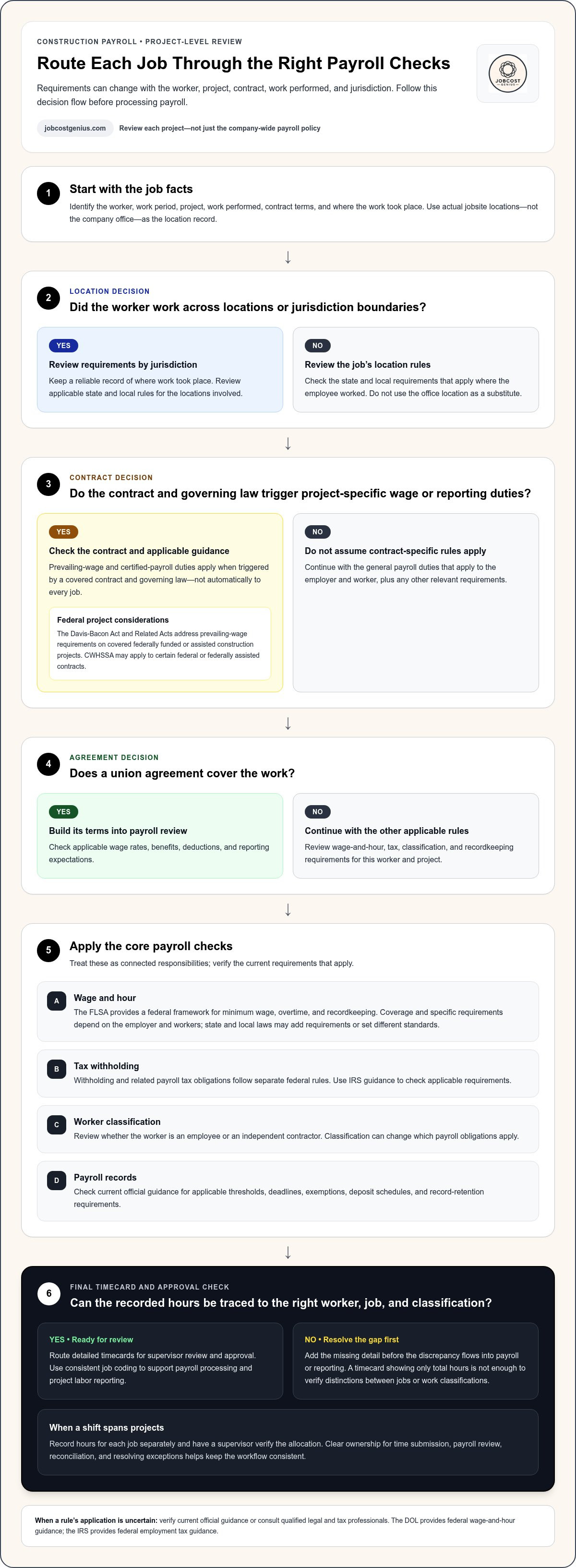
How to Build a Repeatable Construction Payroll Compliance Workflow
A reliable workflow makes responsibilities clear before payroll deadlines arrive. It creates a consistent trail from project setup to employee payment and project reporting. Assign an owner to each handoff, and define how corrections and exceptions move through the process.
What should happen before the first payroll on a project?
Set up project and worker records before hours begin accumulating. Use secure, consistently maintained records, and document the details payroll staff need to apply the right treatment. Confirm applicable wage determinations, agreements, and contract reporting obligations for the project, then assign responsibility for each step.
- Set up the project. Record project codes, work locations, relevant contract requirements, and any applicable wage classifications or reporting rules.
- Maintain worker and pay details. Keep worker information, pay rates, classifications, and authorized deductions organized and current.
- Define responsibilities. Workers submit time; supervisors review and approve it; payroll administrators process approved records; a designated manager resolves exceptions and authorizes corrections.
Make each handoff clear. Set a submission deadline and explain how workers or supervisors should flag an incorrect project code or missing time entry. A documented correction process helps prevent informal changes from reaching payroll without review.
What should payroll administrators review each pay cycle?
Follow the same review sequence each cycle. First, compare submitted and approved hours with the pay period and project assignments. Then verify applicable rates and classifications, overtime calculations, deductions, and payroll output. Investigate missing records, unusual hours, and discrepancies before finalizing payroll. Document how each exception was resolved so the decision can be traced later.
After processing, reconcile payroll totals with accounting records and labor costs assigned to projects. Look for differences between approved time, payroll expense, and project-level labor reporting. A variance may reflect a timing issue, coding error, or correction that needs documentation. Regular reconciliation supports construction industry payroll compliance and makes project financial records more dependable.
To connect labor costs with broader project performance, review this WIP reporting guide. Construction-focused payroll processing and financial reporting can also help connect payroll administration with project records. Learn about construction payroll and financial reporting support for your back-office workflow.
How Construction-Focused Payroll Support Strengthens Financial Control
Payroll is more than a recurring administrative task. For contractors, it connects employee payments and withholding management with labor tracking, bookkeeping, and project financial records. When these activities follow a consistent process, decision-makers can better understand payroll activity and how labor costs are recorded across the business.
What should a construction payroll support process help organize?
A dependable process organizes core payroll information from time submission through payment and reconciliation. That includes processing employee payments, managing payroll withholding, maintaining payroll records, and following up on exceptions such as missing time or corrections. Clear records make it easier to understand how payroll figures were calculated and connect them with the right project in the books.
Consistent labor data also supports project cost visibility. When hours and payroll costs are recorded against the appropriate project, monthly bookkeeping and financial reporting can reflect labor activity more clearly. This gives contractors a stronger basis for reviewing project performance and financial records, without treating payroll data as a substitute for the broader review each project requires.
Construction-focused payroll management can help organize recurring tasks for teams of different sizes and operating complexities. JobCost Genius provides payroll processing alongside bookkeeping and financial reporting, drawing on more than 20 years of industry experience. This support can strengthen back-office administration, but it doesn’t replace legal advice or income tax filing. Contractors remain responsible for understanding which rules apply to their workforce and projects, using current official guidance and qualified professional advice where needed.
How can contractors take the next step?
Start by mapping your current process: who submits time, who approves it, who reviews payroll, and who resolves exceptions. Then trace how payroll information reaches bookkeeping and project reporting. This review can reveal handoff gaps and show where responsibilities or records need clarification.
Consistent payroll management creates a more organized foundation for financial oversight. JobCost Genius connects payroll processing with bookkeeping and financial reporting to help construction businesses keep these recurring financial tasks organized.
Make Payroll Accuracy Part of Project Control
Construction industry payroll compliance is easier to manage when project requirements, worker records, approved time, and payroll reviews follow a consistent process. Because requirements can differ by jurisdiction and contract, build in regular checks and keep payroll documentation connected to project financial records.
Clarify who submits time, who approves it, and who reviews payroll exceptions. Then reconcile payroll totals with labor costs so financial reports reflect how work is assigned across projects. These practices help organize the back office without treating payroll administration as a substitute for legal advice or income tax filing.
JobCost Genius provides construction-focused payroll management tailored to teams of varying sizes and operating complexities, along with bookkeeping and financial reporting. Explore JobCost Genius construction payroll and bookkeeping support to connect these services with your financial workflow.
Frequently Asked Questions
What does construction industry payroll compliance include?
Construction industry payroll compliance includes meeting the wage, hour, tax withholding, worker-classification, recordkeeping, and reporting requirements that apply to the employer and work performed. Contractors should review applicable federal, state, and local rules, along with contract or union agreement terms. Practical controls include recording time accurately, confirming pay rates and classifications, reviewing deductions, maintaining payroll documentation, and submitting project reports when required. Exact requirements depend on the workforce and job.
Do construction companies have to follow prevailing wage requirements?
Construction companies must follow prevailing-wage requirements when applicable law and the project contract make them applicable. Some federally funded or assisted construction work may carry prevailing-wage and certified-payroll obligations, while state or local projects can have separate rules. Don’t assume every public or private project has the same requirements. Review contract provisions and current official guidance to identify applicable wage determinations, worker classifications, reporting expectations, and submission schedules before payroll begins.
How often should a construction company review payroll compliance?
Review payroll at every pay cycle, and reassess requirements when a project, contract, work location, pay arrangement, or workforce changes. Each cycle, compare approved time with rates, classifications, deductions, and payroll output; investigate exceptions before finalizing payments. A broader scheduled review can also check whether records, responsibilities, and procedures remain current. The frequency of any formal review should fit the business’s operations and applicable obligations rather than rely on one calendar for every contractor.
What payroll records should construction contractors keep?
Keep records that show how hours were submitted and approved, how wages and deductions were calculated, and how employees were paid. Depending on the work and applicable requirements, records may also include withholding documentation, worker and pay details, correction approvals, and required contract reports such as certified payroll. Store records so each payroll entry can be traced to its supporting information. Retention periods differ by record type and rule, so verify current requirements before setting a retention schedule.
How do contractors handle payroll for employees working on multiple jobs?
Record hours by project and work period, not just as a single total for the employee. Have workers identify where time was spent, and ask supervisors to review project coding and any applicable pay classifications before payroll processing. Then reconcile approved project hours with the employee’s total hours and payroll output. Clear allocation helps administrators review pay accurately and gives bookkeeping and project reports a more dependable view of labor assigned to each job.
Are construction workers employees or independent contractors for payroll purposes?
A worker’s status depends on the facts of the working relationship and applicable classification rules, not simply the title in a contract or payment arrangement. Misclassification can affect payroll withholding, wage obligations, and required records. Review each relationship carefully and document the basis for the classification. Because different agencies may apply different tests and the details matter, seek qualified legal or tax guidance for uncertain cases rather than relying on a label or general rule of thumb.
What is certified payroll reporting in construction?
Certified payroll reporting is project-specific documentation used on certain covered construction contracts to report worker, hours, wage, and related payroll information. It helps show whether payment aligns with the contract’s applicable requirements. The contract and governing rules determine whether reporting is required, which format to use, what information to include, and when to submit it. Review those instructions before work starts and retain the supporting time and payroll records used to prepare each report.


