

A receivable balance without a clear job behind it is hard to act on. Managing construction accounts receivable means connecting each billing to its contract, tracking retainage and exceptions, and knowing what follow-up is due. When those details are spread across spreadsheets, project files, and accounting records, delays and rejected payment applications can disrupt expected cash flow.
Accurate billing is only the first step. You also need a repeatable process for following up, applying cash to the right job, and reconciling balances so project and financial records stay aligned. Keeping that process consistent can be difficult when collection tasks compete with project work and other administrative responsibilities.
This guide explains how to build a dependable, job-level accounts receivable workflow. You’ll learn how to prepare well-supported customer billings, organize aging balances, retainage, and billing exceptions by job, and establish clear routines for follow-up, cash application, and reconciliation. It also explains how consistent bookkeeping and WIP reporting connect receivables to broader project financial visibility, giving you a clearer view of what’s billed, what’s outstanding, and what needs attention next.
Key Takeaways
- Track billed, collected, outstanding, and retained amounts by customer and job to make receivable balances easier to interpret.
- Connect contract terms, approved changes, supporting documents, and payment application details before submitting a bill.
- Use AR aging alongside invoice status, approval records, and dispute notes to identify which balances need attention.
- Make managing construction accounts receivable more consistent by assigning ownership for billing, follow-up, receipt posting, and reconciliation.
- Keep bookkeeping records aligned with project financials, and use WIP reporting to add context to receivables visibility.
What managing construction accounts receivable means for each job
Construction accounts receivable is the job-by-job record of amounts a contractor has billed customers, collected, still expects to collect, and retained under contract terms. It connects each open balance to the customer and project it belongs to, giving the team a clearer view of what has been earned, invoiced, received, or held back. The general concept of Accounts receivable (AR) is money customers owe for goods or services already provided. In construction, contract billing structures and project records add important detail.
Managing construction accounts receivable supports cash visibility, but it can’t guarantee when a customer will pay. Its value is knowing which amounts are outstanding, what they relate to, and whether a billing or documentation issue needs attention.
How construction receivables differ from a simple invoice list
A construction invoice often reflects more than a single sale. Contracts define the scope and billing conditions; schedules of values break contract amounts into billable components; approved changes may adjust the amount or scope; and billing periods determine when work is submitted for payment. Keep customer, contract, project, and invoice identifiers connected so each balance can be traced to its source. Contract terms and applicable requirements govern billing and payment conditions, so use them to review what is due and when.
An invoice records a request for payment. An application for payment presents a progress billing for review under the project’s process. A receivable balance is the amount recorded as owed after billing, while a cash receipt is a customer payment that must be applied to the appropriate invoice or job. Treat these as separate but connected records. This makes it easier to spot an application that hasn’t yet become an approved invoice or a payment that hasn’t been matched correctly.
Which balances should contractors monitor by job?
Separate billed, unpaid amounts from completed work that hasn’t been billed yet. The first is recorded AR; the second is potential billing that may still need preparation and submission. Combining them can blur the difference between money already invoiced and work not yet included in a billing.
Track retainage separately and link it to the relevant contract and billing record. This keeps withheld amounts visible without mixing them into currently collectible balances. Review the job’s billed and unpaid amounts, unbilled work, and retainage together to understand its receivable position. For broader context on how job financial records fit into construction bookkeeping, see this construction accounting guide.
How construction billing, payment applications, and cash application fit together
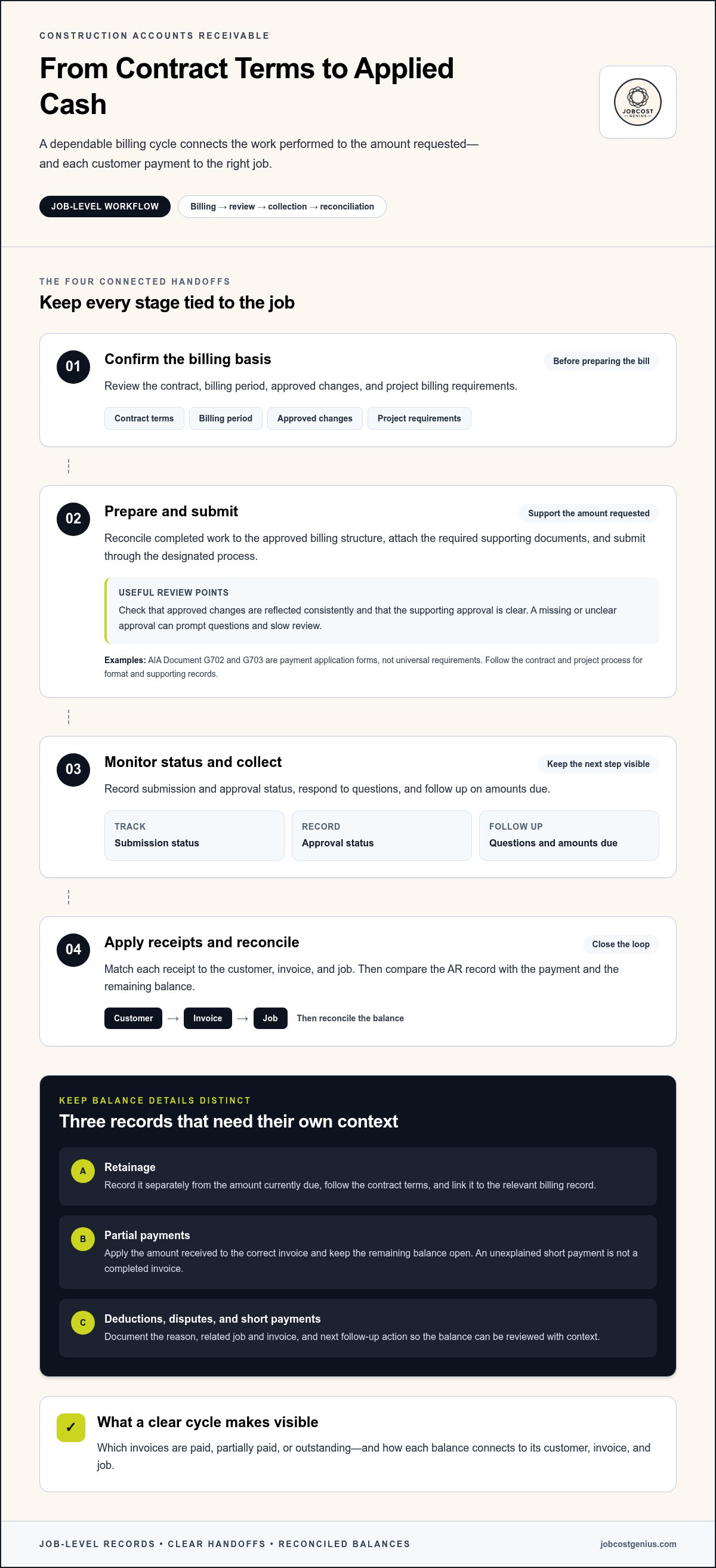
A dependable billing cycle connects the work performed to the amount requested, then connects each customer payment to the right job. For managing construction accounts receivable, every handoff matters. An accurate application can still leave records unclear if its status isn’t monitored or the resulting receipt isn’t applied correctly.
- Confirm: Review the contract, billing period, approved changes, and project billing requirements.
- Prepare and submit: Reconcile completed work to the approved billing structure, attach required supporting documents, and send the application through the designated process.
- Monitor and collect: Record submission and approval status, respond to questions, and follow up on amounts due.
- Apply and reconcile: Match receipts to the customer, invoice, and job, then compare the AR record with the payment and remaining balance.
Keep approved change documentation aligned with the amount billed. If a change is included in an application but its supporting approval is missing or unclear, it may prompt questions and slow the review. A clear connection between contract scope, approved changes, completed work, and billing backup makes it easier to explain how the requested amount was calculated.
Prepare a payment application that can be reviewed
Start with the billing period and reconcile the reported work to the contract’s approved billing structure, such as its schedule of values. Check that approved changes are reflected consistently, then assemble the backup required for that project. AIA Document G702 and G703 are examples of payment application forms, not universal requirements. Use the format and supporting records specified by the contract and project process.
Record retainage and partial payments clearly
Record retainage separately from the amount currently due, following the contract terms, and link it to the relevant billing record. If a customer makes a partial payment, apply the received amount to the correct invoice and preserve the remaining balance as open. Don’t treat an unexplained short payment as a completed invoice.
Document deductions, disputed amounts, and short payments with the reason, related job and invoice, and next follow-up action. This gives the team a clear record to review instead of leaving a balance that appears overdue without context.
Prompt cash application keeps AR records current by showing which invoices are paid, partially paid, or still outstanding. JobCost Genius supports these handoffs with construction-specific payment application formatting and AR management. Learn more about construction accounts receivable support.
Which AR controls reveal aging balances and job-level collection risks?
An AR aging report turns open receivables into a review queue. Organize balances by age, customer, job, and invoice status so the team can see how long an amount has been open and what may be holding it up. Use the aging periods configured for your reporting process, then compare each balance with the contract’s payment conditions and the invoice’s actual status.
Age alone doesn’t explain the risk. Before escalating, check whether the application was submitted, whether approval is pending, whether required documentation is complete, and whether the customer has raised a dispute. These checks help distinguish a collection follow-up from an administrative hold or unresolved billing question. This job-level view also supports broader construction cash flow management without treating every open balance the same way.
How to prioritize overdue construction invoices
Prioritize using the contract deadline, balance significance, age, and reason for nonpayment together. Separate administrative holds, missing documentation, disputed work, and pending customer approval, since each calls for a different next step. Assign an owner and document an action for every unresolved balance, such as resubmitting backup, resolving a billing question, or following up on payment status.
A practical review can use a consistent structure like this:
- Customer, job, and invoice: Identify who owes the balance and which project record it belongs to.
- Open amount and age: Show the unpaid balance and its aging category.
- Status and reason: Note submission, approval, documentation, or dispute status.
- Owner and next action: Record who will act and what needs to happen next.
Keep the notes specific enough that another team member can understand the issue and continue the follow-up without reconstructing the history.
What to reconcile between AR, job cost, and WIP records
Compare billed amounts and cash receipts in AR with the contract and the job’s accounting records. Investigate differences between earned progress, amounts billed, and amounts collected. For example, earned progress may not yet have been billed, or a recorded receipt may need to be matched to the correct invoice. Reconcile the underlying records before treating a variance as a collection problem.
WIP reporting adds context by connecting job progress and financial position. It can help identify whether a difference reflects work not yet billed, a billing entry that needs review, or a payment that hasn’t been recorded as expected. For a deeper explanation of that analysis, see the WIP reporting guide. Consistent checks make managing construction accounts receivable more actionable: each exception has a job, a reason, and a next step.
How to build a repeatable construction AR review routine
A consistent review turns receivables from a static report into a working queue. Set a recurring cadence that fits billing volume, project activity, and contract requirements. A weekly review can be a practical starting point, with additional checks around active billing cycles or key submission dates as needed.
Assign clear ownership for each handoff: billing preparation, submission tracking, customer follow-up, and receipt posting. One person may handle several tasks, but each open balance should still have an accountable owner. Use consistent exception notes, such as “approval pending,” “backup requested,” or “disputed amount,” and record the next action and follow-up date. This makes the reason a balance remains open visible to the whole team.
A practical weekly AR review checklist for contractors
Adapt this sequence to your accounting workflow and project requirements:
- 1. Check new billing activity. Review invoices and payment applications prepared or submitted, items awaiting approval, and upcoming billing deadlines.
- 2. Review aging by job. Identify open balances that need attention and check their submission, approval, and documentation status.
- 3. Assign next steps. For each unresolved item, record why it remains open, the owner, the action, and a follow-up date.
- 4. Verify cash and exceptions. Confirm receipts are applied to the right records and that deductions, disputes, or other exceptions have supporting notes.
Close the review by carrying unresolved items into the next cycle. A balance shouldn’t disappear from attention simply because the report has been reviewed.
Which AR metrics help identify process bottlenecks?
Track open receivables, aging by job, unapplied cash, and retainage separately. Together, these measures can help distinguish collection follow-up from delays in billing, receipt posting, or exception resolution. Compare changes over time and look for recurring issues, such as applications that routinely remain under review or receipts that are difficult to match.
Days sales outstanding (DSO) can offer a broad view of collection patterns, but interpret it cautiously. Contract-based billing, progress applications, approval steps, and retainage can affect how quickly receivables are recorded and cleared. DSO alone won’t explain why a balance is open or whether a delay reflects a process issue. Review it alongside job-level aging and invoice status.
A disciplined routine is a core part of managing construction accounts receivable. For help keeping construction bookkeeping and AR records organized, explore construction-focused bookkeeping support.
How specialized bookkeeping supports construction AR visibility
Construction receivables are most useful when accounting records stay connected to project activity. Consistent transaction entry helps keep invoice balances, customer payments, and job-level reports aligned. If a receipt is recorded without the right customer or project reference, or an invoice adjustment isn’t reflected in the records, the AR balance may be difficult to interpret during monthly reporting.
Construction-focused bookkeeping brings those records into a consistent process. Payment application formatting supports clear, organized billing submissions, while ongoing AR management keeps receivable records and outstanding items visible alongside project financials. This creates a clearer picture of what has been billed and recorded. Although bookkeeping can’t control when a customer pays, current, organized information helps contractors make informed decisions.
When a contractor may need construction-focused AR support
Recurring unapplied cash, missed follow-ups, and job balances that remain unreconciled are signs that the AR process may need more structure. Billing complexity can also grow as a contractor manages more projects, customers, contract terms, and supporting records. Tasks that once fit around an owner’s other responsibilities can become difficult to maintain consistently.
Specialized bookkeeping provides ongoing financial recordkeeping and oversight alongside the contractor’s customer communication and contract processes. A construction-focused workflow helps organize billing support and maintain accurate AR records, giving owners and project teams a dependable basis for review without having to reconstruct each balance from scattered notes.
How AR records connect to broader contractor reporting
Reliable receivable records contribute to clearer monthly financial statements by showing which customer balances are open and how receipts have been recorded. Reviewing those balances by job can also support cash visibility across active projects. The value comes from consistent records and reconciliation, not from assuming an outstanding invoice will be paid by a particular date.
WIP reporting serves a related but distinct purpose. AR tracks amounts billed and outstanding; WIP reporting helps assess work in progress and project financial position. Reviewing both can help contractors compare receivables with project progress without treating the reports as interchangeable. Together, they add context to managing construction accounts receivable and monitoring job finances.
To bring more structure to construction billing records and AR visibility, build a clearer construction AR process with JobCost Genius.
Make Every Receivable Easier to Track
A dependable construction AR process connects each balance to its job, keeps billing support aligned with contract requirements, and gives every open item a clear next step. Regularly reviewing aging, payment status, retainage, and reconciliation exceptions helps contractors see where attention is needed and maintain useful project financial records.
Managing construction accounts receivable isn’t about assuming when customers will pay. It’s about building accurate records and consistent follow-up so you can make informed decisions with a clearer view of billed, collected, and outstanding amounts.
JobCost Genius provides construction-focused accounts receivable management and payment application formatting. Founded by professionals with over 20 years of industry experience, the team supports construction firms with bookkeeping and financial reporting designed for the details of project accounting.
Explore construction-focused bookkeeping support and take the next step toward a more organized AR workflow. With a consistent process and clear job-level records, your team can approach receivables with greater confidence.
Frequently Asked Questions
How do construction companies manage accounts receivable?
Construction companies manage accounts receivable by connecting each customer balance to its contract, job, billing record, and payment activity. A reliable process covers billing preparation and submission, approval-status tracking, follow-up, cash application, and reconciliation. Review open balances by job and document why each remains unpaid, such as pending approval or missing backup. This makes managing construction accounts receivable a repeatable financial workflow rather than a list of invoices without project context.
What should a construction accounts receivable aging report include?
A construction AR aging report should show the customer, job, invoice identifier, invoice date, open amount, aging category, and payment or approval status. Include notes for retainage, disputes, deductions, missing documentation, or other exceptions when relevant. These details help explain why a balance remains open and guide the next action. Use aging categories consistently, then compare the report with billing records and contract terms before deciding which items need follow-up.
How do contractors track retainage in accounts receivable?
Contractors should record retainage separately from the amount currently due and connect it to the relevant customer, job, contract, and billing record. This keeps withheld amounts visible without obscuring the balance available for collection. Track the applicable contract terms and the status of each retainage balance, and update the records when payments or adjustments are posted. Separate tracking supports clearer job-level reporting and helps prevent retainage from being overlooked during routine AR reviews.
What is the difference between a payment application and an invoice?
A payment application requests payment for work completed during a billing period and is typically submitted for review under the project’s billing process. An invoice records a customer billing in the accounting system and establishes a receivable balance. The terms and workflow can vary by contract, so keep the application, its supporting documents, approval status, and resulting invoice connected. This lets the team trace a requested amount through review and into the accounting records.
How often should a contractor review accounts receivable?
Set a recurring review cadence that fits billing volume, active project requirements, and contract conditions. A weekly review can help teams monitor new submissions, approval status, aging balances, upcoming billing deadlines, and unapplied receipts. Contractors with different billing cycles may need additional checks around submission or reporting dates. Whatever the cadence, assign owners and record next actions so unresolved balances remain visible between reviews instead of waiting until month-end.
How can contractors follow up on overdue construction invoices?
Before following up, confirm the invoice or payment application was submitted and check its approval and documentation status. Review the contract’s payment conditions, then identify whether the balance is delayed by a missing document, a dispute, pending approval, or another issue. Contact the appropriate customer representative with the invoice and job details, document the response, and set a next action and follow-up date. Escalate unresolved issues through the process established for that contract.
Can bookkeeping software track receivables by construction job?
Yes, bookkeeping software can track receivables by job when records are consistently coded to the correct customer, project, contract, and invoice. Reporting features vary, so the workflow should preserve those identifiers from billing through receipt posting and reconciliation. Review reports against source records to catch miscoding or unapplied cash. Construction-focused bookkeeping and financial reporting can help maintain consistent job-level records, while a Procore Financials Integration can connect relevant financial workflows.


