

What if the reason your construction company struggles to make payroll isn’t poor profitability, but a cash gap your reports don’t reveal soon enough? You can earn a profit on paper and still feel pressure when labor and materials must be paid for weeks before client payments arrive. Retainage, delayed change orders, and inaccurate Work in Progress (WIP) reports can make that gap harder to predict. Effective cash flow improvement strategies construction company leaders use start with visibility, not just more aggressive collections.
That pressure is part of construction’s payment cycle, and it can grow as your firm takes on larger projects or more jobs at once. A cash forecast built from current project information can show when cash will be needed, where it is tied up, and which figures need attention before a shortage disrupts operations.
This guide covers ways to make cash flow more predictable, prepare payment applications, and track retainage across projects. You’ll also learn how accurate WIP reporting, construction-specific bookkeeping, and connected financial systems can improve visibility into project liquidity and help you grow with greater control.
Key Takeaways
- Review WIP reports consistently to spot overbilling, underbilling, and project risks before they disrupt your cash plan.
- Strengthen your Schedule of Values and payment application process to support clear, complete billing submissions.
- Connect field updates with timely financial decisions to improve cash planning across projects.
- Use Procore Financials Integration to connect project activity with bookkeeping workflows.
- Consider construction-specific bookkeeping when your firm needs more consistent job-cost visibility and financial reporting.
The Construction Cash Flow Gap: Why Profit Does Not Equal Liquidity
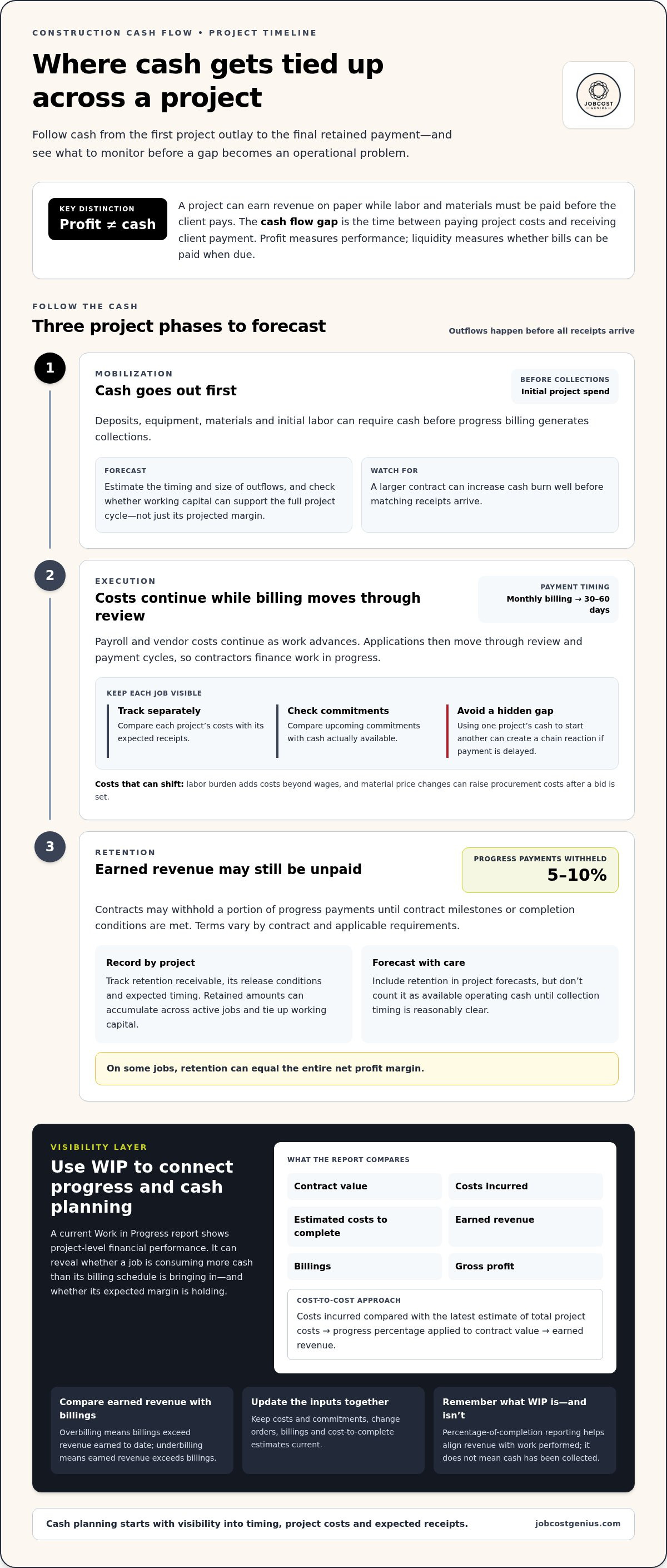
The construction cash flow gap is the time between paying for labor and materials and receiving payment from the client. During that interval, a project can earn revenue on paper while drawing cash out of the company’s bank account. Cash flow tracks money moving into and out of a business, as explained in Cash Flow. Because construction payments and costs happen at different stages of a job, it’s important to track when each is expected.
A profitable P&L statement doesn’t mean funds are available for payroll, suppliers, taxes, or the next mobilization. Revenue may be recognized before the related invoice is approved and paid, while costs are due now. If a contractor treats projected earnings as spendable cash, a shortage can lead to missed obligations and put operations under pressure. Profit measures performance; liquidity measures whether bills can be paid when due.
Track cash through three project phases:
- Mobilization: Cash goes out first for deposits, equipment, materials, and initial labor, before progress billing generates collections.
- Execution: Payroll and vendor costs continue as work advances, while submitted applications move through review and payment cycles.
- Retention: A portion of earned revenue remains unpaid until contract milestones or completion conditions are met.
For a growing contractor, cash burn rate means how quickly available cash is used to cover ongoing project and overhead costs. A larger contract can increase that rate well before it generates matching receipts. Forecast the timing and size of outflows to see whether working capital can support the project’s full cycle, not just its projected margin.
The Front-Loading Trap in Project Execution
Payroll runs on schedule, and suppliers expect payment according to their terms. Client billing may happen monthly, followed by a 30- to 60-day payment cycle. That timing means contractors finance work in progress. Using Project B’s cash to start Project A may hide a shortfall temporarily, but it can create a chain reaction if Project B’s payment is delayed. Track each job’s costs and expected receipts separately, then compare upcoming commitments with cash actually available.
Labor burden adds costs beyond wages, while material price changes can raise procurement costs after a bid is set. If estimates, committed costs, and actual spending aren’t kept current, the cash required to finish can exceed the original plan. That’s why cash flow improvement strategies construction company leaders rely on should include project-level forecasting, not just a review of the company-wide bank balance.
Retention: The Hidden Profit Leak
Contracts may withhold 5–10% of progress payments as retention, though terms vary by contract and applicable requirements. The withheld amount can accumulate across active jobs, tying up working capital while the company continues to pay employees and suppliers. Record retention receivable by project, including its release conditions and expected timing, so earned cash doesn’t disappear from short-term forecasts.
Retention is a later stage of project liquidity, often withheld until completion. On some jobs, it can equal the entire net profit margin.
Include retained amounts in project forecasts, but don’t count them as available operating cash until the timing of collection is reasonably clear. A view of mobilization needs, execution costs, and retention exposure helps owners identify a cash gap before it becomes a payroll emergency.
Leveraging WIP Reporting to Predict and Prevent Cash Gaps
A Work in Progress (WIP) report is a project-level dashboard that compares contract value, costs incurred, estimated costs to complete, earned revenue, billings, and gross profit. It connects field progress to financial performance. Unlike a bank balance, a current WIP report can show whether a job is consuming more cash than its billing schedule is bringing in and whether its expected margin is holding.
Percentage of completion helps align reported revenue with work performed. Under a cost-to-cost approach, a contractor compares costs incurred with the latest estimate of total project costs, then applies that progress percentage to the contract value. The calculation depends on consistent cost coding and updated estimates. It does not mean the cash has been collected. NetSuite’s Construction Cash Flow Management also distinguishes cash movement from reported profit, a distinction WIP helps make visible at the project level.
To make the report useful, update costs and commitments, change orders, billings, and cost-to-complete estimates together. A delayed vendor invoice or unrecorded field cost can make a project appear healthier than it is. Construction-specific bookkeeping helps keep job-cost information organized and reconcile project activity with accounting records. That gives owners a stronger basis for decisions than a spreadsheet assembled from disconnected updates.
Fixing Overbilling and Underbilling
Overbilling occurs when billings exceed revenue earned to date. The extra cash can ease an immediate squeeze, but it is tied to work still owed. Spending it as surplus can leave a later phase underfunded. Underbilling means earned revenue exceeds billings, pointing to cash still to invoice and potentially to missed costs or delayed applications. Compare earned revenue with billings each reporting period. This WIP reporting guide explains how to investigate overbilling and correct reporting issues.
Predictive Cash Flow Analysis via WIP
Turn WIP into a forward-looking view by pairing each project’s cost-to-complete estimate and billing position with the timing of expected payments and obligations. A 30-day forecast can highlight near-term payroll and vendor pressure; 60- and 90-day views can flag upcoming procurement or mobilization needs. Treat these as planning horizons, not guaranteed collection dates.
Compare each project’s current estimated margin with earlier forecasts. If costs rise or progress slows while the contract value stays fixed, profit fade can signal that the team should review purchasing, labor deployment, schedule assumptions, or change-order documentation. WIP reporting can bring these measures together in a view of project health, helping leaders prioritize action before a margin decline becomes a cash shortage.
For contractors looking for cash flow improvement strategies construction company leaders can act on, accurate WIP is a practical starting point. JobCost Genius provides WIP reporting to support project-level visibility as your firm grows. Explore construction bookkeeping support to see how structured reporting can strengthen financial decisions.
Strategic Billing and Retention Management: Shortening the Payment Cycle
Faster billing depends on more than sending an invoice promptly. The application must match contract terms, document completed work clearly, and make it easy for the reviewer to approve. AIA-style progress billing uses G702 as the payment application summary and G703 to break down completed work and stored materials by line item. Standard progress billing can be simpler, but either method can stall if the Schedule of Values (SOV), supporting documents, or billing period doesn’t match the contract.
Build the SOV with enough detail to show how the contract value maps to project activities and milestones. Agree on it before work begins, then submit consistent quantities, completion percentages, and supporting documents with each application. A carefully structured, contract-compliant SOV can make mobilization costs billable early when the contract allows, rather than leaving startup expenses uncovered. Clear billing records and complete supporting details help reduce avoidable errors that can trigger review questions or rejection.
AIA Billing and Progress Payment Optimization
Before submitting, reconcile the G702 summary with the G703 detail, confirm approved change orders are reflected, and check that prior payments and retainage are shown correctly. Lien waivers also affect payment processing: a conditional waiver generally ties the waiver to receipt of payment, while an unconditional waiver indicates payment has been received. Requirements and forms vary by contract and jurisdiction, so use the applicable documents and make sure the waiver amount and period match the payment being processed.
Retention Recovery Strategies
Negotiate retention terms during contract review, not after cash is already withheld. Contractors may propose a cap or a step-down, such as reducing retention from 10% to 5% at 50% completion, subject to agreement and applicable requirements. Define the milestone, release conditions, and required closeout documents in writing. Record retention receivable as a separate balance-sheet item by project, then reconcile it as payments arrive so it stays visible through closeout.
Set a formal accounts receivable escalation policy with clear owners and next steps. Review an aging report on a consistent schedule, confirm receipt of each application, and document questions or disputed items. For overdue invoices, establish when the project team follows up, when finance escalates to the client’s accounts payable contact, and when leadership addresses unresolved issues. Keep communication factual and preserve supporting records.
Closeout can also slow retention recovery if punch-list items, final waivers, or closeout documents remain outstanding. Assign responsibility for each item and track its status alongside the retention balance. Consistent accounts receivable management connects billing follow-up with project completion, making it easier to spot what is delaying collection. These cash flow improvement strategies construction company leaders can standardize across jobs turn billing and retention from informal follow-up into a controlled process.
Field-to-Office: Automating Cash Visibility with Tech
Cash reports lose value when field updates arrive late or don’t match office records. A project manager may record completed work, a superintendent may submit a labor update, and a supplier may send an invoice through separate processes. Until those details are coded to the right job and entered into accounting records, financial reports can show an outdated picture of project costs and commitments.
A connected tech stack gives field and finance teams a shared flow of project information. Procore Financials Integration connects project activity with accounting workflows, helping reduce duplicate entry and discrepancies between project records and bookkeeping. When field data reaches financial records promptly, bookkeepers can use more current costs and commitments to maintain accurate job costing and support reliable WIP reporting.
Procore and QuickBooks: The Power of a Synced Tech Stack
Integration works best when teams agree on how information moves. Before implementation, map the data that must pass between Procore and accounting software, such as project identifiers, cost codes, commitments, invoices, and change information. Set consistent naming and coding rules, assign responsibility for reviewing exceptions, and test the workflow on a defined set of project transactions before expanding it. Procore Financials Integration helps bridge field and office data workflows.
A field-office sync can reduce financial lag by up to 15 days, giving decision-makers a timelier view of job activity than delayed manual updates. To preserve that benefit, teams still need clear procedures for approvals, corrections, and incomplete records. Automation moves information; review keeps it dependable.
Automated AP Workflows for Better Vendor Relations
Automated accounts payable (AP) workflows can capture vendor invoices and field expenses, route them for approval, and assign them to the appropriate project and cost code. Set a consistent process from receipt to payment:
- Capture: Collect invoices and expense documentation in one designated workflow.
- Code and review: Match each item to its project, cost category, and supporting record, then route exceptions to the responsible reviewer.
- Schedule: Track due dates and approved payment timing so finance can plan disbursements and avoid preventable late fees.
Vendor terms matter, too. Compare payment due dates with expected client receipts and planned project outlays. Where possible, negotiate terms that better align with the project’s billing and collection cycle, without assuming client funds will arrive on a particular date. Track material orders, deposits, and expected delivery dates in the project workflow. Long lead times or early deposits can shift cash needs forward, before materials reach the site.
These cash flow improvement strategies construction company leaders implement work best when field reporting, job costing, and AP approvals use consistent project data. To connect field activity with financial records, explore Procore Financials Integration support from JobCost Genius.
Scaling Your Financial Infrastructure: The Case for Specialized Bookkeeping
As a construction firm grows, its books have to do more than record deposits and expenses. They need to connect payroll, job costs, commitments, billing, and project performance to support decisions across multiple jobs. A generalist bookkeeper may keep standard accounts organized but still lack the construction-specific context to interpret a changing cost-to-complete estimate or flag a project-level reporting issue.
Specialized bookkeeping can give a growing company consistent financial oversight without requiring the owner to manage every process alone. Assess the cost-benefit by comparing the investment in support with the time spent correcting errors, rebuilding reports, and chasing missing project information. Also consider the impact of late visibility into margin or cash needs. The objective isn’t simply to reduce administrative hours. It’s to build dependable financial information as the workload expands.
Construction Specialist vs. General Bookkeeper
Construction accounting requires consistent job-cost coding and a clear understanding of how project progress, billings, and costs relate. Errors can distort WIP reporting or leave payroll costs assigned incorrectly. Labor burden and prevailing wage requirements can add further complexity, so processes must capture the relevant labor classifications and costs accurately. A construction-focused bookkeeper understands why these details matter to project reporting. This comparison of construction specialists and generalist bookkeepers outlines the differences.
Taking the Next Step Toward Financial Stability
Monthly recurring oversight creates a steady rhythm for reviewing reconciliations, job costs, project reports, and outstanding financial questions. Instead of waiting until a problem surfaces, owners can use consistent reporting to see where a job is tracking off plan and decide what needs attention. JobCost Genius offers Starter, Growth, and Premium Plans, giving construction firms options for financial support that can scale with their needs.
Organized books also support audit readiness by keeping transactions, project documentation, and financial reporting structured and easier to review. That doesn’t eliminate the need for accurate source records or appropriate professional review. It gives owners a clearer foundation for responding to questions from lenders, bonding stakeholders, or internal decision-makers.
For contractors looking for cash flow improvement strategies construction company leaders can sustain as operations expand, specialized bookkeeping provides a disciplined financial foundation. It helps move the back office from reactive data entry toward regular project oversight, with clearer responsibilities and reporting routines. The result is greater financial confidence: less time spent piecing together figures and more attention available for managing work and planning the next stage of growth.
Choose financial support that fits your firm’s current needs and growth plans. View JobCost Genius plans to explore the available options.
Build Financial Confidence for Your Next Stage of Growth
Growth brings more moving parts, and your financial processes need to keep pace. Make financial visibility part of how you plan each project, manage payroll and compliance responsibilities, and decide when your firm is ready to take on more work. Strong reporting gives you a clearer basis for those decisions than instinct alone.
JobCost Genius supports that foundation with WIP reporting for project oversight and Procore Financials Integration support. These services help connect project activity with financial records, giving your team a more dependable view as the business scales. The cash flow improvement strategies construction company leaders adopt should make the next decision clearer, not add administrative burden.
Explore JobCost Genius bookkeeping, WIP reporting, and Procore Financials Integration services.
Frequently Asked Questions
What is the most common cause of cash flow problems for construction companies?
A mismatch between the timing of project costs and incoming payments is a frequent cause of cash pressure. Payroll, equipment rentals, or supplier invoices may come due while a client application is still being reviewed. Delayed change-order approval can add pressure if extra work is underway but not yet included in billings. Review upcoming obligations against expected collections by date, and flag receipts that depend on unresolved approvals.
How does a WIP report help improve my company’s cash flow?
A WIP report helps you see which jobs may need attention before their financial strain becomes obvious in company-wide results. For example, if committed costs rise but the forecasted cost to complete hasn’t changed, the project’s expected margin may be overstated. Compare estimates with current commitments and approved changes, then assign someone to investigate differences. WIP improves decisions when project managers and finance staff act on the same updated figures.
Should I use overbilling as a strategy to fund my construction projects?
No. Don’t treat overbilling as unrestricted working capital. Amounts billed ahead of earned work correspond to future project obligations. If that cash is spent on unrelated costs, the company may lack funds to complete the work already billed. Instead, build mobilization needs into contract negotiations and billing milestones where terms allow, and forecast cash needs by job. Keep billings aligned with contract requirements and accurately documented progress.
What is the difference between profit and cash flow in construction accounting?
Profit measures revenue less expenses over an accounting period; cash flow tracks actual money received and paid. A contractor might record revenue from completed work before the client pays the invoice, showing profit without equivalent cash in the bank. Conversely, a loan can increase available cash without increasing profit. Use the P&L to assess operating results and cash forecasts to plan whether funds will be available for upcoming obligations.
How can I recover my retention payments faster from project owners?
Make closeout requirements visible well before the project reaches completion. Keep a project-specific checklist for punch-list items, final applications, waivers, approvals, and other contract-required documents, with an owner and status for each. Submit complete closeout materials promptly, then reconcile the retention balance against payments received and follow up on outstanding items. Review the contract’s release terms and applicable requirements, since timing and documentation can differ by project.
Is Procore integration worth the investment for a small construction firm?
It may be worthwhile if disconnected project and accounting records create substantial re-entry, reconciliation, or reporting work. Assess your current workflow first: identify where duplicate entry occurs, how often job details need correction, and which records must move between systems. Then compare expected process improvements with implementation and ongoing costs. Integration can improve information flow, but it won’t replace consistent coding, clear approvals, or staff review.
How often should a construction company perform a cash flow analysis?
Review cash weekly when projects are active and payment timing or purchasing needs can change quickly, then update the forecast whenever a major event shifts expected cash needs. Examples include a delayed client payment, a large material deposit, or a change in project schedule. Reconcile the forecast to actual receipts and disbursements at month-end. The purpose is to spot a developing shortfall early enough to adjust decisions.
Can a specialized construction bookkeeper really help me scale my business?
Yes. A construction-focused bookkeeper can organize financial processes around job costs, project reporting, and recurring review, helping owners make decisions from clearer records as work grows. For cash flow improvement strategies construction company leaders can sustain, consistent reporting and defined responsibilities matter as much as adding projects. JobCost Genius provides specialized construction bookkeeping and financial reporting, helping owners build back-office structure without managing every detail themselves.


