

What if billing could move forward without pulling your team away from the projects that keep the business running? For contractors, payment applications depend on accurate, project-specific documentation. Delays or inconsistent submissions can make receivables harder to track. Outsourced construction billing services can help organize this work, but only when project data, review responsibilities, and follow-up remain visible to your team.
It’s reasonable to want support without giving up control. A clear workflow shows which billing tasks are handled, who reviews each submission, and how billing records connect to project activity. This guide explains what outsourced billing can cover, how to evaluate the workflow, and which information to track for a clearer view of receivables and expected cash flow.
You’ll also learn how construction-specific billing support, payment application formatting, and financial reporting can fit into broader bookkeeping operations, with clear responsibilities and organized records.
Key Takeaways
- Outsourced construction billing services can support project-specific billing administration as part of broader financial operations.
- A defined workflow connects approved project records to billing preparation, review, submission, and receivables tracking.
- Compare in-house, outsourced, and hybrid approaches by capacity, continuity, control, and coordination, while keeping approval authority with your company.
- Prepare for a smoother handoff by organizing billing calendars, project records, customer requirements, and responsibilities for each step.
- Construction-focused billing support and reporting can help keep project records organized and improve visibility into receivables.
What outsourced construction billing services handle, and where they fit
Outsourced construction billing services provide external support for preparing, organizing, submitting, and tracking customer billing tied to construction projects. Tasks can include assembling payment applications and supporting records, then tracking the status of each submission and receivable. The scope depends on contract requirements, your existing workflow, and the tasks and approvals assigned to each person.
Billing administration is one part of construction financial operations, not a catch-all for every finance responsibility. Preparing an invoice or organizing a payment application doesn’t automatically include bookkeeping, payroll, income tax filing, or broader accounting oversight. These functions can connect through shared project and accounting records, but each needs a defined owner. Construction accounting provides context on progress billing and draws, which help explain why construction billing often requires project-specific documentation.
Which construction billing tasks can be outsourced?
Depending on the agreed workflow, billing support can include preparing invoices, formatting payment applications, organizing supporting documents, and tracking receivable status. A billing packet might bring together approved work details, contract information, and required backup so the reviewer can assess the submission as a whole.
Change documentation and retainage records may also affect a billing packet. The contractor’s assigned approver should verify the billed amount and authorize the submission. Preparation and processing support can make the review more efficient, but it doesn’t replace the company’s judgment about which work is approved for billing.
How billing connects to job-cost and cash-flow visibility
Consistent invoice records let a contractor compare amounts billed with project activity and review what remains unbilled or outstanding. For example, when a billing record is tied to a project and billing period, the team can investigate a mismatch between reported progress and the amount submitted instead of relying on a general receivables total.
Billing status also helps teams distinguish work being prepared from submissions already sent and amounts recorded as outstanding. That gives them better information for cash-flow planning, but it cannot establish when a customer will pay. Outsourced billing support can organize and track submissions, but it cannot guarantee faster customer payment. For a broader view of expected inflows alongside project obligations, see construction cash flow management.
JobCost Genius connects construction-focused accounts receivable management and payment application formatting with organized financial records. This keeps billing administration tied to project activity and gives contractors a clearer basis for reviewing receivables and financial information.
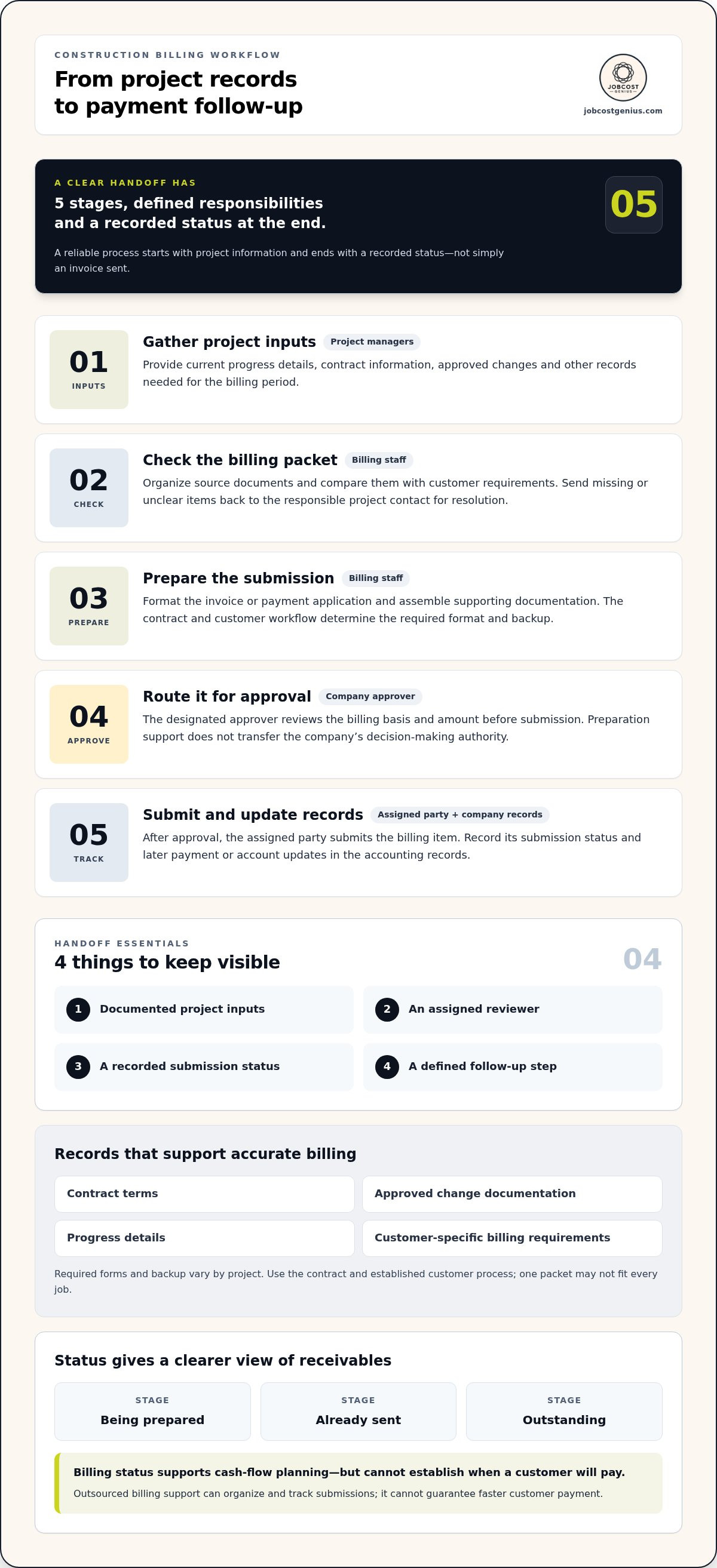
How an outsourced construction billing workflow moves from project records to payment follow-up
A reliable billing workflow starts with project information and ends with a recorded status, not simply an invoice sent. With outsourced construction billing services, responsibilities between project managers, billing staff, company approvers, and accounting records should be clear at every stage. That makes missing information easier to spot and shows where each billing item stands.
- Gather project inputs. Project managers provide current progress details, contract information, approved changes, and other records needed for the billing period.
- Check the billing packet. Billing staff organize source documents and compare them with the applicable customer requirements. Missing or unclear items go back to the responsible project contact for resolution.
- Prepare the submission. Staff format the invoice or payment application and assemble its supporting documentation. The contract and customer workflow determine the format and required backup.
- Route it for approval. The designated company approver reviews the billing basis and amount before submission. Preparation support doesn’t transfer that decision-making authority.
- Submit and update records. Once approved, the assigned party submits the billing item. The company records its submission status and later payment or account updates in its accounting records.
A complete billing handoff has documented inputs, an assigned reviewer, a recorded submission status, and a defined follow-up step.
What records support accurate construction billing?
Useful source records can include contract terms, approved change documentation, progress details, and customer-specific billing requirements. The required forms and backup vary by project, so use the contract and established customer process rather than assuming one packet fits every job. For example, if a change affects the amount being billed, the reviewer needs access to its documentation. Missing change records or unclear retainage details can leave a packet incomplete and require rework.
Organizing current records by project and billing period helps staff find the right information without repeatedly requesting documents or reconciling conflicting versions. The Construction Financial Management Association is an industry resource for construction financial professionals working with these processes.
How billing status becomes useful financial information
Keep distinct stages separate. Submitted billing is an invoice or application sent for review; a recorded receivable is an amount entered in accounting records; a customer payment is cash received and recorded; and remaining contract value is the portion not yet billed, subject to the project’s contract and accounting records. These figures answer different questions and shouldn’t be treated as interchangeable.
Regular updates help management spot items awaiting approval, submissions without a recorded payment, and differences between billed activity and project progress. They support review and planning, not a promise about collection timing. WIP reporting for construction adds project-health context by connecting billing with costs and progress. Contractors can also explore JobCost Genius billing support for construction-focused financial services.
Outsourced vs. in-house construction billing: compare control, capacity, and visibility
The right billing model depends on how much work your team can consistently handle and where project-specific knowledge sits. In-house billing keeps preparation close to project staff. Outsourcing can add capacity for recurring administration or specialized payment application formatting. A hybrid model divides the work. None guarantees faster payment or fewer errors. Results depend on complete records, clear responsibilities, and a functioning review process.
| Consideration | In-house | Outsourced | Hybrid |
|---|---|---|---|
| Capacity | Workload depends on internal staff availability and competing duties. | External support handles agreed billing tasks, adding capacity for that scope. | Internal and external teams share work according to workload and task type. |
| Continuity | Knowledge stays with employees, though coverage may depend on specific people. | Routine preparation and tracking follow the agreed handoff process. | Shared documentation supports continuity while internal staff retain project context. |
| Control | Company staff prepare and review billing internally. | The contractor retains approval authority while assigning preparation or processing externally. | External support can prepare records; designated company staff approve submissions. |
| Coordination | Project and finance teams coordinate directly within the company. | Staff exchange project inputs and review notes with an external billing team. | Internal contacts bridge project operations, billing support, and accounting records. |
What control remains with the contractor?
Outsourcing tasks doesn’t require surrendering company approval authority. The contractor can retain decisions about whether an amount is ready to bill, how contract terms apply to the work, and who owns customer relationships. External billing staff work from agreed records and assigned responsibilities; they don’t replace the company’s judgment about project commitments.
Set practical safeguards before work begins: name the person who approves billing, document who resolves missing project details, and establish how exceptions reach management. If a change record is incomplete or billed progress is disputed internally, the escalation path should pause the item for review rather than leave ownership unclear.
When is a hybrid billing model a practical fit?
A hybrid approach may fit when billing volume fluctuates, project requirements vary, or internal staff understand project decisions but have limited time for recurring preparation and tracking. The company can keep contract interpretation, customer coordination, and final approvals in-house while assigning defined administrative tasks externally. For example, project staff can confirm progress and approve amounts while billing support organizes recurring paperwork and maintains status records.
Before choosing the split, map each task to an owner and consider project complexity, staff capacity, and the review steps your company already uses. Outsourced construction billing services work best within a controlled financial process, not as a substitute for project information or management oversight. For broader context on the accounting structure, see outsourced bookkeeping for construction.
Prepare your construction company for an outsourced billing handoff
A clean handoff starts before recurring billing work moves outside the company. Gather the records, customer instructions, and approval rules the process depends on, then decide how staff will exchange updates. This preparation helps outsourced construction billing services work from consistent inputs and gives your team a clear way to review exceptions without losing visibility.
Set billing responsibilities and review checkpoints
Assign an owner to each stage: project-data delivery, billing preparation, company approval, submission, and status updates. One person may hold more than one role, but the handoff should show who is accountable at each step. Set checkpoints to confirm supporting documents and customer-specific requirements before approval. Establish a regular exception review for missing records, rejected submissions, and overdue receivables, with a named person responsible for resolving each item.
Organize records and reporting expectations
Provide current contract records, customer billing instructions, project identifiers, and relevant billing history. Use consistent file names and project references so an invoice and its backup can be traced to the right job and billing period. Document where current records live and how updates should be shared. If accounting software is part of the process, agree on appropriate access and which information will be entered, updated, or passed between systems. Don’t assume a familiar folder structure or shorthand will be clear to an external team.
Decide what leadership needs to see and how often. A useful status summary can identify billing in preparation, items awaiting approval, submissions sent, outstanding receivables, and unresolved exceptions. Agree on how staff will flag a rejected item or a record that needs input from the project team. Shared definitions for each status prevent a submitted invoice from being mistaken for a received payment.
Use this readiness checklist before transitioning recurring billing work:
- Calendar: Document billing cycles, internal review dates, and customer-specific submission requirements.
- Project records: Gather current contract details, project identifiers, progress support, approved changes, retainage details when applicable, and billing history.
- Responsibilities: Name the people who prepare, review, approve, submit, update status, and resolve exceptions.
- Files and systems: Define naming conventions, record locations, access expectations, and how billing information moves into accounting records.
- Reporting: Set the status categories and reporting cadence leadership will use to monitor open items and receivables.
Keep the checklist with the process documentation and revisit it when customer requirements, project mix, or internal roles change. JobCost Genius provides construction-focused billing and financial support through tailored subscription plans. Learn about construction billing support and how it fits into organized financial operations.
How JobCost Genius supports construction billing and financial oversight
After defining the workflow, deciding where approval authority belongs, and preparing records for a handoff, contractors can assess how billing support fits into broader financial operations. JobCost Genius provides construction-focused bookkeeping and financial reporting, including accounts payable and accounts receivable management, customer billing, and payment application formatting. This connects recurring billing work with the records contractors use to monitor project finances.
Connect billing administration with construction financial records
Billing records are more useful when they sit within an organized accounting process. Construction-focused bookkeeping can connect customer invoices and payment application details with receivables records, giving the company a clearer view of amounts billed and outstanding. This supports review, but it doesn’t promise a particular collection date or replace company approval of billing amounts.
WIP reporting provides a related view of project health, helping contractors consider billing alongside broader project financial information. JobCost Genius also offers Procore Financials integration as part of its construction-focused financial support. Each component has a distinct role: billing administration organizes customer charges and related records, bookkeeping supports financial recordkeeping, and reporting helps management assess project and company information.
Choose a support model that fits your company's stage
Billing needs can change as a construction company takes on different projects, adjusts internal capacity, or develops more involved reporting requirements. JobCost Genius offers tailored subscription plans for small, growing, and established construction firms. The aim is to align support with the company’s operating needs rather than assume every contractor requires the same arrangement.
As you consider a fit, define the billing tasks that need support, the records available to complete them, and the internal approvals your team will retain. Then consider how billing connects to accounts payable, receivables management, WIP reporting, and any relevant integration needs. This frames outsourced construction billing services as part of a coordinated financial operation, not a stand-alone promise of faster payment.
JobCost Genius’s construction-focused team brings more than 20 years of construction industry experience among its professionals. That experience informs a practical approach to billing records and financial reporting, with responsibilities shaped around the contractor’s workflow. Clear expectations still matter: agree on source records, review ownership, and how billing status will appear in financial records.
To explore how billing support fits with your company’s billing and reporting needs, visit JobCost Genius.
Make your next billing cycle more intentional
Use the next billing cycle as a practical starting point. Identify one recurring friction point, such as gathering project updates, routing approvals, or keeping receivable statuses current. Then define what information and ownership would make that step easier to manage. This gives your team a focused way to assess whether outsourced construction billing services fit your operations, without changing every part of the process at once.
JobCost Genius works with construction companies on billing and financial reporting through a construction-focused approach. Consider how billing support may fit alongside your existing responsibilities and reporting priorities.
Discuss construction billing support and take a clear next step toward a more organized billing process. With defined priorities and appropriate support, your team can move forward with greater confidence.
Frequently Asked Questions
What do outsourced construction billing services include?
Outsourced construction billing services can cover recurring customer billing administration, from preparing invoice records to organizing payment application backup and monitoring receivable status. The precise task mix depends on the contractor’s workflow and assigned responsibilities. For example, a company might delegate formatting and record organization while keeping decisions about billable quantities and final approval with its project and finance leads.
How does outsourced construction billing work?
It works through an agreed exchange of project information, billing tasks, review decisions, and status updates. A project lead might provide a completed progress record, while billing staff use it to prepare a draft for company review. If approval is delayed or a customer requests a correction, the assigned owner records the issue and routes it to the person responsible for resolving it.
Can a contractor outsource billing and keep approval control?
Yes. A contractor can delegate administrative preparation while retaining authority over billed amounts and final approval. For example, an external billing team can organize a draft application, but the company’s designated approver can verify the work claimed before it is sent. Documenting who can approve, revise, or hold a submission helps preserve oversight as billing tasks are shared.
Is outsourced construction billing different from bookkeeping?
Yes. Billing focuses on customer-facing charges and related submission records; bookkeeping records financial activity in the company’s accounts and supports reports such as receivables balances. The functions connect, but they answer different questions. A billing record shows what was prepared or submitted, while bookkeeping shows how that activity is reflected in the contractor’s financial records.
How do outsourced billing services handle payment applications?
They can organize project information and supporting documents into the format required for a customer’s payment application process. Requirements differ across contracts, so the billing team needs the relevant instructions and current project records. A practical review step is to compare the draft packet with the applicable requirements before the company’s approver authorizes submission. Formatting support doesn’t determine when a customer will pay.
When should a construction company outsource accounts receivable?
Consider outside support when recurring billing administration competes with project responsibilities, receivable records are difficult to keep current, or payment application preparation requires specialized formatting. Start by identifying where work accumulates, such as unprepared billing items or unresolved account updates. If project information or approval ownership is unclear, address those gaps during the transition so delegated work has a reliable basis.
Can outsourced billing support work with construction accounting software?
It can fit into a software-supported accounting process when the company defines how records, access, and updates will be handled. JobCost Genius offers Procore Financials integration, alongside construction bookkeeping and financial reporting. Define which records are maintained in your accounting environment and how billing information is shared, so project identifiers and receivable updates remain consistent throughout the workflow.


