

Could a project look cash-positive on paper while part of every approved payment is still being withheld? That’s the risk when retainage is treated as a billing detail instead of a contract-driven balance. Managing retainage in construction billing takes more than applying a percentage: teams need to know what’s held, who owes it, and what must happen before release.
Balances can become difficult to reconcile across projects and pay applications. Release terms and timing vary by contract, and cash-flow forecasts can mistakenly count retainage as available money. A consistent process makes these obligations visible and helps prevent missed documentation or delayed follow-up.
This guide explains how to set up retainage tracking, calculate and present withheld amounts in payment applications, monitor retainage receivable and payable separately, and prepare for release. You’ll also learn how to flag balances approaching their release conditions and identify the action still required. Construction-focused bookkeeping, AP/AR management, and WIP reporting can support clearer financial records, while contract review remains essential for understanding each project’s requirements.
Key Takeaways
- Start with the contract: identify the retainage rate, calculation basis, affected work, and release conditions before the first payment application.
- Separate gross work earned, the amount currently due, and retainage withheld so each figure is clear in your billing records.
- Managing retainage in construction billing is easier when each pay application follows the contract’s calculation method and required format.
- Use a monthly review to reconcile balances, check release milestones, organize supporting documents, and prioritize follow-up.
- Connect billing, AP/AR records, and WIP reporting to create a more complete view of retainage across projects.
What managing retainage in construction billing actually involves
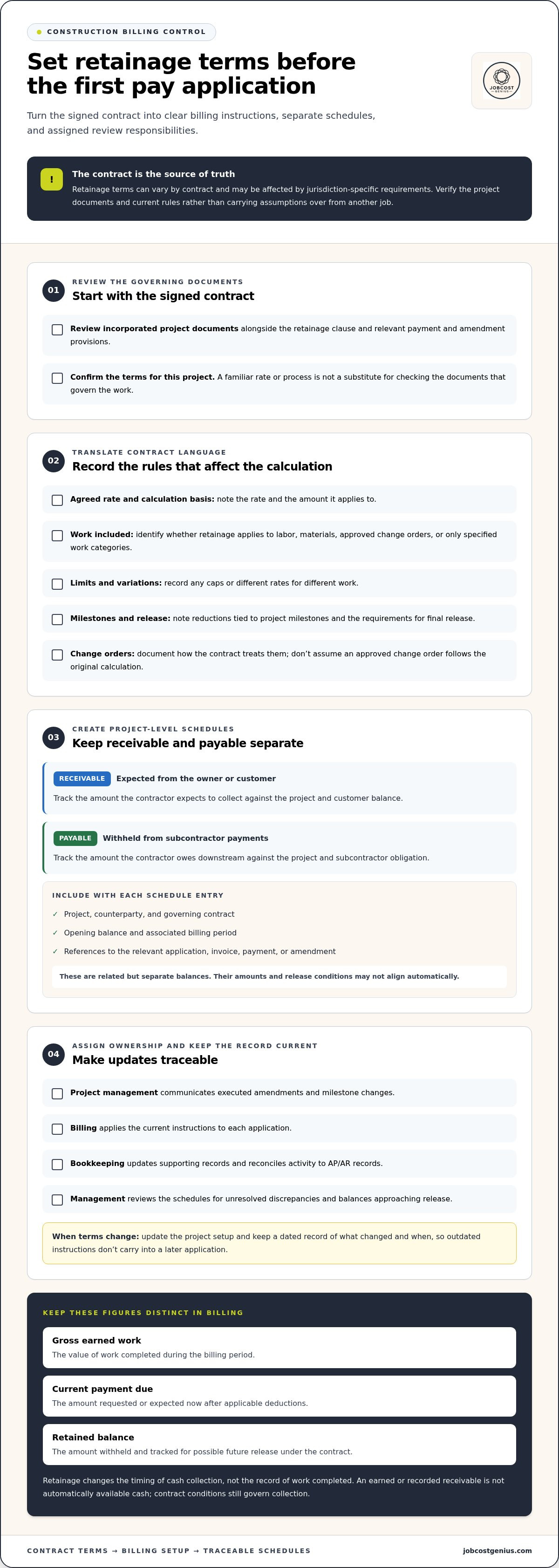
Retainage is payment contractually withheld from work performed until a specified project milestone or other release condition is met. It changes the timing of cash collection, not the record of work completed. To manage retainage in construction billing, keep three figures distinct: gross earned work, the value of work completed during the billing period; current payment due, the amount requested or expected now after applicable deductions; and the retained balance, the withheld amount tracked for possible future release under the contract.
For example, a pay application can show that work has been earned even though only part of its value is currently payable. The remaining amount may still be outstanding as retainage, rather than lost or collected cash. The What is Retainage? overview provides general background, but each project’s contract governs the calculation and release terms.
Retainage can also move through a contracting chain. An owner may withhold amounts from a general contractor, which may in turn withhold retainage from subcontractor payments. These are related but separate balances. The amount due to a subcontractor, its release conditions, and the amount the general contractor expects from the owner may not align automatically. Track each obligation against its own agreement.
Retainage receivable versus retainage payable
Retainage receivable is an amount a contractor expects to collect from an owner or customer; retainage payable is an amount the contractor withholds from a subcontractor’s payment. The receivable belongs to the contractor’s project and customer balance. The payable belongs to its project and subcontractor obligation. Tie each to the specific project, counterparty, and contract terms so one cannot be mistaken for the other or netted against it without a clear basis.
Why retainage needs its own billing controls
A holdback that isn’t reconciled can make collectible cash harder to identify and obscure obligations owed downstream. Keep earned revenue, invoiced amounts, cash received, and retained balances visible as separate figures. They answer different questions: what work was performed, what was billed, what money arrived, and what remains withheld.
Retainage isn’t automatically available working capital. A contractor may have earned the amount and recorded it as receivable, but still need to satisfy contract conditions before collecting it. On the payable side, money withheld from a subcontractor remains an obligation to track, not unrestricted cash. Project-level AP/AR records and financial reporting help management see these balances alongside job performance, while contract review establishes what triggers release. These controls distinguish payment timing from project earnings and help teams follow up on the right balance.
Set up retainage billing from the contract before the first application
Build the billing setup from the signed contract and any incorporated project documents before preparing the first application. Retainage terms depend on the contract and may also be affected by jurisdiction-specific requirements, so verify current rules for the project rather than carrying assumptions over from another job. A familiar percentage or process isn’t a substitute for checking the documents that govern the work.
Translate the terms into clear billing instructions. Record the agreed rate, what amount it applies to, any caps, and the conditions or milestones that change the calculation or trigger release. If an amendment changes the terms, update the project setup and retain a record of what changed and when. This contract-to-ledger handoff gives billing and bookkeeping teams a consistent reference point.
Extract the retainage terms that change the billing calculation
Review the retainage clause alongside relevant payment and amendment provisions. Identify whether retainage applies to labor, materials, approved change orders, or only specified work categories. Note any different rates for different work, limits on the amount withheld, reductions tied to project milestones, and requirements for final release. Don’t assume that an approved change order automatically follows the original calculation; document how the contract treats it.
Assign responsibility for updating the setup when terms change. Project management should communicate executed amendments and milestone changes; billing should apply the current instructions; bookkeeping should update the supporting records. A shared, dated record helps prevent a prior rate or calculation basis from carrying into a later application.
Create project-level retainage schedules
Maintain separate schedules for retainage receivable from the owner or customer and retainage payable to subcontractors. Each schedule should identify the project, counterparty, governing contract, opening balance, and billing period associated with every entry. Include references to the relevant application, invoice, payment, or amendment so reviewers can trace each balance to its source.
Define who prepares, checks, and approves updates. Billing staff can enter amounts with each application, bookkeeping can reconcile activity to AP/AR records, and project management can confirm contract changes and milestone status. Management should have a clear review point so unresolved discrepancies or approaching release conditions aren’t buried in project notes.
A retainage schedule should capture the project, counterparty, contract reference, applicable rate and calculation basis, affected work, amount withheld, billing period, opening and current balances, release conditions, supporting documents, and responsible reviewer. Use that checklist to establish consistent fields across projects without assuming every contract uses identical terms. Construction bookkeeping and financial reporting can keep retainage activity connected to billing and project results. Learn more about construction bookkeeping and financial reporting.
Set up the schedule before the first application, then revise it only when documented contract terms or project events require a change. That gives each later calculation a reliable starting point.
Prepare construction pay applications with retainage calculated and supported
A reliable pay application shows how the amount requested was calculated, not just the final figure. Follow the contract’s calculation method and the owner’s approved format. A form or billing template can organize the information, but it doesn’t replace checking the calculation against current contract terms and prior applications.
Use a consistent comparison to make the period’s activity clear. The exact layout may vary by contract or application format.
| Pay application item | What to show or verify |
|---|---|
| Gross work earned | Value of work completed in the billing period, supported by current progress data. |
| Prior billings | Amounts submitted for earlier periods, so previously billed work isn’t counted again. |
| Current amount | New work and eligible changes or materials included under the contract’s calculation method. |
| Retainage | Current amount withheld, calculated using the applicable terms and reconciled to prior retainage. |
| Net requested | Amount requested after retainage and applicable prior payments, credits, or deductions are accounted for. |
Use the table as a review aid, then enter figures in the required application format. For additional context on AIA billing and payment applications, consult AIA Contracts resources.
Review owner or customer billing before submission
Compare the schedule of values with current completion data for the billing period. Confirm that each line reflects work performed and that approved changes appear in the right place. Recalculate retainage using the contract basis, then compare the result with prior applications and the project schedule. Include progress evidence, approvals, and other documents required by the contract or billing package. Resolve mismatches before submission.
Reconciliation should cover more than the current calculation. Update the cumulative retainage record for approved changes, deductions, and cash receipts. A receipt reduces the outstanding receivable; it doesn’t erase the history of what was withheld or billed. Keep the application, supporting records, and ledger entries aligned so a reviewer can trace each balance.
Reconcile subcontractor retainage before recording payment
Match each subcontractor application to approved work, its subcontract terms, and corresponding owner billing. The owner-side and subcontractor-side retainage amounts may differ because contracts, scopes, or calculation bases differ. Investigate variances rather than assuming the balances should match. Record withheld subcontractor amounts separately from the cash paid and from ordinary unpaid invoices.
This distinction helps accounts payable show what remains payable as retainage, while accounts receivable tracks amounts expected from the owner or customer. Construction-focused AP/AR records help keep those entries tied to the correct project and billing period. Consistent review makes managing retainage in construction billing more transparent and helps teams spot calculation or documentation gaps before they carry into the next application.
Track aging, reconcile balances, and prepare retainage for release
A retainage balance needs regular attention between billing and release. A monthly review turns a static ledger figure into a list of specific actions: confirm the amount, identify what is holding it up, and assign the next step. Apply the same review to receivable amounts expected from customers and payable amounts withheld from subcontractors, while keeping each tied to its own contract and project.
Use this sequence for each project:
- Reconcile. Compare the retainage schedule with applications, approved changes, deductions, and cash receipts. Investigate any difference before carrying the balance forward.
- Age. Record how long each amount has been outstanding and group it by project and counterparty. Aging helps identify balances that need attention, but it doesn’t establish that a release condition has been met.
- Verify milestones. Check the contract for the event or condition that affects release, then confirm its status with the project team and supporting records.
- Assemble documents. Gather the closeout records, approvals, or other items required by the contract. Note gaps and assign responsibility for obtaining them.
- Follow up. Contact the relevant customer, owner, or subcontractor about outstanding approvals or unresolved items. Log the response and set a date for the next review.
For every balance, track the original retainage amount, billed-to-date, collected-to-date, outstanding retainage, and expected release event. Keep projected release dates separate from cash received in forecasts and reports. A date tied to a milestone is an estimate, not a deposit. For broader planning, connect this schedule to construction cash flow management so expected retainage doesn’t inflate available-cash projections.
Use an aging review to prioritize follow-up
Sort balances by project, counterparty, age, milestone status, and missing documentation. Flag overdue approvals and unresolved exceptions, then assign each item to a responsible person. Record every contact, response, next action, and expected update date. This creates a practical follow-up history and helps the team distinguish a balance waiting on project closeout from one stalled by a missing approval or unexplained variance.
Build a release-readiness checklist
Before submitting or processing a release, verify that the contract milestone or closeout condition has been met and documented. Check required closeout records, accepted work, and outstanding corrective items. Then reconcile the final retainage figure to applications, deductions, and receipts. If an item remains open, record what’s missing, who owns it, and the next action rather than treating the balance as ready.
Consistent construction AP/AR records and WIP reporting can help keep these schedules connected to project financial reporting. Construction bookkeeping and financial reporting support organized billing and retainage follow-up.
Make retainage billing a repeatable part of construction financial reporting
Retainage records stay reliable when each team hands off clear, timely information. Project teams confirm work completed, approved changes, milestone status, and open corrective items. Billing uses those details to prepare applications and update retainage schedules. Bookkeeping reconciles applications, receipts, customer balances, and subcontractor obligations. Management reviews the resulting project data to understand what’s earned, what’s outstanding, and what cash timing is projected.
Make the handoff routine, not dependent on someone remembering a detail at month-end. Set a consistent reporting cutoff and name who provides, checks, and records each item. If a project manager reports a milestone as complete, for example, billing can verify the required evidence before updating release expectations. Bookkeeping can then reconcile the change to the ledger and flag any difference for review. This creates a traceable path from project activity to financial reporting.
- Project teams: Share progress, approvals, changes, and closeout status.
- Billing: Apply contract terms to applications and update billed retainage.
- Bookkeeping: Reconcile AP/AR activity, cash receipts, and retainage balances.
- Management: Review project status, unresolved items, and expected cash timing.
Connect retainage records to project financial visibility
Reconcile retainage schedules to project ledgers, customer balances, and subcontractor obligations. Review retained amounts alongside project status, current billing, and expected cash timing so a projected release isn’t mistaken for cash already received. WIP reporting adds context about project performance, but it doesn’t replace contract terms or a retainage schedule. For a broader view of project health, see the WIP reporting guide for construction.
Use management review to surface exceptions that need a decision: a project balance that doesn’t tie to the ledger, a milestone without supporting evidence, or a payable that differs from the subcontract record. Assign an owner and follow-up date. That keeps the financial report useful for action, rather than simply presenting a total.
Use construction-focused bookkeeping to sustain the process
Regular bookkeeping and construction-specific AP/AR management help keep applications, receipts, invoices, and retained balances aligned across reporting periods. WIP reporting complements those controls by showing project financial performance; it is not a substitute for contract review or retainage tracking. Together, consistent records and project reporting give managers a clearer basis for reviewing outstanding balances and expected cash flow.
That discipline is the foundation of managing retainage in construction billing as a repeatable financial process. JobCost Genius provides construction-focused bookkeeping, AP/AR management, and WIP reporting to support organized billing and project visibility. Learn more about JobCost Genius financial support.
Build confidence into your next project cycle
Retainage becomes easier to manage when teams make visibility part of their regular financial routine. Use the next project review to identify where a balance stands, what action is pending, and who owns it. That practical habit turns managing retainage in construction billing from a periodic cleanup task into a clearer basis for decisions about project finances and expected cash.
JobCost Genius supports that work with construction-focused bookkeeping and AP/AR management, helping keep billing and financial records organized. WIP reporting adds visibility into project financial performance, complementing retainage tracking rather than replacing contract review. The firm was founded by professionals with more than 20 years of industry experience.
Strengthen the connection between project billing and financial reporting with JobCost Genius construction bookkeeping and financial reporting support.
Frequently Asked Questions
Is retainage the same as retention?
Yes, the terms are often used for money withheld from a construction payment until contract conditions are met. Usage can vary by company, contract, and jurisdiction, so follow the governing documents. For consistent records, choose one label and connect it to the relevant contract clause, project, counterparty, and release condition. For example, if a subcontract calls the amount “retention” while the owner’s documents say “retainage,” note the terminology in your project records to prevent duplicate or mismatched entries.
What percentage of a construction payment is typically retained?
There’s no single retainage rate for every construction project. Some industry explainers cite 5-10% as general context, but that range isn’t a default for your job. The contract sets the calculation, subject to applicable requirements. For managing retainage in construction billing, use the project’s actual terms and verify current rules for the jurisdiction and contract type. If the documents specify different treatment for certain work or milestones, record those distinctions rather than applying one rate across all billings.
Can a retainage bond replace cash retainage?
It may be allowed on some projects, but a retainage bond isn’t an automatic substitute for a cash holdback. The contract, owner requirements, and applicable rules determine whether an alternative is acceptable and what supporting records are needed. If an arrangement is approved, retain the acceptance with the contract documents and update the project schedule. For example, record the amount covered by the bond separately from any cash retainage still outstanding, so receivable and payable records remain clear.
Can retainage be withheld on stored materials?
Whether stored materials qualify for payment, and how retainage applies to them, depends on the contract and project requirements. Before including stored materials in an application, check the billing terms and required evidence, such as approvals or records identifying the materials. If the project accepts an exception to its usual calculation, document that approval with the application support. This gives reviewers a clear basis for the amount billed and helps prevent the same materials from being claimed again later.
What happens to retainage if a construction contract is terminated?
Termination doesn’t produce one universal retainage outcome. The contract, completed work, unresolved claims, and applicable law may affect what’s due and when. Preserve the latest applications, payment records, evidence of completed work, and related correspondence. Reconcile the project balance, and document disputed amounts separately from undisputed ones. Because termination can raise contractual and accounting questions, involve qualified legal or accounting advisers when interpreting obligations or deciding how to record a disputed balance.
Can retainage be released in stages before final project closeout?
Yes, some contracts allow partial or milestone-based release, while others require later completion conditions before releasing the balance. Don’t assume staged release applies just because it’s used on another project. Check the specific project terms, retain evidence that the milestone was achieved, and keep the approval with the billing records. Once release is authorized, update the schedule and related receivable or payable balance to show the amount released and any retainage that remains outstanding.


