

Penalties for failing to comply with prevailing wage regulations on public works projects can be substantial, often reaching tens or even hundreds of thousands of dollars. For any firm, a single reporting oversight can erase months of hard-earned project profit or lead to debarment from future government work. You likely already know that public works offer incredible growth opportunities, yet the administrative burden often feels like a constant threat to your operational stability. Managing prevailing wage payroll processing for contractors shouldn't feel like walking through a legal minefield.
This guide will help you master the complexities of Davis-Bacon compliance and modern certified payroll reporting to protect your firm’s bottom line. We'll demystify the 2026 updates, including the revised Form WH-347 and the specific shifts in fringe benefit transparency that the Department of Labor now demands. You'll learn how to eliminate manual data entry errors, distinguish between fringe credits and cash payments, and align your field hours with office job-costing. This roadmap transforms your payroll from a source of administrative overwhelm into a streamlined, compliant engine for your business's foundational strength.
Key Takeaways
- Understand the critical thresholds of the Davis-Bacon Act and how federal prevailing wage requirements apply to construction contracts exceeding $2,000.
- Optimize your prevailing wage payroll processing for contractors by implementing the updated Form WH-347 and meeting 2026 transparency standards for fringe benefits.
- Protect your project profitability by identifying high-risk compliance gaps like worker misclassification and inaccurate manual record-keeping.
- Establish a disciplined field-to-office workflow using daily time-tracking and weekly internal audits to ensure accuracy in your certified payroll submissions.
- Learn how to scale your back-office infrastructure with specialized support, moving from basic bookkeeping to advanced job-costing as your public works portfolio grows.
What is Prevailing Wage and the Davis-Bacon Act?
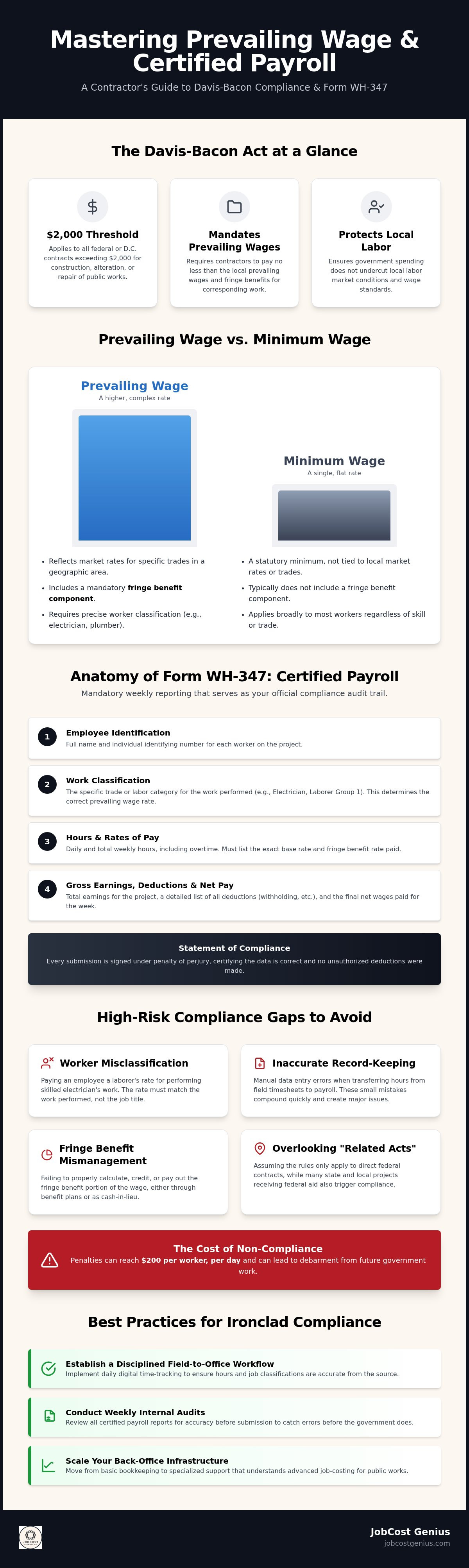
The Davis-Bacon Act, enacted in 1931, serves as the bedrock of federal construction labor law. It mandates that contractors pay laborers and mechanics no less than the locally prevailing wages and fringe benefits for corresponding work on similar projects. This requirement applies to every federal government or District of Columbia contract exceeding $2,000 for the construction, alteration, or repair of public buildings. Prevailing wage standards prevent government spending from eroding local labor market conditions. Accuracy is non-negotiable.
For many firms, the implementation of prevailing wage payroll processing for contractors represents a significant shift in financial management. While the $2,000 threshold is the federal standard, "Related Acts" extend these rules to thousands of state and local projects receiving federal assistance. These include projects funded through grants, loans, or insurance. Your compliance obligations often reach far beyond direct federal contracts into municipal infrastructure and housing. For teams working within these complex sectors or seeking broader technical resources, you may also want to visit CECANI for specialized manuals on municipal development and organizational legalities. Mistakes are costly.
Prevailing Wage vs. Minimum Wage
Prevailing wage rates are significantly higher than standard federal or state minimums. They reflect the actual market rates for specific trades in a defined geographic area. Unlike a flat minimum wage, these rates include a mandatory fringe benefit component. You can meet this obligation through employer contributions to bona fide benefit plans, cash payments, or a combination of both. Precision matters here.
Success depends on exact trade classification. A worker performing electrical tasks must receive the electrician rate, even if their internal title is laborer. Misclassifying a single worker can trigger back-pay orders and heavy penalties. Small errors compound quickly. You need a system that tracks these nuances at the source.
The 2026 Regulatory Landscape
In 2026, the Department of Labor (DOL) has intensified its enforcement focus. They're specifically targeting the transparency of fringe benefit reporting. This follows the July 2026 federal court decision in AGC of America v. U.S. Department of Labor, which clarified several contested provisions. A wage determination is the specific schedule of pay rates for a geographic area.
Contractors must also monitor "Related Acts" like the Clean Water Act or the National Housing Act. These statutes trigger Davis-Bacon requirements on projects that might otherwise appear local. Specialized prevailing wage payroll processing for contractors ensures these nuances aren't overlooked. Generalist bookkeepers often miss the specific labor burden calculations required. This leaves firms vulnerable to penalties that can reach $200 per worker per day in strict jurisdictions. Protect your profit margins.
The Anatomy of Certified Payroll Reporting (Form WH-347)
Certified payroll serves as the official bridge between your internal accounting and government oversight. It is the primary tool for proving you meet the standards of the Davis-Bacon Act. While many generalist payroll systems generate basic reports, prevailing wage payroll processing for contractors requires the specific output found in Form WH-347. This isn't just a summary of hours. It's a comprehensive audit trail that validates every penny paid to your field crew.
Every submission includes a Statement of Compliance. This document is signed under penalty of perjury, certifying that the information provided is correct and that no unauthorized deductions exist. Filing is a weekly obligation for every week work is performed. If your team isn't on-site for a specific week, you may still need to file a "no work" report depending on the project's specific contract terms. Missing a single week can trigger an immediate flag from the contracting agency.
We are seeing a rapid transition toward digital portals. Platforms like LCPtracker or the California DIR portal are becoming mandatory for most public works projects. These systems often catch errors before submission, but they require precise data entry to function correctly. Manual entry into these portals is a common source of fatigue and error for office staff. Modernizing your prevailing wage payroll processing for contractors means moving away from paper and toward integrated digital data flows; for example, firms using PeopleSoft can explore SmartTax W-4 to further automate their tax compliance workflows.
Key Components of Form WH-347
Accuracy starts with the specific data points required by the Department of Labor. You must include:
- Employee Identification: Full names and individual identifying numbers, though social security numbers are typically redacted for privacy.
- Work Classification: This must match the specific wage determination category for the project, such as "Carpenter" or "Power Equipment Operator."
- Daily Hour Tracking: You must record hours worked per day on that specific project, clearly separating them from other work.
- Gross Wages and Deductions: Every deduction must be legal and documented to ensure the worker receives the mandated net pay.
Calculating Fringe Benefits and Labor Burden
One of the most complex aspects of this process is managing fringe benefits. You can pay these as cash on the employee's paycheck or contribute them to an approved "bona fide" plan. Your choice here significantly impacts your construction labor burden calculation. Cash payments increase your payroll tax liability and workers' compensation premiums, which can erode your project margins.
Common mistakes often occur when contractors attempt to claim credits for non-bona fide benefits. Items like company vehicles, travel stipends, or cell phone allowances do not count toward the prevailing wage obligation. Only specific benefits like health insurance, 401(k) contributions, or apprenticeship funds qualify. If these calculations feel overwhelming, our Starter Plan offers a structured way to begin organizing your project costs for better clarity.
Common Compliance Gaps and Financial Risks
Compliance is more than a checkbox; it's a shield for your company's valuation and bonding capacity. While many contractors view prevailing wage payroll processing for contractors as a clerical burden, the Department of Labor views it as a legal mandate. The average penalty for a California Department of Industrial Relations public works violation is approximately $95,000. These costs don't include the legal fees or the administrative time lost during an investigation. Precision is your only defense.
Worker misclassification remains the most frequent trigger for audits. If you pay a skilled journeyman at an apprentice rate or classify a specialized trade as general labor, you're inviting a back-pay order. The DOL doesn't accept "honest mistakes" as a valid excuse. Similarly, relying on "rough estimates" for hours worked will fail an audit every time. You must maintain daily, contemporaneous records that prove exactly who was on-site and what specific tasks they performed.
The use of 1099 independent contractors is another high-risk area. In a prevailing wage environment, the DOL often views these workers as employees. Attempting to bypass labor burden requirements by using 1099s can lead to massive reclassification penalties and unpaid payroll tax liabilities. This doesn't just hurt your current project; it damages your reputation with prime contractors and government agencies alike.
The Impact on WIP Reporting
Inaccurate labor data flows directly into your financial statements, distorting your WIP reporting for construction companies. When you underestimate the true labor burden, your project appears more profitable than it actually is. This creates a dangerous phenomenon known as "profit fade." You might think you're ahead of schedule only to realize at 90% completion that the remaining labor costs exceed your remaining budget. Professional prevailing wage payroll processing for contractors helps prevent the data silos that lead to these financial blind spots.
Debarment and Legal Penalties
The most severe consequence of non-compliance is debarment. This process involves being banned from bidding on any future government contracts for a set period, often three years. Debarment can effectively end a public works contractor's business. Beyond losing future revenue, willful violations can lead to civil money penalties and, in extreme cases, criminal prosecution. Protecting your firm requires a disciplined approach to every certified report you sign. Fines can reach $200 per worker per day in strict jurisdictions, making manual errors a liability you can't afford.
Best Practices for Processing Construction Payroll
Scaling from private residential work to large-scale public infrastructure requires more than just a larger crew. It requires a fundamental shift in how you capture and verify labor data. Precision is a habit. Mastering prevailing wage payroll processing for contractors starts with establishing a disciplined workflow that bridges the gap between the job site and the accounting office. Without this bridge, even the best software will produce flawed reports.
One of the most effective strategies is the use of a construction-specific chart of accounts. This allows you to track compliance costs and labor burden separately from your standard operating expenses. You should also maintain a strict separation between private job payroll and prevailing wage payroll. Mixing these data sets in a single spreadsheet is a recipe for audit failure. Conduct weekly internal audits of all payroll data before you ever hit "submit" on a certified report. This final check is your best defense against the manual entry errors that trigger Department of Labor inquiries.
Integrating Field Data with Office Accounting
Project managers are your first line of defense in compliance. They must verify labor classifications daily to ensure that what is happening on-site matches the wage determination. This is particularly critical when handling "split shifts." If a worker performs two different trades in a single day, such as four hours of carpentry and four hours of general labor, their time must be coded to two separate classifications. Real-time visibility is essential. Syncing your field time-tracking software with your bookkeeping system ensures that office staff aren't guessing about worker roles on Friday afternoon.
If your current workflow is struggling to keep pace with these demands, our Growth Plan provides the specialized oversight needed to manage these complexities as you scale. Moving away from manual data entry toward an integrated system reduces fatigue and protects your project margins.
Training and Documentation
Your back-office team must stay current with the 2026 regulatory environment. For instance, the California Department of Industrial Relations issued general prevailing wage determinations on August 22, 2026, which went into effect on September 1, 2026. Failing to update your pay scales to match these specific dates can lead to immediate underpayment violations. Documentation is equally vital. You must maintain "records of original entry," including time cards and cancelled checks, for at least three years after the project is completed.
The Statement of Compliance is a legal document. It requires a signature from someone with actual knowledge of the payroll and the authority to certify its accuracy. This shouldn't be a rubber-stamp process. When the person signing the report understands the underlying data, they can confidently stand behind the firm's compliance during an audit. This level of meticulousness transforms payroll from an administrative burden into a foundational strength of your business.
Scaling Your Back Office with JobCost Genius
Many contractors hit a "compliance ceiling" when they first enter the public works arena. The administrative requirements of prevailing wage payroll processing for contractors can quickly outpace the capabilities of an in-house team or a generalist bookkeeper. We help you move beyond this barrier. By delegating the meticulous details of certified reporting to specialized experts, you reclaim the time needed to bid on larger, more profitable contracts. This shift transforms your back office from a bottleneck into a strategic asset.
A generalist bookkeeper often treats payroll as a simple transactional task. They might miss the specific labor burden calculations or the trade classification nuances that lead to the $95,000 average penalties seen in strict jurisdictions like California. At JobCost Genius, we focus exclusively on the construction industry. This specialized oversight is inherently safer for your business. It ensures that your fringe benefit credits are calculated correctly and that your submissions to digital portals are accurate the first time.
Our tiered service structure supports your firm at every stage of growth. You might start with our Starter Plan to get your basic project costs under control and ensure compliance on your first few public jobs. As you secure larger government contracts and your crew expands, the transition to our Growth Plan provides deeper financial analysis and more robust reporting. This logical progression ensures you always have the right level of support without paying for unnecessary overhead. We move you from a state of administrative overwhelm to one of organized, financial clarity.
Beyond Simple Data Entry
Effective financial management requires more than just filling out Form WH-347. We integrate your prevailing wage payroll processing for contractors with comprehensive financial oversight. This includes managing AP/AR and ensuring your daily field data flows seamlessly into your general ledger. Our "construction-first" team understands how labor costs impact your bonding capacity and company valuation. We keep your financials in an "audit-ready" state at all times. This provides a sense of stability when dealing with lenders, sureties, or government auditors who demand foundational strength in your reporting.
Getting Started with Professional Oversight
Identifying the right plan depends on your current team size and the complexity of your project portfolio. During our onboarding process, we conduct a thorough review of your existing books to identify any historical gaps. We clean up your data and establish compliant workflows that mirror the best practices of industry veterans. This foundational work ensures your project margins are protected from the moment you break ground. Do not let the fear of an audit hinder your firm's potential for growth. Contact JobCost Genius today to secure your project margins and build a resilient infrastructure for your business.
Secure Your Project Profitability Through Compliance
Public works projects offer a significant opportunity for contractors to stabilize their revenue and scale their operations. However, the complexity of Davis-Bacon compliance and the precision required for Form WH-347 submissions demand more than a generalist's touch. By mastering trade classifications and integrating field data with your office accounting, you protect your firm from the debarment risks and financial penalties that often plague growing businesses. Compliance protects your profit. Accuracy builds your reputation. Accurate prevailing wage payroll processing for contractors is the cornerstone of a healthy, audit-ready construction firm.
You don't have to manage these administrative burdens alone. Our team of specialized construction industry veterans provides national coverage for U.S. contractors, offering fixed monthly pricing that scales with your needs. We move you from administrative overwhelm to strategic financial confidence. Scale your construction business with expert bookkeeping from JobCost Genius and focus on what you do best: building the infrastructure of the future. It's within reach when your back office is built on foundational strength.
Frequently Asked Questions
What is the difference between prevailing wage and certified payroll?
Prevailing wage refers to the specific hourly pay and fringe benefit rates set by the Department of Labor for a trade and location. Certified payroll is the actual reporting process using Form WH-347 to prove you paid those rates. While the wage is the legal requirement, the certified report is the formal documentation submitted to the contracting agency. Effective prevailing wage payroll processing for contractors ensures these two elements align perfectly every week.
Does prevailing wage apply to all subcontractors on a project?
Yes, prevailing wage requirements flow down to every subcontractor and lower-tier subcontractor on a covered project. The prime contractor is ultimately responsible for the compliance of everyone on the job site. If a sub fails to pay the correct rate, the prime may face withheld payments or penalties. You must ensure every firm on your project understands their specific wage determination obligations before work begins.
Can I pay fringe benefits directly to the employee as cash?
You can pay fringe benefits as cash directly on the employee’s paycheck. However, this increases your payroll tax liability and workers' compensation premiums because the cash is treated as taxable gross wages. Many firms prefer contributing to bona fide benefit plans to reduce this extra labor burden. Choosing the right method is a critical part of prevailing wage payroll processing for contractors looking to protect project margins.
What happens if I misclassify a worker on a certified payroll report?
Misclassifying a worker triggers immediate back-pay orders and potential civil money penalties. The Department of Labor requires you to pay the difference between what was paid and the correct trade rate. If the violation is deemed willful, you risk debarment from all government work for up to three years. Consistent internal audits are the only way to catch these errors before they reach an agency auditor’s desk.
How often must certified payroll reports be submitted in 2026?
Certified payroll reports must be submitted weekly for every week in which work is performed on the project. This requirement remains a standard under the Davis-Bacon Act and its Related Acts in 2026. Reports are generally due within seven days after the payroll period ends. Delays in submission can lead to the immediate withholding of contract payments by the government agency or prime contractor.
Do I need to submit a certified payroll report if no work was performed that week?
Most contracts require you to submit "No Work" reports for weeks when your crew is not on-site. This maintains a continuous sequence of report numbers, such as Report #5, #6 (No Work), and #7. Failing to provide these can create gaps in the project record that suggest a lack of oversight. Always check your specific contract language to confirm if "No Work" submissions are mandatory for your current project.
How do I handle overtime pay on a prevailing wage project?
Overtime on prevailing wage projects is calculated at 1.5 times the basic hourly rate, excluding the fringe benefit amount. For example, if the base rate is $40 and the fringe is $10, the overtime rate is $60 plus the $10 fringe, totaling $70 per hour. You don't multiply the fringe benefit portion by 1.5. This distinction is a frequent source of errors in construction accounting and manual data entry.
Can 1099 independent contractors work on a Davis-Bacon project?
While 1099 workers can technically be on-site, the Department of Labor almost always classifies them as employees under Davis-Bacon rules. This means you must still pay them the prevailing wage and include them on your certified payroll reports. Treating them as independent contractors to avoid labor burden is a high-risk strategy that frequently leads to reclassification penalties. Most successful public works contractors utilize W-2 employees to ensure total compliance.


