

What if the biggest risk in vendor payments isn’t the payment itself, but the job-cost detail attached to it? When invoices, approvals, and project records sit across different teams or systems, a routine payment can be late, duplicated, or coded to the wrong job. Effective construction vendor payment management depends on clean cost data and coordinated approvals, not just a payment schedule.
Better visibility does not have to mean another layer of administration. A dependable workflow gives each invoice a clear path from receipt and review to approval and recording, while connecting the obligation to the right project and cost category. That clarity supports more useful job-cost reporting and cash planning.
This guide explains how to assign responsibilities, maintain consistent records, strengthen controls against payment errors, and compare software with internal processes and specialized bookkeeping support. You’ll also see how construction-focused AP management and monthly bookkeeping can support oversight. The goal is a practical process your team can manage consistently, with a clearer view of vendor obligations and project finances.
Key Takeaways
- Define which obligations belong in accounts payable, and distinguish vendor invoices from receivables, pay applications, and procurement.
- Build construction vendor payment management around clear review, coding, approval, and payment-status responsibilities.
- Compare spreadsheets, construction software, and bookkeeping support by how well each handles project coding, approvals, records, and staff ownership.
- Start implementation by mapping current invoice flows and records, then document a consistent process for routine items and exceptions.
- See how construction-focused AP/AR management and organized bookkeeping records can support project cost visibility and monthly reporting.
What construction vendor payment management controls, and why it matters
Construction vendor payment management is the process of tracking, reviewing, approving, recording, and planning amounts owed to vendors and subcontractors, with each obligation tied to the correct project and cost category. It covers the controls and records around an obligation, not simply the act of sending a payment. A clear process helps teams see what is due, what is awaiting review, and how each cost affects project reporting.
Keep related activities distinct. Accounts payable (AP) records amounts the company owes vendors. Accounts receivable (AR) tracks amounts customers or owners owe the company. A pay application requests payment for completed work and generally belongs on the receivables side when your company submits it. Procurement covers sourcing and ordering goods or services. It may create the purchase commitment, while AP handles the invoice and resulting obligation.
This broader view reflects Construction management principles, where budgeting, cost control, contract administration, and documentation connect operational decisions to financial oversight. For construction firms, vendor payment management should make that connection visible in everyday records.
Why construction vendor payments need project-level visibility
A vendor relationship can span multiple jobs, phases, and cost categories. A supplier might provide materials for two active projects, while a subcontractor’s invoice covers work completed across separate phases. Recording the full invoice under one project, or using a general company expense category, can make one job appear over budget and another more profitable than it is.
Project coding links an obligation to the job and cost category it belongs to. This gives managers a more useful view of costs against project budgets and supports more accurate financial reporting. Company-wide cash visibility answers, “What obligations are coming due across the business?” Job-cost visibility answers, “Which project incurred this cost, and where should it appear?” Teams need both views to plan cash and assess individual job performance.
Which payment problems a managed process can prevent
A defined process creates checkpoints where staff can catch issues before an invoice is recorded as an obligation or moves forward for approval. It can reduce the risk of duplicate records, incomplete documentation, missed approvals, and incorrect project or cost coding. No process eliminates every error, but clear review steps make exceptions easier to identify and resolve.
- Duplicate records: Compare invoice details with existing records before entering another obligation.
- Incomplete documentation: Flag missing supporting information for follow-up before the record advances.
- Unclear coding: Route project and cost-category questions to someone familiar with the work.
- Approval gaps: Make the next responsible reviewer visible so an invoice does not sit without an owner.
When ownership is unclear, project staff, accounting, and approvers may each assume someone else is following up. A recorded status and named responsibility show whether an invoice is under review, awaiting approval, or recorded for payment planning. That visibility supports coordination without implying a guaranteed payment date.
How to build a controlled construction vendor payment workflow
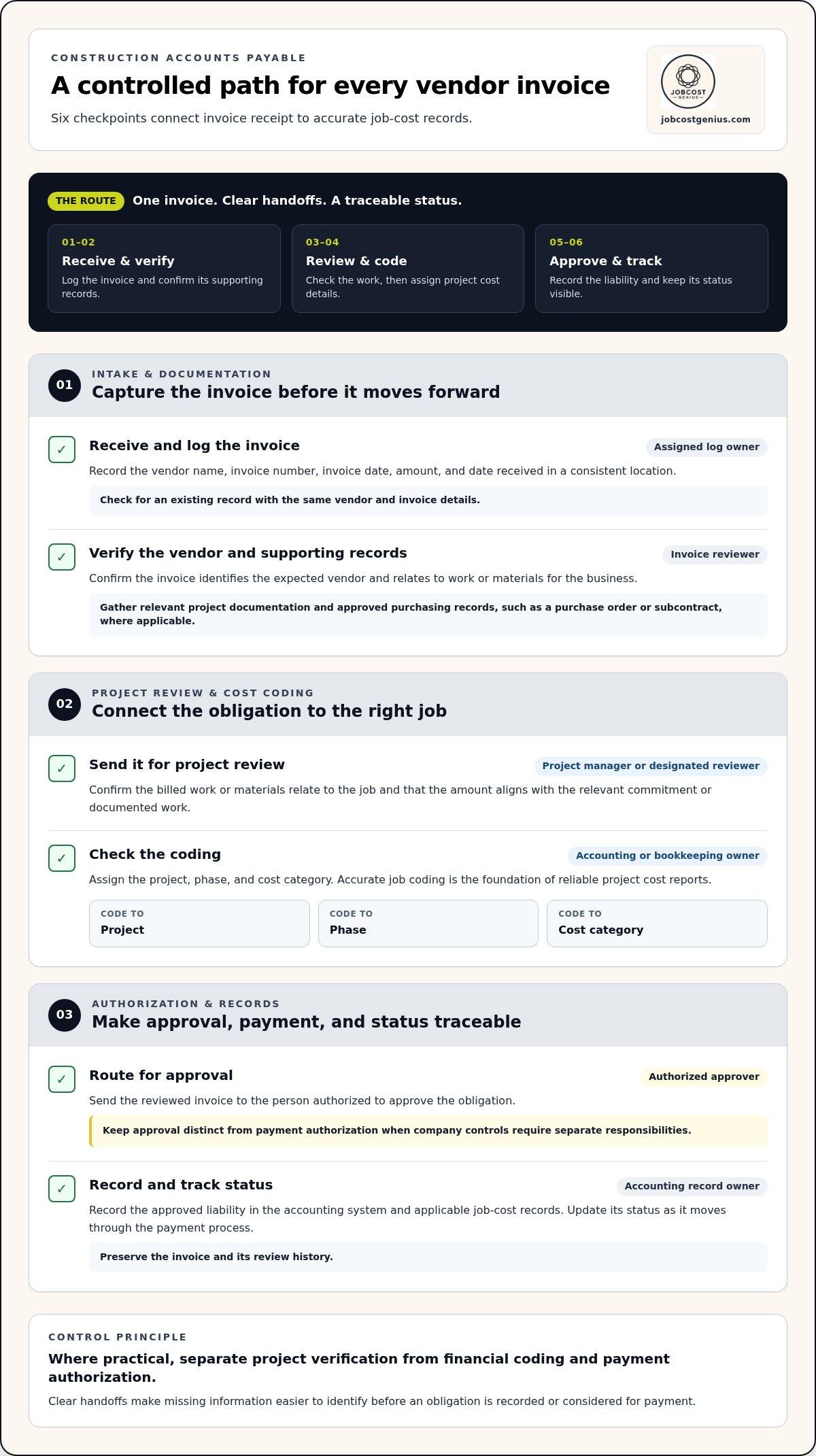
A reliable construction vendor payment management workflow gives each invoice a defined route, a responsible reviewer, and a record of its status. Where practical, separate project verification from financial coding and payment authorization. Clear handoffs make it easier to identify missing information before an obligation is recorded or considered for payment.
- Receive and log the invoice. Record the vendor name, invoice number, invoice date, amount, and date received in a consistent location. Assign someone to check for an existing record with the same vendor and invoice details.
- Verify the vendor and supporting records. Confirm that the invoice identifies the expected vendor and relates to work or materials for the business. Gather relevant project documentation and approved purchasing records, such as a purchase order or subcontract, where applicable.
- Send it for project review. The project manager or designated project reviewer confirms that the billed work or materials relate to the job and that the amount aligns with the relevant commitment or documented work.
- Check the coding. The accounting or bookkeeping owner assigns the project, phase, and cost category. Accurate job coding is the foundation of reliable project cost reports.
- Route for approval. Send the reviewed invoice to the person authorized to approve the obligation. Keep approval distinct from payment authorization when company controls require separate responsibilities.
- Record and track status. Record the approved liability in the accounting system and applicable job-cost records. Update its status as it moves through the payment process, preserving the invoice and its review history.
Route invoices through consistent project and approval checks
Use the same basic checks for each invoice, even when project requirements differ. Compare the vendor, invoice number, amount, project, cost category, and approved commitment against available records. If details conflict or support is incomplete, flag the exception, assign it to the responsible reviewer, and hold the invoice at that step. Do not guess or advance it without a clear record.
This approach aligns with Best practices for construction vendor payment management, which emphasize structured oversight of construction payments. Tailor the review path to your company’s approval authority and project documentation practices.
Keep payment records connected to construction bookkeeping
The invoice, project review, coding, approval, and payment status should remain traceable in the company’s records. Consistent AP records connect vendor obligations with job costs and monthly reporting. JobCost Genius provides construction-focused AP management and bookkeeping support to help keep those records organized. Explore construction-focused AP and bookkeeping support.
How construction firms can compare payment-management approaches
The right approach depends on where your current process loses visibility: invoice status, project coding, approval history, or bookkeeping records. Spreadsheets can be a practical starting point for a smaller volume of invoices, but they rely on staff to update and maintain shared information. Construction or procurement software may centralize project-related records, while specialized bookkeeping support connects AP administration with job costing and financial reporting.
Compare approaches against the controls your team needs, not just the number of features. The table highlights common differences. Actual capabilities vary by tool and how your company uses it.
| Area | Spreadsheets | Construction or procurement software | Specialized bookkeeping support |
|---|---|---|---|
| Workflow visibility | Depends on consistent manual updates and shared access. | Can provide a shared place to organize workflow information, depending on the platform. | Supports organized AP records and ongoing financial oversight. |
| Project coding | Staff enter and maintain project and cost details manually. | May connect invoice information to project records, subject to setup and use. | Construction-focused bookkeeping aligns AP records with job-cost categories. |
| Approval controls | Approval status must be recorded and followed up by the team. | Available controls depend on the system and its configuration. | Can support clear bookkeeping records; company approvers retain their decision-making role. |
| Recordkeeping | Depends on file organization, version discipline, and staff follow-through. | Centralized recordkeeping depends on the platform and the information entered. | Connects vendor invoice records with accounting and monthly financial records. |
| Staff ownership | Internal staff maintain the tracker and resolve exceptions. | Staff still enter data, oversee approvals, and manage exceptions. | Provides ongoing construction bookkeeping support while company staff retain operational approvals. |
Software can organize information, but it cannot define who owns each decision or make incomplete records accurate. Every approach still needs accountable staff, consistent project and cost coding, and a clear way to resolve exceptions. This comparison is about the operating model for vendor payment oversight, not a step-by-step invoice-processing procedure.
When a software-led process may fit
A software-led approach may suit teams that need shared records, standardized routing, or clearer invoice-status visibility across projects. Its value depends on disciplined data entry and named approval owners. Before relying on system records for reporting, define who maintains project and cost details, who reviews exceptions, and how staff keep records current.
When construction-focused bookkeeping support may fit
Bookkeeping support can help when vendor invoice administration needs to align with job costing and monthly financial records, particularly if internal capacity is stretched. Construction-specific invoice handling and compliance formatting help keep records organized for accounting review. Learn how outsourced bookkeeping for construction firms can support this broader financial process.
How to implement vendor payment management without disrupting operations
Change works best when it starts with the process your team already follows. Before changing tools or responsibilities, map where invoices arrive, how many the team handles, how project and cost codes are assigned, who approves obligations, and where records are stored. This review helps you address specific gaps instead of adding steps that do not solve the problem.
Use the findings to stage the rollout:
- Document the existing route. Follow a sample of invoices from receipt through review, approval, accounting records, and status updates. Note where ownership becomes unclear or information must be re-entered.
- Set one consistent workflow. Define the required handoffs, who owns each step, what information must be present, and how staff record status. Keep the process workable for project and accounting teams.
- Write down exception handling. Specify where staff send an invoice with a coding question, missing support, a duplicate flag, or an approval issue. Assign an owner for follow-up and a way to document the resolution.
- Pilot before expanding. Test the workflow on a manageable group of projects. Gather feedback from project reviewers and accounting staff, adjust unclear steps, then extend the process with updated instructions.
Track a small set of indicators during the pilot: uncoded invoices, time awaiting approval, duplicate flags, and reconciliation issues. Review patterns rather than treating each exception as an isolated problem. For example, repeated coding questions may point to an unclear cost-category reference or a gap in project setup. Use the findings to refine the workflow before wider adoption.
Set practical controls and review routines
Document approval thresholds and separate invoice review from payment authorization where company policy allows. Set a recurring review of open vendor obligations and unresolved questions, with an owner and next step for each item. Align retained records with relevant contracts, company policies, and applicable jurisdiction-specific requirements. Documentation needs can vary by project and location.
Connect vendor obligations to cash and project reporting
Use recorded obligations and their status to inform cash planning, without treating the AP list as a complete cash-flow strategy. Before using vendor data in project reports, review coding for accuracy and consistency. For broader project financial context, WIP reporting for construction companies can help frame how job costs relate to overall project performance.
Construction vendor payment management relies on both a workable process and dependable financial records. JobCost Genius provides construction-focused bookkeeping and reporting support as your workflow takes shape. Explore JobCost Genius support.
How JobCost Genius supports construction vendor payment management
JobCost Genius provides construction-focused bookkeeping and financial reporting. Its services support the records and oversight behind construction vendor payment management, from organizing vendor invoices to keeping AP and AR information aligned with construction accounting needs. This work connects day-to-day records with financial oversight and reporting.
A sound workflow pairs accurate records with people who review and authorize obligations. Construction-specific bookkeeping connects those records to job-cost categories and monthly reporting, giving company leaders a clearer financial basis for reviewing project performance and obligations.
What specialized construction bookkeeping adds to the process
Recurring bookkeeping supports consistent transaction records and monthly financial statements. Organized vendor records help the accounting team track AP, while customer records support AR oversight. Construction-focused handling also accounts for vendor invoices and construction-specific billing and compliance formatting, helping keep records organized for review and financial reporting. JobCost Genius was founded by professionals with more than 20 years of industry experience, bringing construction knowledge to this ongoing financial work.
In practice, this support reinforces the controls established in your workflow. Consistent project and cost information gives the team a more useful basis for reviewing job costs, while orderly AP records make vendor obligations easier to follow through the accounting cycle. Your company’s approvers retain responsibility for their decisions and payment authorization.
Choose support that matches the firm's stage and systems
A small firm may need a different level of bookkeeping support than a growing contractor managing more projects or an established company with broader reporting needs. JobCost Genius offers tiered plans tailored to small, growing, and established construction firms. This lets companies align ongoing financial support with their stage of operations rather than treating bookkeeping as a one-time cleanup.
Related offerings include WIP reporting and Procore Financials integration support. These can complement bookkeeping as part of a broader financial reporting approach, alongside accurate records and clear responsibility within the payment workflow. For a wider view of planning obligations against cash needs, consult this guide to construction cash flow management.
With vendor invoice handling, AP/AR management, and construction-focused financial reporting, JobCost Genius supports the recordkeeping foundation your team relies on. Explore bookkeeping support for construction firms.
Make your next payment-process improvement count
Your next improvement does not need to begin with a new system. Choose one recurring source of uncertainty, such as unclear ownership or incomplete project coding, and make it easier for your team to address. A focused adjustment can build confidence in the records without adding unnecessary steps to daily work.
As your company grows, revisit whether your current construction vendor payment management approach still fits the volume of work, project structure, and financial oversight your team needs. The right support should strengthen your accounting foundation while leaving operational decisions and payment authorization with your company.
JobCost Genius provides construction-specific bookkeeping and financial reporting, with support structured for firms at different stages. Build clearer construction financial oversight with JobCost Genius and take the next step toward a workflow your team can manage with confidence.
Frequently Asked Questions
How can a construction company prevent duplicate vendor payments?
Use a single invoice register and check each incoming invoice against existing records before approval. Compare the vendor name, invoice number, amount, and date, watching for resubmissions with altered numbering. After recording an invoice, update its status and link it to the accounting entry so reviewers can see whether it is already in process or paid. For construction vendor payment management, a repeatable duplicate check is more dependable than relying on memory.
How should contractors reconcile vendor statements?
Compare each statement line with the accounts payable ledger and the vendor invoices on file. Identify invoices that appear on the statement but not in your records, payments the vendor has not applied, and credits that may be missing. Ask the vendor about differences and document the response before adjusting records. A statement is a useful cross-check, but it should not replace invoice-level review or be entered as a new bill without checking for duplicates.
What is the difference between a vendor invoice and a subcontractor pay application?
A vendor invoice requests payment for supplied goods or services, while a subcontractor pay application typically requests progress payment for work performed during a project period. For example, an invoice may bill for delivered materials; a pay application may outline work completed against a subcontract. The documents can require different review and supporting records. Classify each according to the transaction and your accounting process rather than treating every request for payment as an invoice.
How should a contractor handle a vendor credit?
Record a vendor credit as its own transaction and connect it to the original invoice or purchase, when identifiable. Confirm the credit amount and reason against the supporting credit memo or vendor communication, then apply it to the appropriate open balance or account under your accounting procedure. Do not simply reduce a later invoice total without recording the credit separately. A clear link between the credit and the affected cost helps preserve an understandable audit trail.
What records should a construction company keep for vendor payments?
Maintain the invoice and supporting project records, such as the relevant purchase documentation, delivery confirmation, or work review. Keep a record of coding, approvals, vendor credits, payment status, and any questions or corrections. For example, if an invoice is split across two jobs, retain enough detail to show how the amount was allocated. Follow company recordkeeping policies and applicable contract or jurisdiction-specific requirements when determining retention practices.
Do construction vendor payment platforms replace bookkeeping?
No. A payment or construction management platform may organize invoice details and related workflow information, but bookkeeping still involves maintaining accounting records, reconciling activity, and preparing financial reports. A platform also depends on accurate information and defined staff responsibilities. Treat software as part of the financial process, not a substitute for accounting oversight. Construction-focused bookkeeping support can connect AP records with job costs and monthly financial reporting.
Should vendor payments be made before an invoice is approved?
Generally, a company should complete its required invoice review and approval before authorizing payment. Paying first can leave the business without a documented decision on the vendor, amount, project allocation, or supporting records. If a documented company policy or contract calls for an exception, route it through the appropriate authorization and record the reason. Keep the exception visible so it can be reviewed during reconciliation rather than handled informally.


