

What if a bookkeeping plan records every transaction but still leaves you guessing whether a project is profitable? Contractor bookkeeping subscription plans should do more than keep the ledger current. In construction, job costs, progress billing, retainage, payroll, and cash flow all shape what the numbers mean.
Comparing plans by monthly workload and service level is a useful start. But transaction processing alone may not give you the project visibility needed to manage costs or understand cash needs. The right fit depends on your operation’s complexity, payroll and billing demands, and the financial insight you expect from recurring support.
This guide explains what construction-focused bookkeeping can cover, how to match a plan to your company’s workload, and how to prepare for a consistent monthly process. You’ll also learn how JobCost Genius’s Starter, Growth, and Premium plans fit into the picture, along with WIP reporting and Procore Financials integration. The goal is organized records and clearer insight into jobs and cash flow.
Key Takeaways
- Compare contractor bookkeeping subscription plans by the workload and financial oversight your business needs, not by tier names alone.
- Use project complexity, payroll and billing demands, reporting needs, and your team’s capacity to guide plan selection.
- Clarify how recurring work covers recordkeeping, reconciliations, payroll, AP/AR, and reporting.
- Prepare account records, payroll details, and project documentation so monthly bookkeeping can follow a clear, consistent process.
- JobCost Genius offers Starter, Growth, and Premium plans, as well as WIP reporting and Procore Financials integration for construction-focused financial workflows.
Why contractor bookkeeping subscription plans need to fit construction work
A bookkeeping subscription is recurring financial work delivered each month under an agreed scope. It establishes a regular process for organizing records, reconciling accounts, and preparing financial information. The scope matters: a subscription is not simply a software license, and it is different from a one-time cleanup.
Quotable definition: Reliable monthly bookkeeping turns organized, project-aware records into timely information contractors can use to make operating decisions.
Why construction bookkeeping differs from generic monthly record keeping
A company-wide expense category can show that money went to materials or labor. By itself, it won’t show which project incurred the cost, whether that cost matches the work billed, or how the job is performing overall. Contractors need financial records with enough project detail to connect costs and revenue to the work they relate to.
That connection is the foundation of job costing: assigning project costs and revenue to individual jobs so performance can be assessed at the project level. For example, a materials purchase recorded only as a general expense may be accurate in the company ledger but less useful for understanding a specific job’s financial picture. Construction accounting covers the specialized concepts behind these records. For a broader overview of the discipline and its processes, see this construction accounting guide for small firms.
Project-level records also help owners interpret company-wide results. A strong month overall can hide a job with rising costs, while a temporary cash squeeze may reflect the timing of project billing and payments rather than the company’s full financial position. Preserving the connection between transactions and jobs gives financial reports more operational meaning.
What a recurring subscription is designed to solve
Recurring bookkeeping replaces irregular catch-up with a repeatable monthly process. A consistent close organizes the period’s recorded activity and gives owners a dependable starting point for reviewing cash flow, obligations, and project performance. It also helps prevent administrative backlogs by making routine recordkeeping an ongoing responsibility instead of a task postponed until records become difficult to reconstruct.
That ongoing scope differs from one-time cleanup, which addresses historical records or an accumulated backlog. It also differs from standalone software: software provides a tool, while bookkeeping applies a process to the business’s records. Tax preparation support is another distinct part of financial administration. JobCost Genius provides tax preparation support, while a monthly bookkeeping subscription is defined by its recurring recordkeeping and reporting work.
Reliable reporting depends on the information entering the process. Contractors need to provide accurate, timely source records, such as transaction details and project documentation. Missing or delayed information can limit how complete and current the books are, even when the monthly workflow is clearly defined. Set expectations for both the recurring work and your team’s role in supplying records. That shared structure turns bookkeeping into useful oversight, rather than data entry without decision context.
What contractor bookkeeping subscription plans can cover each month
A useful monthly scope connects routine bookkeeping tasks to the decisions contractors need to make. The work can include recordkeeping and reconciliations, payroll processing, accounts payable and receivable management, and financial reporting. Compare the stated scope with your company’s workload instead of assuming every subscription covers the same activities.
Records, reconciliations, and monthly financial statements
Transaction categorization organizes spending and income into consistent accounts, while bank reconciliations compare recorded activity with account statements. Together, these tasks help identify missing transactions and keep the books aligned with source records. Connecting transactions to the relevant job adds project context, making financial reports more useful than company-wide totals alone.
Consistent records create a stronger foundation for monthly financial statements, such as a profit and loss statement and balance sheet. These reports help owners review results and understand the company’s financial position. When comparing plans, identify which reconciliations are performed, how the monthly close is structured, and which reports the recurring scope delivers. This lets you judge the work by useful outputs, not just task labels.
Payroll, payables, receivables, and project reporting
Payroll processing helps record labor activity in the books. For contractors, labor costs can influence a job’s financial picture, so accurate payroll information and appropriate project coding matter. AP/AR management supports the flow of money in and out by handling vendor invoices, customer billing, and payment records. Construction-specific billing formats and payment applications can also be part of the workflow.
Financial reporting turns those records into information for review. Work in Progress (WIP) reporting addresses a distinct project-level need by helping contractors assess project status and financial performance. It is not interchangeable with routine transaction processing. Contractors who need this view can explore the construction WIP reporting guide to understand how it fits into financial oversight.
- Records and reconciliations: organize transactions and align the books with account activity.
- Payroll processing: record labor activity for clearer financial tracking.
- AP/AR management: handle vendor invoices, customer billing, and payment activity.
- Reporting: prepare financial statements and project-focused reports such as WIP.
Tax preparation support helps organize financial records for tax-related work. Define responsibilities clearly so bookkeeping, payroll, billing workflows, and reporting work together. To assess how recurring bookkeeping could support your construction workflows, review JobCost Genius bookkeeping plans alongside the work your business needs each month.
How to compare contractor bookkeeping plan levels and find the right fit
Plan names alone don’t show whether a subscription matches your operation. Compare contractor bookkeeping subscription plans against four factors: monthly workload, operational complexity, reporting needs, and the bookkeeping capacity you already have. The right scope covers the recurring work that supports your decisions without leaving important gaps or adding oversight your business won’t use.
Decision rule: As jobs, teams, and billing workflows become more complex, the need for coordinated financial oversight usually grows too.
Workload: Consider the volume and consistency of transactions, invoices, payroll activity, and account reconciliations.
Company complexity: Look at the number of active jobs, how costs are tracked, and how much coordination your project and financial workflows require.
Reporting needs: Decide whether company-wide statements are enough or whether you need project-level insight, including WIP reporting.
Internal capacity: Identify which records your team can prepare reliably and which recurring tasks need support.
JobCost Genius offers Starter, Growth, and Premium plan levels. Compare them against your actual workload and desired oversight rather than assuming a tier name automatically defines a particular set of services. Review the scope of each option and consider how it fits your current work and likely operational changes.
When a simpler bookkeeping subscription may be sufficient
A smaller operation with relatively straightforward transactions, fewer moving parts, and limited administrative capacity may need a focused recurring process more than broad financial oversight. Even at this stage, consistent reconciliations and dependable monthly records matter. They help the owner work from organized information instead of an incomplete picture assembled only when a decision or deadline demands it.
List the tasks that must happen every month and the reports you’ll actually review. A simpler fit isn’t the same as skipping financial discipline; it means aligning recurring work with the business’s current complexity.
When growth or complexity calls for broader oversight
More employees, several concurrent jobs, and heavier billing workflows can make financial coordination harder. These changes can increase the need to connect payroll and project activity, monitor receivables, and understand how individual jobs are progressing. If company-level results don’t answer your project questions, consider whether WIP reporting would provide useful visibility.
Value isn’t a count of tasks. It’s the practical oversight those tasks produce. Reconciliations may be completed accurately, for example, but their business value depends on whether the resulting records are timely and useful for reviewing cash needs or making operating decisions. Compare the plan scope with the reports you need, the work your team can reliably provide, and the complexity you’re managing. That gives you a clearer basis for selecting a tier and reassessing the fit as the business changes.
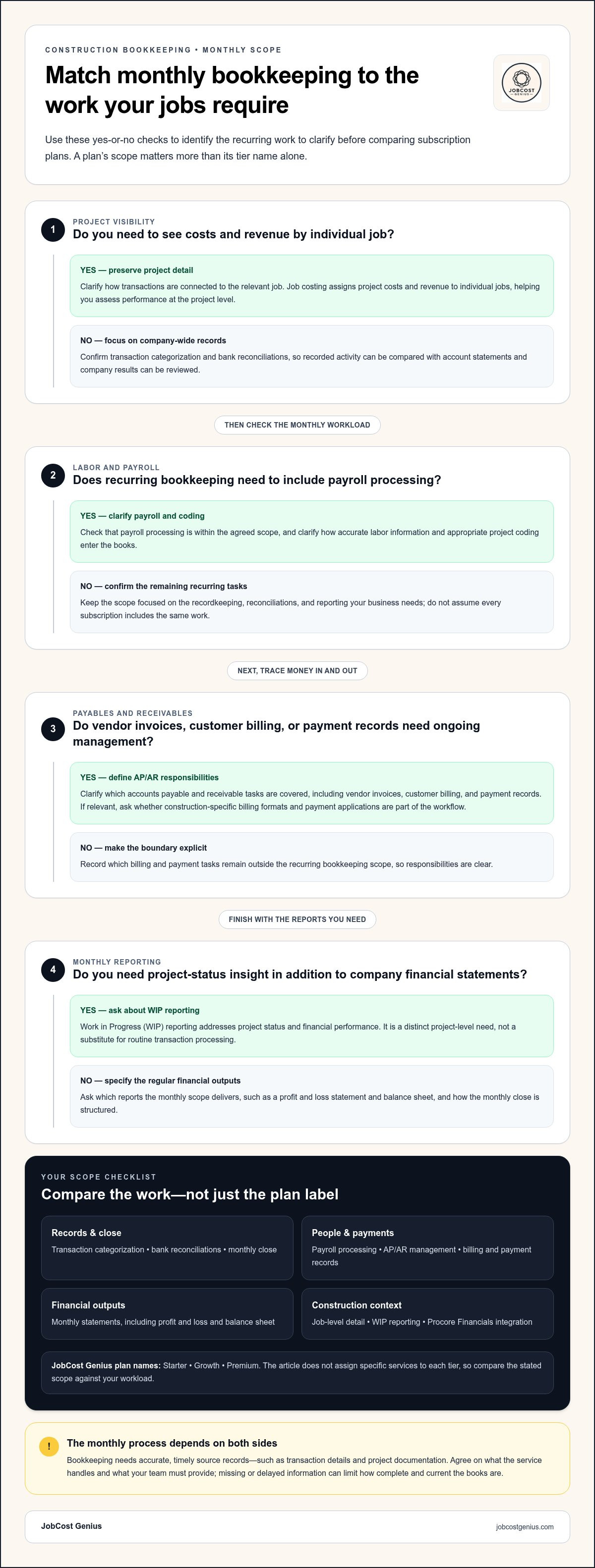
How to assess a bookkeeping subscription before the monthly work begins
A clear starting process helps turn a bookkeeping agreement into a repeatable monthly workflow. Before work begins, gather the records the process depends on, decide who supplies and approves information, and identify the reports management needs. This preparation also makes it easier to compare plans by practical fit, not just stated scope.
Prepare financial records and define recurring responsibilities
Build a current inventory of financial and project records. Include bank and credit card accounts, payroll details, vendor bills, customer invoices, and documentation that connects costs and revenue to jobs. Note which accounts are active and where supporting documents are stored. Gaps are easier to identify before the first recurring close than after a report is due.
- Gather account records. Collect recent bank and credit card statements, account details, and transaction support so the bookkeeping process has a clear starting point.
- Organize payroll information. Identify the payroll records and labor details used to record employee costs, along with the person responsible for supplying them.
- Collect vendor and customer documentation. Assemble bills, invoices, payment records, and relevant billing documents to support AP/AR tracking.
- Group project documentation. Make job-related records easy to connect to the correct project, including cost and billing support used in your existing workflow.
Next, set responsibilities. Decide who provides source documents, who reviews or approves routine transactions, and how questions about unclear items will be resolved. Establish a consistent handoff method for each accounting period, such as a shared document process with clear file naming. A predictable handoff reduces avoidable follow-up and helps keep the monthly close moving.
Set reporting expectations and connect the right systems
Define what management needs to see regularly. That may include company financial statements, cash-related information, or project-level reporting. Specify the reporting period and who will use each view. Clear expectations align the bookkeeping scope with the decisions the reports are meant to support.
Then map how information moves between field and office systems. If project and financial activity is managed through Procore, Procore Financials integration can help coordinate those workflows. JobCost Genius provides Procore Financials integration. Establish which system holds each record and how project activity should connect with accounting data.
With records, responsibilities, and reporting priorities organized, you’ll have a stronger foundation for ongoing bookkeeping. Explore JobCost Genius bookkeeping plans to see how construction-focused recurring support can align with your company’s financial workflow.
Explore JobCost Genius contractor bookkeeping subscription plans
JobCost Genius provides construction-focused recurring bookkeeping and financial reporting for contractors. The service supports organized records and gives owners clearer information for managing company finances and projects. Its contractor bookkeeping subscription plans include Starter, Growth, and Premium options for businesses to compare as their workload and oversight needs change.
A construction-focused approach to recurring financial oversight
Construction finances involve more than recording company-wide transactions. Owners need records that make sense in the context of jobs, labor, billing, and project performance. JobCost Genius brings construction-industry experience informed by professionals with more than 20 years of industry experience, grounding recurring bookkeeping and reporting in the realities contractors manage.
JobCost Genius provides monthly recordkeeping, payroll processing, accounts payable and receivable management, and tax preparation support. The company also offers WIP reporting and Procore Financials integration. These services address different financial needs, so the right combination depends on the company’s operations and reporting priorities.
For a contractor, organized records can support more than a clean close. They can help connect financial activity to operating questions, such as how project costs are developing or what the company needs to monitor across receivables and cash flow. The practical value comes from matching recurring work and reporting to the way the business runs, rather than treating bookkeeping as isolated data processing.
Choose the next step that matches your company’s needs
Use three considerations to narrow the fit: the volume of monthly activity, the complexity of your jobs and workflows, and the level of company or project reporting you need. A business with straightforward activity may prioritize a consistent financial foundation. A contractor managing expanding teams, concurrent jobs, or more involved billing may place greater value on broader visibility and coordinated support. The Starter, Growth, and Premium tiers give you options to evaluate against those needs, but a tier name alone doesn’t define its scope.
It can also help to understand how ongoing support fits within the broader bookkeeping landscape. This outsourced bookkeeping guide for construction offers additional context for contractors considering recurring financial support.
Before choosing, identify the work your team needs handled regularly and the reports that would make financial review more useful. Then explore JobCost Genius subscription options to find a plan level aligned with your workload, operational complexity, and desired project visibility. A considered fit can establish a steadier bookkeeping rhythm and a clearer foundation for contractor decisions.
Build a clearer financial rhythm for your next stage
The right bookkeeping arrangement should support the way your company operates now and leave room for its needs to change. As you evaluate contractor bookkeeping subscription plans, focus on the financial decisions you want to make with greater confidence. What information would help you spot a job that needs attention? Which recurring tasks are pulling time away from running projects? What would make your monthly review more useful?
Use those questions to shape your next step. A clear view of your workload, reporting priorities, and internal capacity gives you a practical basis for choosing an appropriate level of support. It also helps turn bookkeeping from a periodic obligation into a steadier part of managing the business.
JobCost Genius offers construction-focused bookkeeping and financial reporting, supported by professionals with more than 20 years of industry experience. Explore the Starter, Growth, and Premium options to see which direction fits your operation. Explore JobCost Genius bookkeeping plans and take the next step toward more organized financial oversight.
Frequently Asked Questions
What is included in a contractor bookkeeping subscription?
A contractor bookkeeping subscription covers recurring financial tasks, with the specific scope defined by the service. It can include transaction categorization, bank reconciliations, and monthly statements, as well as construction-related services such as payroll processing and AP/AR management. JobCost Genius provides recurring bookkeeping and contractor financial services. Map the work to your processes, including who sends invoice records and who reviews unusual transactions.
How do I choose between contractor bookkeeping subscription plans?
Choose a plan by matching its stated scope to your business’s activity and reporting needs. Consider whether your workload includes frequent transactions, multiple active jobs, payroll changes, or customer billing steps that require close coordination. Then identify what your team can consistently manage and where recurring support would help. Comparing plans this way grounds the decision in day-to-day needs. Reassess as your projects and administrative workload change.
Are bookkeeping subscription fees tax deductible for contractors?
Whether bookkeeping fees are deductible depends on your business circumstances and applicable tax rules, so there isn’t a universal answer for every contractor. Keep invoices and payment records with your business expense documentation, and ask a qualified tax professional how the expense applies to your situation. Bookkeeping helps maintain organized financial records, but that is separate from tax advice. Keep your records clear enough to show what service was paid for and when.
Can a bookkeeping subscription help track construction job costs?
Yes, recurring bookkeeping can support job-cost tracking by maintaining consistent records of project-related financial activity. For example, recording a supplier charge with the correct job reference makes it easier to review that cost alongside other project activity. The usefulness of the view depends on the detail in source records and how project information is captured. Job-cost tracking and WIP reporting are related but distinct, so identify which reports answer the questions your team needs to resolve.
How does contractor bookkeeping differ from general small-business bookkeeping?
Contractor bookkeeping accounts for financial activity tied to projects, rather than treating every transaction only as a company-wide expense or income item. A cost recorded without its job reference, for example, may be less useful for evaluating project performance. Construction billing and project schedules also shape how owners interpret financial results. A construction-focused process keeps those workflows in view, helping contractors use records that better reflect how their work is delivered and billed.
What should I prepare before starting a bookkeeping subscription?
Prepare current account statements, accounting records, payroll information, vendor bills, customer invoices, and project documents. Also write down who approves payments, who provides supporting records, and which reports management needs to review. A consistent folder structure by accounting period and job makes source documents easier to locate. If records are incomplete or spread across different systems, note those gaps early to establish a realistic starting workflow.


