

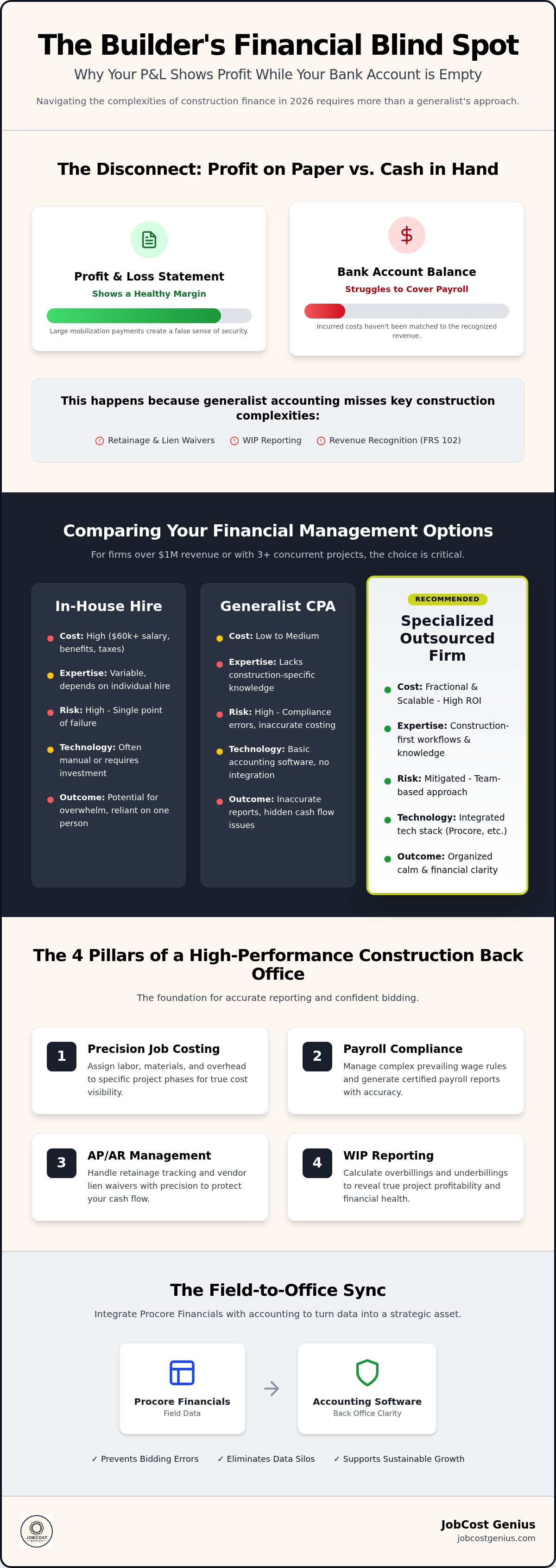
Why does your Profit and Loss statement show a healthy margin while your bank account struggles to cover the next mobilization? It's a disconnect that signals a lack of project-level visibility. You've likely dealt with the stress of prevailing wage compliance or the disruption caused by frequent admin staff turnover. These hurdles make it nearly impossible to maintain a steady financial workflow. Many owners find that generalist accountants simply don't understand the complexities of retainage or job costing. This is why specialized outsourced bookkeeping for construction firms has become the essential standard for growth-minded builders in 2026.
We believe your financial data should provide a roadmap, not a riddle. This guide explores how specialized financial management transforms administrative overwhelm into a state of organized calm and financial clarity. You'll discover how to navigate the 100% bonus depreciation under the One Big Beautiful Bill Act and adapt to the 2026 FRS 102 revenue recognition models. We will outline the path to achieving accurate monthly WIP reports and seamless Procore integrations. This approach ensures your back-office costs scale with your business while maintaining the meticulous accuracy your projects demand.
Key Takeaways
- Understand the critical difference between generalist CPAs and specialized services that handle construction-specific revenue recognition and retainage.
- Discover how specialized outsourced bookkeeping for construction firms eliminates the single-point-of-failure risk often associated with in-house administrative staffing.
- Learn why Work in Progress (WIP) reporting is the essential 2026 tool for maintaining real-time visibility into project profitability and cash flow.
- Master the field-to-office sync by integrating Procore Financials with your accounting software to prevent bidding errors and data silos.
- Identify the right path for your business growth using a tiered framework that scales from foundational support to complex financial oversight.
What is Specialized Outsourced Bookkeeping for Construction Firms?
Specialized Bookkeeping for the building trades is a managed service that provides industry-specific financial oversight. It extends far beyond basic data entry; it involves a comprehensive system that tracks every dollar from initial transaction to the final Work in Progress (WIP) report. For many contractors, outsourced bookkeeping for construction firms represents a strategic transition from administrative overwhelm to a state of organized calm. It replaces the frantic search for missing invoices with a disciplined, project-focused workflow designed to capture costs in real-time.
This specialized approach focuses on the technical pillars that generalist accountants often miss. These core components include:
- Job Costing: Assigning labor, materials, and overhead to specific project phases.
- Payroll Compliance: Managing complex prevailing wage rules and certified payroll reports.
- AP/AR Management: Handling retainage tracking and vendor lien waivers with precision.
- WIP Reporting: Calculating overbillings and underbillings to reveal true project profitability.
Why Generalist Accounting Fails the Contractor
Generalist CPAs typically rely on cash-basis or simple accrual methods that don't reflect the reality of a construction site. In 2026, the updated FRS 102 revenue recognition model requires a specific five-step approach to recognize profit over time. If your bookkeeper isn't adjusting for these rules, your Profit and Loss statement is effectively lying to you. It might show a surplus because you just received a large mobilization payment, even though your incurred costs are lagging. Unlike retail or service sectors where revenue is recognized at the point of sale, construction accounting in 2026 requires matching income to project milestones and actual costs incurred. This ensures you don't overspend today only to find a cash hole at the end of the project.
The Back-Office as a Growth Engine
A robust back office isn't just a cost center; it's the foundation for scaling your business. When you use outsourced bookkeeping for construction firms, you gain the data necessary to bid with confidence. You can analyze past performance at the phase level to identify where margins are slipping. This level of detail is critical for securing bonding and financing in 2026, especially as the gross receipts threshold for the small contractor exception sits at $32 million. Lenders and sureties look for the "organized calm" that comes from professional financial management. By integrating tools like Procore Financials, you turn your financial data into a strategic asset that supports sustainable growth rather than a burden that holds you back.
Comparing Your Options: In-House vs. Generalist vs. Specialized Specialist
Every contractor eventually reaches a point where "doing the books" on weekends is no longer sustainable. You're faced with three primary paths: hiring in-house, using a local generalist, or partnering with a specialized firm. Choosing the wrong one often leads to expensive cleanup projects later. This decision usually hinges on specific revenue milestones. If you're managing more than three concurrent projects or reaching the $1M annual revenue mark, the complexity of your financial reporting requires more than basic data entry.
An in-house hire brings a sense of proximity, but it comes with high overhead. A qualified construction controller often commands a salary exceeding $60,000, plus benefits and payroll taxes. This model creates a single point of failure; if your bookkeeper leaves, your entire financial workflow stops. You also inherit the burden of managing their performance and providing ongoing training on changing 2026 tax laws. Local generalists offer a lower price point but carry significant risks. They often treat construction like retail, ignoring the nuance of retainage and certified payroll. This leads to inaccurate job costing and compliance errors that can trigger audits.
This is where outsourced bookkeeping for construction firms provides the highest ROI. These firms use construction-first workflows and scalable technology. You get the expertise of a full team for a fraction of the cost of a single senior hire. They understand the "organized calm" that comes from having a back office that scales with your project load.
Cost vs. Value: The Real ROI of Outsourcing
For business owners across various industries who need to reclaim their time, On the Hook Bookkeeping offers professional bookkeeping and payroll services that bring similar levels of organization and clarity to their financial records.
The real ROI of outsourcing isn't just about the monthly fee. Subscription models, like our Growth Plan, eliminate hidden costs like software licenses, workstation setups, and employee benefits. Most importantly, a specialized team significantly reduces overbilling and underbilling errors. These errors often hide cash flow problems until it's too late to fix them. A specialized firm ensures your WIP reports are accurate every month, protecting your margins from the start. If you're ready to move toward project-level clarity, you can explore our tiered plans to see which fits your current revenue milestone.
Mitigating the 'Loss of Control' Myth
Some owners fear that outsourcing means losing touch with their data. In reality, cloud-based systems provide 24/7 visibility. You can see your WIP reports and project profitability from any device at any time. Organizations like the Construction Financial Management Association (CFMA) emphasize that modern financial management relies on this level of real-time data access. You aren't losing control. You're gaining a team of experts who ensure your data is actually useful for decision-making. Understanding the Construction Bookkeeper vs Generalist: Why It Matters helps clarify how specialized oversight protects your company's foundational strength.
The 4 Pillars of a High-Performance Construction Back Office
A high-performance back office functions as the central nervous system of a construction company. It transforms raw data into actionable insights that protect your margins. When you utilize outsourced bookkeeping for construction firms, you're investing in a system built on four foundational pillars. These pillars ensure that your financial health is visible, predictable, and compliant. This structure moves your business away from reactive fire-fighting and toward a state of organized calm.
Accurate job costing serves as the first pillar. It requires tracking every dollar spent at both the project and phase levels. Without this granularity, you can't determine which tasks are profitable and which are draining your resources. This data is vital for precise bidding in a market where input prices for nonresidential construction increased by 8.4% as of May 2026. Knowing your exact costs per phase allows you to adjust future bids to reflect current market realities.
WIP Reporting: The Pulse of Your Profit
A Work in Progress (WIP) report is the second pillar and the most critical tool for managing project health in 2026. It identifies "project fade" before it erodes your profit. By utilizing accrual accounting, a WIP report shows whether you're overbilled or underbilled. This provides a true financial view that a standard P&L simply cannot offer. Professional organizations like the Construction Financial Management Association (CFMA) advocate for this level of reporting to ensure long-term stability and bonding capacity. To master this process, refer to our WIP Reporting for Construction: The Definitive 2026 Guide.
The third pillar is payroll compliance. With the construction industry needing to attract an estimated 349,000 new workers in 2026, managing a diverse workforce is increasingly complex. You must handle prevailing wage rules, certified payroll for public works, and 1099 contractor documentation with meticulous care. Errors here don't just lead to financial loss. They can result in legal penalties and the loss of eligibility for government contracts.
Streamlining Cash Flow through AP/AR
The final pillar is the management of Accounts Payable (AP) and Accounts Receivable (AR). This involves fast-tracking the draw request process to shorten your payment cycles. Efficient outsourced bookkeeping for construction firms ensures that lien waivers are tracked and insurance certificates are monitored for every subcontractor. This discipline prevents costly legal disputes and keeps projects moving. Managing these cycles is the key to maintaining liquidity when material costs are volatile. You can find more strategies in our guide on Construction Cash Flow Management. By stabilizing these four pillars, you create a back office that supports sustainable scaling.
The Field-to-Office Sync: Software and Integration Mastery
A "disconnected" office creates data silos that directly lead to bidding errors and lost profits. When field teams and office staff operate on separate, unlinked platforms, the resulting friction creates administrative overwhelm. This specific challenge is why outsourced bookkeeping for construction firms has become a strategic necessity. By centralizing data, you ensure that every project manager, estimator, and accountant works from the same set of numbers. This synchronization eliminates the information lag that often hides project fade until it's too late to intervene.
Procore Financials: Bridging the Gap
Mastering the Procore Financials Integration Services is essential for modern project oversight. This integration bridges the field-to-office gap by automating the flow of costs between your project management software and your accounting system. It significantly reduces double-entry and administrative errors that occur when data is manually moved between silos. By providing project managers with real-time budget vs. actual data, you empower them to make decisions based on facts rather than intuition. This transparency ensures that field leadership is fully aligned with the company’s financial goals.
While Procore manages the day-to-day project lifecycle, QuickBooks serves as your ultimate Source of Truth. Ensuring data integrity across these platforms requires a disciplined approach to software maintenance. An outsourced partner acts as a strategic guide, maintaining and optimizing your tech stack so you don't have to. They ensure that every commitment, change order, and invoice is correctly mapped. This level of meticulousness is what creates the "organized calm" necessary for scaling a construction business without increasing administrative headcount.
Modernizing Legacy Systems
A major trend in 2026 is the rapid transition from desktop legacy software toward cloud-based agility. Many firms are moving away from Sage 300 and similar on-premise systems to benefit from the mobility and security of the cloud. This transition is critical for maintaining compliance with the 2026 FRS 102 revenue recognition standards. "Real-time visibility into job costs is the single most important factor for protecting margins in a volatile market, ensuring that every dollar spent is tracked against the budget," according to financial analysts. This shift ensures that your financial data is accessible, secure, and ready for analysis at any moment.
If your current software feels like a burden rather than a tool, it's time to modernize your workflow. Explore our Procore integration support to see how we can unify your field and office data for better project-level clarity.
Choosing Your Path: The JobCost Genius Tiered Framework
Selecting the right level of support is essential for maintaining project-level clarity as your business evolves. Unlike generalist firms that offer one-size-fits-all solutions, JobCost Genius provides a structured framework designed to match your specific growth stage. This tiered approach ensures you aren't paying for enterprise-level features before you need them, while guaranteeing you have the foundational strength to scale. For many owners, outsourced bookkeeping for construction firms starts with a focus on clean data and reliable transaction entry starting at our $800 monthly baseline.
- Starter Plan: This is the baseline for emerging contractors who need to move away from spreadsheet-based accounting. It focuses on establishing a solid foundation with accurate job costing and basic financial reporting.
- Growth Plan: Designed for expanding teams, this plan adds deeper oversight for complex projects. It includes more frequent reporting and advanced cash flow management to support a growing project pipeline.
- Premium Plan: This enterprise-level offering includes specialized Procore Financials integration and strategic financial reporting. It's built for firms requiring real-time field-to-office synchronization and high-level technical support.
Identifying Your Milestone
Knowing when to transition between tiers depends on your revenue milestones and project complexity. A firm reaching the $2M to $5M annual revenue mark often outgrows the Starter Plan as payroll compliance and multiple-project tracking become more demanding. If you're managing large-scale commercial contracts or require a dedicated Procore integration to sync your field and office data, the Premium Plan becomes the necessary choice. We act as your strategic guide, helping you identify these triggers before administrative friction begins to erode your margins. Our team understands the unique pressures of the 2026 market, ensuring your back office remains an asset rather than a bottleneck. Utilizing outsourced bookkeeping for construction firms allows you to focus on the job site while we handle the technical financial infrastructure.
Ready for Financial Clarity?
The transition to professional oversight should never disrupt your ongoing work. Our onboarding process is methodical and logical, designed to integrate seamlessly with your current operations. During the first 30 days, we focus on back-office setup and cleaning up your historical data. We prioritize fixing your WIP reporting to ensure you have immediate visibility into project profitability. This initial phase transforms administrative overwhelm into a state of organized calm. If you're ready to stop guessing at your margins and start building on a foundation of data, it's time to take the next step. Schedule your discovery call with JobCost Genius today to begin your journey toward financial clarity.
Build Your Future on a Foundation of Financial Clarity
Modern construction requires more than just tracking expenses. It demands real-time visibility into project health and seamless field-to-office synchronization. By adopting outsourced bookkeeping for construction firms, you replace administrative friction with a structured system built for growth. You've seen how specialized WIP reporting and Procore integrations protect your margins from project fade.
JobCost Genius acts as your strategic guide, providing the meticulous oversight needed to navigate 2026 tax laws and labor shortages. Our tiered plans start at $800 per month, ensuring that expert financial management is accessible at every stage of your business. Every plan includes specialized WIP reporting to keep your cash flow predictable. Whether you need the foundational support of our Starter Plan or the enterprise-level mastery of our Premium Plan, we're here to ensure your back office is a growth engine.
Ready to scale with confidence? Explore JobCost Genius Bookkeeping Plans
It's time to trade administrative overwhelm for the organized calm your business deserves.
Frequently Asked Questions
What is the difference between a general bookkeeper and a construction specialist?
A construction specialist understands the unique financial lifecycle of a project, whereas a generalist focuses on simple cash flow. Specialized outsourced bookkeeping for construction firms prioritizes job costing, retainage tracking, and Work in Progress (WIP) reporting. These elements are vital for accurate revenue recognition under 2026 standards. Without this expertise, your P&L might show profit while your project is actually underbilled, creating a dangerous gap in your financial visibility.
How much does outsourced construction bookkeeping cost in 2026?
Our tiered service plans are designed to scale with your business needs. The Starter Plan begins at $800 per month, providing a solid foundation for emerging contractors. As your project volume and complexity increase, you can transition to our Growth or Premium plans. These higher tiers provide the advanced reporting and technical support required for larger operations, ensuring your back-office costs remain predictable while your business grows.
Do I still need an in-house person if I outsource my bookkeeping?
You don't need a dedicated in-house bookkeeper when you partner with a specialized firm. We manage the transaction entry, reconciliations, and financial reporting that typically consume an admin's time. This allows your team to focus on project management and field operations. While you'll still need someone to handle on-site duties like collecting timecards or receiving materials, our system eliminates the need for a full-time office controller or accounting clerk.
Can you integrate with Procore and QuickBooks Online?
Yes, we specialize in bridging the data gap between the field and the office. We provide expert Procore Financials integration support to ensure your project data flows seamlessly into QuickBooks Online. This synchronization eliminates double-entry and reduces administrative errors. By maintaining QuickBooks as your "Source of Truth," we ensure your financial reports reflect real-time project costs, allowing your project managers to make informed decisions based on accurate budget data.
How do you handle certified payroll and prevailing wage reports?
We maintain meticulous workflows to handle the complexities of certified payroll and prevailing wage compliance. Our team ensures that your labor costs are correctly categorized and that all required reports are filed accurately and on time. This is particularly critical in 2026, as labor regulations continue to evolve. By managing these technical requirements, we protect your eligibility for public works contracts and prevent the legal penalties associated with non-compliance.
What happens if I already have a messy set of books?
We frequently onboard firms with disorganized financial records. Our first 30 days are dedicated to a structured cleanup process where we reconcile accounts and establish accurate job costing. We transform your existing data into a clean, reliable foundation for future growth. This initial setup period is essential for fixing your WIP reporting and ensuring that your historical data provides a clear picture of your company's financial health.
Will I still have access to my financial data in real-time?
You retain full, 24/7 access to your financial data through our cloud-based systems. We prioritize transparency, ensuring you can view your WIP reports and project profitability dashboards from any device at any time. This real-time visibility is a cornerstone of our service, moving you away from the "black box" of traditional accounting. You'll always have the information you need to discuss bonding, financing, or project strategy with confidence.
Do you handle my income tax filings at the end of the year?
We don't provide income tax filing services. Our role is to maintain a tax-ready set of books throughout the year so your CPA can file your returns efficiently. We focus on the day-to-day management of your job costs, payroll, and financial reporting. By providing clean, accurate data at year-end, we reduce the time and cost associated with your annual tax preparation, allowing your tax professional to focus on high-level strategy.


