

What if the best way to speed up payments from GCs is to prevent avoidable delays before an application reaches the reviewer? When labor, vendors, and project costs keep moving, an application returned for missing details can put extra pressure on cash flow. Confirming submission requirements, checking the backup, and keeping a clear follow-up record help move the process along without turning every status check into a tense conversation.
It’s frustrating when GC rules, deadlines, or approval status aren’t clear. Even a complete application can take time to review, but accurate documentation and timely, professional follow-up can help you identify bottlenecks and address questions sooner. Start by finding out which stage the application has reached, then focus your next step on what is actually holding it up.
This guide explains how to confirm project-specific billing requirements, prepare a complete payment application, track its progress, and follow up with a GC while protecting the working relationship. It also covers how organized accounts receivable processes, bookkeeping, and job-cost visibility support consistent oversight of outstanding payments. The goal isn’t to promise a particular payment date. It’s to make each submission clearer, reduce preventable rework, and give your team a documented process for managing receivables.
Key Takeaways
- Separate submission issues you can control from GC review queues, funding cycles, and contract terms.
- Build a repeatable application process around the project’s billing calendar, required backup, review, and submission records.
- Use the authorized submission route and save evidence of receipt, status updates, and handoffs.
- Learn how to speed up payments from GCs with a follow-up cadence tied to project requirements and application status.
- Keep outstanding applications visible alongside company cash flow with organized receivables and job-cost records.
Why GC payments get delayed, and which parts contractors can control
Completed work doesn’t immediately become cash in the bank. While an application moves through review and payment processing, payroll, suppliers, and other project costs continue. That gap can put pressure on cash flow, especially when the reason for a hold isn’t clear. First identify where the application sits, then determine whether the delay relates to something your team can resolve.
Some friction is preventable: a missed billing deadline, backup that doesn’t match the amount billed, an incomplete form, or a change order with unclear approval status. Other timing depends on the GC’s review queue, funding cycle, and the payment terms in the contract. Broader project disruptions can also have financial consequences, as outlined in discussions of the causes and impacts of construction delays.
Where a GC payment application can stall
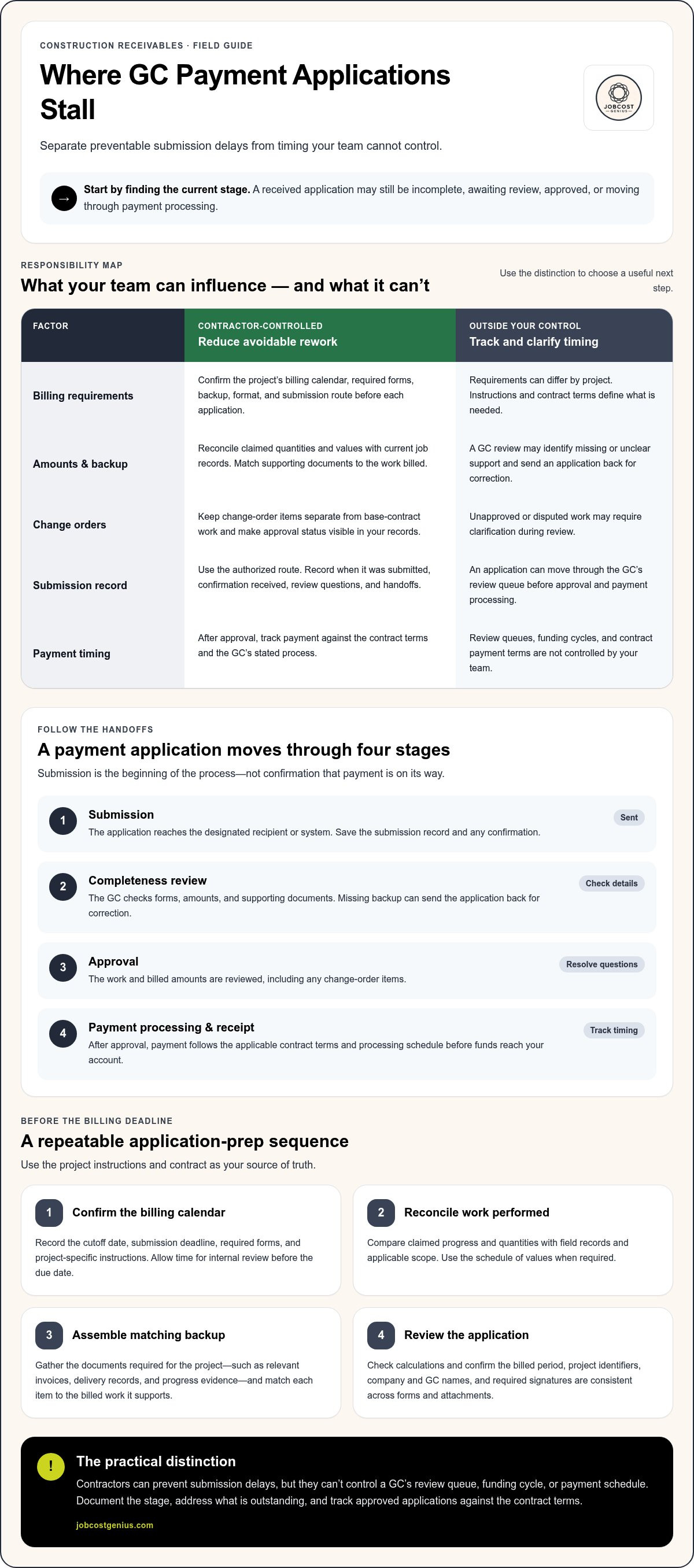
Think of payment as a sequence of handoffs. Submission is only the first step. An application may have been received but still be incomplete, awaiting review, or approved but not yet processed for payment. Recording the current stage helps distinguish a correction request from a payment moving through the GC’s workflow.
- Submission: The application reaches the designated recipient or system.
- Completeness review: The GC checks forms, amounts, and supporting documents. Missing backup can send an otherwise valid application back for correction.
- Approval: The work and billed amounts are reviewed, including any change-order items.
- Payment processing and receipt: After approval, payment follows the applicable contract terms and processing schedule before funds reach your account.
The contract and project billing instructions define the required documents, format, and calendar. Don’t assume a packet accepted on one job will meet another project’s requirements. Keep a copy of the instructions with the billing records so the person preparing each application can check them before submission.
What contractors can influence, and what they cannot
Your team can reduce avoidable back-and-forth by verifying quantities against completed work, submitting by the project’s deadline, keeping backup consistent with the billed amount, and responding promptly to questions. Make change-order status visible in your records so unapproved or disputed work isn’t mistaken for routine approved progress.
- Compare billed quantities and values with current job records before submission.
- Use the project’s required supporting documents and keep them aligned with the application.
- Record when the application was submitted, what confirmation you received, and any review questions.
- Ask whether anything remains outstanding, then document the response and next step.
Separate an unresolved approval issue from payment timing after approval. If the GC needs clarification, address that issue directly. If approval is complete, track payment against the contract’s terms and the GC’s stated process. This distinction helps you choose a useful follow-up rather than treating every wait as the same problem.
Contractors can prevent submission delays, but they can’t control a GC’s review queue, funding cycle, or payment schedule. A disciplined process won’t dictate when funds arrive, but it can help avoid preventable holds and make bottlenecks easier to identify. That’s the practical starting point for how to speed up payments from GCs.
Prepare a complete GC payment application before the billing deadline
A complete application starts before billing day. Use the GC’s current project instructions and contract as your source of truth. They define the required format, billing calendar, supporting documents, and submission method. Put those requirements into a repeatable routine so your team has time to find discrepancies before the application reaches a reviewer.
Reconcile completed work with the schedule of values
Before assembling the packet, compare claimed progress with field records, approved scope, and the project’s billing format. If a schedule of values is required, use it to organize completed work and, where permitted, stored materials by line item. Keep change orders separate from base-contract work and tie each billed amount to its documented approval status. Flag differences early so the reviewer can trace each amount to its supporting records.
Follow this sequence for each billing cycle:
- Confirm the billing calendar. Record the cutoff date, submission deadline, required forms, and project-specific instructions. Allow time for internal review before the due date.
- Reconcile work performed. Compare quantities and progress claimed with field records and the applicable scope. Identify items that need clarification before they flow into the application.
- Assemble the backup. Gather the documents required for the project, such as relevant invoices, delivery records, and progress evidence. Match each item to the billed work it supports.
- Review the application. Check calculations and confirm that the billed period, project identifiers, company and GC names, and required signatures are consistent across the forms and attachments.
- Submit through the specified process. Use the format and route stated in the project instructions. Save the submitted packet and any receipt or confirmation for your records.
- Log the application. Record the submission date, amount, billing period, supporting documents, and current status. This gives your team a clear reference for tracking questions and outstanding receivables.
Assemble project-specific backup and review the application
Don’t assume one universal packet works for every GC. Projects may require specific forms or evidence, or use a designated system or format. AIA G702 and G703 are examples of payment application forms, but use them only when the project’s requirements call for them. A final check against the GC’s current instructions can catch missing attachments, inconsistent figures, or an unsigned form before submission.
Organized documentation also makes internal review more useful. The best practices for construction payment management include systematic oversight, which aligns with checking application details against job records before billing. This habit supports cleaner submissions without implying that a GC’s review or payment timing is within your control.
If maintaining this process across projects is a strain, construction-focused accounts receivable support can help keep application formatting and receivables records organized.
Compare billing routes and align your submission with the GC’s process
The right submission route is the one the project authorizes. A portal may provide a central place for applications and status updates, while email can leave a clear sent record. A GC may also direct contractors through another workflow. Don’t choose based on convenience alone: the contract and current written project instructions take precedence over general process recommendations.
Use this comparison to identify what to document for the route specified on your project. Required formats and status details vary, so follow the GC’s instructions rather than treating the table as a universal rule.
| Route | Required format | Receipt evidence | Status visibility | Common handoff risks |
|---|---|---|---|---|
| Project portal | Portal fields, templates, and attachments specified for the project | Submission confirmation or portal record, if provided | May show submitted, under review, or correction status when the GC uses those functions | Incomplete fields, files attached to the wrong billing period, or a submission left in draft |
| Required application and backup in the requested file format | Sent message and any delivery or acknowledgment record | Usually requires a separate status response or tracking log | Unclear subject line, wrong recipient, large attachments, or missing project identifiers | |
| Designated workflow | Steps, forms, and supporting records specified by the GC | Workflow receipt, reference number, or written acknowledgment when available | Depends on the workflow and how review updates are communicated | Unclear ownership between handoffs or uncertainty about where corrections belong |
Use the project’s required submission channel
If the GC designates a portal, use it as directed and confirm the application has moved from draft to submitted status. For email, use a subject line that identifies the project, billing period, and application, then retain the sent message and attachments. Avoid submitting through multiple channels unless the project process calls for it. Duplicate versions can create confusion about which packet is current.
Create a reliable submission and status record
For each application, log the submission date, billing period, amount, channel, confirmation, reviewer, and next follow-up date. Track approval, requested corrections, resubmission, and payment as separate milestones. That way, a correction request won’t be mistaken for an approval delay, and a submitted application won’t disappear from receivables tracking.
A useful AR record is more than an invoice-date list; it shows where each application stands and what action comes next. This record also helps team members hand off follow-up without losing context. Connected field-to-office records can support consistent project information across teams; Procore financials integration services relate to that coordination. A documented route and status record make it easier to spot applications that need attention, while GC review and payment timing remain part of the GC’s process.
Follow up on unpaid GC applications with a clear, documented cadence
Following up doesn’t have to strain a good working relationship. A neutral, specific question can clarify whether an application is still under review, needs a correction, or has moved to payment processing. Set a project-specific cadence based on the contract, the GC’s process, the submission date, and the application’s current status. A universal follow-up deadline may not fit every project.
Set the next check-in around a stated review date, a response you’re waiting for, or the relevant contract terms. If no timing has been provided, ask for an update and agree on when to reconnect. Keep the tone factual. Timely follow-up is part of managing receivables and keeping the next step visible, not an accusation.
Ask a focused question when approval is pending
Make the message easy to answer. Identify the project, billing period, submission date, and application, then ask whether anything is still needed to continue review. Avoid sending “Any update?” without context. A few identifying details help the recipient locate the application and provide a useful status.
Subject: Payment application status, [Project], [Billing Period]
Hello [Name],
I’m following up on application [number or identifier] for [project], covering [billing period]. We submitted it on [date], and our current understanding is that it’s [status, if known]. Could you let us know whether any backup, clarification, or correction is still outstanding to continue review? If it’s complete, please share the next expected step or update when available.
Thank you,
[Name]
After a reply, note what was agreed, who owns the next action, and when to check back. If the GC requests a correction, confirm the specific item and route the revised application through the project’s established process. This keeps the exchange focused on resolving the issue rather than assigning blame.
Resolve disputed amounts, holds, or missing documentation
When an application is partly disputed, separate the questioned items from undisputed billed work in your internal records and correspondence. Respond with the relevant project documentation and a concise explanation tied to the application line or amount. For missing backup, provide the requested record or clarify why it doesn’t apply. Keep versions and responses together so the history stays clear.
If a hold remains unresolved, use the project’s established contacts and contractual escalation process. Don’t treat an approval question and a payment-timing question as interchangeable: first clarify what is holding up review, then track payment according to the contract and the GC’s process. Formal legal notices or other legal steps can depend on project terms and jurisdiction, so verify applicable requirements with qualified counsel before acting.
Consistent receivables follow-up also gives owners a clearer view of expected cash and unresolved items. For broader context, construction cash flow management strategies can help connect application status with the company’s overall cash-flow planning. A documented cadence is a practical part of how to speed up payments from GCs, even though it can’t control the GC’s review or payment schedule.
For construction-focused support with accounts receivable records and payment-application formatting, explore JobCost Genius AR support.
How JobCost Genius supports more disciplined construction receivables
Better payment follow-up starts with reliable financial records. Contractors need to know which applications have been submitted, which are awaiting review, which have been approved, and which remain outstanding. JobCost Genius provides construction-focused bookkeeping, accounts receivable management, and payment-application formatting. These services help keep receivables organized, but they can’t guarantee a GC’s approval or determine when payment will arrive.
Keep construction receivables and supporting records organized
Construction billing connects project activity to financial records. If application details, job costs, and receivable entries don’t line up, it can be harder to see whether an amount is pending, held for clarification, or approved. Consistent formatting and organized supporting records give your team a clearer view of each application’s status and help maintain continuity as work moves from project tracking into accounting.
Construction-focused accounts receivable management supports regular review of open items and follow-up records. For example, your team can distinguish an application awaiting GC review from one returned for correction, then keep the related correspondence and documentation associated with that receivable. This creates a more useful view of what needs attention, without promising that the GC will act on a particular timeline.
Job-level financial context can also help owners understand how outstanding receivables fit alongside project performance. WIP reporting for construction companies adds project-health context that can complement receivables tracking and job-cost visibility. Together, these records can help clarify where financial pressure is building and which project information may need review.
Use financial visibility to make the next step clearer
Recurring bookkeeping and monthly financial reporting help owners review receivables alongside company cash flow. Instead of looking at an unpaid application in isolation, your team can consider its status in the broader financial picture, spot recurring holds, and decide which records or follow-up actions need attention. That visibility supports more deliberate decisions about cash planning and internal priorities.
JobCost Genius also offers Procore Financials Integration. This service can support contractors who want project and accounting information considered within broader financial processes. The value is clearer records and visibility, not an assumed automation feature or a guaranteed collection result.
To put the process into practice, organize current receivables by project and status, identify repeated reasons applications are held or returned, and assess whether your bookkeeping process gives you enough visibility to act. A consistent construction-specific AR process supports the practical work behind how to speed up payments from GCs, while GC approval and payment timing remain outside your control.
See how JobCost Genius supports construction businesses with bookkeeping, receivables oversight, WIP reporting, and payment-application formatting.
Make receivables oversight part of your next step
Improving how to speed up payments from GCs begins with treating receivables as an ongoing operating process, not a task that starts only when cash is tight. Use your current open applications to spot repeated hold-ups, then decide which recordkeeping or follow-up steps your team can make more consistent in the next billing cycle.
JobCost Genius supports construction businesses with accounts receivable management and payment-application formatting, backed by professionals with over 20 years of industry experience. WIP reporting and Procore Financials Integration can also support broader project and financial visibility. These services strengthen oversight, but they don’t control a GC’s approval or payment schedule.
Start by organizing the receivables already in progress and identifying where your team needs clearer records or recurring financial support. A more consistent process can give you a firmer basis for managing cash flow and planning the work ahead.
See how JobCost Genius supports construction businesses with construction-focused financial oversight and take the next step toward a more organized receivables process.
Frequently Asked Questions
How long should it take a GC to pay a contractor?
There’s no single payment timeline for every construction project. The controlling dates may depend on the signed contract, billing terms, approval steps, application schedule, and applicable rules. Review the agreement and project instructions, then note key dates in one place, such as the application cutoff, approval milestone, and expected payment date. Tracking each milestone separately helps you see whether the application is still under review or payment is pending after approval.
What should I do if a GC has not paid an approved invoice?
Confirm the approval date and the next payment milestone in the contract or project process, then send a concise inquiry. Reference the project, billing period, approval date, and outstanding amount, and ask whether anything remains to be completed before payment. Save the response with the application record. If the issue continues, use the project’s established escalation path and seek qualified advice about rights that may apply to your situation.
Can a GC reject a payment application for missing paperwork?
A GC may return an application for correction if it doesn’t meet the project’s documented submission requirements. Those requirements can differ across contracts, so a packet accepted on another job may not be complete here. If a reviewer identifies a missing item, record the request, provide the relevant document or clarification, and note when you resubmit. Keeping the correction history helps your team understand what changed if the application needs further review.
How do I follow up with a GC without damaging the relationship?
Use a professional, specific message that asks for information rather than assigning blame. Identify the project and application, state when it was submitted, and ask whether the reviewer needs clarification or additional documentation. Avoid guessing at the cause of the delay. For example, “Could you let us know whether anything is needed from our team to continue review?” A written record of the response and next step helps keep future communication consistent and constructive.
Does submitting a payment application early make a GC pay faster?
Submitting early can help only if the application follows the project’s billing calendar and is ready for review. A packet sent before the cutoff but missing a required attachment may still need correction. Check whether early submissions are accepted, and make sure the billing period and requested format are right. Keep the submission confirmation so you can distinguish an application received by the GC from one that is still being prepared internally.
What records should a contractor keep to track payments from GCs?
Keep a project file with the applicable billing instructions, submitted applications, supporting documents, confirmations, approval notices, correction requests, correspondence, and payment records. A useful tracking entry also identifies the project, billing period, amount, and next action. For example, a note that an application is approved but awaiting payment is more informative than marking it simply “open.” Consistent records make it easier to review receivables during handoffs or cash-planning discussions.
Can bookkeeping services help contractors get paid faster by GCs?
Construction-focused bookkeeping can support accurate receivables records, organized applications, and consistent follow-up, which may help reduce avoidable administrative holds. For contractors considering how to speed up payments from GCs, these processes improve visibility into what is submitted and what still needs attention. They can’t control a GC’s approval decision or payment timing. JobCost Genius provides construction-specific accounts receivable management and payment-application formatting to support a more disciplined financial process.


