

Why does your bank account feel empty when your job cost reports show a healthy profit? It’s a common paradox in the construction industry. You’re often stuck waiting 60 days for a progress payment while payroll remains due every single Friday. When you add in retention funds held for months and the constant risk of underbilling, it’s easy to feel like you’re losing control. If you’ve been searching for construction bookkeeping services Oklahoma City, you know that generalists often miss the nuances of AIA billing and WIP reporting that keep a firm solvent.
We understand that managing a construction firm requires more than basic accounting; it requires a disciplined approach to financial visibility. This article provides a roadmap to master these complexities and achieve predictable monthly cash flow. You’ll learn how to optimize your billing cycles, manage retention effectively, and increase your bonding capacity for larger projects. We’ll break down the specific strategies needed to transform your financial operations into an engine for sustainable growth in 2026, ensuring your business stays resilient in a shifting regulatory environment.
Key Takeaways
- Identify the "timing gap" between front-loaded labor costs and delayed milestone payments to maintain liquidity during weekly payroll cycles.
- Discover how specialized construction bookkeeping services Oklahoma City utilize WIP reporting to catch underbilling and cash leaks in real time.
- Implement AIA billing standards and a detailed schedule of values to minimize payment disputes and speed up your receivables.
- Transition from manual spreadsheets to integrated financial tools to gain the real-time oversight required for scaling past the $1M revenue mark.
- Leverage professional financial reporting to improve your bonding capacity and secure the larger, more complex projects available in the 2026 market.
Why Construction Cash Flow is a Unique Financial Challenge
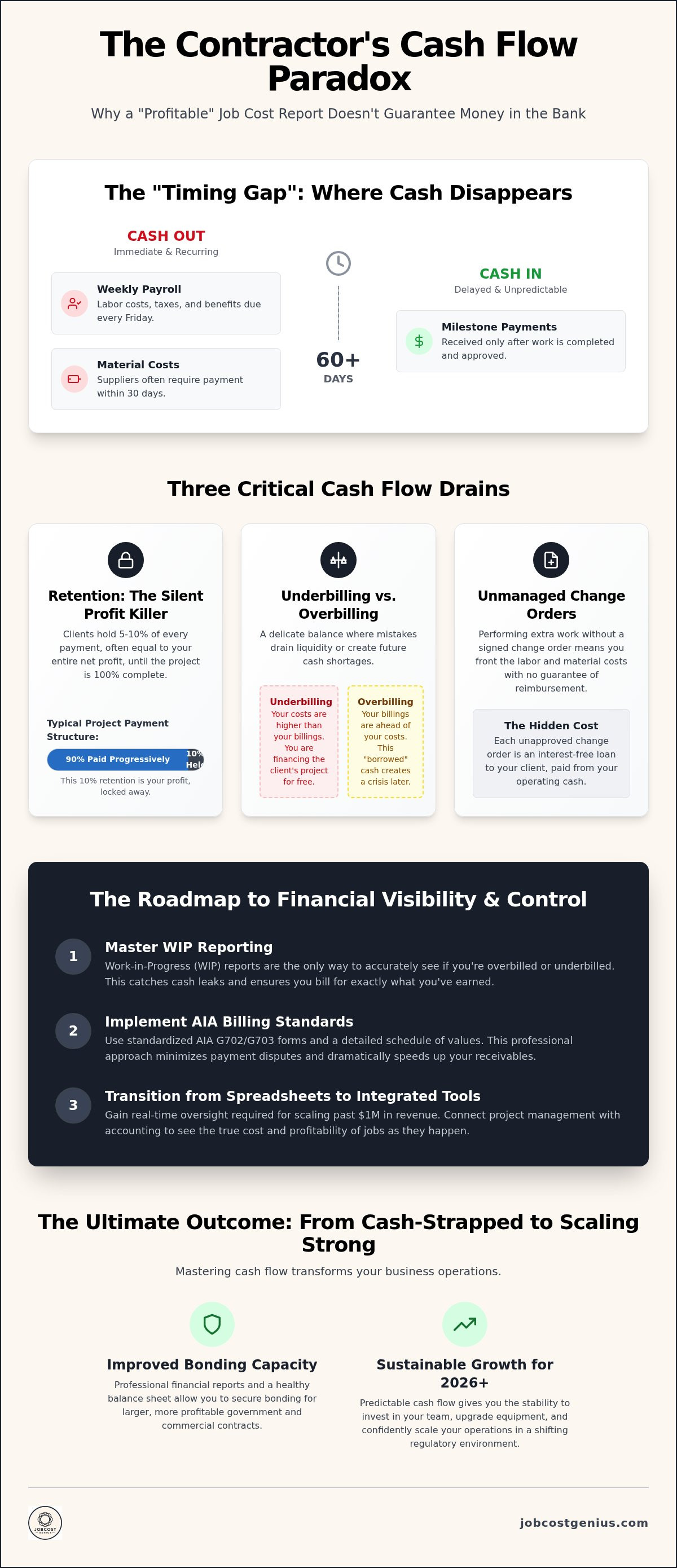
Construction isn't like retail. You don't get paid at the point of sale. Instead, you face a structural "Timing Gap." This is the period between paying for labor and materials and receiving your first milestone payment. For many growing firms, this gap creates a "profitable but broke" paradox. Your project reports might show a 20% margin, but your bank account is empty because that profit is tied up in unpaid invoices or work not yet billed. Managing cash flow effectively is the only way to bridge this gap. Without it, you can't secure the bonding required for larger municipal or commercial contracts. Many contractors seeking specialized construction bookkeeping services Oklahoma City realize that a standard bookkeeper doesn't understand these industry-specific pressures.
The Impact of Labor and Material Front-Loading
Payroll is a weekly reality that can't be deferred. Labor costs, including taxes and benefit burdens, must be paid immediately to remain compliant and keep your crew on-site. With 2026 regulations requiring additional continuing education and specific endorsements for trades like roofing, your labor burden is more complex than ever. You can't ask your crew to wait 60 days for a check just because a client is slow to pay. Material suppliers often offer 30-day terms, but those invoices frequently come due before you've even submitted your first progress billing. A common, yet dangerous, mistake is using deposits from new projects to pay off debts from old ones. This creates a cycle that eventually collapses when growth slows. Effective liquidity management ensures you pay for current project costs using the revenue generated by that specific project.
Retention: The Silent Profit Killer
Retention is a standard practice where owners hold back 5% to 10% of every payment until the project is 100% complete. In an industry where net profit margins often hover around 10%, this means the client is effectively holding your entire profit until the very end. If you don't track these funds meticulously, they can easily be forgotten or lost in the final closeout shuffle. Specialized construction bookkeeping services Oklahoma City focus on tracking retention as a separate asset on the balance sheet. This ensures you have the visibility needed to collect every dollar earned once the punch list is done. Reliable tracking prevents the administrative overwhelm that often leads to missed final payments and helps maintain a healthy balance sheet for future bonding needs.
The Critical Drivers of Contractor Liquidity
Contractors often mistake a high bank balance for high profit. This is a dangerous assumption. Your "Cash on Hand" is simply the money currently in your account. "Earned Revenue," however, represents the portion of the contract you’ve actually fulfilled based on progress. If you’ve collected $100,000 but only completed $60,000 of work, that extra $40,000 is a liability, not profit. Using WIP reporting for construction companies is the only reliable way to distinguish between these two figures. It identifies where cash is leaking through forgotten billings or unapproved change orders.
Change orders are notorious for derailing cash flow. When you perform extra work without a signed change order, you're fronting the labor and material costs with no guarantee of immediate reimbursement. Accurate transaction categorization is essential here. Every expense must be tied to a specific cost code to maintain project health. Without this level of detail, your forecasting becomes guesswork. Many firms find that specialized construction bookkeeping provides the discipline needed to track these variables accurately.
Underbilling vs. Overbilling: Managing the Balance
Underbilling happens when your costs incurred exceed your billings to date. You're effectively acting as an interest-free bank for your client. This drains your liquidity and makes payroll weeks stressful. Overbilling occurs when you bill ahead of the work performed. While this provides a temporary cash cushion, it's "borrowed" money. If you spend it on overhead or other projects, you'll face a massive cash shortage when the project nears completion. A robust WIP report allows you to maintain a neutral cash position, ensuring you bill exactly what you've earned.
Job Costing as a Cash Visibility Tool
Job costing is the backbone of financial visibility. You must track every project dollar to catch budget overruns before they erode your cash reserves. This includes a precise labor burden calculation. You aren't just paying an hourly wage; you're paying for workers' comp, payroll taxes, and benefits. If your bookkeeping doesn't account for these hidden costs, your cash forecasts will be off by 15% to 20%. This is why construction accounting for small firms must prioritize job-level detail over general ledger totals. For contractors scaling their operations, choosing construction bookkeeping services Oklahoma City ensures these nuances are managed by experts who understand the financial requirements for expanding teams.
Advanced Billing Strategies to Accelerate Payments
Billing in the construction industry isn't just about sending an invoice; it's about following a framework that project owners and lenders trust. If you've been researching construction bookkeeping services Oklahoma City, you likely know that a disorganized invoice is the fastest way to get your payment pushed to the bottom of the pile. Adopting the American Institute of Architects (AIA) billing standard provides the transparency needed to move your application through the approval chain quickly. By using standardized forms, you speak the language of architects and developers, which significantly reduces the administrative friction that delays your cash.
A strict schedule of values is your primary tool for reducing payment disputes. This document breaks down the entire contract sum into specific work items. When your schedule of values is detailed and clear, the client knows exactly what they're paying for at each stage. This clarity prevents the "back-and-forth" questions that often stall approvals for weeks. Additionally, integrating lien waivers into your billing process is essential. Providing a conditional lien waiver with your invoice proves that you're prepared to release claims once the funds clear, which often accelerates the check run for the owner's accounting department.
Mastering AIA Billing and Progress Payments
The G702 and G703 forms are the gold standard for progress payments. These documents build trust because they show a clear history of the total contract, previous payments, and the current amount due. Accuracy is critical here. If your percentage-of-completion billing doesn't align with the actual field progress, architects will reject the application. To speed up approvals, ensure your internal project logs match your billing claims exactly. When the field data and the financial data are in sync, you eliminate the reasons for an architect to delay their signature.
Optimizing Accounts Receivable (AR) Workflows
Don't wait until a payment is 30 days late to start the conversation. You should set up automated reminders that trigger a few days before a milestone payment is due. Automation ensures that your invoices aren't forgotten in a client's crowded inbox. You can also reduce friction by offering multiple payment methods; while ACH is standard, some clients may pay faster if they have a credit card option for smaller change orders. Finally, established firms always have a clear collections policy. If a project payment stalls, you need a documented escalation process to handle the issue before it impacts your weekly payroll liquidity. This proactive approach is a hallmark of the sophisticated infrastructure found in the Growth Plan for scaling contractors.
Modern Reporting Tools for Real-Time Cash Oversight
Relying on last month's financial statements to make today's decisions is a recipe for a cash crisis. Retrospective bookkeeping tells you where you've been, but real-time oversight tells you where you're going. As construction firms scale past the $1M revenue mark, the limitations of manual spreadsheets become a significant risk. Spreadsheets are a liability. They are prone to broken formulas and data entry delays. This often results in a "data silo" where the office doesn't know what the field is spending until the invoices arrive weeks later. Transitioning to specialized construction bookkeeping services Oklahoma City allows you to implement systems that capture data at the source, ensuring your CEO dashboard reflects the true state of your liquidity.
Procore Financials and Field-to-Office Sync
Procore financials integration services eliminate the need for double entry. When your project management software talks directly to your accounting system, you gain instant visibility into project health. Project managers can see budget status in real time, which prevents the overspending that happens when field staff are forced to wait for office reports. By capturing job costs in the field, your cash forecasts update automatically. This integration ensures that every dollar spent on site is accounted for immediately, providing a single source of truth for both your PMs and your accounting team. To see how these integrations can stabilize your reporting, explore our Procore Financials Integration options.
Building a 13-Week Cash Flow Forecast
The 13-week cash flow forecast is the gold standard for contractor liquidity. It provides a rolling view of your anticipated payroll, vendor payments, and milestone receipts. This isn't just about survival; it's a strategic tool. When you can see your cash position three months out, you can negotiate better terms with suppliers or plan major equipment purchases with confidence. Your forecast should account for:
- Weekly payroll and labor burden costs.
- Anticipated material draws and subcontractor payments.
- Projected milestone receipts based on your schedule of values.
- Fixed overhead and equipment financing payments.
Having this visibility reduces the stress of payroll weeks and allows you to make data-driven decisions about taking on new work. It moves your business from a reactive state to a proactive one, which is essential for maintaining the financial strength required for bonding and expansion.
Scaling with Professional Construction Bookkeeping
Scaling a construction company is impossible if the business owner is still the one entering receipts at midnight. Transitioning from "DIY" bookkeeping to specialized outsourced support is a critical milestone for any growing firm. Accurate, professional financial statements do more than just track spending; they are the foundation of your bonding capacity. Banks and sureties require high level visibility into your WIP reports and cash flow before they'll back larger projects. If you've been looking for construction bookkeeping services Oklahoma City, you need a partner who understands the industry's unique demands, like the complexities of prevailing wage payroll processing. This expertise ensures you remain compliant with state and federal regulations while freeing up your time to focus on bidding and high level project execution.
Choosing the Right Plan for Your Growth Stage
Your financial infrastructure must evolve alongside your team. We offer tiered solutions designed to meet you where you are. Our Starter Plan provides the essential financial hygiene needed for smaller contracting firms to maintain clean books. For those scaling their operations and adding more crew members, the Growth Plan offers the expanded reporting and visibility required to manage a larger workforce. Finally, the Premium Plan delivers enterprise level oversight for high revenue contractors who need comprehensive financial management across multiple complex jobsites. Each level ensures that your bookkeeping remains a strategic asset rather than an administrative burden.
The ROI of Specialized Construction Financials
Outsourcing your back office to industry experts provides a significant return on investment. By moving away from generalist bookkeepers, you reduce overhead and eliminate the risk of costly errors. Generalists often miss the nuances of retention tracking or labor burden, which can lead to cash shortages or labor compliance issues. Professional management helps you avoid expensive penalties and ensures your firm is positioned as a low risk partner for major developers. In the 2026 market, professionalized financials are the key to building the trust necessary for sustainable growth. Accurate reporting transforms your administrative overwhelm into organized calm, giving you the clarity needed to lead your company with confidence.
Building a Resilient Financial Foundation for 2026
Managing construction cash flow requires more than just balancing a checkbook. It’s about mastering the timing gap and using advanced reporting to stay ahead of weekly payroll. By implementing WIP reporting and AIA billing standards, you transform your financial operations from a source of stress into a strategic advantage. If you’re searching for construction bookkeeping services Oklahoma City, you need a partner who understands these industry-specific mechanics better than a generalist would. This specialized oversight is the key to increasing your bonding capacity and securing larger, more profitable contracts.
JobCost Genius brings over 20 years of industry experience to help you scale your firm with confidence. We provide expert Procore financials integration and meticulous WIP reporting support through specialized tiered plans starting at $800 per month. You don't have to manage these complexities alone. Get a Specialized Construction Cash Flow Analysis from JobCost Genius to gain the financial clarity your business deserves. Take the first step toward predictable liquidity and sustainable growth today. Your company's future depends on the foundational strength of its financial infrastructure.
Frequently Asked Questions
What is the most common cause of cash flow problems in construction?
The most common cause is the structural delay between front-loaded costs and milestone receipts. You pay labor weekly and suppliers monthly; however, you might wait 60 days for a client check. This mismatch drains liquidity quickly. Without a clear billing framework, these gaps become unmanageable. Many firms seek construction bookkeeping services Oklahoma City to align their billing cycles with their actual cash outflows and payroll requirements.
How often should a contractor review their cash flow statement?
You should review your cash flow position at least once a week. Monthly reviews are too retrospective for the fast pace of construction. A weekly check allows you to anticipate payroll needs and material payments before they become emergencies. This regular cadence ensures you can react to project delays or billing disputes in real time. It's the only way to maintain the financial clarity required for growth.
What is retention, and how does it affect my project's cash flow?
Retention is a portion of your contract price, typically 5% to 10%, held by the owner until the project reaches final completion. It affects cash flow because it often represents your entire net profit margin. If you don't track it as a separate asset on your balance sheet, you might overlook it during closeout. Specialized bookkeeping ensures these funds are monitored so you collect every earned dollar.
Can QuickBooks handle construction-specific cash flow needs?
QuickBooks can handle basic tasks, but it often struggles with complex WIP reporting and AIA billing without specialized setup. It doesn't natively track percentage-of-completion or retention as effectively as industry-specific software. Most contractors find that integrating QuickBooks with Procore Financials provides the necessary visibility. Relying on generic software settings often leads to data silos and inaccurate job costing, making it harder to scale past the $1M revenue mark.
What is the difference between cash and accrual accounting for contractors?
Cash accounting records transactions only when money changes hands; accrual accounting records them when they are earned or incurred. For contractors, accrual is necessary for accurate job costing and WIP reporting. It provides a truer picture of project profitability by matching revenue to the actual work performed. Most bonding companies and lenders require accrual-based financial statements to evaluate your firm's stability and overall financial health.
How does WIP reporting help manage cash flow?
WIP reporting helps manage cash flow by identifying overbilling and underbilling in real time. It shows exactly how much revenue you've earned versus what you've actually invoiced. This visibility prevents you from "borrowing" cash from the future or acting as an interest-free bank for your clients. Using these reports ensures you maintain a neutral cash position across all active jobsites, protecting your company's weekly liquidity and payroll stability.
Should I use project deposits to pay for other jobs?
You shouldn't use deposits from a new project to fund the debts of an old one. This practice creates a dangerous cycle that collapses if your sales volume slows down. Each project must be financially self-sustaining to ensure long-term stability. Utilizing construction bookkeeping services Oklahoma City helps you track project-specific funds. This ensures that every dollar stays tied to the correct cost codes and project milestones to prevent cash shortages.
How can I improve my accounts receivable turnover in construction?
You can improve accounts receivable turnover by adopting AIA billing standards and a detailed schedule of values. These tools reduce client questions and speed up the approval process significantly. Additionally, setting up automated payment reminders ensures your invoices aren't buried in a client's inbox. Offering digital payment options like ACH also reduces the friction that often delays milestone funds. Consistent follow-up on outstanding invoices is essential for maintaining predictable cash flow.


