

Your general ledger isn't just a tax document; it's the most powerful project management tool your firm owns. Most contractors realize too late that a standard, generalist accounting setup is actually hiding project losses in plain sight. When you're building a construction chart of accounts, you aren't just listing categories for your CPA. You're creating a specialized framework that separates direct labor from labor burden and distinguishes project expenses from company overhead. It's the difference between guessing your margins and knowing them.
You likely feel the constant pressure of trying to pull accurate WIP reports from a system that wasn't designed for the field. This guide will show you how to master a construction-specific structure to unlock precise job costing and absolute financial clarity. We'll cover the 2026 standards for five-digit account numbering, how to integrate the latest OBBBA tax changes like 100% bonus depreciation, and the exact steps to ensure your books are ready for bonding or federal audit requirements. By the end of this guide, you'll have a roadmap for a financial foundation that supports growth rather than obscuring it.
Key Takeaways
- Adopt the industry-standard 5-digit numbering system to ensure your financial data is organized for both immediate clarity and long-term scalability.
- Learn why building a construction chart of accounts is the essential first step to separating direct labor from labor burden, preventing project losses from being buried in general expenses.
- Categorize direct and indirect costs accurately to gain clear visibility into project-specific margins versus total company overhead.
- Master the use of Retainage and Contract Asset accounts to produce the precise WIP reports required for bonding and 2026 tax compliance.
- Explore how a specialized account structure facilitates seamless integration with Procore Financials, synchronizing field data with your back-office accounting.
The Foundation: Why Construction Accounting Needs a Specialized Chart of Accounts
The Chart of Accounts (COA) is the organizational backbone of your firm's financial system. It isn't just a list of categories for your tax preparer; it's the primary engine that drives your job costing. While general business accounting focuses on period-based results like monthly profit and loss, construction accounting demands a project-based perspective. Every dollar must be tied to a specific job, phase, or cost code. Without this granularity, your financial statements will only tell you that you're losing money, not why. When building a construction chart of accounts, you're essentially creating the data source for your Work in Progress (WIP) reporting, which is the only way to accurately track earned revenue on long-term contracts.
The Pitfalls of Generalist Bookkeeping
Off-the-shelf accounting software usually provides a generic COA designed for retail or service businesses. These setups are dangerous for contractors because they encourage "lumping" costs into broad categories. When you lump all labor into a single account, you lose the ability to separate field labor from office overhead. This makes it impossible to calculate an accurate labor burden, which includes taxes, insurance, and benefits for your crew. If you can't see the specific cost of labor for a concrete pour versus a framing phase, you can't identify where project-specific losses are occurring. Generalist setups hide these leaks until the project is over and the profit has already vanished.
Project-Centric Financial Architecture
A sophisticated COA allows you to track revenue by job type, such as distinguishing between high-margin service work and long-term contract projects. This structure ensures that your financial accounts match your bidding and estimating process. If your estimator bids a job based on five specific cost categories, your COA should be able to report back on those same five categories. This alignment creates a feedback loop that makes your future bids more accurate and your current projects more profitable. A construction COA is a multi-dimensional tool for tracking both company health and job performance. By structuring your accounts this way, you move from reactive bookkeeping to proactive financial management.
- Granularity: Breaks down costs by project phase rather than just month-to-month totals.
- Accuracy: Separates direct project costs from general administrative expenses.
- Insight: Provides the raw data needed for bonding agents and tax compliance under 2026 regulations.
The 5-Digit Numbering System: Structuring Your General Ledger for Success
Standardizing your ledger requires more than just picking numbers at random. By 2026, the 5-digit numbering system has become the definitive standard for firms that want to scale. This structure provides the necessary "room to grow" that a 4-digit system lacks. When building a construction chart of accounts, you must look beyond the current month and anticipate the complexity of future projects. Five digits allow for 99,999 possible combinations, ensuring you never have to "force" an account into a range where it doesn't belong.
The Hierarchy of Accounts
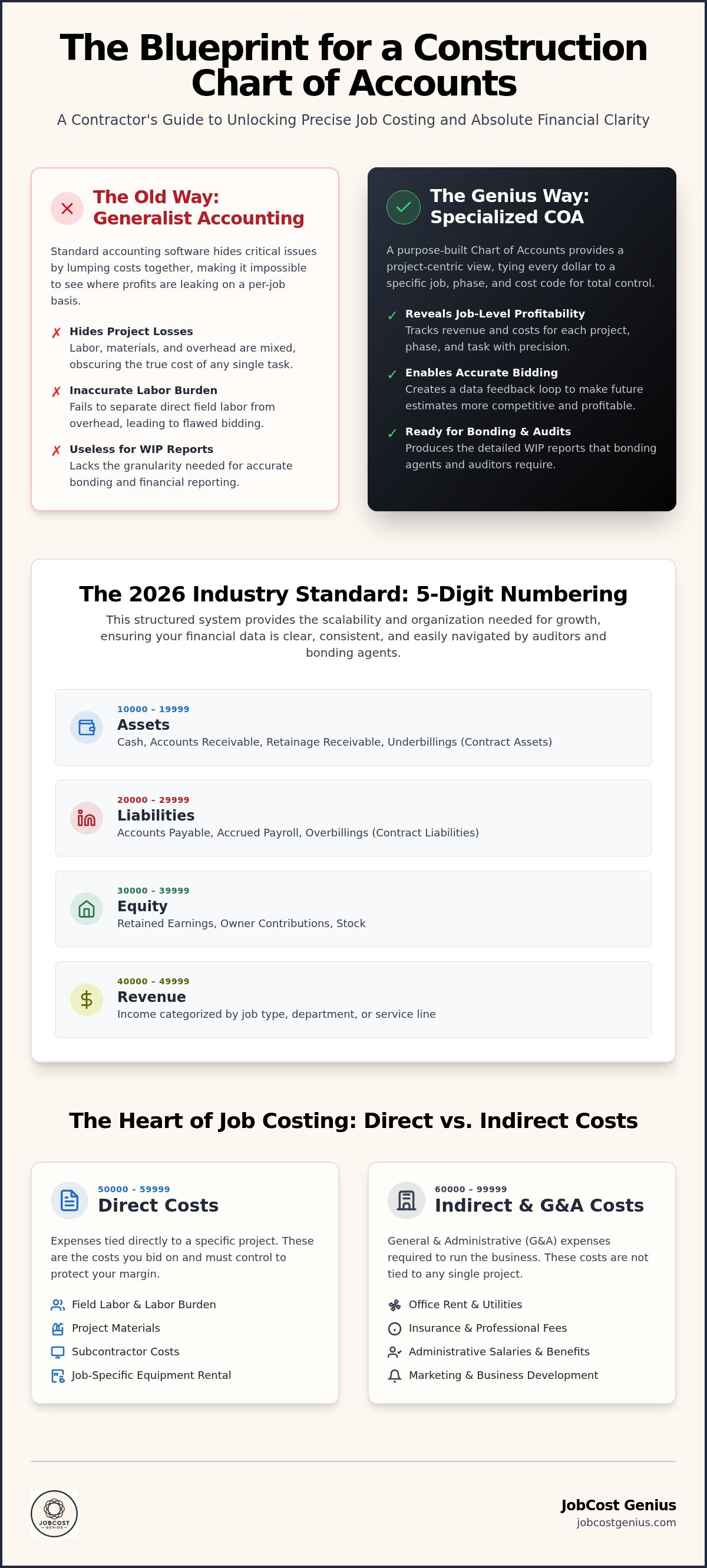
A disciplined ledger follows a predictable sequence. This organization ensures that any bonding agent or auditor can navigate your financials with confidence. Use the following standard ranges to group your accounts:
- 10000-19999: Assets. This includes your cash, accounts receivable, and specific construction entries like Retention Receivable and Underbillings.
- 20000-29999: Liabilities. Track your accounts payable, accrued payroll, and Overbillings (the "Contract Liability" account).
- 30000-39999: Equity. Retained earnings and owner contributions.
- 40000-49999: Revenue. Categorize income by job type or department.
- 50000-59999: Direct Costs. This is the heart of your job costing, where you track labor, materials, and subs.
- 60000-99999: Indirect and G&A Expenses. Capture company overhead and administrative costs.
Always leave gaps in your numbering. Instead of using 51001 and 51002, use 51010 and 51020. These intervals allow you to insert sub-accounts later without breaking the logical flow of your reports. If the transition from a messy system feels daunting, our Growth Plan includes specialized setup to ensure your ledger is built for scale from day one.
Standardizing for Industry Compliance
One critical gap in many generalist setups is the failure to align with the Construction Specifications Institute (CSI) MasterFormat. To achieve true estimating accuracy, your 50000-series (Direct Costs) should mirror the CSI divisions used in your bids. If your estimate tracks "Division 03 - Concrete," your ledger should have a corresponding range in the 53000s. This alignment makes variance analysis instantaneous. You can immediately see if your actual spend on concrete exceeded your estimated budget without manual cross-referencing.
This level of detail is also essential for Procore Financials Integration. When your account codes match your project management software, data flows seamlessly from the field to the office. You eliminate the need for double entry and reduce the risk of coding errors. Standardizing your COA isn't just about clean books; it's about creating a financial language that both your project managers and your bookkeeper can speak fluently.
Direct vs. Indirect Costs: Categorizing for Maximum Profit Visibility
Precision in your financial reporting depends entirely on how you distinguish between direct project expenses and company overhead. When building a construction chart of accounts, you must draw a hard line between these two categories. Direct costs, typically housed in the 50000 series, are the "boots on the ground" expenses that wouldn't exist if you weren't performing a specific job. Indirect costs, found in the 60000 series and above, represent the price of staying in business regardless of your current contract volume. If these categories blur, your Gross Profit figure becomes a meaningless number that can't guide your bidding strategy.
The Cost of Goods Sold (COGS) section of your Profit and Loss statement is the pulse of your firm's health. For a builder, COGS reflects the true cost of production. Miscategorizing an overhead item, like office utilities, as a direct project cost will artificially inflate your project estimates. This error leads to uncompetitive bids and lost opportunities. Conversely, burying field materials in overhead makes your projects look more profitable than they actually are, causing you to under-bid future work and slowly erode your cash reserves.
The Labor Burden Dilemma
Tracking field labor is the most complex part of construction bookkeeping. Gross wages are only the starting point. To see your true project costs, you must account for labor burden, which includes FUTA, SUTA, FICA, workers' comp, and health benefits. With the U.S. construction sector projected to need an additional 499,000 workers in 2026, the cost of retaining talent is rising. Your COA should be structured to allocate these burden costs back to specific jobs. This granularity is vital during workers' comp audits, where clear records can prevent overpayment on premiums by proving exactly which hours were spent in high-risk versus low-risk classifications.
Equipment and Tool Allocation
Managing equipment costs requires a strategic approach within your ledger. Project-specific rentals are straightforward direct costs, but owned equipment is more nuanced. Under the 2026 OBBBA tax changes, bonus depreciation has been restored to 100% for qualifying property, making owned equipment a significant tax lever. To track these assets accurately, many firms use an "Equipment Clearing" account. This allows you to capture the total cost of ownership, including maintenance and fuel, and then distribute those costs across projects based on usage. Indirect costs should be minimized in the 50000 range to ensure clean job-cost reports. This discipline ensures your field-to-office data remains reliable for long-term strategic planning.
Tracking the Complexities: Setting Up WIP, Retainage, and Liabilities
Construction accounting lives and dies by the balance sheet. While your Profit and Loss statement shows how a project performed, your balance sheet reveals your firm's true liquidity and long-term stability. When building a construction chart of accounts, you must look beyond standard categories to capture the timing differences inherent in long-term contracts. This requires specific accounts for retainage and WIP-related adjustments that generalist setups simply ignore. Without these, your financial reports will show a distorted view of your cash position and earnings.
Navigating Retention and Cash Flow
Retainage is a unique challenge that requires dedicated accounts. You should never lump retention into your standard Accounts Receivable. Doing so overstates your available cash and misleads your operations team about what's actually collectible in the short term. Setting up Retainage Receivable and Retainage Payable accounts allows you to track "held" cash separately from your liquid trade receivables. This distinction is critical for maintaining a healthy debt-to-equity ratio, which bonding agents scrutinize closely. For firms struggling to manage these cycles, implementing JobCost Genius AR management strategies can significantly accelerate your payment timelines and clarify your actual cash on hand.
WIP-Ready Balance Sheets
Accurate Work in Progress (WIP) reporting depends on two specific accounts: Contract Assets and Contract Liabilities. In the industry, these are often referred to as "Costs in Excess of Billings" and "Billings in Excess of Costs." These accounts act as the bridge between your job-cost data and your financial statements. If you've spent money on a project but haven't billed the client yet, that's a Contract Asset. If you've collected a deposit or overbilled for work not yet performed, that's a Contract Liability. Configuring your COA to support accrual-basis accounting ensures that your equity section reflects true project earnings rather than just the timing of your invoices.
Your chart of accounts should also serve as a compliance shield. By structuring your 20000-series (Liabilities) to include specific sub-accounts for 1099 subcontractor tracking and Certificate of Insurance (COI) compliance, you create an automated audit trail. This prevents the administrative nightmare of scrambling for documentation at year-end. If your current balance sheet feels like a mystery, our WIP Reporting services can transform your data into a clear roadmap for project profitability.
From Setup to Strategy: How JobCost Genius Optimizes Your Financial Infrastructure
Building a construction chart of accounts provides the blueprint, but disciplined management ensures the structure holds. Many firms start with high standards only to fall victim to "data drift," where miscoded invoices and inconsistent entries slowly degrade the accuracy of their job costing. JobCost Genius acts as your strategic partner, transforming your ledger from a static list into a dynamic decision-making tool. We specialize in taking contractors from administrative overwhelm to a state of organized financial clarity. Our team ensures that the technical foundations we've discussed, from 5-digit numbering to retainage tracking, remain perfectly maintained every month.
Done-For-You Construction Bookkeeping
Delegating your financial management prevents the gradual slide into messy books that often occurs when operations get busy. Our Starter Plan and Growth Plan are designed to scale alongside your firm, providing specialized oversight that a generalist bookkeeper can't offer. We produce monthly financial statements that CEOs actually understand, focusing on the metrics that drive project success. A core component of our service is Procore Financials Integration. We synchronize your field data with your office ledger, ensuring that every change order and material purchase is reflected in your financial reports without the need for manual double entry.
The Path to Financial Confidence
True financial confidence comes from moving beyond basic record-keeping into strategic analysis. By maintaining a clean COA, we provide the raw data needed for sophisticated WIP Reporting and overhead analysis. This visibility is essential for navigating the 2026 economic landscape, including the latest OBBBA tax changes and restored bonus depreciation rules. You gain the peace of mind that comes from having audit-ready, industry-compliant books that satisfy both bonding agents and tax authorities. We position your firm as a disciplined, professional entity ready for high-level growth. Schedule a consultation to build your custom construction chart of accounts and take the first step toward total project visibility.
Securing Your Firm’s Financial Future
A project-based accounting system is the only way to ensure your firm remains profitable in an increasingly complex market. Mastering the structure of your ledger allows you to stop guessing about margins and start making data-driven decisions. By implementing a 5-digit numbering system and strictly separating direct labor from overhead, you create the visibility required for accurate job costing. Building a construction chart of accounts is a one-time investment that pays dividends through better bidding, cleaner audits, and improved cash flow management.
JobCost Genius specializes in maintaining this meticulous infrastructure for growing contractors. Our team of industry veterans brings 20+ years of experience to every client, providing specialized WIP reporting and expert Procore Financials integration. We ensure your books remain industry-compliant so you can focus on the field. Scale your construction firm with expert bookkeeping-view our plans. You've built the business; now let's build the financial engine that sustains it.
Frequently Asked Questions
What is a construction chart of accounts?
A construction chart of accounts is a specialized list of every financial category in your general ledger, specifically structured to support project-based accounting. Unlike retail or service setups, it prioritizes job costing by tracking expenses at the project level. It serves as the essential framework for generating accurate profit and loss statements by job and managing your firm's total financial health.
How many digits should a construction chart of accounts have?
The 5-digit numbering system is the definitive 2026 industry standard for firms that intend to scale. This format provides 99,999 possible combinations, giving you enough "room to grow" without breaking your ledger's logical flow. It allows you to use the 10000-50000 ranges for core accounts while leaving plenty of space for detailed sub-accounts and CSI-aligned divisions.
What is the difference between a general COA and a construction COA?
Generalist setups focus on time periods, but a construction setup focuses on projects. Building a construction chart of accounts requires adding specific accounts for direct labor, labor burden, and subcontractor costs that a general business doesn't need. It also includes unique balance sheet entries like retainage and contract liabilities that are critical for tracking long-term project performance.
How do I handle retainage in my chart of accounts?
You must create separate accounts for Retainage Receivable and Retainage Payable on your balance sheet. Don't lump these into your standard trade AR or AP categories. Keeping retention separate ensures your reports reflect your actual liquid cash position. This distinction is vital for bonding agents who need to see exactly what cash is held back versus what is immediately available.
Should I use CSI codes in my accounting software?
Aligning your ledger with CSI MasterFormat divisions is a best practice for any firm doing complex project work. When your accounting codes match your estimating divisions, you can compare actual costs against your original bid with zero manual cross-referencing. This alignment turns your bookkeeping into a powerful tool for improving future bidding accuracy and project management.
What are the most common mistakes in construction account setup?
The most frequent errors are lumping all labor into a single category and failing to separate direct project costs from general office overhead. When you bury labor burden in overhead, you lose the ability to see the true cost of your field team. This lack of granularity hides project losses and often leads to under-bidding future jobs because your historical data is flawed.
Can I use QuickBooks for a specialized construction COA?
QuickBooks can handle a construction setup, but it requires extensive manual configuration to move beyond its generic templates. You'll need to build the 5-digit structure and job-costing logic from scratch to get professional-grade results. Many firms find that integrating QuickBooks with Procore Financials provides the best balance of accounting simplicity and field-to-office synchronization.
How does the chart of accounts affect my WIP reporting?
Your chart of accounts is the engine that generates your Work in Progress reports. Without specific accounts for Contract Assets (Costs in Excess of Billings) and Contract Liabilities (Billings in Excess of Costs), you can't accurately adjust for timing differences on long-term jobs. A well-built COA ensures your earned revenue is calculated correctly, which is essential for 2026 tax compliance and bonding requirements.


