

Paying over $100,000 annually for a full-time, in-house bookkeeper is an overhead burden that most modern contractors are moving away from. You've likely felt the frustration of inaccurate WIP reports leading to overbilling or the constant fear that a tax audit might trigger because of messy records. It's natural to ask how much does outsourced construction bookkeeping cost when you're trying to balance professional oversight with lean project margins. In 2026, the shift toward specialized, off-site financial management isn't just about saving money; it's about gaining the precise visibility you need to scale.
We understand that every dollar counts when you're managing labor shortages and fluctuating material costs. This guide will help you discover the specific factors that drive construction bookkeeping fees and how to choose a pricing plan that protects your bottom line. We'll preview how market rates are structured for specialized services, explain how the One Big Beautiful Bill Act affects your equipment deductions, and show you how to transition from administrative overwhelm to total financial confidence. Whether you need basic support or full Procore integration, understanding these costs is the first step toward a more profitable job site.
Key Takeaways
- Understand why specialized construction bookkeeping typically commands a 20-30% premium over general accounting due to the complexity of job costing and WIP reporting.
- Learn how transaction volume and active project counts serve as the primary drivers when determining how much does outsourced construction bookkeeping cost for your firm.
- Compare tiered service levels, such as the Starter and Growth Plans, to find a scalable solution that aligns with your current revenue and reporting needs.
- Evaluate the true ROI of outsourcing by comparing the fully burdened cost of in-house staff against the specialized expertise of a partner familiar with Procore Financials.
- Identify red flags in low-cost bookkeeping quotes to ensure your chosen partner provides the project-level visibility required to protect your margins.
Understanding the Range: What Determines Construction Bookkeeping Costs in 2026?
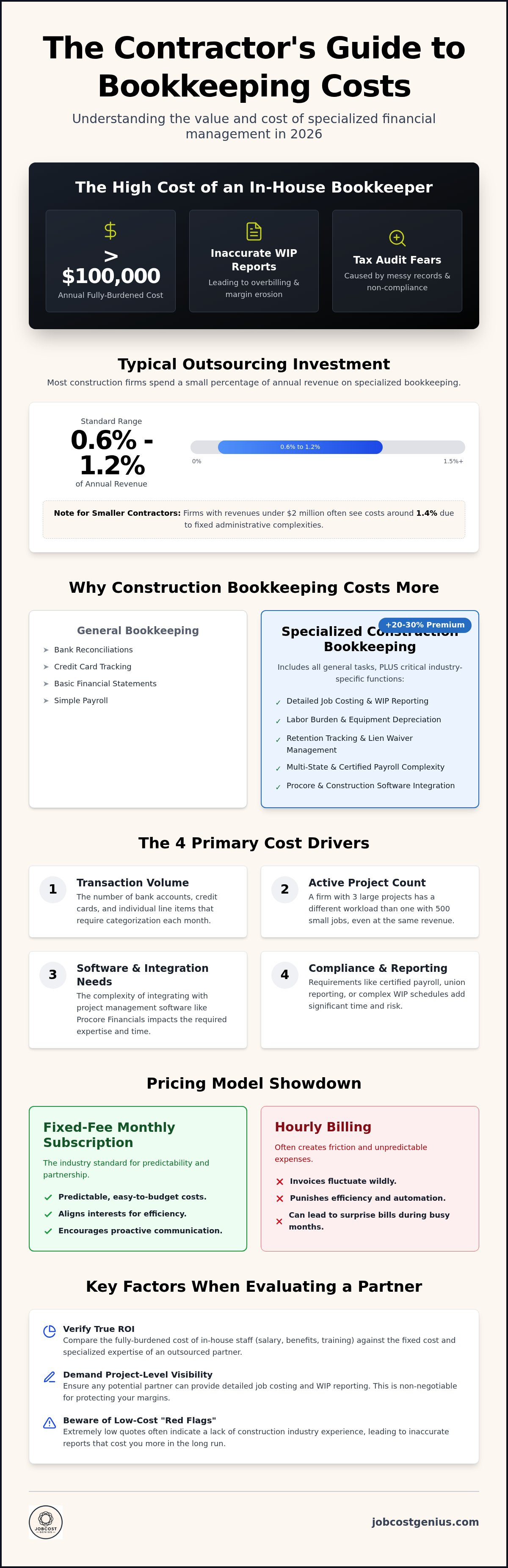
Determining how much does outsourced construction bookkeeping cost requires looking past simple data entry. In the current market, most well-run construction firms spend between 0.6% and 1.2% of their annual revenue on professional bookkeeping services. For smaller contractors with revenues under $2 million, this figure often climbs toward 1.4% because the administrative burden of job costing doesn't scale down as quickly as revenue does. You're paying for specialized knowledge, not just a spreadsheet filler.
Construction bookkeeping typically costs 20-30% more than general retail or service-based accounting. This premium exists because your financial records must account for complex variables like labor burden, equipment depreciation, and multi-state payroll. A compliance-only bookkeeper might ensure your bank accounts reconcile; however, a construction-specialist partner ensures your project margins stay intact. Modern Accounting outsourcing has shifted from a back-office expense to a strategic project management tool that identifies overbilling before it impacts your cash flow.
The Baseline: Monthly Retainers vs. Hourly Rates
Fixed-fee monthly subscriptions have become the industry standard for 2026. This model provides budget predictability and aligns the interests of the contractor and the bookkeeper. Hourly billing often creates friction. It punishes efficiency and leads to unpredictable invoices during heavy transaction months. A typical starter retainer for a small trade contractor covers the essentials: bank reconciliations, credit card tracking, and basic financial statements. It provides a foundation of organized calm that allows you to focus on the field rather than the filing cabinet.
Why Construction is a Specialized Financial Tier
The administrative requirements in construction are significantly higher than in other industries. You must track retention, manage lien waivers, and verify insurance certificates for every sub on the job site. These aren't optional tasks; they're risk management necessities. Job costing at the task or cost-code level is equally labor-intensive but vital for profitability. Implementing robust construction accounting for small firms early on is the best way to prevent project-level blind spots. When your bookkeeping partner understands these nuances, your financial reports become a roadmap for growth rather than just a historical record for the IRS.
The 4 Primary Cost Drivers for Outsourced Contractor Accounting
While annual revenue provides a high-level benchmark, it rarely tells the full story of your administrative needs. To accurately determine how much does outsourced construction bookkeeping cost, you must look at the specific operational variables that dictate the workload. A firm doing $5 million in revenue with three large projects has vastly different requirements than a service contractor doing the same volume across 500 small jobs. The manual effort required to reconcile every invoice and receipt is what ultimately shapes your monthly fee.
Industry standards from the Construction Financial Management Association emphasize that financial health depends on project-level accuracy. Achieving this level of detail requires more than just balancing a checkbook. It involves tracking every dollar back to a specific cost code, a process that becomes more expensive as your company grows in complexity. Understanding these four drivers will help you evaluate quotes with a more critical eye.
Transaction Volume and Revenue Complexity
The number of bank accounts and credit cards you use significantly impacts your monthly retainer. Every statement line requires verification and categorization. For high-volume subcontractors, revenue is often a deceptive metric; a company with high material costs but low project counts might actually have fewer transactions than a smaller firm with a massive fleet. We define "transactional density" as the total volume of financial events relative to your revenue, and it's a primary factor in 2026 pricing models. More "events" simply mean more hours of professional oversight.
The Complexity of WIP and Job Costing
Work in Progress (WIP) reporting is the heartbeat of a construction business. The frequency of these reports often determines your service tier. If you require weekly updates to monitor overbilling and underbilling, your costs will reflect that higher touchpoint. This level of reporting is essential for maintaining bank covenants and securing the bonding capacity needed for larger contracts. Tracking these figures prevents cash flow surprises that can stall a project mid-stream. If you're feeling the weight of these requirements, seeking professional construction bookkeeping can provide the clarity needed to protect your project margins.
Payroll and Compliance Management
Payroll in construction is rarely straightforward. Fees increase when you move from simple W2 processing to managing 1099 contractors, union fringes, or prevailing wage requirements. Certified payroll reporting for state or federal projects adds another layer of specialized labor to the bookkeeping process. Additionally, your bookkeeper must maintain the records necessary for workers' comp audits and general liability renewals. These compliance tasks are time-sensitive and carry heavy penalties for errors, making them a significant driver of service costs.
The Tech Stack and Integration
The tools you use to run your field operations influence your back-office expenses. Integrating accounting software with platforms like Procore or Buildertrend requires technical expertise and ongoing maintenance. While these integrations automate the field-to-office sync, setting them up correctly and troubleshooting data gaps requires a higher level of professional service. A partner who understands these specific integrations will charge more than a generalist, but they'll save you thousands in avoided data entry errors.
Tiered Pricing Models: From Starter Packages to Enterprise Oversight
When evaluating how much does outsourced construction bookkeeping cost, it's helpful to view services through a tiered lens. This structure ensures you aren't paying for enterprise-level features while you're still managing a small crew. It also allows for seamless scaling as your backlog grows. Most specialized firms organize their offerings into Starter, Growth, and Premium plans to match the specific stages of a contractor's lifecycle.
The Starter Level: Essential Foundations
The Starter Plan provides the essential foundations for small GCs or single-trade subcontractors. At this level, the focus is on accuracy and compliance. You'll receive monthly bank reconciliations, expense categorization, and standard financial statements like the P&L and Balance Sheet. This plan typically starts at $800 per month. It's designed for firms with lower transaction volumes who need to move away from DIY spreadsheets and toward professional financial stability.
The Growth Level: Scaling with Project Data
The Growth Plan is the sweet spot for contractors reaching the $1M to $5M revenue mark. As your crew expands and your project list grows, simple reconciliation isn't enough to protect your margins. This tier includes vital WIP Reporting and detailed job costing. It also handles accounts payable and receivable management, which fast-tracks your payment applications. Having a partner to manage these details ensures your project data is current, allowing you to make informed decisions about new bids based on real-time margin analysis.
Premium and Enterprise: The Outsourced Controller
The Premium Plan serves as an outsourced controller for established firms requiring advanced financial oversight. This tier is essential for contractors requiring Procore Financials Integration or complex cash flow forecasting. High-level strategic oversight at this stage prevents profit bleed on multi-million dollar jobs. You'll receive customized reporting for boards or investors and comprehensive audit preparation. This level of support transforms your back office into a strategic asset that protects your foundational strength during periods of rapid revenue growth.
Messy books are a common reality in the construction industry. If your records are behind, expect to pay a one-time catch-up fee during the onboarding process. These fees vary based on the months of backlog and the complexity of the missing data. When calculating how much does outsourced construction bookkeeping cost, remember to factor in these initial cleanup costs. A standard setup fee ensures your chart of accounts is correctly structured for construction-specific reporting from day one.
The Hidden Costs of In-House vs. The ROI of Outsourcing
Many contractors view bookkeeping as a simple administrative expense. This perspective ignores the massive overhead associated with maintaining internal staff. When you analyze how much does outsourced construction bookkeeping cost, the return on investment becomes clear compared to the "fully loaded" expense of an employee. You aren't just paying for data entry; you're investing in project-level accuracy that prevents margin erosion and protects your cash flow.
Comparing Salary to Subscription
Hiring a construction-literate bookkeeper in 2026 is an expensive proposition. In markets like New Jersey, New York, or Pennsylvania, a qualified full-time bookkeeper costs between $80,000 and $110,000 annually. This equates to a monthly burden of $6,700 to $9,200 when you factor in payroll taxes, health insurance, and retirement benefits. By contrast, specialized outsourced services typically range from $700 to $2,500 per month. This shift transforms a high fixed cost into a manageable variable expense. A subscription model also provides continuity that a single employee cannot match; your financial oversight doesn't stop because one person takes a vacation or falls ill.
Avoiding the "Cost of Error" in WIP Reporting
A generalist bookkeeper often lacks the specialized knowledge to handle complex WIP adjustments. If they miss an underbilling entry, your cash flow might appear healthier than it actually is, leading to a disastrous crunch mid-project. The "Knowledge Gap" is a tangible risk that impacts your bottom line. For example, failing to leverage the 100% bonus depreciation reinstated by the One Big Beautiful Bill Act could result in thousands of dollars in missed tax savings on new equipment. The most expensive bookkeeping is the kind that has to be redone by a CPA at year-end because the original records were structurally flawed.
Beyond the salary, you must consider technology overhead. Maintaining licenses for QuickBooks, Procore, and advanced reporting tools adds thousands to your annual budget. Outsourcing allows you to access these high-end tools without the direct software cost. It also provides the scalability to ramp up support during peak season and scale back when the backlog is light. This flexibility protects your foundation without the emotional and financial strain of hiring and firing cycles. If you're ready to trade administrative overwhelm for financial clarity, explore our outsourced construction bookkeeping plans to see which tier fits your current revenue.
Evaluating Quotes and Selecting Your Construction Bookkeeping Partner
Comparing bids for financial services is different than comparing material quotes for a job site. When you ask how much does outsourced construction bookkeeping cost, the answer depends heavily on the depth of project-level visibility included in the proposal. A low-cost quote often signals that the provider is treating your business like a simple retail shop, omitting the complex job costing and WIP adjustments that protect your margins. Selecting the right partner requires looking beyond the monthly retainer to ensure they possess the specialized expertise your projects demand.
Red flags in low-cost quotes usually involve a lack of industry-specific deliverables. If a proposal doesn't mention retention tracking, insurance certificate management, or lien waivers, you'll likely face "scope creep" fees later. Software proficiency is another non-negotiable factor in 2026. A partner should demonstrate deep experience with platforms like Procore, Buildertrend, or Sage. This technical knowledge ensures your field-to-office sync remains automated and accurate, preventing the data gaps that lead to financial blind spots.
What Should Be Included in Every Quote?
Every professional proposal should start with a standard list of accounting essentials. This includes bank reconciliations, monthly financial statements, sales tax tracking, and year-end preparation for your CPA. However, a contractor-specific quote must go further. You should see explicit line items for:
- Detailed job costing at the task or cost-code level.
- Regular WIP (Work in Progress) reporting to track over/underbilling.
- Payroll compliance, including certified payroll if you take on government contracts.
- Clear definitions of AP and AR management to prevent administrative bottlenecks.
Onboarding is the final variable to consider. Expect a timeline of 30 to 90 days to move from "messy books" to "financial clarity," depending on the length of your backlog. This phase is an investment in your company's foundational strength.
The JobCost Genius Approach to Pricing
We believe your back office should be a strategic asset, not a source of stress. Our pricing tiers are structured to grow alongside your project pipeline, ensuring you always have the right level of oversight without overpaying for unnecessary features. Whether you're a trade contractor needing a Starter Plan or a large GC requiring specialized Procore Financials integration, our team provides the organized calm you need to scale with confidence. Ready for a back office that works as hard as your field crew? See our pricing plans and discover how much does outsourced construction bookkeeping cost when it's tailored to your specific operational needs.
Building a Foundation of Financial Clarity
Professional bookkeeping in the construction industry is a strategic investment in your project health. It moves beyond simple data entry by providing the job costing and WIP reporting necessary to protect your margins. By understanding the primary drivers of service fees, you can select a plan that scales with your revenue without adding unnecessary overhead. Determining how much does outsourced construction bookkeeping cost is the first step toward replacing administrative overwhelm with organized, actionable data.
We've designed our services to meet the specific needs of modern contractors. With starter plans beginning at $800 per month, our team of specialized WIP and job costing experts provides the stability your business needs to grow. We offer no-stress Procore Financials integration to ensure your field and office stay perfectly synced. It's time to stop worrying about audit triggers and start focusing on your next big project. View Our Construction Bookkeeping Pricing Plans today and build your firm on a foundation of total financial confidence.
Frequently Asked Questions
Why is construction bookkeeping more expensive than regular bookkeeping?
Construction bookkeeping requires project-level detail that generalists simply don't provide. You must track retention, manage lien waivers, and calculate labor burden for every specific job site. These additional layers of documentation ensure your project margins remain accurate and your bonding capacity stays intact. This specialized oversight carries a 20% to 30% premium over standard retail accounting due to the technical complexity involved.
How much should a small construction company spend on bookkeeping?
Small construction firms typically spend between 0.6% and 1.4% of their annual revenue on professional financial management. When evaluating how much does outsourced construction bookkeeping cost, remember that this investment protects your project profitability. For a firm earning $1 million, this equates to a range of $600 to $1,100 per month depending on your transaction density and the number of active projects you manage.
Do I have to pay a setup fee for outsourced construction accounting?
Yes, most specialized firms charge an initial setup fee to ensure your chart of accounts is correctly structured for the industry. This phase involves mapping your cost codes and integrating your field software with your accounting platform. It's a foundational step that prevents future reporting errors and ensures your financial data is reliable from the first day of service.
Is payroll processing usually included in the monthly bookkeeping fee?
Payroll processing is frequently offered as a tiered add-on or included in higher-level plans like the Growth or Premium options. Construction payroll involves unique complexities like union fringes and certified payroll reporting for federal projects. These tasks require more time and specialized knowledge than standard commercial payroll, which is why they're often priced based on the size of your crew.
Can I get a fixed-price quote if my revenue fluctuates seasonally?
Fixed-price monthly subscriptions are the standard for 2026 because they offer budget predictability despite seasonal revenue shifts. Most providers base their tiers on average transaction volume and active project counts rather than monthly revenue alone. This allows you to maintain consistent financial oversight without worrying about fluctuating hourly invoices during your busiest building months.
What happens if my books are currently behind or inaccurate?
If your books are behind, your provider will typically charge a one-time catch-up fee to reconcile historical data. This process involves cleaning up old entries and ensuring your WIP reports are accurate for previous periods. It's an essential first step to achieving the financial clarity needed for informed decision-making and tax compliance.
How does integrating software like Procore affect my monthly cost?
Integrating software like Procore typically moves you into a higher service tier due to the technical oversight required for Procore Financials. This integration automates the field-to-office sync but requires a bookkeeper who understands how to map data between the two systems. The higher cost is offset by the elimination of manual data entry errors and better real-time visibility.
Is it cheaper to hire a local bookkeeper or a national specialized firm?
A local generalist might have a lower hourly rate, but a specialized firm often provides better ROI through industry-specific insights. Specialized firms understand construction tax incentives and bonding requirements that generalists might miss. Choosing a partner with deep industry experience ensures your back office supports your long-term growth rather than just providing basic compliance.


