

How much of your hard earned profit is quietly disappearing into the gaps between your job site and your general ledger? Many contractors accept thin margins as a cost of doing business, but the reality is often found in overlooked administrative leaks. When you evaluate the ROI of a dedicated construction bookkeeper, you're looking at more than just saved time; you're looking at the recovery of stolen margins. You likely feel the weight of administrative burnout, especially when managing complex AIA billing or staring at WIP reports that don't reflect the truth on the ground. You understand that every uncaptured change order or miscalculated labor burden is money straight out of your pocket.
We'll show you how a specialized partner pays for itself by identifying and plugging the profit leaks that generalists simply cannot see. By moving beyond basic data entry, a construction specialist provides the financial clarity you need to bid more accurately and collect payments faster. This guide explores how specialized WIP reporting and Procore Financials Integration turn your back office from a bottleneck into a scaling engine that supports growth without adding headcount. You'll discover how to transform your financial management from a source of stress into a foundation for predictable profitability.
Key Takeaways
- Understand why construction accounting requires a specialized approach to move beyond basic data entry and into true profit protection.
- Identify the "hidden" margin leaks that often cost contractors on every job and learn how WIP reporting captures these losses.
- Evaluate the true ROI of a dedicated construction bookkeeper by comparing the overhead of in-house staff against the efficiency of a specialized partner.
- Leverage software integrations like Procore Financials to eliminate manual data entry errors and provide project managers with real-time financial visibility.
- Discover how a structured back office allows your firm to scale operations without the burden of increasing administrative headcount.
Defining the ROI of a Dedicated Construction Bookkeeper
ROI is often viewed through the narrow lens of cost replacement. If an outsourced service costs less than an in-house employee, that's perceived as a win. However, for a contractor, the true ROI of a dedicated construction bookkeeper involves a more complex equation. It's the combined value of direct cost reduction, proactive risk mitigation, and aggressive margin recovery. When your financial data is imprecise, you aren't just losing time; you're losing the ability to make informed bidding decisions. Calculating the ROI of a dedicated construction bookkeeper requires looking past the monthly fee and focusing on the profit that returns to your bottom line when errors are eliminated.
Construction Bookkeeping ROI is the measurable increase in net profit through precise job costing and compliance.
The Three Pillars of Construction ROI
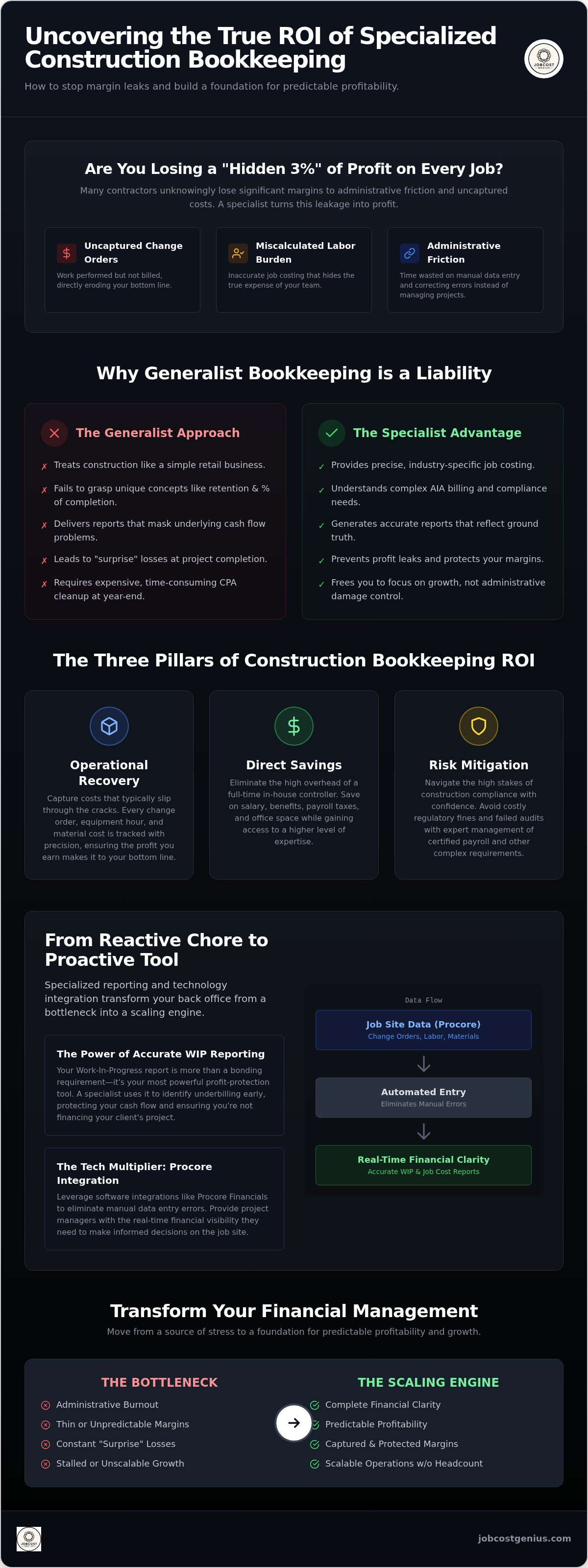
There are three primary areas where a specialist generates value that a generalist cannot match. First, you see direct savings. Scaling firms often realize immediate gains by eliminating the overhead associated with a full-time in-house controller. This includes not just the base salary, but the heavy burden of benefits, payroll taxes, and dedicated office space. Second, you achieve operational recovery. This pillar focuses on capturing costs that typically slip through the cracks of a standard ledger. When you track every change order and equipment hour with precision, you stop donating your profit to the project. Finally, there is risk mitigation. A specialist understands the high stakes of certified payroll and audit compliance. Avoiding a single regulatory fine or a failed audit provides an ROI that often dwarfs the annual cost of the service itself.
Why Generalist Bookkeeping is a Liability
Generalists often treat your business like a retail shop or a standard service provider. This is a fundamental mistake. Construction accounting is significantly different from other industries because it relies on unique principles like retention and the percentage of completion method. A generalist who doesn't understand these nuances will provide reports that look healthy on paper while your actual cash flow is struggling. They fail to account for the timing of revenue and expenses, leading to "surprise" losses at the end of a project.
The financial cost of an industry blind bookkeeper is often hidden until year end. You might pay a lower hourly rate for a generalist, but you'll likely face a massive bill from your CPA to clean up messy books before taxes can be filed. This cleanup tax frequently exceeds the cost of hiring a specialist from the start. Beyond the numbers, there is a heavy opportunity cost. Every hour a business owner spends correcting entry errors or chasing down missing job costs is an hour not spent bidding new work or managing field operations. A specialist removes this burden, allowing you to focus on high value growth rather than administrative damage control.
Plugging the Margin Leaks: How Specialized Reporting Generates Profit
Construction is often described as a game of inches. While a project might look successful on the surface, many contractors unknowingly lose a "Hidden 3%" of their margin on every job through administrative friction and uncaptured costs. This is where the ROI of a dedicated construction bookkeeper becomes most evident. A specialist doesn't just record history; they use real-time data to prevent profit from leaking out of your business. By managing change orders as they occur and tightening the cash conversion cycle, a dedicated professional ensures that the work you perform actually reaches your bottom line.
The Financial Power of Accurate WIP Reporting
Work in Progress (WIP) reporting is often treated as a chore for the bonding company. In reality, it's your most powerful profit-protection tool. A dedicated bookkeeper identifies underbilling early in the project lifecycle. When you underbill, you're essentially acting as a bank for your client, which cripples your operational cash flow. Conversely, a specialist helps you manage overbilling. While overbilling provides a temporary cash infusion, it can lead to disaster if you're "borrowing" from future profits to pay for current mistakes. Learning the nuances of fixing overbilling on WIP reports to protect cash is essential for long-term stability.
Following industry standards set by organizations like the Construction Financial Management Association (CFMA) ensures your reporting is both accurate and bank-ready. This level of meticulousness allows you to spot "profit fade" before it becomes irreversible. When your back office provides this degree of visibility, you gain the confidence to make aggressive, data-backed decisions on the job site.
Job Costing and Labor Burden Accuracy
Understanding your true labor cost is the difference between a profitable bid and a losing one. A generalist often fails to calculate the full labor burden, which includes payroll taxes, workers' comp, insurance, and benefits. Without this data, your job costing is fundamentally flawed. A dedicated construction bookkeeper tracks these variables weekly, comparing estimated costs against actual field performance. This allows you to identify which project types are your most profitable and which ones are consistently draining your resources.
A specialized partner ensures your back office runs as efficiently as your best field crew. You can explore how our tiered service plans provide this level of expert oversight. By focusing on these granular details, you transform your accounting department from a cost center into a strategic asset that recovers stolen margins and supports sustainable growth.
Cost Comparison: In-House vs. Generalist vs. JobCost Genius
Choosing the right staffing model for your back office is a strategic decision that directly impacts your bottom line. Many contractors default to an in-house hire or a local generalist without analyzing the long term financial impact. When you calculate the ROI of a dedicated construction bookkeeper, you must look at the total cost of ownership rather than just the hourly rate. A specialized partner provides a level of efficiency that internal staff or non-industry bookkeepers simply cannot match. This comparison highlights why a tiered, specialized approach often yields the highest return for growing firms.
The True Cost of an In-House Team
The financial burden of a full time employee extends far beyond their base salary. When you hire a junior staffer at a $60,000 salary, the actual cost to your business often climbs toward $80,000 after accounting for payroll taxes, health insurance, and retirement benefits. You also have to consider the hidden costs of recruiting, onboarding, and providing office equipment. Furthermore, software licensing for specialized tools can add thousands to your annual overhead. There is also the risk of a "single point of failure." If your only bookkeeper leaves, your financial operations stall. In contrast, our Starter Plan provides a team-based approach for a fraction of that cost, ensuring your books stay current regardless of individual staff changes.
Generalist vs. Specialist: The Real Math
A generalist bookkeeper charging $25 per hour might seem like a bargain. However, you must account for the "owner's tax." This is the time you spend explaining industry concepts like retention, prevailing wage, or specific AIA billing formats to someone who doesn't speak the language. The complexity of construction accounting and financial management requires specialized training that generalists lack. If a generalist makes a mistake on a pay application, it could delay your cash flow by thirty days or more. These delays are expensive and avoidable.
The ROI of a dedicated construction bookkeeper is realized through speed and accuracy. Because we understand the nuances of the industry, we don't need you to explain how a project works. We manage the details of your Growth Plan or Premium Plan with 20 years of industry experience. This expertise reduces the management burden on the business owner. Instead of fixing errors or explaining retention, you can focus on bidding new work and managing your crews. You aren't just buying a service; you're buying back your time and securing your financial foundation.
The Tech Multiplier: ROI through Software Integration
Technology acts as a powerful force multiplier for your financial operations. The ROI of a dedicated construction bookkeeper is significantly amplified when they bridge the gap between field data and the general ledger. Manual data entry remains a primary source of profit leaks; it introduces errors that compound over the life of a project. By implementing a field to office sync, firms can reduce data entry errors by up to 90% while ensuring that project managers have access to real-time information. This synchronization allows for immediate course correction when a job starts to veer off budget.
Implementing a specialized Procore Financials Integration provides project managers with the visibility they need to manage their budgets effectively. This integration ensures that every dollar spent in the field is reflected in your accounting software without delay. A Procore financials consultant can save 10+ hours of admin time weekly by automating these complex job costing workflows. This automation also speeds up the billing cycle, which reduces your AR days and strengthens your relationships with subcontractors and vendors.
Maximizing Your Tech Stack (Procore, Buildertrend, Sage)
Your back office should serve as a unified source of data for lenders and bonding agents. When your project management software and accounting systems are disconnected, you're forced to reconcile data manually, which leads to discrepancies and missed costs. Whether you use Procore, Buildertrend, or Sage, a dedicated bookkeeper ensures these platforms communicate effectively. Choosing the right foundation is critical; you can read more about Procore vs QuickBooks: Choosing Your Tech Stack to understand which tools best support your growth.
Scalability without Friction
A major benefit of specialized technology is the ability to scale operations without a linear increase in cost. A dedicated partner can often handle a 2x increase in project volume without requiring a 2x increase in administrative headcount. This is achieved by automating repetitive tasks, such as vendor invoice processing and payroll compliance checks. These systems ensure your financial statements are audit ready at all times, providing the peace of mind you need to focus on high level strategy. Learn how our Procore Financials Integration services can help you build a more resilient and scalable back office.
Securing Your Financial Foundation with JobCost Genius
Many construction firms operate in a state of perpetual "survival mode," where financial reporting is a reactive task rather than a proactive strategy. You might find yourself scrambling to gather documents for a lender or struggling to explain a sudden dip in cash flow. JobCost Genius transforms this dynamic by turning your back office into a strategic asset. With over 20 years of industry-specific experience, our team provides the organized calm you need to make confident decisions. When you understand the ROI of a dedicated construction bookkeeper, you realize it isn't just about balancing books; it's about building a foundation that supports long-term scaling.
A Partner Invested in Your Project Profitability
We don't believe in one-size-fits-all solutions. Our tiered service offerings, including the Starter Plan, Growth Plan, and Premium Plan, are designed to evolve alongside your business. This flexibility ensures you always have the right level of oversight without paying for unnecessary overhead. Our team speaks "Contractor" fluently. This means we understand the pressure of bid deadlines, the complexity of lien waivers, and the critical nature of timely payroll. We act as a disciplined extension of your team, ensuring every financial detail aligns with your operational goals. For a deeper look at the landscape ahead, consult our 2026 Construction Accounting Guide for Small Firms to prepare your business for upcoming industry shifts.
Your Next Steps to a Healthier Bottom Line
Transitioning to a specialized bookkeeping partner is a methodical and structured process. We start by identifying your immediate pain points and structuring a solution that addresses your specific project needs. During the first 90 days of specialized oversight, we focus on several key objectives:
- Establishing a clean baseline by reconciling historical data and cleaning up the chart of accounts.
- Implementing or optimizing your WIP reporting to provide immediate visibility into project margins.
- Streamlining your field-to-office data flow to eliminate manual entry bottlenecks.
- Setting up consistent reporting rhythms so you never have to guess about your cash position.
Securing your financial future begins with a single decision to prioritize accuracy and specialized expertise. Starting today ensures your margins are protected for the 2026 fiscal year and beyond. You've worked hard to build your reputation in the field; let us provide the foundational strength your back office requires. The ROI of a dedicated construction bookkeeper is most visible when you finally have the freedom to focus on the work you love. Schedule your financial health checkup with JobCost Genius to see how we can help you recover your stolen margins and scale with confidence.
Building a More Profitable Future for Your Firm
Recovering your stolen margins requires moving beyond basic data entry and embracing specialized financial oversight. You've seen how accurate WIP reporting and seamless software integrations transform your back office from a cost center into a profit-generating engine. By identifying hidden leaks early, you protect your cash flow and ensure that every job contributes to your long-term stability. The ROI of a dedicated construction bookkeeper isn't just found in a spreadsheet; it's realized in the peace of mind that comes from professional, industry-specific management.
JobCost Genius brings over 20 years of industry experience to your business. We provide the specialized WIP and AIA billing expertise you need to scale without the friction of adding internal headcount. With transparent pricing starting at $800/month, you can secure a strategic partner who understands the unique demands of the job site. You've built a reputation for quality in the field; now it's time to match that excellence in your financial foundation. Start protecting your margins with JobCost Genius specialized bookkeeping today and take the first step toward predictable, strategic growth.
Frequently Asked Questions
How much can a construction company save by outsourcing their bookkeeping?
Outsourcing typically reduces administrative overhead by 30% to 50% when compared to the total cost of an in-house employee. You eliminate the burden of payroll taxes, health benefits, and recruitment costs. More importantly, you gain a partner who identifies uncaptured change orders and job costs. These recovered margins often exceed the monthly service fee, providing a clear financial advantage for growing firms.
What is the difference between a general bookkeeper and a construction-specific one?
A construction-specific bookkeeper understands industry-specific requirements like retention, prevailing wage, and AIA billing formats. Generalists often treat every business like a retail shop, failing to account for the percentage of completion method. This specialized knowledge prevents the "cleanup tax" typically paid to CPAs at year-end. It ensures your financial reports reflect the reality of your project sites rather than just basic bank transactions.
Why is WIP reporting so important for my construction business ROI?
WIP reporting acts as an early warning system for your cash flow by identifying underbilling and overbilling trends. It allows you to see exactly where a project stands in terms of profitability compared to your original estimates. This level of granular visibility is a key component when measuring the ROI of a dedicated construction bookkeeper, as it prevents project-level losses before they become irreversible.
Can a dedicated bookkeeper help me get better bonding and bank loans?
Yes, sureties and lenders require accurate, industry-standard financial statements and WIP reports to assess your bonding capacity. A dedicated professional ensures your books are audit-ready and reflect the true profitability of your projects. This professional presentation builds trust with financial institutions. It often leads to higher credit limits and better bonding rates because your financial foundation is transparent and reliable.
Is it worth paying $800 or more a month for bookkeeping services?
A specialized service starting at $800/month provides significantly more value than a generalist bookkeeper or a junior in-house staffer. This investment secures 20 years of industry experience and specialized WIP management. When you factor in the time saved and the errors avoided, the ROI of a dedicated construction bookkeeper becomes evident through increased net profit and reduced administrative stress for the owner.
How does Procore integration improve my company’s financial health?
Procore Financials Integration eliminates manual data entry by syncing field costs directly with your accounting software. This real-time visibility allows project managers to track budgets accurately and avoid expensive overruns. By bridging the gap between project management and the general ledger, you reduce administrative friction. This ensures your financial data is always current, allowing for faster billing cycles and improved cash flow.
What are the most common profit leaks in a construction business?
The most frequent profit leaks include uncaptured change orders, miscalculated labor burdens, and consistent underbilling on large projects. Many contractors also lose margin through administrative burnout and delayed payment cycles. A specialized partner identifies these gaps through meticulous job costing. They ensure every hour worked and every material purchased is billed correctly to the client, protecting your bottom line from quiet erosion.
Do I need a construction bookkeeper if I already have a CPA for taxes?
Yes, because a CPA typically focuses on year-end tax compliance rather than daily job costing and WIP management. A dedicated bookkeeper provides the granular, day-to-day data that your CPA needs to file accurately. This proactive management reduces the time your CPA spends correcting industry-blind errors. It lowers your overall professional fees while providing the real-time reporting necessary to run your business effectively.


