

What if the real test of payroll isn’t just whether employees get paid, but whether labor costs land in the right project records? Construction payroll processing services need to account for jobsite information that arrives late or in different formats, along with changing pay rates, worker types, and project requirements.
That complexity can make payroll feel like a separate administrative task, even though labor records also inform job costs and financial reporting. Contractors need accurate payments and organized records, with workflows that support payroll tax and labor compliance responsibilities.
This guide compares construction payroll service features, workflows, and fit so you can assess which support matches your team’s needs. You’ll learn what to look for in payroll administration, how to evaluate the connection between labor data and project finances, and where WIP reporting and Procore Financials integration fit into a broader financial workflow. The goal is a more informed choice and a clearer path from jobsite hours to useful project-level financial insight.
Key Takeaways
- Assess construction payroll processing services by how well they handle your workforce’s mix of employees, projects, and pay categories.
- Compare in-house processing, payroll software, and outsourced support by who owns each task and what capacity your team has.
- Use a consistent handoff for employee records, hours, project coding, exception review, and payroll processing.
- Accurate labor and project coding can make payroll records more useful for project cost oversight and financial reporting.
- Explore how construction-focused payroll management can work alongside bookkeeping, WIP reporting, and Procore Financials integration.
What construction payroll processing services handle for contractors
Construction payroll processing services organize payroll inputs, manage payroll administration, and process employee payments. The work starts with gathering and reviewing information such as hours, project assignments, pay rates, and employee records. Those details are then used to support a payroll run. The precise workflow depends on how a team collects labor information and what administrative support it needs.
Construction payroll services provide managed support for turning workforce and job data into organized payroll records and employee payments. Payroll software is a tool that helps process or record that information. Software can assist with calculations and data entry, but it doesn’t necessarily manage the full administrative workflow or connect labor details to a contractor’s broader financial review.
How construction payroll differs from a basic payroll run
A standard payroll run becomes more involved when hours come from multiple jobsites, arrive in inconsistent formats, or need project assignments before processing. A worker might spend part of a pay period on one project and the rest on another. If roles, pay rates, or work schedules change, payroll records need to reflect those distinctions clearly.
Worker arrangements and project requirements can add further detail. Some public works contracts involve prevailing-wage and certified-payroll obligations. The Davis-Bacon Act is one relevant federal law; contractors managing these requirements may need guidance specific to certified payroll. See the dedicated guide for more detail.
Which payroll tasks can a service support?
A construction payroll service can process employee payments and manage tax withholdings. In practical terms, that means organizing the payroll inputs used to determine employee pay and applicable withholdings, while maintaining records of the information used. Clear records make it easier to review payroll activity and reconcile labor information with financial records.
- Payment processing: Use organized employee and payroll information to support employee payments.
- Withholding management: Track withholding details as part of payroll administration.
- Payroll records: Keep labor and payment information available for review and reconciliation.
- Labor compliance support: Organize payroll information related to applicable labor requirements.
Payroll management is related to bookkeeping, but the tasks are distinct. Payroll records can inform bookkeeping and financial reporting, while bookkeeping organizes financial activity across the business. Tax preparation support may involve organizing payroll information for review, but it is distinct from income tax filing. Keeping those responsibilities clear helps contractors understand what their payroll workflow covers and how its records support broader financial oversight.
How to evaluate construction payroll processing services
Compare the workflow, not just the payroll feature list. Strong construction payroll processing services should fit how your team captures labor, assigns work, reviews payroll inputs, and uses financial records. They should also make clear which responsibilities belong to the service and which remain with your staff.
Compare workforce fit, processing responsibilities, reporting, support, and financial handoffs.
| Criterion | What to assess |
|---|---|
| Workforce fit | Can the workflow accommodate your employee types, work locations, and changing schedules? |
| Processing responsibilities | Clarify who organizes payroll inputs, reviews exceptions, manages withholdings, and processes payments. |
| Reporting | Understand how payroll records are maintained and made available for review. |
| Support | Identify how questions and corrections are handled during the payroll process. |
| Financial handoffs | Assess how labor information can move into project costing and bookkeeping workflows. |
Match the service to workforce and project complexity
Start with the shape of your operation. Consider team size, employee types, work locations, and how often schedules or assignments change. Then assess whether the process organizes hours by employee, project, and applicable pay category. When a crew member works across projects, clear hour assignments help keep labor records useful for both payroll review and project cost tracking.
Different rates, union work, or prevailing-wage projects may add process requirements. Reporting obligations depend on the work and the rules that apply. The U.S. Department of Labor outlines prevailing wage and compliance obligations for federal construction contracts. Identifying the requirements that apply helps define the records and review steps your workflow needs.
Check reporting, support, and financial workflow fit
Payroll processing and time tracking are related, but they aren’t the same function. A time-tracking tool captures hours; payroll processing uses organized information to support payments and payroll records. Compare each part separately, including how corrections, project assignments, and pay categories pass from time entry into payroll.
Review how payroll records will support reconciliation, project costing, and month-end bookkeeping. Consistent labor coding can give financial reviewers a clearer view of costs by project. For broader context on connecting accounting processes, see this construction accounting guide for small firms. Contractors considering a connected payroll and financial workflow can also explore construction payroll management.
Outsourced payroll, payroll software, or in-house processing?
Each model assigns payroll work differently. In-house processing keeps tasks with your team. Software can automate calculations or transfer information, while an outsourced service adds managed payroll administration. The right fit depends on your workforce’s complexity, the time and expertise available internally, and how closely payroll needs to connect with project finances.
| Model | Responsibilities | Operational strengths | Trade-offs |
|---|---|---|---|
| In-house | Staff organize inputs, review records, process payroll, and maintain the workflow. | Direct control over each step and internal records. | Requires ongoing staff time and payroll knowledge, especially as requirements grow more complex. |
| Payroll software | Your team enters or transfers workforce information and operates the system. | Can support calculations, data entry, and repeatable steps. | Automation doesn’t remove the need to collect complete information, resolve exceptions, or oversee the process. |
| Outsourced payroll | A service supports recurring payroll administration and processing; your team supplies and reviews workforce information. | Can shift administrative work away from internal staff and connect payroll with financial workflows. | Requires a clear handoff of accurate employee, hours, and project details. |
When in-house or software-led payroll may fit
A stable workflow with straightforward pay arrangements may be manageable internally, particularly when a team has the time and knowledge to maintain payroll records and review each run. Software can make calculations or data transfer more efficient, but people still need to gather hours, assign projects, check unusual entries, and address missing or incorrect details. Contractors remain responsible for supplying complete and accurate workforce information. Payroll administration also needs to account for applicable wage and hour rules, including the Fair Labor Standards Act (FLSA).
When outsourced construction payroll support may fit
Outsourcing may suit a contractor when payroll tasks compete with project management, field coordination, or other financial responsibilities. Construction-focused payroll processing services provide managed support for recurring payroll work, while organized labor records help inform bookkeeping and project-level financial review. The value is not simply moving a task elsewhere; it is creating a defined workflow that connects payroll information with broader financial oversight.
Consider the service model alongside the rest of your finance function. This outsourced bookkeeping guide for construction firms offers broader context on how external support can fit into accounting operations. JobCost Genius connects construction-focused payroll management with bookkeeping and financial reporting, with construction payroll support as part of that workflow.
Prepare your construction payroll workflow for a smooth handoff
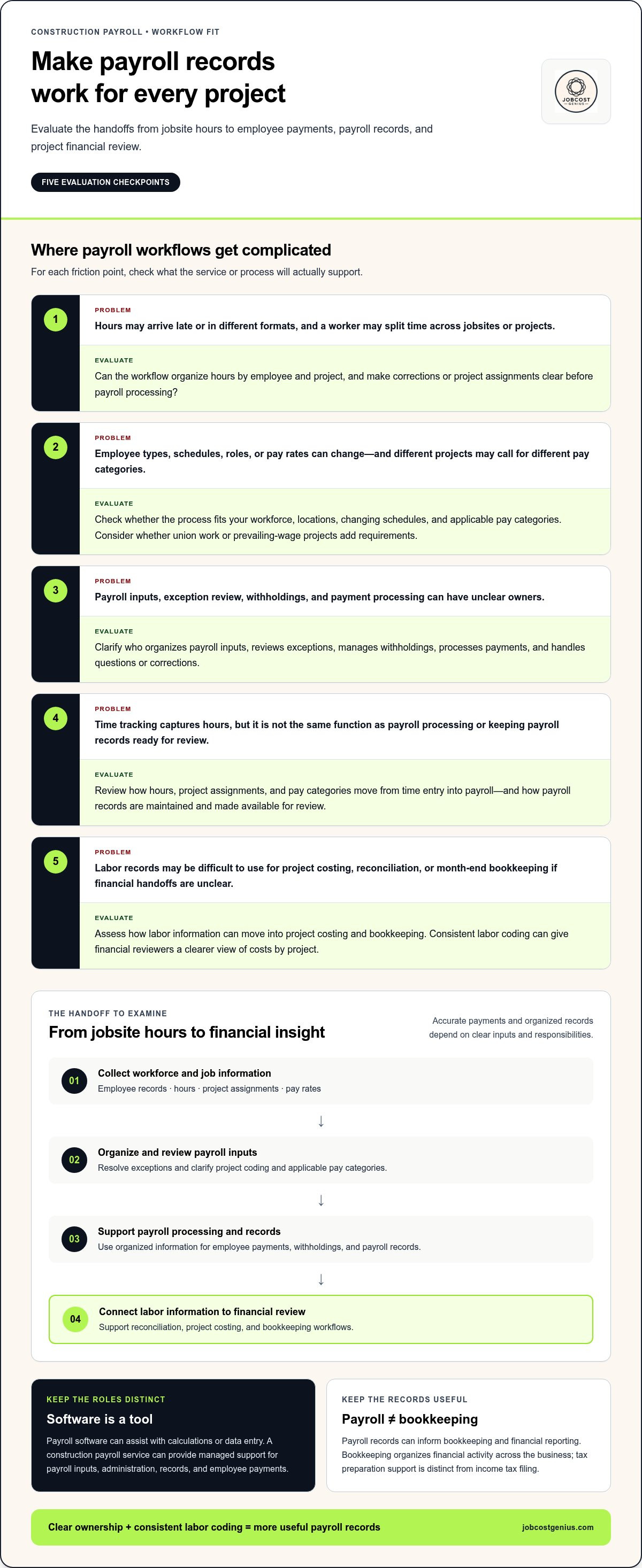
A repeatable handoff makes payroll easier to review and labor information more useful after payments are processed. Before each payroll run, organize the same core inputs and apply consistent project and labor codes. The steps below are general workflow guidance, not a substitute for checking legal or jurisdiction-specific payroll requirements that apply to your projects.
- Organize employee records. Keep current employee details and applicable pay information in an orderly record set.
- Collect hours. Gather time information for the relevant pay period and identify missing or unclear entries.
- Assign projects. Code each block of labor to the appropriate project and applicable pay category.
- Review exceptions. Resolve incomplete entries, unusual hours, or approved adjustments before processing.
- Process payroll. Use the reviewed information to support employee payments and maintain organized payroll records.
Collect consistent employee and time information
For each worker, organize the employee record, hours, pay category, project assignment, and any approved adjustments. Set a consistent rhythm for submitting and reviewing these details before each payroll run. This helps prevent information from arriving in disconnected formats or at the last minute. Missing project codes or unclear adjustments can lead to follow-up corrections and complicate the review. Keep project-specific reporting obligations separate from this general preparation process; requirements depend on the work and applicable rules. For added context, see this prevailing wage payroll guide for contractors.
Connect payroll records to project financials
Consistent labor coding gives financial reviewers a clearer view of which projects incurred payroll costs. For example, coding hours to the correct job helps distinguish labor across projects rather than leaving it grouped in a general record. Consistent coding supports job cost review, but payroll records complement rather than replace bookkeeping, WIP reporting, or broader financial analysis. A WIP reporting guide for construction can help explain how project health is assessed alongside cost information.
JobCost Genius connects construction-focused payroll management with bookkeeping and financial reporting. Explore construction payroll support to see how an organized handoff fits into your broader financial workflow.
How JobCost Genius supports construction payroll processing
JobCost Genius provides construction-focused payroll management alongside bookkeeping and financial reporting. Its construction payroll processing services support employee payment processing, tax withholding management, and labor compliance workflows for teams with different sizes and levels of complexity. Payroll is treated as part of an organized financial process, not as a transaction disconnected from project records.
Payroll support alongside construction financial oversight
Reliable payroll records help contractors understand how labor information relates to project costs and broader financial activity. JobCost Genius supports payroll administration alongside bookkeeping and financial reporting, so contractors can consider these workflows together. The company’s founders bring more than 20 years of industry experience.
JobCost Genius also offers WIP (Work in Progress) Reporting and Procore Financials Integration. These related offerings support wider financial oversight and are distinct from payroll processing. Keeping those roles clear helps set expectations: payroll records organize employee payment and labor information, while WIP reporting and financial integration contribute to other parts of project and accounting review.
That connection matters during financial review. When labor information is organized consistently, it is easier to interpret alongside project costs and bookkeeping records. Payroll doesn’t replace those processes, but it can provide important information contractors use to understand business and project performance.
Choose the next step based on your payroll needs
Start by defining your current workflow. Consider the size and complexity of your workforce, where payroll administration creates the most friction, and how you need labor information organized for project reporting. For example, a team managing changing work assignments may prioritize clear project-level labor records, while another may focus on organizing payroll inputs and maintaining a dependable review process.
JobCost Genius offers Starter, Growth, and Premium as tiered service plans. They give contractors at different business stages options for support, without assuming every team needs the same level of service. A clear view of your payroll workload and financial reporting needs can help guide the fit.
If you’re looking for construction-focused support that connects payroll management with bookkeeping and financial reporting, explore JobCost Genius payroll support.
Build a payroll workflow that supports better project insight
The right payroll approach should match your workforce, internal capacity, and project reporting needs. As you compare construction payroll processing services, look beyond payment processing. Consider who organizes and reviews payroll inputs, how labor records are coded to projects, and whether those records can support bookkeeping and financial review.
A consistent handoff helps keep payroll information organized and makes labor costs more useful in the wider financial picture. JobCost Genius brings construction-focused payroll management together with bookkeeping and financial reporting. Its payroll support includes employee payment processing, tax withholding management, and labor compliance support, backed by founders with more than 20 years of industry experience.
Take the next step toward a payroll workflow that fits your construction business. Explore construction payroll support from JobCost Genius and find a clearer path from organized labor records to project-level financial insight. With the right process in place, your team can approach payroll with greater confidence and control.
Frequently Asked Questions
What do construction payroll processing services include?
Construction payroll processing services can organize payroll inputs, process employee payments, manage tax withholdings, and support labor compliance workflows. Contractors still need to provide accurate employee and time information and retain appropriate records. JobCost Genius provides construction-focused payroll management alongside bookkeeping and financial reporting, with support tailored to construction teams of varying sizes and complexities.
Can construction payroll services handle different pay rates and job assignments?
Yes. Construction payroll workflows can organize information for employees who work across projects, roles, or pay categories. Accurate processing depends on complete employee and time records, including clear project assignments and applicable pay details. Contractors should identify the pay rules that apply to their workforce and follow any relevant legal or reporting requirements. JobCost Genius tailors payroll management to construction teams and supports organized financial records.
Is outsourced construction payroll better than payroll software?
Neither option is automatically better for every contractor. Payroll software can help capture information, transfer data, or automate parts of processing, while an outsourced service can take on payroll administration and provide specialized support. Compare who owns each task, your workforce complexity, reporting needs, and internal capacity. Contractors can also combine software with managed support, provided responsibilities and data handoffs are clearly defined.
How does construction payroll connect to job costing?
Payroll information can support job costing when labor hours and related costs are consistently assigned to projects. This helps contractors review project expenses alongside budgets and other financial records. Payroll processing doesn’t replace job cost accounting or WIP reporting, but organized labor data can inform those workflows. The value of that information depends on consistent coding and a reporting process that fits the company’s accounting setup.
Does a construction payroll service file payroll taxes?
Tax withholding management, payroll tax preparation support, and filing responsibilities are distinct tasks, so define each responsibility clearly in the payroll workflow. JobCost Genius provides payroll management that includes tax withholding and tax preparation support. Contractors should maintain accurate records and follow current filing requirements and deadlines that apply to their circumstances.
What information should I prepare before using construction payroll processing services?
Before using construction payroll processing services, organize employee details, approved hours, project assignments, pay categories, and any adjustments for the payroll period. Establish a consistent process for reviewing time records and resolving exceptions before processing. For example, flag hours without a project code for review instead of passing them through as incomplete. Required records and compliance steps depend on your workforce and applicable rules.


