

Professional WIP reporting is not a back-office overhead cost; it is a self-funding insurance policy against project profit fade. For many construction firms, the real cost of inaccurate data shows up in sudden cash flow crunches and missed overbillings that never get recovered. Understanding WIP reporting services pricing is the first step toward moving away from manual Excel tracking and toward a state of organized financial clarity.
You likely already know the frustration of spending hours in outdated spreadsheets only to feel a sense of anxiety when a bonding agent asks for your latest schedule. We understand that you need clear visibility into your overbillings and underbillings without the headache of managing it yourself. This guide will show you exactly how professional financial oversight is structured and how to select a model that provides audit-ready statements for your lenders. We will break down the differences between Starter, Growth, and Premium service tiers, while explaining how specialized Procore Financials integrations can transform your project health data into a predictable monthly investment.
Key Takeaways
- Learn how accurate WIP reporting serves as a critical bridge between field operations and your general ledger to eliminate profit fade.
- Identify the core variables, such as monthly revenue and project volume, that influence WIP reporting services pricing and overall service scope.
- Compare tiered financial oversight models, including Starter and Growth plans, to find a scalable solution with a predictable monthly fee.
- Calculate the hidden costs of manual Excel tracking, including the risk of overpaying taxes on unearned revenue.
- Discover how Procore Financials integration delivers audit-ready statements that build trust with lenders and bonding agents.
The True Value of Work-in-Progress (WIP) Reporting Services
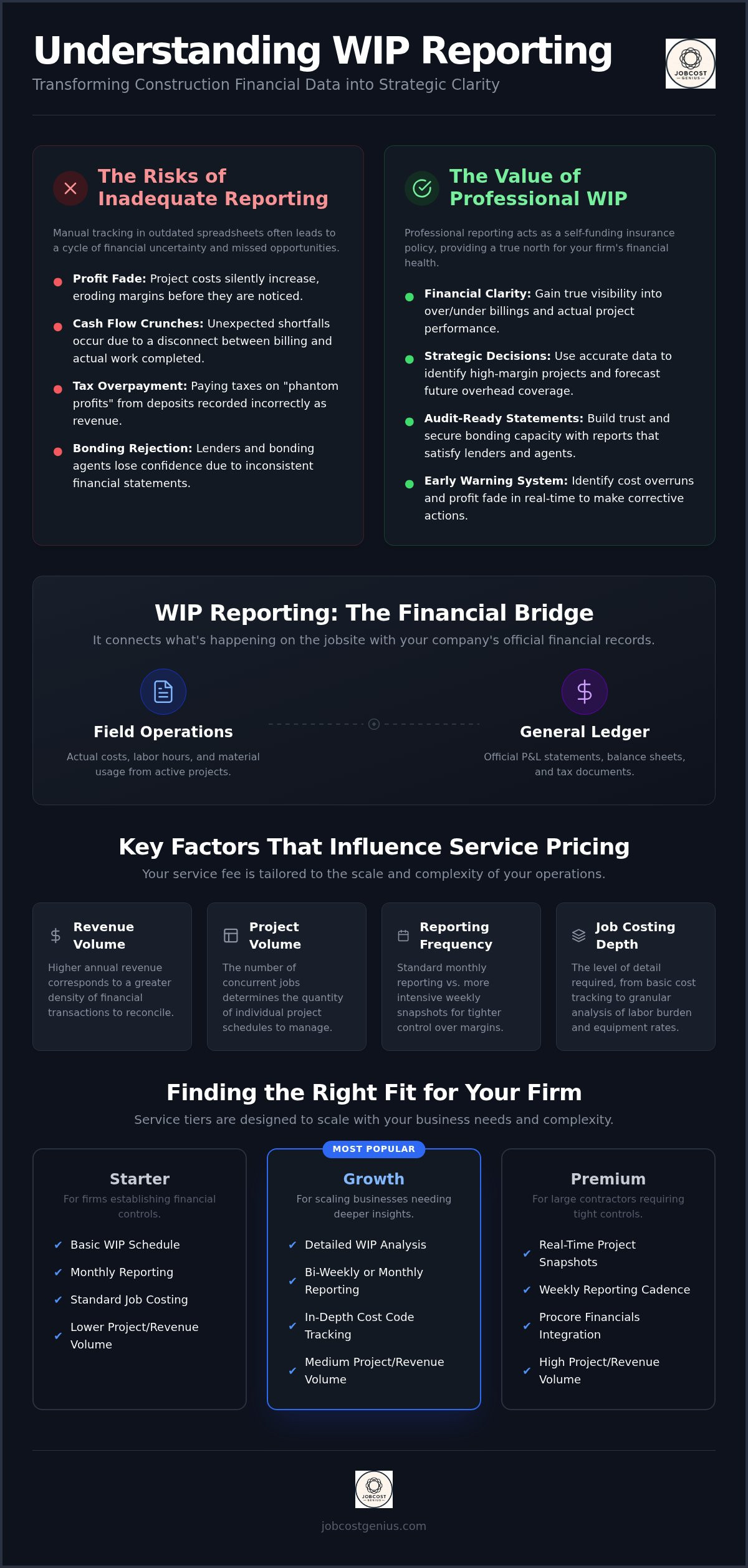
In the construction industry, the profit reflected on a standard profit and loss statement is often a distraction from reality. Without a specialized Work-in-Progress (WIP) schedule, your financial statements only reflect cash movement rather than actual project performance. Professional WIP reporting acts as the essential financial bridge between your project managers in the field and the general ledger in the office. It ensures that every dollar spent and every hour worked aligns with the revenue you've actually earned. While many firms focus primarily on WIP reporting services pricing during their search for a partner, the value of this service lies in its ability to provide a true north for your firm's financial health.
Generalist bookkeepers often fail to produce accurate construction WIP schedules because they don't understand the nuances of the percentage-of-completion method. They might record a large deposit as immediate revenue, which artificially inflates your profits and leads to a false sense of security. A specialized construction accountant looks deeper. They reconcile estimated costs against actuals to ensure your reports satisfy the strict requirements of bonding agents and bank lenders. This level of oversight is vital for securing the bonding capacity needed to land larger, more lucrative contracts.
Professional reporting also serves as an early warning system for "profit fade." This occurs when project costs slowly climb while the contract value remains stagnant. By the time a generalist notices the issue, your cash reserves might already be depleted. Specialized WIP management identifies these trends in real-time, allowing you to course-correct before a single project undermines your entire fiscal year.
WIP as a Strategic Decision-Making Tool
Accurate WIP data allows you to move beyond reactive accounting and start making proactive business decisions. By analyzing historical WIP reports, you can determine exactly which project types or sectors yield your highest margins. You'll gain the ability to spot underbillings, which indicate that you are essentially "financing" the owner's project with your own capital. Conversely, recognizing overbillings helps you set aside cash for future costs rather than spending it as profit today. This level of organization transforms your financial department into a strategic asset.
The Consequences of Poor Project Reporting
The risks of inadequate reporting extend far beyond messy spreadsheets. Poor data often leads to significant tax liabilities on "phantom profits" that exist on paper but haven't been realized in cash. Bonding companies are also quick to reject contractors who present inconsistent financial statements, as it signals a lack of operational control. Without a clear WIP schedule, it's nearly impossible to forecast whether your current project pipeline will cover your company-wide overhead in the coming months. This uncertainty creates a cycle of administrative overwhelm that limits your ability to scale confidently.
Key Factors That Influence WIP Reporting Services Pricing
Pricing for professional financial oversight is not a flat fee across the industry. It's determined by the specific demands of your construction firm's operations. Most providers calculate WIP reporting services pricing based on the volume of data that needs to be scrubbed, reconciled, and analyzed each month. If your firm manages $2 million in annual revenue with five active projects, your reporting needs are vastly different from a $50 million firm managing dozens of concurrent jobs. Higher revenue volumes typically involve a higher density of transactions, from material invoices to subcontractor pay applications, all of which must be accurately allocated to the correct cost codes.
The frequency of your reporting also plays a major role in the cost structure. A standard monthly financial close is the baseline for most firms. However, larger contractors often require weekly project snapshots to maintain tight control over their margins. This increased cadence requires more frequent data touches and real-time reconciliation. Industry experts at Procore emphasize the importance of WIP accounting for continuous project monitoring, as it allows owners to catch cost overruns before they become permanent losses.
Project Complexity and Job Costing Depth
Not all WIP reports are created equal. A basic report might only track total contract value against total costs. Deep job costing, however, includes labor burden, equipment rates, and indirect cost allocations. If your firm self-performs labor, the reporting complexity increases. You must track hourly rates, fringe benefits, and workers' compensation across multiple job sites. High change order volume also adds administrative hours, as each change must be properly documented in the WIP schedule to prevent revenue leakage. This level of detail requires a more sophisticated management approach but provides the clarity needed to protect your bottom line.
Software Integration and Data Sync
Your technology stack is perhaps the most significant variable in modern pricing models. Manual data entry is slow, expensive, and prone to human error. Transitioning to an automated system where your field software talks directly to your accounting software can significantly reduce administrative overhead. Professional Procore financials integration help ensures that your data remains consistent across platforms. While there is an initial setup investment, the long-term reduction in manual labor often makes this the more cost-effective choice for growing firms. If you want to see how these integrations fit into your specific budget, you can explore our tiered service options to find the right balance of automation and oversight.
Tiered Pricing Models: Finding the Right Fit for Your Firm
Selecting a financial oversight model shouldn't feel like a guessing game. While the variables discussed previously dictate the workload, structured service tiers provide the predictability you need for budgeting. Most firms find that WIP reporting services pricing follows a logical progression based on their current stage of growth. By moving away from hourly billing and toward a fixed monthly fee, you gain a partner invested in your efficiency rather than their own billable hours. This alignment ensures that your financial statements remain audit-ready without the surprise of fluctuating administrative costs.
Every firm has unique requirements, but most construction accounting needs fall into three distinct categories. Whether you're a local subcontractor or a regional general contractor, these models provide a framework for organized financial growth. For those managing more specialized requirements, such as AIA billing or certified payroll for government contracts, custom quotes ensure that every regulatory detail is captured without overpaying for unnecessary features.
The Starter Plan: Foundational Accuracy
The Starter Plan is the essential entry point for contractors moving away from "shoebox accounting" and toward professional visibility. With specialized construction bookkeeping starting at $800/month, this tier focuses on the core pillars of financial health. We prioritize clean transaction categorization and the production of monthly financial statements. This plan is designed for firms that need to establish a baseline of accuracy before tackling the complexities of deep job costing. It provides the foundational strength required to satisfy basic bank requirements and provides a clear view of your monthly overhead coverage.
Growth and Premium: Scaling Your Financial Infrastructure
As your firm expands, the complexity of your reporting must scale alongside your project list. The Growth Plan is tailored for firms managing multiple active jobs that require more frequent AP/AR management. At this level, we focus on fast-tracking payment applications to keep your cash flow steady. You'll receive more detailed labor burden calculations and equipment cost tracking, which are vital for understanding the true profitability of self-performed work. This tier helps you move beyond basic bookkeeping into strategic financial management.
For enterprise-level oversight, the Premium Plan offers the most robust support. This includes advanced financials for firms managing complex, multi-year contracts that demand meticulous attention to detail. We utilize resources like this Guide to Work in Progress (WIP) to ensure your schedules meet the highest industry standards. This tier often includes dedicated tech support for your Procore Financials Integration, ensuring that your field and office data remain in perfect sync. It's the ultimate solution for firms that view their financial department as a strategic engine for growth rather than a back-office necessity.
Hidden Costs of Manual WIP vs. Professional Reporting Fees
Many contractors view their monthly accounting bill as a necessary evil rather than a strategic investment. This perspective often overlooks the "Excel Trap," where high-salary project managers spend a significant portion of their week performing manual data entry. When you evaluate WIP reporting services pricing, you must compare the service fee against the true cost of your field staff's time. If a project manager spends five hours a week wrestling with outdated spreadsheets, you're effectively paying a premium for manual reporting that is inherently prone to human error. Freeing up your field staff to focus on production rather than paperwork is the first step toward reclaiming your project margins.
Professional oversight also mitigates the risk of tax overpayment. Without accurate revenue recognition, your firm might pay taxes on revenue that hasn't been truly earned yet. This drain on your liquidity can be far more expensive than a monthly service fee. Additionally, year-end "cleanup" by a CPA firm often comes with a high price tag. Maintaining audit-ready statements throughout the year eliminates these massive one-time expenses and ensures your financial house is always in order. By the time your annual review rolls around, your records are already reconciled and ready for inspection.
Eliminating the Cost of Profit Fade
Profit fade is the gradual erosion of margin due to untracked costs. Early detection of cost overruns can save thousands in project margin by allowing for immediate course correction before the damage becomes permanent. Having an "outside eye" verify project completion percentages provides an unbiased check against over-optimism in the field. This objective verification ensures that your reported profits are grounded in reality, not just best-case scenarios. By identifying these issues in real-time, you protect your cash reserves and maintain the foundational strength of your business.
Bonding and Financing Efficiency
Banks and bonding agents reward organization with better terms and increased capacity. Utilizing professional construction accounting for small firms can lead to lower interest rates on lines of credit because it demonstrates a high level of fiscal control. It reduces the friction and time-cost associated with annual financial reviews, as your statements are already in a format that lenders trust. There is also an intangible value in "financial confidence." When you know your numbers are accurate, you can bid on larger jobs with the certainty that your firm can handle the cash flow requirements. To see how these savings can impact your bottom line, view our transparent pricing plans and find a model that fits your firm's needs.
Partnering with JobCost Genius for Accurate Financial Oversight
JobCost Genius understands that construction accounting requires more than just balancing a checkbook. We speak the language of the job site, from retainage and cost-to-complete to labor burden and equipment rates. Our team acts as a strategic guide rather than a distant vendor, positioning your firm for long-term stability. While generalist firms struggle with the technicalities of the percentage-of-completion method, we specialize in delivering the organized calm that comes from expert-led financial oversight. We don't just provide reports; we provide the foundational strength your business needs to bid on larger contracts with confidence.
A core component of our service is the seamless sync between your field operations and office records. We specialize in Procore Financials Integration to ensure that your project managers and accountants are looking at the exact same numbers. This level of synchronization eliminates the data silos that lead to costly project errors. Our WIP reporting services pricing is designed to be predictable and transparent. By offering fixed monthly fees rather than hourly billing, we ensure you always know your administrative costs upfront. This model allows you to budget for expert oversight without the fear of surprise billable hours at the end of the month.
Our Onboarding Process
We begin every partnership with a meticulous assessment of your current chart of accounts. This initial phase identifies reporting gaps and ensures that your financial foundation is solid before we layer on advanced tracking. Next, we set up your WIP schedule to tie directly to your general ledger, creating a single source of truth for your project health. Finally, we establish a consistent monthly rhythm for financial reviews and project analysis. This structured approach ensures that you always have the data needed to make informed decisions about your project pipeline and overhead coverage.
Ready for Financial Clarity?
Our tiered plans are built to adapt to your firm’s unique growth path. Whether you're moving away from manual spreadsheets with our Starter Plan starting at $800/month or seeking enterprise-level oversight through our Premium Plan, we provide the infrastructure needed to scale. We help you move beyond the "Excel Trap" and into a state of financial clarity that satisfies both internal stakeholders and external bonding agents. The first step is a detailed review of your current reporting needs. This consultation allows us to understand your specific challenges and recommend the right oversight model for your firm.
Get a custom quote for your WIP reporting and bookkeeping needs today.
Transition to Organized Financial Growth
Moving from manual spreadsheets to professional oversight is a critical milestone for any growing construction firm. You've seen how specialized reporting protects your margins and ensures your project data is audit-ready for bonding agents and lenders. Understanding WIP reporting services pricing allows you to budget for this expertise as a predictable monthly investment rather than a fluctuating overhead cost. By partnering with industry veterans who possess over 20 years of experience, you ensure that your WIP schedules are accurate, compliant, and strategic.
JobCost Genius provides the organized calm your back office needs. With transparent monthly pricing starting at $800, we offer a scalable path that grows alongside your project volume. Our team is ready to help you eliminate the "Excel Trap" and reclaim your time for field production. It's time to replace administrative anxiety with the confidence of knowing your overbillings and underbillings are precisely tracked.
View our Tiered Pricing Plans and Get Started
We look forward to helping you build a more profitable and predictable future for your firm.
Frequently Asked Questions
How much do construction accounting services typically cost?
Professional construction accounting fees vary based on your firm's annual revenue and the number of active projects requiring oversight. At JobCost Genius, our Starter Plan begins at $800 per month for foundational bookkeeping and transaction management. As your operations grow to include complex payroll or deep job costing, pricing scales into our Growth and Premium tiers. This structured model ensures you receive expert-led financial oversight without the unpredictability of hourly billing.
What is included in a standard WIP reporting service?
A standard service includes the reconciliation of contract values, estimated costs, and actual costs incurred to date. We calculate your percentage of completion for every active job to determine accurate revenue recognition. The final deliverable is a comprehensive WIP schedule that clearly identifies overbillings and underbillings. This report serves as the essential link between your field production and your general ledger, providing a true picture of your project profitability.
Can I get WIP reports if I use QuickBooks Online?
Yes, you can generate professional WIP reports while using QuickBooks Online. While the software itself lacks a native, automated WIP module, a specialized construction bookkeeper can bridge this gap. We extract your project data and apply the percentage-of-completion method to create an external WIP schedule. This ensures your financial statements remain accurate and audit-ready even if your primary accounting software is a generalist platform.
Why is WIP reporting more expensive than standard bookkeeping?
WIP reporting requires a higher level of technical expertise and more frequent data reconciliation than standard bookkeeping. It involves sophisticated revenue recognition calculations that generalist accountants often don't understand. The complexity of tracking labor burden, equipment rates, and cost-to-complete estimates is a primary driver of WIP reporting services pricing. This specialized oversight acts as an insurance policy against profit fade and tax overpayment on unearned revenue.
How does Procore integration affect the cost of accounting services?
Integrating your accounting system with Procore Financials typically involves an initial setup fee followed by a monthly maintenance component. This integration requires technical expertise to ensure cost codes and prime contracts sync correctly between the field and office. While it may increase the base WIP reporting services pricing, the investment pays for itself by eliminating manual data entry and reducing the risk of human error in your financial reporting.
Do I need a CPA or a construction bookkeeper for WIP reports?
You need a specialized construction bookkeeper for the day-to-day management of your WIP reports. While a CPA is essential for year-end tax filings and high-level audits, a construction bookkeeper provides the monthly oversight required to manage project margins. Most firms find that a specialized bookkeeping partner offers the industry-specific knowledge needed for accurate WIP schedules at a more cost-effective monthly rate than a traditional CPA firm.
What information do I need to provide for an accurate WIP report?
To produce an accurate report, you must provide the original contract value, any approved change orders, and updated cost-to-complete estimates. Your project managers play a vital role by verifying the actual progress on the job site. We combine this field data with your recorded labor, material, and subcontractor costs. This collaboration ensures that the final WIP schedule reflects the true financial status of every project in your pipeline.
How often should my WIP reports be updated?
Most construction firms update their WIP reports monthly as part of the standard financial close process. This frequency ensures that your overbillings and underbillings are reconciled before you issue monthly financial statements to lenders or bonding agents. High-volume contractors or those managing high-risk projects may choose bi-weekly snapshots. Regular updates allow you to identify cost overruns early enough to implement course corrections and protect your project margins.


