

Why does your Profit and Loss statement show a healthy margin while your business bank account is dangerously low? It is a frustrating paradox that keeps many owners up at night. You are successfully managing complex builds, yet the cash flow gaps between project draws feel like a constant, high-stakes gamble. If you feel like your current system is failing to capture the true state of your operations, you are not alone. Most generic accounting advice ignores the unique complexities of the trades. Implementing specialized bookkeeping for general contractors is the only way to transform that administrative overwhelm into financial clarity and organized calm.
We understand the pressure of protecting thin margins while material costs fluctuate. In 2026, relying on outdated myths about job costing or subcontractor compliance can lead to devastating audit risks and lost profits. This article will debunk five of the most expensive misconceptions currently hurting construction firms. You will discover how to leverage new 2026 tax rules, such as the restored 100 percent bonus depreciation and the 2.5 million dollar Section 179 limit, to strengthen your financial foundation. We will show you how accurate WIP reporting and integrated financial systems can finally provide the professional confidence you need to scale your business.
Key Takeaways
- Transition from period-based accounting to project-centric logic to capture the true financial health of every job.
- Configure your software with a specialized construction Chart of Accounts to ensure your data reflects the unique realities of the trades.
- Uncover why "profitable" projects often lead to cash shortages by mastering the mechanics of overbilling and underbilling.
- Protect your margins by calculating true labor burden and maintaining compliance with 2026 federal certified payroll standards.
- Realize the operational ROI of specialized bookkeeping for general contractors through tiered plans that scale with your firm's revenue and complexity.
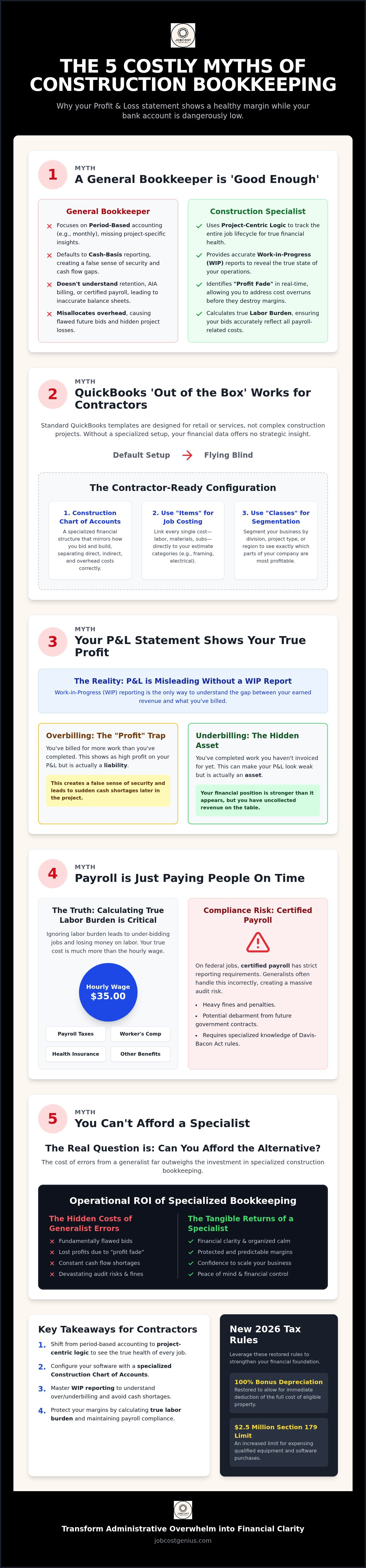
Myth 1: A General Bookkeeper Can Handle Construction Accounts
A general bookkeeper excels at balancing a checkbook and categorizing monthly utilities. However, the specialized nature of bookkeeping for general contractors requires a deep understanding of the project lifecycle rather than just a 30 day calendar cycle. When a professional treats your construction business like a standard retail shop, they often default to cash basis accounting. This is a critical mistake for growing firms. Cash basis reporting fails to account for long term liabilities and creates a false sense of security that can lead to sudden cash shortages during the gap between project draws.
Specialists understand the intricacies of retention tracking and AIA billing requirements. If your bookkeeper doesn't know how to track the 5 or 10 percent of a contract held back by the owner, your balance sheet will never be accurate. They also possess the skills to identify "profit fade" before it ruins your margins. Profit fade occurs when costs slowly escalate beyond the original estimate. A construction expert spots these trends in real time, allowing you to address overruns before the project becomes a net loss.
Project-Based vs. Period-Based Accounting
Most accounting software is designed for period based reporting, where the goal is to see how much money was made in January or February. In contrast, Construction accounting focuses on the lifespan of a specific job. Simply tagging a transaction with a "Customer" name isn't true job costing. You need to track labor, materials, and equipment against specific budget codes to see if you are actually making money on the street. This distinction is vital for long term contracts where revenue recognition and tax liabilities can span multiple years. For a deeper dive into these differences, read our guide on Construction Bookkeeper vs General Bookkeeper: Why Specialists Save Your Profits.
The Hidden Costs of Generalist Errors
When a generalist handles your books, misallocated overhead is a common result. If your indirect costs aren't distributed correctly across your projects, your next bid will be fundamentally flawed. You might win the job because you were the lowest bidder, but you'll lose money because you didn't account for your true operational costs. Generalists also frequently miss "labor burden" calculations. They might track hourly wages but ignore the costs of payroll taxes, workers' compensation, and benefits. This leads to an inaccurate view of your labor costs. Furthermore, handling certified payroll incorrectly on federal jobs in 2026 creates a massive audit risk that can result in heavy fines or being barred from future government contracts.
Myth 2: QuickBooks 'Out of the Box' is Ready for Contractors
QuickBooks is a powerful tool, but its standard configuration is fundamentally flawed for the construction industry. The default "Service" or "Retail" templates are built for businesses with simple transaction cycles, not firms managing multi-month projects with complex billing requirements. Effective bookkeeping for general contractors requires a system built on a specialized Construction Chart of Accounts. Think of this structure as your financial DNA. It dictates how every dollar is tracked, from initial mobilization to final retention release. Without this foundation, your reports will be a disorganized collection of numbers that offer no strategic insight into your true project margins.
Granular tracking is only possible when you utilize "Items" and "Classes" with precision. Items allow you to link specific costs directly to your estimate categories, such as framing, electrical, or site prep. Classes help you segment your company by division, region, or project type. This setup ensures that your financial data mirrors your actual field operations. If you aren't using these features to their full potential, you're essentially flying blind. You might see that you spent money, but you won't know exactly which phase of the project is over budget.
Customizing Your Chart of Accounts
Your accounting structure must align with how you bid work. If your estimating software uses CSI codes but your books use generic expense categories, you'll never achieve accurate job costing. A customized approach allows you to separate direct costs, like field labor and materials, from indirect project expenses like temporary utilities or equipment maintenance. This clarity is essential for identifying where your money is actually going. For a step-by-step breakdown of this process, see our guide on Building a Construction Chart of Accounts: The Definitive 2026 Guide.
Integration vs. Manual Entry
Manual data entry is the silent killer of project profitability. When your field team tracks costs in one system and your office team manually enters them into another, errors are inevitable. These reporting delays often mean you don't see a budget overrun until weeks after it happened. Modern bookkeeping for general contractors relies on seamless field-to-office synchronization. Utilizing a Procore Financials Integration eliminates double-entry and provides real-time visibility into your financial health. This ensures your tech stack supports 2026 compliance standards while freeing your team from administrative drudgery. If you're tired of chasing down missing receipts, a professional software integration can finally bridge the gap between your job site and your back office.
Myth 3: Your P&L Statement Shows Your Actual Profit
Many owners look at their Profit and Loss (P&L) statement and see a healthy net income, yet they struggle to meet payroll or pay vendors. This discrepancy is a primary source of administrative overwhelm. Standard bookkeeping for general contractors often fails because it doesn't account for the timing differences between when work is performed and when it is billed. If your P&L doesn't reflect your actual job progress, it is essentially lying to you. You might feel profitable on paper while your bank account tells a different, more dangerous story.
The core of this issue lies in the concepts of overbilling and underbilling. Overbilling occurs when you've invoiced more than the work you've actually completed. This creates a temporary cash surplus, but it also creates a liability for future costs that haven't hit your books yet. Underbilling is the opposite. You've performed the work and incurred the costs, but you haven't billed the client. This drains your cash and hides your true performance. WIP reporting acts as the essential bridge between immediate cash flow and the long-term accrual reality of your projects.
The WIP Report: The Contractor’s Real Dashboard
A Work in Progress (WIP) report is the only way to see your true earned revenue. While your P&L shows what you billed, the WIP report calculates what you actually earned based on the percentage of project completion. This distinction is vital for spotting a project that is bleeding out due to cost overruns long before the final check is cut. By comparing estimated costs to actual costs, you gain a real-time view of your project health. For a comprehensive look at these mechanics, review our 2026 Construction Accounting Guide for Small Firms. It provides the framework needed to move beyond basic spreadsheets.
Fixing the 'Lying' Financial Statement
To fix a misleading financial statement, your bookkeeper must make adjusting entries that align costs with revenue. This process moves overbilled amounts to the balance sheet as a liability and underbilled amounts as an asset. It's a technical adjustment that provides a foundation of financial clarity. Bonding agents and lenders prioritize these reports because they provide a transparent view of your firm's financial capacity. They don't want to see a simple P&L; they want to see that you understand your WIP. Beyond the technical benefits, there is a profound psychological relief in knowing your true net margin. It replaces guesswork with professional confidence and allows you to bid your next project with certainty.
Myth 4: Payroll is Just About Paying Employees on Time
Cutting checks on Friday is only a small fraction of the payroll process. In the specialized world of bookkeeping for general contractors, payroll is the primary engine for accurate job costing. If you only track gross pay, you are ignoring nearly 30 percent of your actual labor costs. This "true labor burden" is the difference between a profitable project and one that ends in a deficit. When you fail to account for the full cost of your team, your bids are structurally unsound before the first shovel hits the ground.
Misclassification of 1099 versus W2 workers is another ticking time bomb for growing firms. With the 2026 reporting threshold for Form 1099-NEC increasing to 2,000 dollars, regulatory scrutiny on subcontractor relationships is higher than ever. Misclassifying an employee as an independent contractor to avoid taxes or insurance premiums can lead to back taxes and penalties that wipe out years of profit. Accurate bookkeeping for general contractors ensures that every worker is categorized correctly and every hour is tracked against the right cost code.
Calculating Your True Labor Burden
Your true labor burden includes every dollar spent to keep a worker on the job site. You must factor in workers' compensation insurance, employer-side payroll taxes, health benefits, and union dues. An extra 5 dollars per hour in "hidden" costs might seem negligible, but across a 10,000 hour project, it represents a 50,000 dollar hole in your estimate. Automating your time tracking is the only way to eliminate "guesstimated" hours. This data allows you to see exactly how much labor is being spent on specific phases like framing or site prep, providing the clarity needed to protect your project margins.
Compliance and Reporting Requirements
Managing multi-state payroll adds significant complexity for regional contractors. Each state has unique withholding requirements and labor laws that you must navigate with precision. For those pursuing federal jobs in 2026, certified payroll reporting is a non-negotiable requirement. You must prove you are paying the prevailing wage and maintaining strict compliance with federal standards. Automated tax withholding management reduces the risk of human error and ensures you stay audit-ready throughout the year. Our Growth Plan and Premium Plan take the technical heavy lifting of labor burden and retention tracking off your plate, allowing you to focus on the build instead of the paperwork.
Myth 5: You Can't Afford Professional Construction Bookkeeping
Many contractors view specialized financial help as a luxury reserved for firms with eight-figure revenues. This is a dangerous assumption that often leads to stagnant growth. In reality, the return on investment for professional bookkeeping for general contractors is realized the moment you avoid a single underbilled project or capture a missed change order. Transitioning from administrative overwhelm to financial clarity typically takes just 90 days when you have a strategic back-office partner managing the technical details of your operations.
Positioning JobCost Genius as your partner allows you to stop playing catch-up with your receipts. We provide the disciplined expertise needed to navigate the unique complexities of this field. When your financial data is structured correctly, you move from a state of constant worry to one of organized calm. You gain the ability to make data-driven decisions that protect your cash flow and project margins.
The Cost of Inaction
Every hour you spend wrestling with a spreadsheet is an hour you aren't managing your crew or closing new deals. The cost of your time as an owner is likely the most expensive "administrative" expense on your Profit and Loss statement. Professional oversight ensures your books are audit-ready, which is critical given the 2026 tax landscape. With the Section 179 deduction limit at 2.5 million dollars and the restoration of 100 percent bonus depreciation, you need precise records to maximize your tax advantages. Accurate financials also improve your standing with bonding agents. They need to see a stable net worth and working capital before they will increase your aggregate limit for larger projects.
Choosing the Right Level of Support
We provide structured solutions that scale alongside your revenue. Whether you are a local firm or a regional powerhouse, our plans ensure you never outgrow your financial infrastructure. Our Starter Plan is designed to set a clean financial foundation for firms moving away from basic DIY methods. As your complexity increases, our Growth Plan and Premium Plan offer advanced WIP reporting and seamless Procore Financials Integration. This tiered approach allows you to access industry veteran expertise without the six-figure overhead of a full-time in-house controller. You can view our specialized construction bookkeeping plans to find the right fit for your current volume and future goals.
Build Your Financial Foundation for 2026
Managing a construction firm in 2026 requires more than just high-quality craftsmanship; it demands financial precision. You've seen how generic accounting fails to capture the reality of project-based work and how a standard software setup can lead to messy, unusable data. By prioritizing expert WIP reporting and a true understanding of your labor burden, you can move away from administrative overwhelm. Specialized bookkeeping for general contractors is the essential bridge between doing the work and actually keeping the profit.
Don't let inaccurate job costing or cash flow gaps stall your firm's growth. Implementing an industry-specific Chart of Accounts and integrating your field data with your back office provides the clarity needed to bid with confidence. It's time to treat your financial infrastructure with the same meticulousness you bring to your job sites. You've already done the hard work of building a reputation; now it's time to protect it.
Scale your construction firm with JobCost Genius bookkeeping starting at $800/mo and gain access to expert WIP reporting, Procore integration support, and a professional Chart of Accounts setup. We're ready to help you transform your back office into a strategic asset. You have a bright future ahead, and with the right financial partner, there's no limit to how far your business can go.
Frequently Asked Questions
What is the difference between general bookkeeping and construction bookkeeping?
Construction bookkeeping focuses on individual project lifecycles and granular job costing rather than just monthly calendar periods. General bookkeeping tracks company-wide income and expenses by date, which fails to reveal the true profitability of a specific build. To manage a firm effectively, you must track labor, materials, and subcontractors against a specific budget for every job site.
Why does my P&L show a profit but my bank account is empty?
This disconnect happens because a standard Profit and Loss statement often ignores the timing of cash inflows and outflows. You might have "earned" revenue on paper that hasn't been collected yet, or you may have overbilled a client, creating a temporary cash surplus that is actually a future liability. Specialized bookkeeping for general contractors prioritizes cash flow management to reveal these hidden gaps.
What is a WIP report and why do contractors need one?
A Work in Progress (WIP) report is a financial tool that adjusts your revenue based on the actual percentage of project completion. It identifies whether you are overbilled or underbilled on every active job in your pipeline. Contractors need this report to provide an accurate picture of their financial health to bonding agents, lenders, and for internal strategic planning.
Can I use QuickBooks for construction bookkeeping?
You can use QuickBooks, but it requires a specialized configuration to handle the unique complexities of the trades. The software must be set up with a custom Construction Chart of Accounts and utilize "Items" and "Classes" for detailed job costing. Without these specific adjustments, the standard version will produce messy data that fails to support professional project management.
What is labor burden and how do I calculate it?
Labor burden is the total cost of an employee beyond their gross hourly wage. It includes employer-paid taxes, workers' compensation insurance, health benefits, and retirement contributions. To calculate it, you sum all these indirect costs and divide them by the total number of hours worked to find your true hourly cost for every person on the job site.
How much does professional bookkeeping for general contractors cost?
Professional bookkeeping for general contractors is typically priced as a fixed monthly fee based on your firm's revenue and transaction volume. While generalists might charge hourly, specialized firms offer tiered plans that provide predictable costs and better alignment with your goals. This investment scales with your business, ensuring you have the right level of oversight as project complexity grows.
What is retention in construction accounting?
Retention is a portion of the contract price that the owner withholds until the project is substantially complete to ensure the work is finished correctly. It is typically 5 or 10 percent of each progress payment. In your books, this must be tracked as a separate receivable so you don't overstate your available cash while the funds are still being held.
How do I manage AIA billing and progress payments?
AIA billing is managed through standardized forms that track the original contract sum, change orders, and the total work completed to date. You must align your bookkeeping entries with these schedules to ensure your invoices match your project's percentage of completion. Using integrated software can automate this process and reduce the manual entry errors that lead to payment delays.


