

A generalist bookkeeper is often the most expensive "savings" a construction firm ever makes. While a standard accountant might keep the lights on, they rarely understand the specialized mechanics of AIA billing or the critical nature of real-time job costing. If you've ever felt the sting of profit fade or the anxiety of an inaccurate WIP report during a bank draw, you know that generic financial oversight isn't enough to protect your margins. Understanding the current market for monthly bookkeeping fees for general contractors is the first step toward reclaiming your time and your profitability.
We agree that your focus should be on the job site, not deciphering complex ledger entries. This guide provides a comprehensive breakdown of 2026 pricing standards, cost drivers, and the specific ROI of specialized construction accounting. You'll learn how to identify a partner who handles Procore or Sage integrations with ease while ensuring your business capitalizes on new 2026 tax provisions like the One Big Beautiful Bill Act. We'll show you how to transition from administrative chaos to a structured system that produces accurate financial statements for bonding and long-term growth.
Key Takeaways
- Understand why generalist accounting fails to track retention and labor burden, often leading to hidden project losses.
- Discover the primary drivers behind monthly bookkeeping fees for general contractors, including transaction volume and certified payroll requirements.
- Compare the true cost of an in-house administrative salary against specialized tiered plans that scale with your project count.
- Identify how real-time WIP reporting and software integrations prevent profit fade by allowing for immediate course corrections.
- Learn how to choose between the Starter and Growth plans to ensure your financial infrastructure supports your bonding and bank draw needs.
Beyond the Ledger: Why Construction Bookkeeping Fees Differ from General Accounting
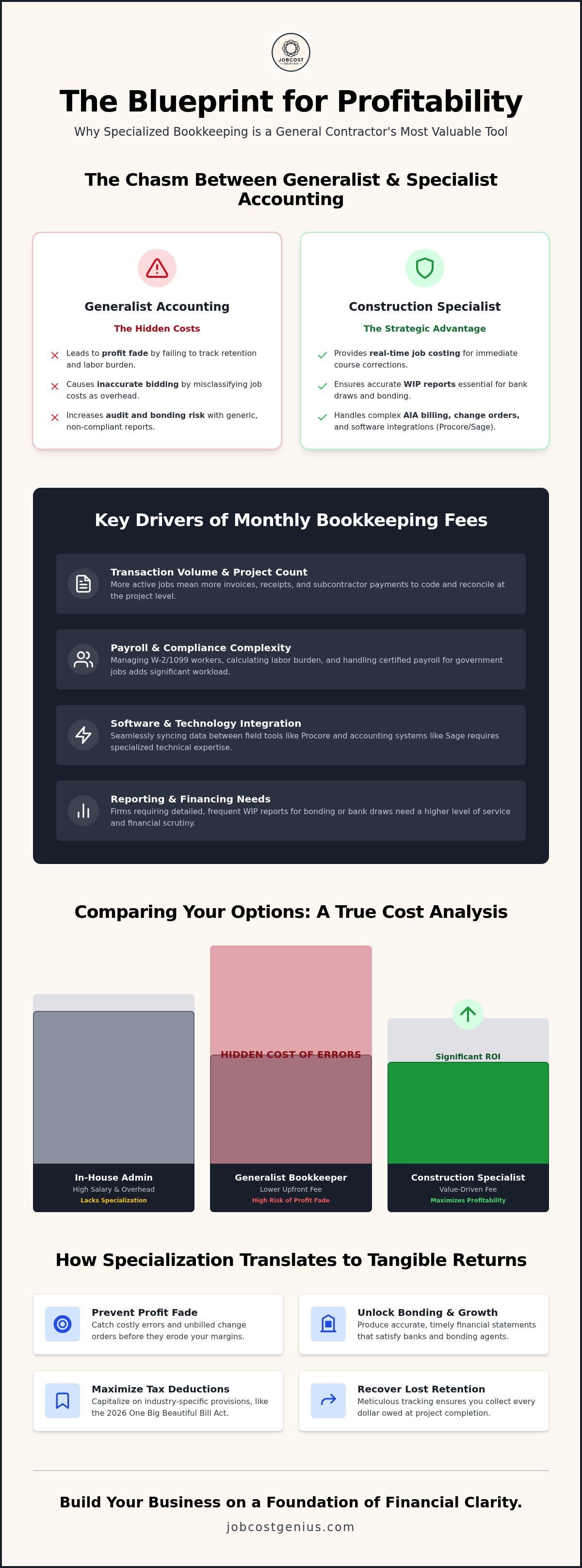
Construction bookkeeping isn't a standard administrative task. It's a specialized discipline that tracks every dollar at the project level. Most generalist accountants treat your business like a retail store, focusing on high-level income and expenses. However, general contractors operate in a high-stakes environment where one missed entry can lead to significant profit fade. When evaluating monthly bookkeeping fees for general contractors, you're paying for the ability to track retention, calculate accurate labor burden, and manage complex change orders. These elements are the foundation of your project margins. Accurate data is also your greatest asset when meeting bonding requirements or securing bank financing for large-scale projects.
The High Cost of Generalist Errors
Generalist bookkeepers often misclassify field expenses as general overhead. This error skews your project data and leads to inaccurate bidding on future jobs. If your records don't reflect the true cost of production, you risk failing an audit or losing your bonding capacity. A construction specialist ensures every expense maps to a specific cost code. This meticulousness often pays for itself through recovered retention and maximized tax deductions under current 2026 regulations. Expert oversight transforms your accounting from a reactive cost into a proactive tool for financial stability. It moves your firm beyond simple "checkbook accounting" and toward a state of organized project profitability.
Project-Based vs. Company-Wide Accounting
Standard profit and loss statements provide a snapshot of the company, but they don't tell you which projects are actually making money. General contractors require granular data that standard accounting models simply don't provide. While a service business might track revenue by month, you must track it by project phase and contract percentage. You need to see the financial health of each job site in real time to prevent minor issues from becoming major losses. This shift from company-wide reporting to detailed project tracking is what allows firms to scale without losing control. For a deeper dive into these requirements, see our 2026 Construction Accounting Guide for Small Firms. This strategic focus ensures that your monthly bookkeeping fees for general contractors translate directly into project-level clarity and long-term business growth.
Factors Influencing Monthly Bookkeeping Costs for General Contractors
Determining monthly bookkeeping fees for general contractors involves more than just looking at your annual revenue. While a retail business might have hundreds of simple sales, a GC manages a complex web of vendor invoices, subcontractor payments, and retention schedules. The depth of your financial reporting, particularly the need for accurate WIP reports, significantly influences the final cost. If your firm requires seamless data syncing between field tools like Procore and your office ledger, the technical expertise required shifts the pricing model. You aren't just paying for data entry; you're investing in a system that tracks every dollar across multiple job sites.
Transaction Volume and Project Count
The number of active jobs you manage directly correlates to the bookkeeper's workload. Managing accounts payable for five projects is vastly different from overseeing twenty. Each project brings a new set of vendor invoices and receipts that must be coded to specific job phases. High-volume AP management requires meticulous attention to detail to ensure you aren't overpaying subcontractors or missing early-pay discounts. As your project count grows, your bookkeeping partner spends more time reconciling these accounts to maintain project-level visibility. This granular tracking is essential for preventing the "profit fade" that occurs when small, unrecorded expenses accumulate over the life of a project.
The Complexity of Payroll and Compliance
Payroll in construction is rarely straightforward. Beyond simple W-2 processing, you're likely managing 1099 contractors and calculating complex labor burdens for accurate job costing. If you take on federal or state-funded projects, certified payroll reporting becomes a necessity. This reporting requires a high level of precision and adds a premium to monthly service fees due to the increased audit risk and reporting requirements. Managing workers comp audits and 1099 compliance throughout the year prevents the administrative overwhelm that typically hits during tax season. If you're looking to streamline these complexities, exploring a tailored bookkeeping plan can provide the foundational strength your back office needs.
Software integrations also play a major role in 2026 pricing. Syncing field data from platforms like Procore or Buildertrend to your office ledger requires a bookkeeper who understands both the construction workflow and the accounting software. This integration ensures that your project managers and your accounting team are looking at the same numbers. It eliminates the blind spots created by disconnected systems and provides the real-time data needed to capitalize on 2026 tax provisions, such as the restored 100% bonus depreciation under the One Big Beautiful Bill Act. Investing in a partner who understands these technical nuances ensures your monthly bookkeeping fees for general contractors deliver a measurable return on investment.
Comparing Service Models: In-House vs. Generalist vs. Construction Specialist
Choosing the right accounting model is a strategic decision that shapes your firm’s financial foundation. This choice directly impacts your monthly bookkeeping fees for general contractors and, more importantly, the reliability of your project data. While some firms prefer the proximity of an in-house employee, others find that specialized outsourced firms provide a higher level of technical accuracy. Understanding the trade-offs between these models allows you to select a partner that aligns with your growth trajectory and project complexity.
The Hidden Costs of In-House Staffing
A full-time in-house bookkeeper in competitive markets like NJ, NY, or PA typically costs between $80,000 and $110,000 per year once you include benefits, taxes, and overhead. Beyond the salary, you must account for the cost of software licenses for tools like QuickBooks or Procore. An in-house model often creates a "single point of failure" risk. If your only bookkeeper leaves, your financial history and current job costing expertise leave with them. Additionally, you must invest significant time and capital into ongoing training to keep staff updated on 2026 tax law changes, such as the new depreciation rules under the One Big Beautiful Bill Act. Outsourced specialists mitigate these risks by providing a team-based approach with built-in redundancy.
Why Generalists Struggle with WIP and AIA
Generalist bookkeepers often lack the technical expertise required for progress billing and the preparation of AIA G702 and G703 forms. These documents are essential for commercial projects and bank draws, yet they are notoriously difficult to manage without construction-specific training. A generalist might accurately record total revenue but fail to identify "overbilling" or "underbilling" on a Work in Progress report. This oversight masks potential cash flow crises until it is too late to course-correct. WIP reporting is the pulse of a construction business; it reveals exactly where you stand on every project before the job is closed. Specialist firms prioritize these reports, ensuring your monthly bookkeeping fees for general contractors deliver the strategic visibility needed to protect your margins.
Many growing firms now utilize a "Hybrid" model. In this scenario, field staff or project managers handle basic data entry in the field, while a specialist firm performs a rigorous monthly review. This ensures that the technical aspects of your accounting, such as retention tracking and labor burden calculations, are handled by experts. It provides the high-level oversight of a Premium Plan without the overhead of a full-time executive. This structured approach transforms your back office into a strategic asset that supports bonding capacity and long-term scaling.
Calculating ROI: When Does a $1,500+ Monthly Fee Pay for Itself?
Many firms view accounting as a necessary but stagnant overhead cost. However, when evaluating monthly bookkeeping fees for general contractors, the focus must shift from the price tag to the recovered margin. A low-cost generalist might record your transactions, but they rarely provide the strategic oversight needed to prevent profit fade. Industry data indicates that professional bookkeeping often saves two to five times its cost by eliminating tax penalties, identifying duplicate vendor payments, and catching billing errors early. For a firm managing multiple active job sites, a higher monthly investment is a defensive strategy for your bottom line.
Eliminating Profit Fade with Real-Time Data
Profit fade is the silent killer of construction margins. Consider a scenario where a material overage of $20,000 occurs due to an unrecorded vendor price hike. Without real-time job costing, you might not notice this variance until the final reconciliation, long after the opportunity for a change order has passed. A specialist firm identifies these discrepancies as they happen. This oversight also prevents the common risk of double-paying subcontractors who may inadvertently submit multiple invoices for the same phase of work. Knowing exactly where every project dollar is located transforms administrative overwhelm into organized calm.
Strategic Benefits for Scaling GCs
Clean, professional financial statements are mandatory for contractors looking to increase their bonding capacity or secure bank draws. Lenders and sureties view meticulous record-keeping as a primary indicator of a low-risk business. By outsourcing to a specialist, you also reclaim dozens of hours each month. Instead of wrestling with ledger entries, you can focus on high-value bidding and field operations. Specialized firms also ensure that retention tracking is handled with precision. This ensures that the final 5% or 10% of your contract value is never "forgotten" or lost in administrative delays. To see how specialized reporting can protect your project margins, explore our tiered service plans.
Faster AP/AR management directly improves your company’s cash flow and strengthens your vendor relationships. When you pay subcontractors on time and provide accurate documentation for bank draws, you build a reputation for reliability. This reputation allows you to secure better pricing and priority scheduling from your preferred trades. In the 2026 market, where economic uncertainty remains a factor, having a partner who handles Procore or Sage integrations ensures your financial infrastructure is as solid as your builds. The ROI of specialized bookkeeping isn't just about tax savings; it's about building a scalable, resilient business.
Selecting Your Plan: Tailored Financial Oversight for Every Stage
Finding the right fit for your firm shouldn't be a guessing game. Monthly bookkeeping fees for general contractors are ultimately determined by the level of visibility your project managers require and the complexity of your current project load. We've structured our services into three distinct tiers to ensure you only pay for the oversight you need while maintaining a clear path for future scaling. Whether you're a local firm establishing your foundation or a regional player managing complex commercial builds, your financial infrastructure must remain as solid as your job sites.
- Starter Plan: Designed for firms moving away from "shoebox accounting" or generalist bookkeepers. This tier focuses on essential record keeping, ensuring your ledger is accurate and your transactions are correctly coded to construction-specific categories.
- Growth Plan: Built for expanding teams that require more than just a balance sheet. This plan introduces sophisticated project-level tracking to manage increasing project counts and subcontractor volumes.
- Premium Plan: Our enterprise-level solution for contractors utilizing advanced platforms like Procore. This tier provides comprehensive support for complex AP/AR management and deep technology integrations.
From Record Keeping to Strategic Reporting
The transition from the Starter Plan to the Growth Plan represents a shift from compliance to strategy. While the Starter tier keeps you organized, the Growth Plan introduces critical WIP reporting and detailed cash flow analysis. This visibility allows you to see the "pulse" of your business before a project concludes. For firms operating at the highest level, the Premium Plan handles the technical heavy lifting of Procore Financials sync. This ensures your field data and office ledger remain perfectly aligned; preventing the administrative gaps that often lead to profit fade. These plans are designed to grow with you, ensuring you never have to endure a messy transition as your revenue increases.
Getting Started: The Onboarding Process
Moving from messy books to a structured subscription is a methodical process. We begin by refining your Chart of Accounts to reflect the specific needs of the construction industry. This foundation allows for accurate job costing and makes future bonding or bank draws significantly easier. Our team works with you to migrate data from your current system into a disciplined environment where every dollar is tracked. This transition transforms your back office from a source of anxiety into a strategic asset. To find the right fit for your firm's current trajectory, explore our tiered bookkeeping plans for General Contractors.
To determine which tier fits your current needs, consider this checklist:
- Do you have more than five active projects requiring simultaneous tracking?
- Are you required to provide WIP reports for bonding or bank financing?
- Does your team need field-to-office software integrations like Procore?
- Is your current monthly transaction volume exceeding your internal capacity to manage?
Selecting a plan based on these factors ensures your monthly bookkeeping fees for general contractors deliver the maximum ROI. By choosing a specialist partner, you secure the financial clarity needed to capitalize on 2026 tax provisions and protect your project margins for years to come.
Building a Stronger Financial Foundation for Your Firm
Specialized oversight is the difference between merely surviving a project and maximizing its total profitability. By moving beyond generalist accounting, you eliminate the blind spots that lead to profit fade and administrative overwhelm. Investing in a partner who understands the technical nuances of the construction industry ensures your data is accurate for bonding, bank draws, and long-term scaling.
When you evaluate monthly bookkeeping fees for general contractors, remember that you're paying for project-level clarity. Our team brings over 20 years of industry experience to every engagement; serving as Procore Financials integration experts who bridge the gap between the field and the office. With specialized WIP reporting included in our Growth and Premium plans, you gain the real-time insights needed to make informed mid-project corrections.
Ready to transform your financial infrastructure? View Our Monthly Bookkeeping Tiers for Contractors to find the right fit for your firm's current stage. Your back office should be an engine for growth, and we're here to help you build it with confidence.
Frequently Asked Questions
How much should a general contractor pay for bookkeeping monthly?
Industry standards for 2026 indicate that firms with revenue between $500,000 and $2 million typically pay between $700 and $1,400 per month for outsourced services. Smaller operations with revenue under $250,000 can expect costs between $300 and $800. These monthly bookkeeping fees for general contractors scale based on your transaction volume and the complexity of your job costing needs.
What is the difference between a general bookkeeper and a construction bookkeeper?
A construction bookkeeper tracks finances at the project level, managing retention and labor burden calculations that generalists often overlook. While a general bookkeeper focuses on company-wide profit and loss statements, a specialist ensures every expense is coded to a specific job phase. This granular approach is essential for preventing profit fade and maintaining the accurate project margins needed for bonding.
Do bookkeeping fees include payroll processing for construction crews?
Many specialist firms include basic payroll management in their tiered plans, though certified payroll for federal jobs often requires a higher service level. Managing a mix of W-2 employees and 1099 subcontractors requires meticulous compliance tracking to avoid year-end tax surprises. It's best to verify if your chosen plan covers workers' comp audit support and complex labor burden tracking for field staff.
Why is WIP reporting included in some bookkeeping fees but not others?
Work in Progress (WIP) reporting is a strategic financial tool rather than a basic record-keeping task. Because it requires calculating percentage-of-completion and identifying overbillings or underbillings, it's typically reserved for Growth or Premium service tiers. This report serves as the financial pulse of your business; providing the data necessary for securing bank draws and larger commercial contracts.
Is there an extra fee for Procore or Buildertrend integration?
Technical integrations for platforms like Procore or Buildertrend require specialized expertise and are usually bundled into Premium service tiers rather than charged as standalone fees. These integrations ensure your field data and office ledger stay synchronized in real time. While some generalists might struggle with these connections, a specialist firm includes this management to maintain the integrity of your financial infrastructure.
Can a bookkeeper help me with AIA billing and progress payments?
Yes, a specialist construction bookkeeper is trained to handle complex progress billing and AIA G702/G703 forms. These documents are critical for commercial projects and ensuring timely cash flow from bank draws. Having an expert manage this process reduces the risk of payment delays caused by administrative errors or improper documentation that a generalist might miss.
How do I know if I am overpaying for my monthly construction accounting?
Well-run construction businesses generally spend between 0.4% and 3.5% of their annual revenue on bookkeeping services. If your monthly bookkeeping fees for general contractors exceed this range without providing strategic value like WIP reporting or Procore integration, you may be overpaying. The true measure of cost is the ROI generated through recovered margins and the time you reclaim for bidding.
What is the typical setup fee for a new construction bookkeeping service?
Setup fees depend on the state of your current records and whether you require catch-up bookkeeping to fix historical errors. In 2026, cleaning up a backlog of complex construction records typically costs between $700 and $1,000 per month of historical data. A proper setup ensures your Chart of Accounts is tailored for construction-specific needs before you transition into a standard monthly subscription.


