

Overbilling is essentially a high-interest loan you've unknowingly taken from your future self. While a flush bank account feels like success, it often masks a looming deficit that can derail your bonding capacity and mislead your executive team. If your financial statements don't reflect the actual progress of your jobs, you're likely struggling with fixing overbilling on WIP reports to satisfy your surety agent and bank. It is a common frustration for contractors who find their cash-basis thinking at odds with the rigorous cost-to-cost reconciliation required in the current 2026 economic environment.
You aren't alone in feeling that administrative overwhelm when your cash on hand doesn't match your earned profit. We understand the pressure of keeping your reports accurate while managing the complexities of the $32 million gross receipts threshold for small contractor exceptions. This guide provides the exact accounting adjustments and management strategies you need to align your billings with costs and restore your firm’s financial credibility. We will walk through the cost-to-cost reconciliation process under ASC 606 standards and show you how to maintain clean, bank-ready statements that ensure predictable cash flow and stable bonding capacity.
Key Takeaways
- Distinguish between cash on hand and actual project profitability to avoid the "cash flow mirage" that misleads your executive team.
- Learn the cost-to-cost method for identifying financial red flags and fixing overbilling on WIP reports before they impact your bonding capacity.
- Master the two-step calculation needed to determine earned revenue and align your billings with actual project progress.
- Implement structured monthly WIP meetings between accounting and project managers to standardize the percent-complete approval process.
- Understand how specialized construction financial oversight ensures your financial statements remain bank-ready and accurately reflect your firm's growth.
Understanding Overbilling and the 'Cash Flow Mirage'
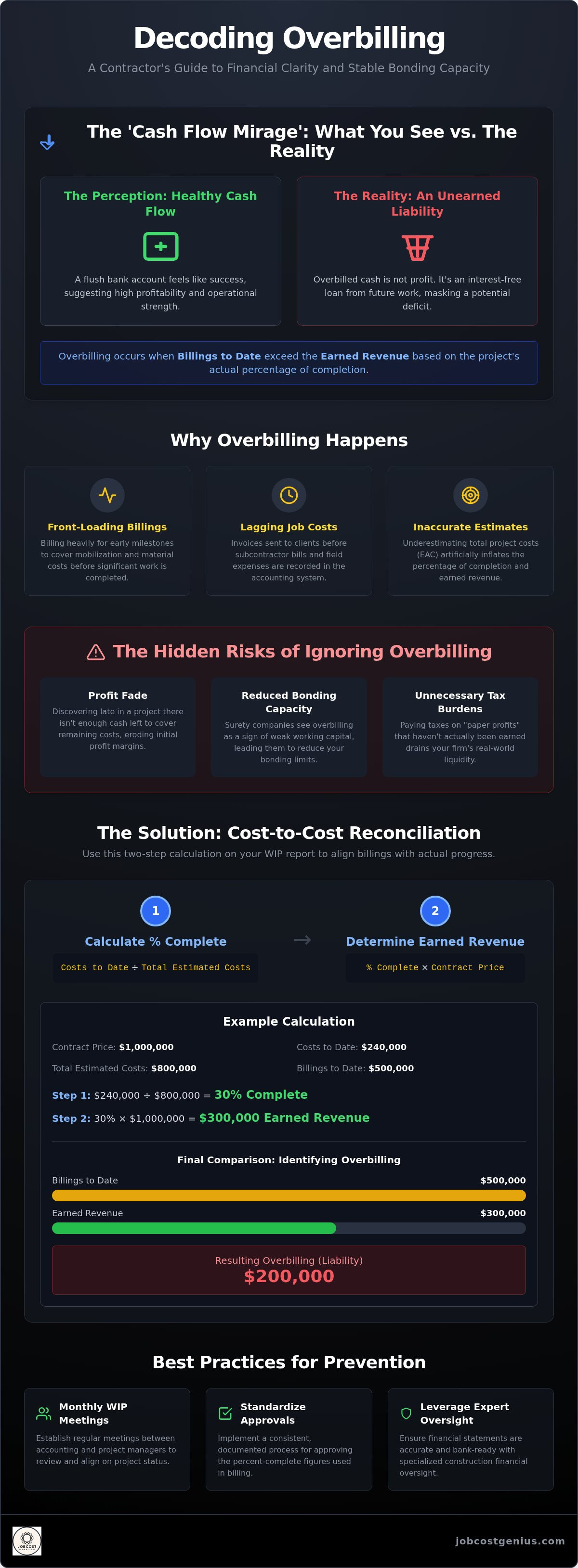
Overbilling occurs when the total amount you've billed a client exceeds the revenue you've actually earned based on the project's percentage of completion. In the context of a Work in process (WIP) report, this is calculated by comparing your "Billings to Date" against your "Earned Revenue." While seeing a high billing figure might feel like a win for your accounts receivable department, it often creates a dangerous psychological trap known as the "Cash Flow Mirage."
The Cash Flow Mirage is the false sense of security that comes from having a surplus of cash in the bank that hasn't been earned yet. This money doesn't represent profit; it represents a commitment to perform future work using funds you've already collected. When contractors rely on this unearned cash to cover current overhead or other project deficits, they're essentially taking an interest-free loan from their future selves. This practice makes fixing overbilling on WIP reports difficult because the cash is often spent before the accounting department can reconcile the job's true financial status.
Adhering to Generally Accepted Accounting Principles (GAAP) requires a strict commitment to the matching principle. This principle dictates that revenue must be recognized in the same period as the expenses incurred to generate it. Recognizing revenue too early through overbilling violates this standard and distorts your financial health. Overbilling is a liability on the balance sheet, not a gain on the P&L.
Why Overbilling Happens (Intentional vs. Accidental)
Overbilling isn't always a sign of poor management; sometimes, it's a strategic or systemic byproduct of the construction cycle. Common causes include:
- Front-loading the schedule of values: Contractors often bill heavily for early milestones to cover mobilization costs and initial material purchases.
- Lagging job costs: If field expenses and subcontractor invoices haven't been entered into the system yet, but the monthly billing has already gone out, the report will show an artificial spike in overbilling.
- Inaccurate estimates at completion (EAC): If your total estimated costs are too low, your percentage of completion will appear higher than reality, skewing your earned revenue calculations.
The Hidden Risks of Ignoring Overbilling
Ignoring these discrepancies leads to "Profit Fade," which is the painful realization late in a project that there isn't enough cash left to finish the work. Beyond internal cash struggles, excessive overbilling signals instability to outside partners. Surety bond companies closely monitor these figures; they may reduce your aggregate bonding limit if they believe you're using "billings in excess of costs" to mask a lack of working capital. Additionally, you may face unnecessary tax burdens by paying taxes on "profits" that haven't actually been realized yet, further draining your liquidity. Proactively fixing overbilling on WIP reports is the only way to maintain a transparent, bank-ready financial profile.
Identifying Overbilling: Red Flags in Your Job Cost Data
Identifying overbilling requires moving away from the bank balance and toward the data. The Cost-to-Cost method is the industry standard for this analysis. You divide actual costs incurred by total estimated costs to find your true percentage of completion. This provides an objective metric for progress that isn't influenced by how much you've managed to invoice the client. Overbilling is identified by the delta between revenue recognized and revenue billed.
Once you have your percent complete, compare it to your percent billed. If you've billed 50% of the contract but have only incurred 30% of the estimated costs, you have a 20% overbilling discrepancy. This gap is a significant red flag that demands attention when fixing overbilling on WIP reports. It signals that you're holding cash for work that hasn't been performed yet, which can lead to a shortage of funds during the project's final phases.
Watch out for the "Uninstalled Materials" trap. This happens when you bill for a massive delivery of steel or HVAC units sitting in the yard. While you've spent the money and billed the client, that material isn't "in progress" yet. Including these in your percent complete calculation artificially inflates your progress and hides potential profit fade. For a deeper look at these mechanics, The Field Guide to Construction WIP Reports offers excellent perspective on tracking field progress against accounting data.
Analyzing the Schedule of Values (SOV)
Look at your Schedule of Values (SOV). Are the early line items disproportionately "heavy"? Front-loading mobilization or submittal costs is common, but it creates a liability that must be tracked meticulously. You should also check for unapproved change orders. If you're billing for work that isn't yet reflected in your budget, your WIP report will look skewed. Cross-referencing the SOV with actual field progress reports ensures that what you tell the client matches what the project manager sees on-site.
Spotting Discrepancies in Job Cost Reports
Inaccurate job cost reports are often the root of overbilling errors. Review your labor burden to ensure all indirect costs are captured in your "Costs to Date." If these costs are missing, your percent complete will look lower than it actually is, leading to accidental overbilling. Similarly, check your accounts payable. If subcontractor invoices are sitting on a desk instead of in the system, your costs are understated. Utilizing a structured WIP reporting for construction companies framework allows you to spot these outliers before they become systemic issues. If you find these reconciliations overwhelming, our specialized WIP reporting services can help you clean up your ledger and restore financial clarity.
Step-by-Step: How to Fix Overbilling with WIP Adjustments
Executing the right accounting moves is the only way to turn a messy report into a bank-ready document. Once you've identified the discrepancies, you must follow a structured process for fixing overbilling on WIP reports. This ensures your financial statements accurately reflect the matching principle and satisfy your surety agent's requirements.
Step 1: Calculate Earned Revenue. Multiply your total contract estimate by your current percentage of completion. If a $1,000,000 project is 40% complete, your earned revenue is $400,000.
Step 2: Determine the Overbilling Amount. Subtract your earned revenue from your total billed amount. If you've invoiced $450,000 on that same project, you are overbilled by $50,000.
Step 3: Create the Adjusting Journal Entry. Move that $50,000 excess from your P&L to your balance sheet. This prevents you from reporting income you haven't yet earned.
Step 4: Reconcile the Liability. Ensure your "Billings in Excess of Costs" account matches the sum of all overbilled amounts across your active project list. This reconciliation creates a clean audit trail for external reviewers.
Step 5: Review the Adjusted P&L. Your net income should now reflect the true margin earned during the period. This provides a realistic view of company performance rather than a cash-inflated illusion.
The Journal Entry Logic
Correcting your books requires a specific two-sided entry. You must Debit Revenue to reduce the over-reported income on your Profit and Loss statement. Simultaneously, you Credit Billings in Excess of Costs. This establishes a current liability on your Balance Sheet, representing work you owe to your clients. It's standard practice to reverse this entry at the start of the next accounting period. Reversing ensures that as you incur new costs, the previously deferred revenue is recognized naturally. This maintains financial continuity without the risk of double-counting income.
Re-Estimating the 'Cost to Complete'
The integrity of your WIP report depends entirely on your "Total Estimated Cost" figure. If this number is outdated, your percentage of completion is a fiction. For instance, a modest 5% increase in estimated labor or material costs can instantly transform what appeared to be fair billing into significant overbilling. This happens because the higher denominator reduces your percent complete, which in turn lowers your earned revenue. Fixing overbilling on WIP reports requires active collaboration with your project managers. They provide the eyes on the ground updates needed to adjust estimates before a job reaches 90% completion and the cash runs dry. Regular site-level feedback ensures your accounting team isn't just crunching numbers, but reflecting the physical reality of the job site.
Preventing Future Overbilling: Best Practices for Project Teams
Fixing overbilling on WIP reports after the fact is a necessary corrective measure, but the most profitable firms focus on prevention. This shift requires breaking down the silos between your accounting department and your field teams. When project managers understand how their billing decisions impact the company's bonding capacity and tax liability, they become partners in financial accuracy rather than just production drivers. Establishing a culture of transparency ensures that your financial statements reflect the actual state of your projects at all times.
Implementing monthly WIP meetings is the most effective way to maintain this alignment. These sessions should involve a line-by-line review of every active project, comparing actual costs to date against the total estimated cost at completion. By standardizing the "Percent Complete" approval process before any invoice is sent to the client, you ensure that billings are rooted in physical reality rather than aggressive cash flow needs. This level of discipline is a core component of construction accounting for small firms that want to scale without losing control of their margins.
Field-to-Office Data Sync
Technology is the bridge that eliminates the data lag causing accidental overbilling. Mobile time-tracking ensures that labor costs, which are often the most volatile job expense, hit your ledger daily instead of weekly. Digitizing subcontractor pay apps prevents the "shoebox effect" where invoices sit in a truck for weeks, hiding thousands of dollars in true costs from your reports. For firms using modern software stacks, our expertise in Procore financials integration automates this cost-collection process. This integration creates a single source of truth where field progress and financial data live in sync, making the task of fixing overbilling on WIP reports much less frequent.
The 'Conservative' Billing Strategy
Adopting a conservative billing mindset protects your long-term stability and reputation with lenders. You should align your Schedule of Values (SOV) as closely as possible to the project's physical milestones. While front-loading might provide a temporary cash boost, it's vital to educate project managers on the surety perspective; overbilling is a liability, not a surplus. Setting internal thresholds, such as a maximum of 5% to 10% of the contract value for overbilling, provides a clear benchmark for your teams. If a project exceeds this threshold, it should trigger an immediate management review to determine the cause. If you're ready to stop the cycle of administrative overwhelm and start building a foundation of financial clarity, explore our Premium Plan for ongoing WIP oversight.
Leveraging Expert Oversight for Clean WIP Reports
Generalist bookkeepers often excel at standard transaction entry, but they frequently miss the technical nuances required for construction-specific adjustments. Fixing overbilling on WIP reports requires more than just balancing a checkbook; it demands a deep understanding of the percentage-of-completion method and the matching principle. Without specialized oversight, subtle errors in cost allocation compound over time. These discrepancies often remain hidden until they surface during a high-stakes year-end audit or a bonding review. By then, the damage to your financial credibility can be difficult to reverse.
JobCost Genius acts as your strategic partner by transforming messy, disorganized job cost data into clean, bank-ready reports. We look beyond the surface level of your bank balance to ensure your revenue recognition aligns with the physical reality of your projects. Accurate WIP reporting is the foundation of the JobCost Genius Growth Plan. By providing this expert layer of management, we help you maintain the financial transparency necessary to secure larger contracts and more favorable terms from your surety agent. Our goal is to replace administrative overwhelm with a state of organized calm.
Moving Beyond Basic Bookkeeping
There is a fundamental difference between simple transaction entry and strategic cost analysis. While a standard bookkeeper tracks what you spent, specialized oversight analyzes whether that spending aligns with your project's progress. This proactive approach prevents the chaos that occurs when you're forced to reconcile months of data at once. For contractors managing complex, multi-state projects with varying labor burdens and tax requirements, our Premium Plan provides the deep-dive reporting needed to maintain compliance across all jurisdictions. Monthly recurring oversight ensures that your financial statements are always ready for external inspection, which eliminates the stress of unexpected audit surprises and keeps your infrastructure lean and efficient.
Taking the Next Step Toward Financial Clarity
If you find yourself constantly questioning whether your cash on hand represents true profit or just unearned revenue, your firm has likely outgrown DIY tracking. Relying on manual spreadsheets or generalist staff for fixing overbilling on WIP reports creates a bottleneck that limits your ability to scale. Professional oversight provides the peace of mind that comes from knowing your bonding capacity is protected and your cash flow is predictable. You deserve to focus on building your projects while we focus on the foundational strength of your financial reporting. To stop the cycle of financial uncertainty, schedule a consultation to fix your WIP reporting issues and regain control over your firm's financial future.
Build a Foundation of Financial Clarity
Aligning your billings with actual project progress is the only way to protect your bonding capacity and ensure long-term stability. By moving beyond the "cash flow mirage" and adopting a rigorous cost-to-cost reconciliation, you transform your financial statements from misleading documents into strategic assets. Successful firms recognize that fixing overbilling on WIP reports is not just a year-end cleanup task; it's a monthly discipline that requires seamless communication between the field and the office.
Accurate WIP reporting provides the transparency your bank and surety agent demand. Whether you're adjusting journal entries to reflect true earned revenue or integrating Procore financials to capture costs in real-time, the goal is a bank-ready ledger that reflects reality. As specialized construction bookkeeping and Procore financials integration experts, we provide the meticulous oversight needed to maintain this standard. Get your WIP reports back on track with JobCost Genius and replace administrative overwhelm with professional confidence. You have the tools to restore your firm's financial credibility; now it's time to put them into practice.
Frequently Asked Questions
Is overbilling on a WIP report always a bad thing?
No, overbilling isn't inherently negative and is often used strategically to fund mobilization and early project costs. It becomes a problem only when it's unmanaged or used to mask job losses. Maintaining a reasonable level of overbilling, typically under 10% of the contract value, is generally accepted by industry partners as a sign of healthy cash flow management.
How often should I update my WIP report to catch overbilling?
You should update your WIP report at least once a month to coincide with your standard billing cycle and financial close. However, waiting 30 days to review data often leads to reactive management. Implementing daily or weekly cost tracking through field-to-office sync tools allows for proactive oversight, making the process of fixing overbilling on WIP reports much more manageable before the month-end deadline.
What is the difference between overbilling and a front-loaded SOV?
Front-loading a Schedule of Values (SOV) is the action of assigning higher monetary values to milestones completed early in the project. Overbilling is the resulting accounting state where your total billings exceed the revenue you've actually earned based on costs incurred. While front-loading is a common tactic to improve liquidity, it must be balanced with accurate cost-to-cost reconciliation to remain GAAP compliant.
Can overbilling cause me to lose my construction surety bond?
Yes, excessive overbilling can significantly reduce your bonding capacity. Surety agents view "Billings in Excess of Costs" as a liability that represents work you owe but haven't performed. If your overbilling exceeds 10% to 15% of your total backlog, agents may interpret this as a lack of working capital, leading them to tighten your aggregate limits or deny new bonds.
How do I explain overbilling to a client who thinks I'm overcharging?
Explain that overbilling is a timing difference in cash flow, not an increase in the total contract price. You can point to the mobilization costs, submittal preparation, and early material procurement required to keep the project on schedule. Reassure the client that your billings align with the agreed-upon Schedule of Values and that the total project cost remains unchanged regardless of the payment timing.
What is the journal entry for Billings in Excess of Costs?
The standard adjusting entry requires you to Debit Revenue on your Profit and Loss statement and Credit Billings in Excess of Costs on your Balance Sheet. This move effectively reduces your reported income for the period and establishes a current liability. This entry should be reversed at the start of the following period to ensure revenue is recognized as you incur the corresponding costs.
Does overbilling affect my company's net worth?
Yes, overbilling reduces your company's net worth on a GAAP-adjusted basis. When you shift unearned revenue from the P&L to a liability account on the Balance Sheet, you decrease your net income and retained earnings. Fixing overbilling on WIP reports is essential because it ensures your equity reflects earned profit rather than temporary cash surpluses that you still owe in labor and materials.
How does Procore help in fixing overbilling issues?
Procore Financials Integration eliminates the data lag that often leads to accidental overbilling. By capturing labor hours and subcontractor invoices in real-time, the software ensures your "Costs to Date" are always current. This accuracy allows your accounting team to see the true percentage of completion, preventing them from billing for progress that hasn't been supported by documented job costs.


