

Up to 30% of employers have misclassified at least one worker, a mistake that can trigger penalties reaching 100% of the employer's share of FICA taxes. Managing construction payroll for 1099 workers often feels like a high-stakes balancing act between keeping the job site moving and keeping the IRS at bay. You likely feel the daily pressure of tracking labor costs against specific jobs while monitoring subcontractor insurance expirations. It is a specialized environment where small administrative errors lead to significant financial exposure.
This 2026 compliance guide provides the clarity you need to transform that administrative overwhelm into organized calm. You'll learn to master the complexities of independent contractor management, from the new $2,000 reporting threshold under the One Big Beautiful Bill Act to advanced project-based job costing. We will explore streamlined workflows for paying subs, accurate job cost reporting, and the specific documentation required for an audit-proof back office. This guide ensures you maintain compliance while protecting your project margins with professional precision.
Key Takeaways
- Define the independent contractor relationship clearly to mitigate misclassification risks that can lead to severe financial penalties.
- Establish a non-negotiable documentation workflow that secures W-9s and Certificates of Insurance before any funds are released to subcontractors.
- Connect construction payroll for 1099 workers to specific project codes to ensure your job costing and WIP reports reflect true labor expenses.
- Stay compliant with 2026 tax regulations by mastering the updated $2,000 reporting threshold and critical February 2 filing deadlines for Form 1099-NEC.
- Identify when administrative complexity hinders growth and how specialized accounting support can restore operational focus to the job site.
Understanding IRS Classification: Employee vs. 1099 Contractor
Misclassification isn't just a minor clerical error. It is a significant financial liability that can stall a growing firm's progress. In the trades, the distinction between a dedicated laborer and an independent sub often becomes unclear. The IRS relies on specific common law rules to determine IRS Classification: Employee vs. 1099 Contractor status. Successfully managing construction payroll for 1099 workers requires you to maintain a clear boundary between your staff and your subcontractors.
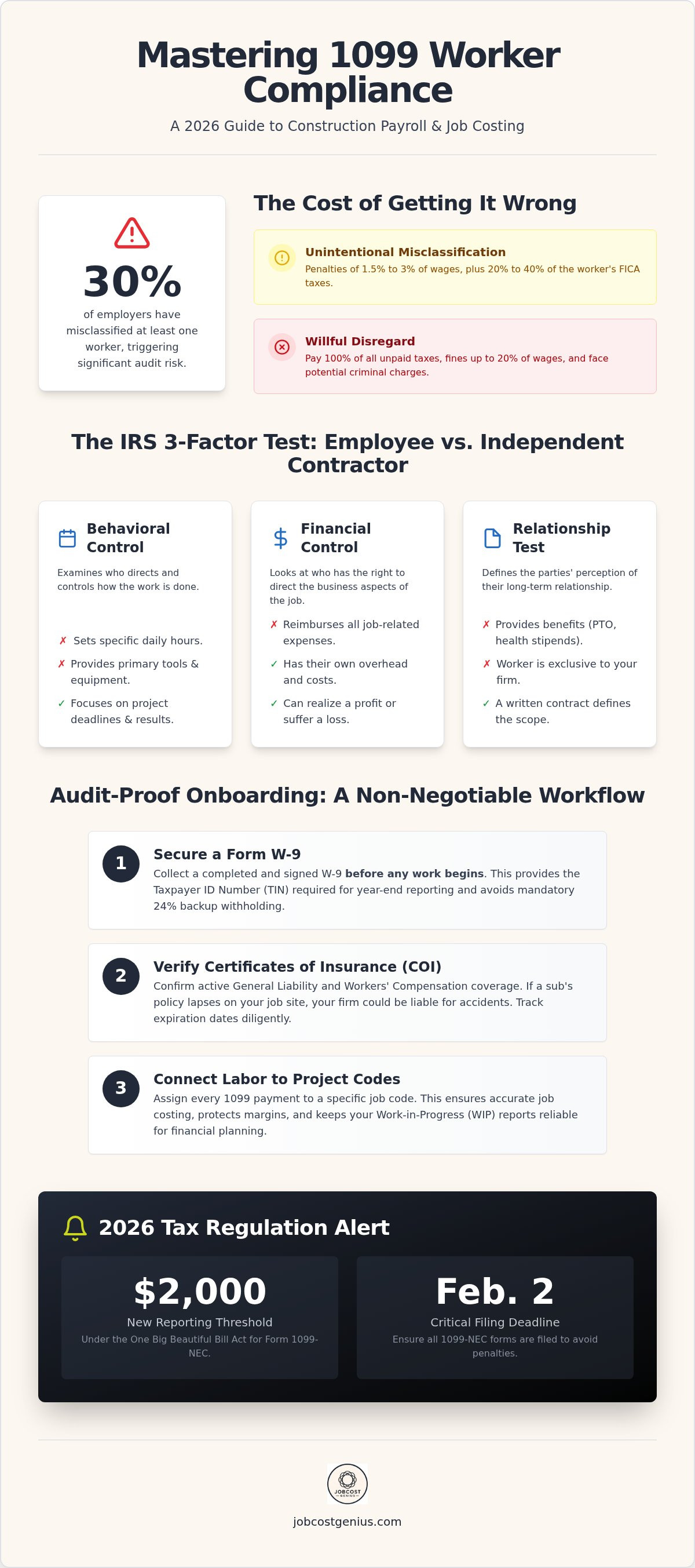
Current data shows that up to 30% of employers have misclassified at least one worker. For a construction company, this is the most common trigger for a federal audit. The financial fallout is immediate and heavy. Unintentional misclassification can lead to penalties of 1.5% to 3% of the worker's wages. You may also owe 20% to 40% of the FICA taxes that should have been withheld. If the IRS finds willful disregard, you face paying 100% of all unpaid taxes, fines up to 20% of wages, and potential criminal charges including up to one year in prison.
The Behavioral and Financial Control Tests
This test examines the level of direction you provide on the job site. If you control the process rather than just the result, the IRS sees an employee. Focus on these three areas to maintain compliance:
- Equipment: True contractors provide their own tools and heavy equipment. If you supply the excavators and hand tools, the worker looks like an employee.
- Schedules: You should set project deadlines, not specific daily hours. Contractors manage their own time to meet the contract terms.
- Financial Risk: Independent subs have their own overhead. They should have the potential to either make a profit or suffer a loss on the job.
The Relationship Test for Long-Term Subcontractors
Long-term partnerships are common in construction, but they require careful documentation. A written contract is essential to define the scope, but it doesn't override the daily reality of the work. The IRS looks at how both parties perceive the relationship over time.
Exclusivity is a major red flag. If a sub only works for your firm and cannot take on other projects, they resemble an employee. Additionally, avoid providing any "perks" or benefits. Offering health stipends or paid time off to a contractor blurs the lines and makes your construction payroll for 1099 workers look like a standard W-2 payroll. Maintain a professional, results-oriented relationship to stay compliant and protect your business from unnecessary scrutiny.
Step-by-Step Documentation: What You Need Before the First Payment
Releasing a check to a subcontractor before securing their documentation creates an immediate liability for your firm. In the high-stakes environment of a job site, administrative discipline is your first line of defense. Proper documentation ensures that your construction payroll for 1099 workers remains audit-proof and that your business is shielded from third-party claims. Every new partnership must begin with a standardized onboarding process that goes beyond a simple handshake.
The Form W-9 is your most critical tool. It provides the Taxpayer Identification Number (TIN) necessary for year-end reporting. Under the 2026 "One Big Beautiful Bill Act," the reporting threshold for 1099-NEC forms has increased to $2,000. Despite this higher limit, you should collect a W-9 from every sub before they strike a single nail. Failing to obtain a correct TIN can trigger mandatory backup withholding at a rate of 24%. Referencing the official Understanding IRS Classification guidelines helps ensure you are applying these requirements to the right individuals.
Certificates of Insurance (COI) are equally vital. You must verify that every sub carries active General Liability and Workers Compensation coverage. If a subcontractor’s policy lapses while they are on your site, the financial responsibility for accidents often rolls up to the prime contractor. Tracking these expiration dates manually is a common point of failure for growing firms. Managing this level of detail is often where contractors hit an administrative wall, which is why our Growth Plan includes dedicated support for these back-office requirements.
The Essential 1099 Onboarding Checklist
A disciplined back office relies on a repeatable system. Use this checklist to clear every sub before processing their first invoice:
- Electronic W-9 Collection: Store digital copies to streamline the February 2 filing deadline.
- TIN Verification: Match the provided name and number against IRS records to prevent filing errors.
- COI Validation: Ensure your firm is listed as an "Additionally Insured" party on their policy.
- Subcontractor Agreement: Execute a signed contract that clearly defines the scope of work and 1099 status.
Lien Waivers and Progress Payments
Lien waivers are the primary mechanism for protecting your project from legal claims. You must collect a conditional lien waiver with every progress billing. This document confirms that the sub waives their right to place a lien on the property once they receive the specific payment amount. Once the check clears, you should secure an unconditional waiver. Integrating this process into your accounts payable workflow ensures that no final project check is released until all potential lien threats are neutralized. This structured approach provides the financial clarity needed to maintain healthy project margins and project stability.
Job Costing 1099 Labor: Connecting Payroll to Project Health
Job costing is the backbone of financial health in construction. While many contractors view payments to subs as simple line items, they are actually complex variables in your project's profitability. Managing construction payroll for 1099 workers requires more than just issuing a check. It demands precise allocation to the correct job cost codes. Without this granular data, you cannot accurately assess whether a specific project is making money or draining your reserves.
Labor burden for 1099s involves more than just the invoice amount. You must account for management time, specialized equipment needs, and the administrative cost of maintaining compliance. Following IRS guidelines on worker classification ensures that your job costing remains based on legal relationships. Comparing these fully burdened actual costs against your estimates is the only way to protect your project margins. It transforms your construction payroll for 1099 workers from a tax task into a strategic management tool.
Allocating Subcontractor Invoices to Cost Codes
Visibility starts with a standardized Chart of Accounts. Every subcontractor invoice should be coded to a specific phase of the project, such as framing, electrical, or finish work. This level of detail allows you to track "back-charges" effectively. If a sub damages existing work or fails to clean the site, those costs must be recorded against their specific contract to maintain an accurate general ledger. Meticulous job costing reveals hidden project losses by identifying exactly where actual labor expenses exceed your initial estimates.
The Link Between 1099s and WIP Reports
Your WIP reporting for construction companies is incomplete without accounting for 1099 labor. Many contractors make the mistake of only including paid invoices in their reports. To see your true financial position, you must account for unpaid subcontractor invoices and earned work that hasn't been billed yet. This ensures your balance sheet reflects real-time liabilities rather than just historical payments.
Overbilling subcontractors can also distort your financials. It creates an artificially inflated cash position that hides upcoming liabilities. By tracking these labor costs accurately, you build a database of historical data that improves your future bidding accuracy. You stop guessing and start bidding based on what it actually costs to complete a project. This disciplined approach to reporting builds the foundational strength necessary for scaling your operations.
Processing Payments and Year-End Tax Reporting
Establishing a disciplined payment cycle transforms your office from reactive to proactive. Most firms choose between net-15 or net-30 terms to manage their cash flow effectively. Consistency here builds trust with your subcontractors and ensures you remain a preferred partner for the best talent. When managing construction payroll for 1099 workers, you must distinguish between Form 1099-NEC and Form 1099-MISC. Use the 1099-NEC for all trade labor and professional services. Form 1099-MISC is typically reserved for other payments like equipment rentals or office leases.
For the 2026 tax year, the One Big Beautiful Bill Act (OBBBA) has raised the reporting threshold to $2,000. This is a significant jump from the previous $600 limit. You only file if the total annual payment meets or exceeds this new $2,000 amount. If a sub doesn't provide a valid Taxpayer Identification Number (TIN), you're legally required to withhold 24% as backup withholding. This ensures the IRS receives its share even if the contractor remains non-compliant with their documentation.
Best Practices for Regular Disbursements
Digital disbursements provide a level of transparency that paper checks cannot match. Transitioning to ACH payments allows you to track funds in real time and reduces the risk of lost mail or check fraud. Before approving any payment, match the subcontractor's invoice to the original purchase order or contract. This verification step prevents overpayment and ensures that the work billed has actually been completed to your professional standards.
If your projects involve government funding, you may also need to manage prevailing wage payroll processing for contractors, which adds another layer of complexity to your disbursement workflow. Accurate record-keeping here is not just a preference; it's a requirement for staying on the right side of federal and state labor laws.
Avoiding Common Year-End Filing Errors
Reconciling your general ledger with your 1099-NEC totals is the most effective way to catch errors before filing. Discrepancies often occur when payments are coded to the wrong account or when "back-charges" aren't properly deducted from the total compensation. Maintaining digital copies of every processed form throughout the year makes this reconciliation process much faster and more accurate.
The deadline to file Form 1099-NEC with the IRS and furnish copies to recipients is February 2, 2026. Because January 31 falls on a Saturday, the IRS provides this small window of extra time. The IRS now requires electronic filing for businesses with 10 or more aggregate returns, making manual paper filing obsolete for most growing contractors. Our Starter Plan helps you maintain the meticulous records needed to meet these deadlines without the year-end stress.
Scaling Your Back Office: When to Outsource Construction Payroll
Scaling a construction firm requires a strategic shift from manual oversight to robust infrastructure. Many contractors hit an "administrative wall" when the volume of subcontractor invoices and compliance documents begins to interfere with project schedules. When you spend more time chasing W-9s than managing job sites, your growth has outpaced your back-office capacity. Moving to professional services reduces the fixed overhead of in-house staff while ensuring that construction payroll for 1099 workers remains accurate and compliant.
Specialized construction accounting for small firms provides a level of industry-specific insight that generalist bookkeepers cannot offer. These experts understand that a 1099 payment isn't just a tax event; it's a critical component of your project's financial health. JobCost Genius integrates 1099 management directly into our Growth Plan, allowing you to offload the meticulous tracking of insurance certificates and tax documentation to a team that understands the trades. This transition transforms a source of administrative stress into a predictable, variable cost.
Starter vs. Growth: Choosing the Right Support Level
The transition from basic bookkeeping to full payroll management usually happens when a firm begins managing multiple large-scale projects simultaneously. Our Starter Plan provides the essential financial foundation, but the Growth Plan is designed for firms that need deeper operational integration. Leveraging Procore Financials Integration or Buildertrend for 1099 tracking ensures that your field data and financial reports remain synchronized. This connectivity allows for the production of monthly financial statements that provide the clarity needed for CEO-level decision making. You stop reacting to bank balances and start leading based on real-time project data.
The Peace of Mind Factor
Outsourcing your payroll allows you to focus entirely on the field where your expertise is most valuable. You can trust that disciplined experts are managing the construction payroll for 1099 workers and the compliance details that could otherwise lead to costly IRS audits. This professional management also improves your subcontractor relationships. When subs are paid accurately and on time, they're more likely to prioritize your projects and provide more competitive pricing in the future.
Ready to simplify? Explore JobCost Genius Payroll Management and see how our specialized team can help you reclaim your time and protect your project margins.
Mastering Your Subcontractor Payroll Strategy
Mastering construction payroll for 1099 workers requires a blend of regulatory knowledge and operational discipline. You've learned how to navigate the updated reporting thresholds and the critical importance of maintaining clear classification boundaries. By integrating lien waivers and insurance tracking into your daily workflow, you protect your firm from both IRS audits and project-level liabilities. Precise job costing ensures that every subcontractor payment contributes to a clear, real-time picture of project health.
Transitioning from administrative overwhelm to financial clarity often requires a specialized partner. JobCost Genius provides construction-specific bookkeeping experts who understand the unique nuances of the trades. Our team offers specialized WIP and job cost reporting alongside proven Procore and Sage 300 CRE integration support. We handle the technical complexities so you can stay focused on the job site. Get a Custom Quote for Construction Payroll Services today and build your business on a foundation of professional stability. Your back office should be an engine for growth, not a bottleneck for your progress.
Frequently Asked Questions
Do I need to provide workers comp for 1099 subcontractors?
You aren't legally required to provide workers comp for independent contractors, but you must verify they carry their own coverage. If a sub lacks a valid Certificate of Insurance, your own insurance carrier will likely charge you a premium for their labor during an annual audit. This effectively makes you financially responsible for their coverage. Always secure a COI before the first day of work to avoid these unexpected back-charges.
What is the difference between 1099-NEC and 1099-MISC for contractors?
Form 1099-NEC is specifically for non-employee compensation, while Form 1099-MISC covers other payment types like rent or legal settlements. In the trades, almost all labor payments meeting the $2,000 threshold for 2026 belong on the 1099-NEC. Using the wrong form can trigger IRS inquiries and filing errors. Maintaining a clean distinction in your general ledger ensures you select the correct form during the January filing season.
Can a 1099 worker be considered an employee if they only work for me?
Yes, exclusivity is a major indicator of an employee relationship under IRS common law rules. If a worker relies on your firm as their sole source of income and cannot take other projects, the IRS often views them as an employee. This is true even if you have a signed contract stating they are an independent sub. You must ensure they maintain their own business identity and have the freedom to work for others.
How do I handle 1099 payroll if I have a federal prevailing wage contract?
Managing construction payroll for 1099 workers on federal projects requires you to ensure every subcontractor pays their laborers the required prevailing wage rates. You must collect certified payroll reports from your subs to prove compliance with the Davis-Bacon Act. Even though they aren't your direct employees, you are responsible for verifying that the correct fringe benefits and hourly rates are paid for all work performed on the project site.
What happens if a subcontractor does not provide a W-9?
If a subcontractor fails to provide a valid W-9, you are legally required to begin backup withholding at a rate of 24% from their payments. These funds must be sent directly to the IRS. Without a Taxpayer Identification Number, you cannot fulfill your year-end reporting requirements. It is a best practice to withhold all payments until the W-9 is signed and verified to prevent administrative complications and potential IRS penalties later.
How much does it cost to outsource construction payroll for 1099s?
Costs for professional payroll management vary based on the volume of subcontractors and the complexity of your job costing requirements. Most specialized firms offer tiered plans that scale with your business growth. These services typically replace the cost of a part-time in-house administrator while providing higher levels of compliance and reporting accuracy. Investing in a professional service often pays for itself by preventing misclassification penalties and reducing internal overhead.
Is it better to pay subcontractors by the hour or by the job?
Paying by the job is generally better for maintaining independent contractor status. Hourly pay can suggest an employee relationship because it implies you control the process and duration of the work. A flat fee for a specific scope of work emphasizes the result rather than the method. This results-oriented approach aligns with the IRS behavioral control tests and helps protect your firm during worker classification audits.
Are 1099 workers eligible for the same business expense deductions as employees?
No, 1099 workers are responsible for their own business expenses and deductions. Unlike employees who may receive reimbursements for travel or tools, independent contractors must cover their own overhead. This includes their own vehicles, equipment, and insurance. If you begin paying for a sub’s daily expenses or providing their primary tools, you risk blurring the lines between a contractor and an employee. This can lead to significant misclassification issues.


