

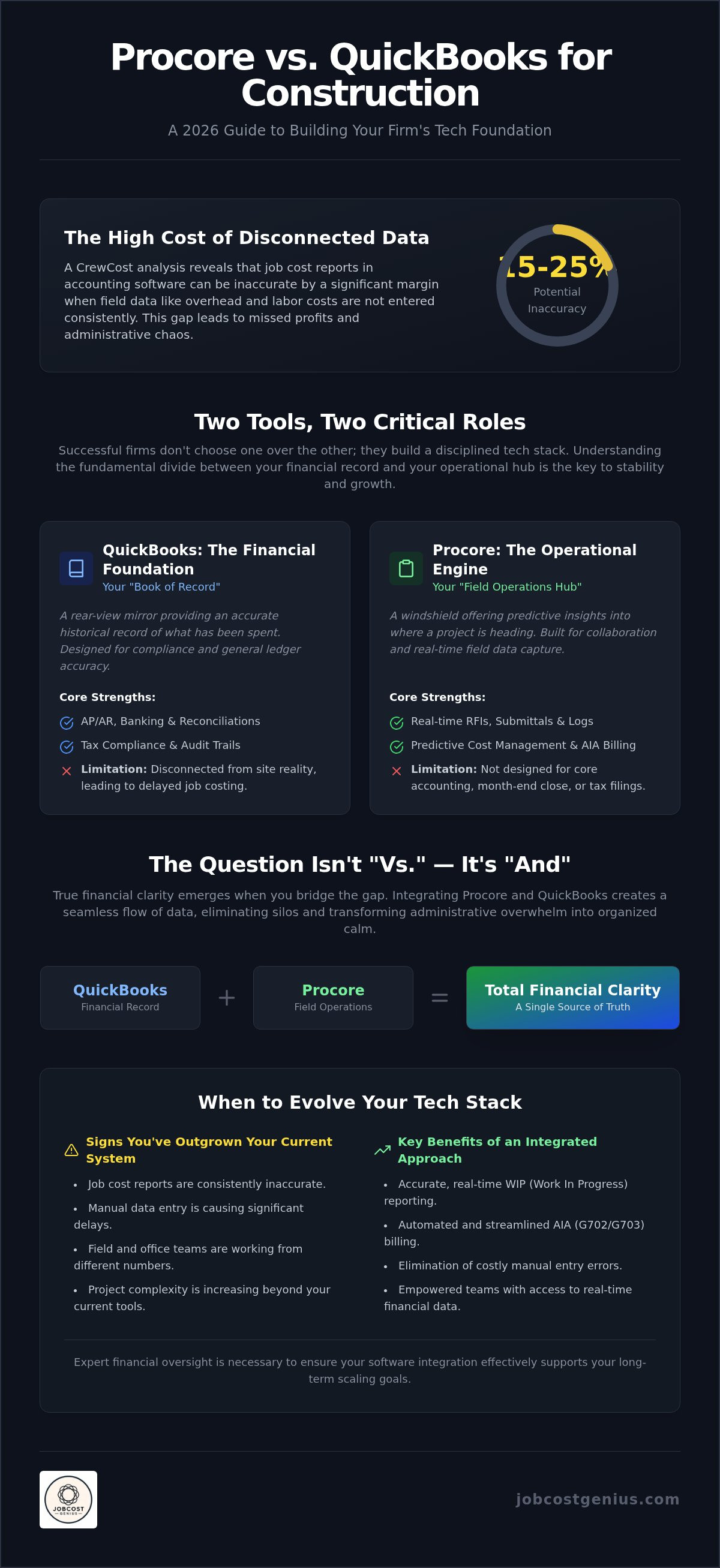
A recent CrewCost analysis revealed that job cost reports in QuickBooks can be inaccurate by as much as 15% to 25% when overhead and labor costs are not entered consistently. For a growing firm, this margin of error often leads to missed profits and significant administrative chaos. You probably already know the frustration of field teams and office staff working from different sets of numbers. This friction makes the procore vs quickbooks for construction decision a critical turning point for your business infrastructure.
We understand that you need more than just software; you need a system that ensures your financial reporting reflects field reality. In this 2026 guide, you will discover whether your firm requires a dedicated project management platform, a robust accounting system, or a strategic integration of both. We provide a clear roadmap for when to upgrade your tech stack and how to eliminate the manual data entry errors that stall your growth. From the latest AI-driven features to updated pricing tiers, we will help you build a foundation of organized calm and professional confidence. Our goal is to move you from administrative overwhelm to a state of total financial clarity.
Key Takeaways
- Distinguish between your financial book of record and your operational hub to maintain strict compliance while empowering field teams.
- Evaluate procore vs quickbooks for construction by understanding how a best-of-breed approach bridges the gap between accounting and project management.
- Identify the specific revenue milestones and project complexities that indicate your firm is ready to transition to a more robust, integrated tech stack.
- Learn how the Procore Financials connector and specialized WIP reporting transform raw data into accurate, real-time financial clarity.
- Understand why expert oversight is necessary to ensure your software integration effectively supports your long-term scaling goals.
The Fundamental Divide: Accounting Software vs. Project Management
Successful construction firms don't just use software; they build a disciplined tech stack. The debate around procore vs quickbooks for construction often overlooks a simple fact: these tools serve different masters. QuickBooks is your "Book of Record." It's designed for tax compliance, audit trails, and general ledger accuracy. Procore acts as your "Field Operations Hub." It manages RFIs, submittals, and the daily pulse of project health. Attempting to force one tool to do the work of the other creates friction that erodes your profit margins.
Using an accounting tool for project management leads to operational lag. Office staff often wait days for paper trails to catch up with the general ledger. Conversely, using a project tool for core accounting leads to significant compliance risks. Project management platforms aren't built to handle the complexities of a month-end close or tax filings. True stability comes from understanding where one system ends and the other begins.
QuickBooks: The Financial Foundation
QuickBooks remains the industry standard for small to mid-sized business accounting. It provides the stability needed for AP/AR, banking reconciliations, and foundational financial reporting. It's built for meticulous financial oversight. However, it has clear limitations when handling complex field data. A general ledger cannot track drawing revisions or equipment logs. When you rely solely on QuickBooks, your office remains disconnected from the site's daily reality. This gap leads to delayed job costing and a lack of real-time financial visibility.
Procore: The Operational Engine
Procore empowers field teams with real-time project documentation. As a specialized project management software, it prioritizes collaboration and resource allocation. Project managers prefer Procore's interface because it mirrors the actual workflow of a job site. It creates a vital field-to-office feedback loop that ensures everyone works from the same set of drawings. Without this operational engine, project health becomes a guessing game based on outdated reports. It's the engine that drives production, while accounting keeps the score.
At JobCost Genius, we see firms struggle when these two systems exist in silos. True financial clarity requires a bridge between the field and the office. We specialize in Procore Financials Integration to ensure your project data flows seamlessly into your accounting records without manual entry errors. This integration transforms your administrative overwhelm into a state of organized calm.
Comparing Core Capabilities for Construction Teams
When evaluating procore vs quickbooks for construction, the primary differentiator is how each platform handles data entry and visibility. QuickBooks is essentially a rear-view mirror. It provides an accurate historical record of what has already been spent. Procore acts as a windshield. It offers predictive insights that allow teams to see where a project is heading before the budget is blown. A CrewCost analysis recently found that job cost reports in QuickBooks can be inaccurate by 15% to 25% when overhead, labor, and equipment costs aren't entered consistently. This discrepancy often occurs because the office lacks the real-time field data that Procore is designed to capture.
Job Costing and Financial Visibility
QuickBooks excels at general financial management but struggles with the granular labor burden and equipment tracking required for complex projects. Procore’s predictive cost management allows teams to track commitments and change orders in real-time. This ensures that the project’s profit margin is protected throughout the lifecycle. By capturing field data as it happens, Procore eliminates the operational lag that plagues firms relying solely on accounting software. Access to this live data transforms administrative overwhelm into a state of financial clarity.
Compliance and Reporting Requirements
Managing AIA billing and retention tracking is a specialized task that standard accounting tools often handle through manual workarounds. Procore automates the G702 and G703 process, reducing the risk of billing errors. For firms working on federal or state-funded projects, the requirements are even stricter. Managing prevailing wage payroll processing for contractors requires meticulous record-keeping that spans both operational and financial systems. While QuickBooks handles general payroll, Procore’s ability to track daily logs and hours makes it easier to generate the documentation needed for certified payroll compliance.
User accessibility also defines the divide. Subcontractors and field teams need a platform for RFI management and blueprint updates; these are essential parts of the role of a construction manager. Back-office accountants require the security and general ledger controls found in QuickBooks. In 2026, both platforms have introduced AI-powered tools to bridge these gaps. QuickBooks now features "Continuously Clean Books" and "Invoicing on Autopilot" to automate bookkeeping. Meanwhile, Procore has released "portfolio monitoring" and "capital planning" tools to help owners forecast future spending with higher precision. If your job costing feels like a guessing game, our Growth Plan provides the specialized oversight needed to bridge these systems effectively.
Why Procore vs QuickBooks is the Wrong Question
Most successful construction firms eventually realize that choosing between these two systems is a false dilemma. The most profitable companies adopt a "Best of Breed" strategy. They use QuickBooks for its robust general ledger and Procore for its superior field management. Attempting to force one tool to do everything often leads to operational gaps. When you treat the procore vs quickbooks for construction debate as an "either/or" choice, you risk creating dangerous data silos.
Data silos occur when your project manager and your bookkeeper see different sets of numbers. A PM might see a project as 80% complete based on field progress, while the bookkeeper sees only 60% based on paid invoices. This disconnect is a recipe for overbilling and profit fade. Manual synchronization between systems is slow and prone to human error. It often results in delayed change orders that never make it to the final bill. True financial clarity requires these systems to speak the same language in real time.
The Power of the Procore-QuickBooks Integration
The Procore Financials connector bridges the gap between your field operations and your back office. It automates the flow of prime contracts, change orders, and invoices directly into your accounting system. This automation eliminates the need for double-entry, which significantly reduces administrative overhead. Your office staff can focus on high-level financial strategy rather than manual data entry. By linking these platforms, you ensure that every field commitment is instantly visible to your accounting team. This level of coordination is a core component of our Procore Financials Integration service.
Managing the "Single Source of Truth"
To avoid confusion, your firm must define which data lives in which system. We recommend treating Procore as the source for all project-related commitments and QuickBooks as the final authority for payments and tax records. This structure improves the accuracy of your financial reporting. Specifically, it enhances the reliability of your WIP reporting for construction companies. Accurate WIP reports prevent the surprises that typically surface at the end of a project. WIP reporting is the bridge between project progress and financial reality. When your integration is managed correctly, your financial statements finally reflect the actual conditions on the job site.
Decision Framework: When to Step Up Your Tech Stack
Every construction business reaches a point where standard accounting tools hit a functional ceiling. Revenue milestones often dictate this shift; while a firm generating $500,000 might manage with basic bookkeeping, a $1M firm typically faces project complexities that demand more. Managing multiple subcontractors and complex change orders requires real-time operational visibility that a general ledger simply cannot provide. The cost of inaction is high, often manifesting as missed billing opportunities or administrative errors that erode your hard-earned margins.
When your team size grows, the "walking to the office" method for handing in timecards is no longer viable. This manual approach creates a bottleneck that slows down your payroll and job costing cycles. In the procore vs quickbooks for construction evaluation, the decision to upgrade is usually driven by a need for stability and foundational strength. You aren't just buying software; you're investing in a system that supports a state of organized calm as you scale. This transition moves your business from a reactive state to a proactive operational posture.
Signs You Have Outgrown QuickBooks Alone
Identify the red flags in your current process before they lead to a financial crisis. If you are losing money on change orders because they weren't tracked in real-time, your system is failing you. Consistently late or inaccurate WIP reports are another clear indicator that your office and field are out of sync. Perhaps most tellingly, if your field teams have abandoned your central system for individual spreadsheets, you have a data silo problem. These fragmented processes make it impossible to achieve the financial clarity needed for strategic growth.
Choosing the Right Plan for Your Growth
Your tech stack should mirror your current operational needs while leaving room for future expansion. For new contractors, focusing on construction accounting for small firms ensures you build the right habits early. As you scale, moving to our Growth or Premium plans provides the specialized oversight required for Procore Financials Integration and advanced WIP reporting. These tiered options allow you to add complexity only when your project volume justifies the investment.
Evaluating the ROI of a Procore implementation fee requires looking beyond the initial cost. Consider the hours saved by eliminating double-entry and the profit protected by accurate, real-time job costing. A disciplined expert can help you navigate this transition, ensuring your software serves as an essential component of your infrastructure. If you're ready to stop the profit fade and regain control of your numbers, explore our Growth Plan to see how we bridge the gap between your field and office.
Maximizing Your Tech Stack with Expert Financial Oversight
Software provides the structural foundation for your business, but it doesn't provide the operational strategy. Many firms invest heavily in the procore vs quickbooks for construction integration only to discover that their data remains fragmented. This occurs because software alone cannot correct a fundamentally flawed accounting process. You need a disciplined expert who understands how field-level commitments translate into general ledger entries. Without professional oversight, your integration often becomes a source of administrative confusion rather than a tool for financial clarity.
A generalist bookkeeper typically lacks the specialized knowledge required to manage Procore’s cost codes. They might not realize that a single misallocated expense in the field can distort your job costing reports for months. Monthly recurring oversight is essential for maintaining project profitability. It ensures that your AP/AR management follows construction-specific compliance, including the meticulous tracking of retainage and sub-tier lien waivers. We transform this complex data into actionable, CEO-level dashboards. These visual reports allow you to make high-stakes decisions based on real-time financial reality, not delayed guesswork.
Beyond Software: The Need for Industry Expertise
The "human element" is the most frequent point of failure in any tech stack. When a project manager enters a change order in Procore, it must map correctly to the budget in QuickBooks to maintain accurate WIP reporting. Generalist accountants often miss these nuances, leading to "profit fade" that only becomes visible when a project is too far gone to save. Our role is to ensure that every dollar tracked in the field is accounted for in the office. This meticulous approach protects your margins and provides the foundational strength needed for long-term stability.
Getting Started with JobCost Genius
At JobCost Genius, we serve as the strategic bridge between your field operations and your financial records. We handle the technical complexities of Procore Financials Integration to ensure your sync remains clean and your data stays accurate. Our team leverages over 20 years of industry experience to manage the flow of information between the office and the job site. We don't just manage your books; we build a foundational strength that allows your firm to scale with professional confidence. This partnership is designed to transform your administrative overwhelm into a state of organized calm.
Taking the next step toward operational excellence is simple. We offer tiered solutions, from our Starter Plan for emerging firms to our Premium Plan for those requiring advanced WIP reporting. Each plan is structured to provide the stability you need at your specific stage of growth. If you're ready to stop fighting your software and start using it as a competitive advantage, we are here to guide you. Schedule a consultation to optimize your construction tech stack today. Let us help you turn your financial reporting into a reliable roadmap for your firm’s future.
Building Your Foundation for 2026 and Beyond
Choosing the right tech stack is only the first step toward operational excellence. Real success comes from a disciplined approach to your financial data. Most top-tier firms have moved past the procore vs quickbooks for construction debate by embracing a best-of-breed strategy that uses both tools in tandem. This ensures your field operations remain agile while your back office maintains strict general ledger compliance. By eliminating data silos, you'll protect your profit margins and gain the clarity needed to scale with confidence.
At JobCost Genius, we bring over 20 years of industry experience to help you bridge the gap between project progress and financial reality. Our specialized WIP and Procore reporting services ensure your integration remains clean, accurate, and actionable. We offer tailored plans for scaling firms to provide the stability and foundational strength your growing business deserves. It's time to move from administrative overwhelm to a state of organized calm. Get Expert Help with Procore Financials Integration and start building your firm's future on a solid financial foundation today.
Frequently Asked Questions
Does Procore replace QuickBooks for construction accounting?
No, Procore does not replace QuickBooks because it lacks a general ledger. While Procore excels at managing project financials and field costs, you still need QuickBooks for core accounting tasks like bank reconciliations and tax preparation. Most firms find the strongest results by using both systems together. This ensures your project managers have operational tools while your accountants maintain a compliant book of record.
How much does it cost to integrate Procore with QuickBooks?
The cost of integration varies based on your annual construction volume and the specific connector you choose. Procore uses an Annual Construction Volume pricing model rather than a flat fee for its software. You should also account for implementation costs and potential third-party connector fees. Investing in a professional setup helps you avoid the long-term expense of manual data entry errors and sync delays.
Can I manage certified payroll in QuickBooks without Procore?
Yes, you can manage certified payroll within QuickBooks, particularly if you use the Workforce Elite tier. As of June 2026, QuickBooks allows users to generate certified payroll reports directly within the system. However, using Procore alongside it can simplify the process by providing more accurate field time tracking. This combination ensures that your labor burden data remains consistent across both operational and financial reports.
What is the biggest benefit of using Procore for a general contractor?
The primary benefit is achieving real-time visibility into project health and field operations. Procore centralizes RFIs, submittals, and daily logs so that your office stays connected to the job site. This coordination prevents the operational lag that often leads to budget overruns. For a general contractor, having one truthful source for project documentation reduces risk and improves overall team accountability.
How long does a Procore Financials integration typically take?
A standard Procore Financials integration typically takes between four and twelve weeks to complete. This timeline depends on the complexity of your current data and how quickly you can map your existing cost codes. Clean data is the most important factor in a successful sync. Working with a disciplined expert can often accelerate this process and ensure your systems remain stable from day one.
Do I need a specialized bookkeeper to manage Procore and QuickBooks?
While not strictly required, a specialized bookkeeper is highly recommended to manage the procore vs quickbooks for construction workflow. Generalist accountants often struggle with the specific cost code mapping and WIP reporting requirements of the construction industry. Expert oversight ensures your data flows correctly between systems. This professional management transforms administrative chaos into financial clarity and prevents costly double-entry errors.
What happens to my historical data when I move to Procore?
Your historical financial data generally remains in QuickBooks to maintain your permanent book of record. Most firms choose to start new projects in Procore while letting older projects finish in their existing system. This approach prevents data corruption and allows for a cleaner transition. You can still reference past performance in QuickBooks while utilizing Procore’s predictive tools for all your future project management needs.
Is Procore suitable for small residential contractors?
Procore is suitable for small residential contractors who manage high project volumes or complex subcontractor networks. If your revenue has surpassed the $1M mark, you've likely outgrown basic spreadsheets and entry-level tools. The platform provides the foundational strength needed to handle intricate change orders and documentation. Evaluating the procore vs quickbooks for construction balance helps you decide if your current operational friction justifies the investment.


