

Why does your P&L show a healthy profit while your bank account struggles to cover next week's payroll? This "profit mirage" is a frequent symptom of a reporting system that fails to account for the unique timing of job costs and billings. Mastering construction financial statement preparation is about more than just keeping the books; it's about creating a project-driven dashboard that reflects the actual health of your business. You need a financial foundation that supports growth rather than creating administrative overwhelm.
We understand that the complexity of WIP schedules and over/under billings often feels like a moving target. You need reports that satisfy bonding agents and provide a clear view of your project-level margins. This guide provides a structured roadmap to transform your accounting into a strategic asset. You'll learn the specialized methodology required to calculate true profitability, increase your bonding capacity, and ensure your monthly reporting remains accurate and actionable throughout 2026. By aligning your internal records with industry standards, you can move from financial confusion to a state of organized calm and professional confidence.
Key Takeaways
- Learn how specialized construction financial statement preparation differs from standard accounting by aligning project costs with revenue recognition.
- Identify why tracking retainage and WIP adjustments is essential for keeping your balance sheet in sync with actual field progress.
- Discover a structured workflow for reconciling your job cost ledger and updating estimated costs to complete to avoid month-end surprises.
- Recognize the "profit mirage" by correctly classifying overbillings as liabilities to reveal your company's true liquidity.
- Understand how accurate reporting directly influences your bonding capacity and provides the foundational data needed to scale your operations.
What Makes Construction Financial Statement Preparation Unique?
Construction financial statement preparation is the specialized process of aligning project costs with revenue recognition to reveal a firm's true financial position. Standard GAAP reporting often fails contractors because long-term contract cycles create a mismatch between cash flow and earned income. Without specific adjustments, your books might show massive losses during heavy mobilization and artificial gains during billing cycles. Success in this industry requires moving beyond basic accounting to a project-driven model.
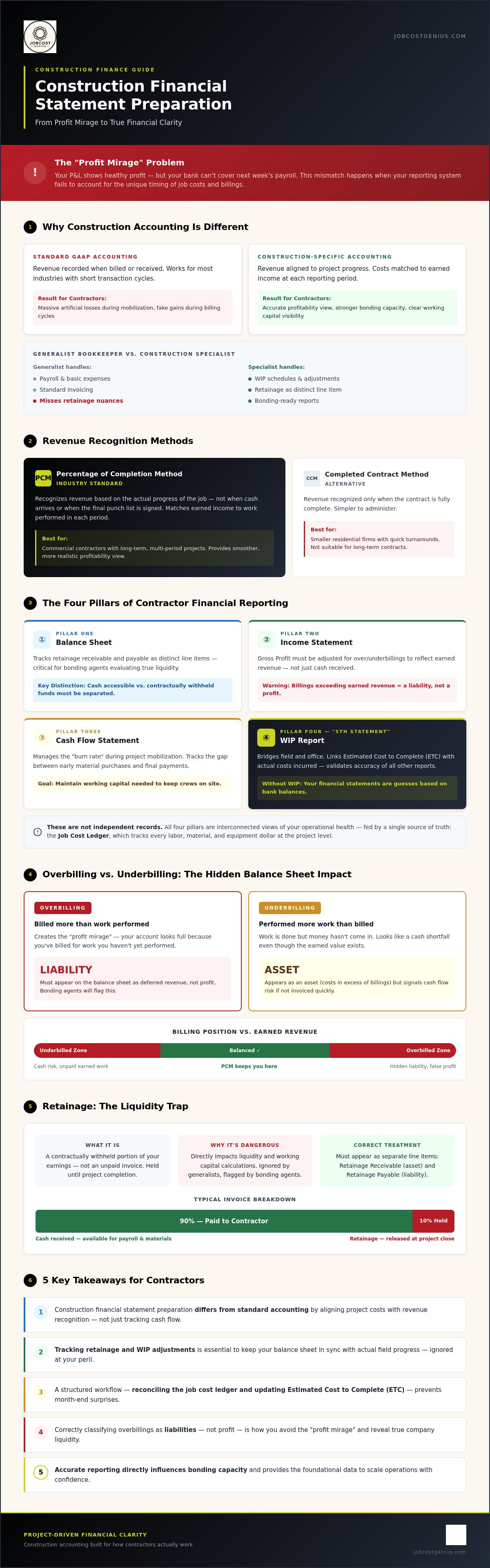
To maintain financial clarity, you must rely on four essential documents: the Balance Sheet, the Income Statement, the Cash Flow Statement, and the WIP (Work in Progress) Report. These aren't independent records; they're interconnected views of your operational health. The foundation for all this reporting is the Job Cost Ledger. This ledger tracks every dollar spent on labor, materials, and equipment at the project level. It's the source of truth that feeds into your broader financial statements, ensuring that every expense is tied to a specific contract.
The Generalist vs. Specialist Gap
A general bookkeeper might handle your payroll and basic expenses well, but they often miss critical construction nuances like retainage. Retainage isn't just an unpaid invoice. It's a contractually withheld portion of your earnings that directly impacts your liquidity and working capital calculations. When these nuances are ignored, the resulting reports are often rejected by bonding agents and lenders. Inaccurate reporting makes your firm look unstable, which can lead to reduced credit limits or lost project opportunities. You can explore these risks further in our guide on Construction Bookkeeper vs Generalist: Why It Matters.
Revenue Recognition: The Percentage of Completion Method
The Percentage of Completion Method (PCM) is the industry standard for commercial contractors. It allows you to recognize revenue based on the progress of the job rather than waiting until the final punch list is signed. The Percentage of Completion Method matches recognized revenue to the specific progress of work performed on a contract. While smaller residential firms might use the Completed Contract Method for quick turnarounds, PCM provides a smoother, more realistic view of profitability for larger projects. This method prevents the "profit mirage" where a bank account looks full only because you've overbilled for work you haven't yet performed. By using PCM, construction financial statement preparation becomes a tool for long-term stability rather than just a month-end chore.
The Four Pillars of Contractor Financial Reporting
Effective construction financial statement preparation rests on four interconnected pillars. While general businesses rely on three standard reports, contractors require a specialized framework to account for the unique timing of project lifecycles. The first pillar is the Balance Sheet. Unlike standard reports, a contractor's balance sheet must track retainage receivable and payable as distinct line items. This distinction is critical for bonding agents who evaluate your liquidity based on how much cash is truly accessible versus what is contractually withheld until project completion.
The second pillar, the Income Statement, reveals the true profitability of your operations. However, a raw P&L is often misleading. Gross Profit must be adjusted for overbillings and underbillings to reflect earned revenue rather than just cash received. If your billings exceed your earned revenue, you're looking at a liability, not a profit. The third pillar is the Cash Flow Statement. This document helps you manage the "burn rate" that occurs during project mobilization. By tracking the gap between initial material purchases and final project payments, you can maintain the working capital needed to keep crews on site. Finally, the WIP report acts as the "Fifth Statement," serving as the anchor that validates the accuracy of the other four.
Why the WIP Report is Non-Negotiable
The WIP report bridges the gap between the field and the office. It links estimated costs to complete (ETC) with actual costs incurred, allowing you to calculate current period earnings with precision. Without this report, your financial statements are merely guesses based on bank balances. You can master this essential tool by reviewing our WIP Reporting for Construction: The Definitive 2026 Guide. Establishing this level of detail is a core component of the specialized oversight provided by JobCost Genius.
Tracking Retainage and Committed Costs
Retainage is a specialized asset or liability that significantly affects your firm's liquidity ratios. It represents earned income you cannot yet spend, making it a vital metric for credit limit evaluations. Equally important is the tracking of committed costs. By recording subcontracts and purchase orders as they are issued, you gain visibility into future cash requirements. This proactive tracking prevents the common mistake of assuming a high bank balance equals available profit, ensuring your firm stays resilient during the lean months of a long-term contract.
Step-by-Step Workflow for Preparing Construction Statements
Moving from raw data to a finished report requires a disciplined, repeatable cycle. This process ensures that your financial position isn't just a snapshot of your bank balance, but a precise reflection of your project performance. A methodical approach to construction financial statement preparation prevents the common errors that lead to bonding rejections or cash flow crises. Follow these five steps to ensure your reporting remains foundational to your firm's growth.
Step 1: Reconcile the Job Cost Ledger with the General Ledger. Every dollar spent must have a project home. You must ensure that the total costs recorded in your job cost modules match the total project expenses in your general ledger. If these two sources don't align, your project margins will be fundamentally flawed.
Step 2: Update Estimated Costs to Complete (ETC) for every active project. This is the most critical step for accuracy. You must collaborate with project managers to get realistic, updated forecasts of remaining costs. Without accurate ETCs, your percentage of completion calculations will be incorrect, leading to skewed revenue recognition.
Step 3: Calculate Overbillings and Underbillings using the WIP schedule. Use your updated ETCs and actual costs to determine exactly how much revenue you've earned on each job. Compare this to what you've actually billed. This calculation reveals whether you're using the client's money to fund the job or using your own capital to float project costs.
Step 4: Post adjusting journal entries to the Income Statement and Balance Sheet. Once your WIP schedule is finalized, you must move the over/underbilling amounts into your financial statements. These entries adjust your "Sales" and "Cost of Goods Sold" to reflect earned values rather than just cash movements.
Step 5: Review the "Cash vs. Accrual" variance to ensure operational liquidity. While accrual reporting is required for bonding, cash is what pays your crews. Reviewing the variance helps you understand if your reported profits are translating into actual cash flow.
Field Data Collection: The Office Pipeline
Daily logs and field reports are the fuel for your financial engine. When field teams record labor hours and material deliveries accurately, your job costing becomes a real-time tool rather than a historical record. Utilizing Procore Financials Integration significantly reduces manual entry errors by syncing these field costs directly with your accounting software. This automation ensures that change orders are captured and approved before the month-end close, preventing "revenue leakage" on extra work performed but not yet billed.
The Month-End Closing Checklist
Accuracy requires a final layer of verification before statements are issued. Your checklist should include verifying accounts payable (AP) against specific project budget codes to ensure costs hit the correct line items. You must also confirm that accounts receivable (AR) matches your AIA billing schedules to prevent payment delays. Finally, finalize your labor burden calculation. This ensures that the true cost of employees, including taxes and benefits, is correctly allocated to project overhead rather than being buried in general expenses.
Avoiding the "Profit Mirage": Accuracy Checks and Pitfalls
A high bank balance during the early stages of a project often creates a false sense of security. In this industry, cash on hand doesn't always equal earned profit. Many contractors fall into the "profit mirage" because their construction financial statement preparation fails to account for the timing of billings versus actual work performed. Understanding the nuances of overbilling and underbilling is the only way to ensure your reported margins reflect reality rather than an optimistic guess.
Overbilling occurs when your progress billings exceed the costs incurred and the earned profit on a job. While this provides a temporary boost to your cash flow, it represents a liability on your balance sheet. Overbilling is essentially a zero-interest loan from the client. If you use these funds to cover general overhead or mobilize for other jobs, you'll face a cash crunch when it's time to finish the project. Conversely, underbilling is reported as an asset, but it often signals operational inefficiencies. It suggests that you've performed work you haven't yet billed, which can lead to unnecessary strain on your company's working capital.
Two other silent killers of profitability are "Front-Loading" and "Profit Fade." Front-loading involves aggressively billing for early milestones to fund mobilization. While common, it distorts your financial health by showing inflated profits at the project's start. Profit fade is even more dangerous. It occurs when your estimated costs to complete (ETC) steadily increase as the job progresses, slowly eroding your projected margin. This is often caused by optimism bias in the field, where project managers hesitate to report cost overruns until it's too late to course-correct.
Fixing Overbilling and Underbilling
To fix these discrepancies, you must use your WIP report to post adjusting journal entries at the end of every month. These entries move unearned revenue out of your income statement and into a liability account on your balance sheet. Bonding agents look for a healthy balance between over and underbillings. They want to see that you're "billing ahead" enough to stay liquid, but not so much that you're "robbing Peter to pay Paul" across multiple jobs. If you find these adjustments overwhelming, the experts at JobCost Genius can help you implement a "WIP-first" accounting workflow.
Audit-Proofing Your Financial Documentation
Accuracy isn't just about the math; it's about the trail. You must maintain a clean connection between every vendor invoice, purchase order, and the general ledger. As your firm scales, the level of scrutiny from external parties will increase. You may need to move from a "Compilation," which is a basic presentation of your data, to a "Review" or a full "Audit" performed by a CPA. A Reviewed statement provides "limited assurance" that no material modifications are needed, which is often the minimum requirement for securing larger bonding capacities and bank lines of credit.
Strategic Oversight: Using Statements to Scale Your Firm
High-growth contractors view financial reports as strategic instruments for scaling rather than just historical logs for the IRS. Once you've mastered the mechanics of construction financial statement preparation, these documents become your primary tools for navigating complex market conditions. The data allows you to calculate your true Working Capital and Liquidity Ratio with precision. These metrics are the first things a bonding agent or bank representative looks at when determining your firm's risk profile. By maintaining a healthy ratio of current assets to current liabilities, you demonstrate the foundational strength required to take on larger, more lucrative contracts.
Accurate reporting directly influences your bonding capacity and credit limits. When your financial statements clearly show that your overbillings are controlled and your project margins are stable, sureties gain the confidence to increase your aggregate bond limits. This transition marks the point where a business owner moves from "doing the bookkeeping" to true financial management. You can't lead a firm effectively if you're stuck in the weeds of manual data entry. Utilizing the JobCost Genius Starter or Growth plans provides the professional infrastructure needed to make this leap, giving you the clarity to make high-stakes decisions based on facts rather than intuition. This same commitment to professional oversight is essential for the long-term success of residential developments, where My Utah HOA Manager provides the specialized financial and community management needed to protect property values.
For developers and property owners, obtaining precise RICS-approved valuations from Rebuild Costs is a vital step in risk management, ensuring that assets are fully protected and financial statements reflect accurate replacement figures.
Benchmarking for Builders
Strategic oversight involves more than just looking at your own numbers; it requires comparing your performance against industry standards. You should monitor your overhead percentage to ensure your administrative costs aren't eating into your project profits. Another critical metric is "Days in AR," which tracks the average time it takes to collect payment after an invoice is issued. If this number is climbing, it often indicates a bottleneck in your payment application process or a need for more aggressive follow-up on retainage. Tracking these benchmarks through consistent construction financial statement preparation allows you to spot trends before they become crises.
The Path to Outsourced Financial Excellence
Outsourcing your accounting to a construction-specific firm like JobCost Genius saves significant overhead compared to hiring full-time, specialized staff. Generalist bookkeepers often lack the technical knowledge to manage WIP schedules or Procore integrations, leading to errors that surface during year-end audits. Monthly recurring oversight ensures your books are always "audit-ready," preventing the panic that typically accompanies tax season. This proactive approach protects your firm's reputation with lenders and keeps your growth trajectory on track. To begin professionalizing your reporting, get a specialized financial health checkup for your construction firm today.
Building a Foundation for Profitable Growth
Success in the 2026 construction market requires more than just field expertise; it demands financial precision. By mastering construction financial statement preparation, you move beyond the "profit mirage" and gain a clear view of your project-level margins. We've explored how a WIP-first methodology transforms your reporting from a historical record into a strategic dashboard. You now understand that accurate over/underbilling adjustments are the key to satisfying bonding agents and securing the credit limits your firm needs to scale.
Professionalizing your back office is the most effective way to protect your hard-earned equity. Our Oklahoma City based team provides the specialized support needed to maintain these complex systems. With specialized WIP reporting included and deep Procore integration expertise, we ensure your financial infrastructure is as solid as your builds. It's time to trade financial confusion for data-driven confidence and professional stability.
Stop guessing your profits—get expert construction financial reporting today. Your firm's next level of growth is built on the accuracy of your numbers.
Frequently Asked Questions
What is the most important financial statement for a construction company?
The Work in Progress (WIP) report is the most critical document for any contractor. While the Balance Sheet and Income Statement are standard, the WIP report bridges the gap between field progress and office accounting. It validates the accuracy of your earned revenue and ensures your profit isn't just a result of aggressive billing. Without this "fifth statement," your other reports lack the necessary context to satisfy bonding agents.
How often should a contractor prepare a WIP report?
You should prepare a WIP report at least once a month during your month-end closing cycle. Monthly reporting allows you to catch "profit fade" early and adjust your estimated costs to complete before they impact your liquidity. Consistent reporting is a foundational part of professional construction financial statement preparation, ensuring that your project managers and accountants stay aligned on every active contract's health.
Why does my P&L show a profit when I have no cash in the bank?
Your P&L shows a profit because it reflects earned revenue, but your bank account is empty because of timing differences. This often happens when you have high retainage receivables or when your cash is tied up in mobilization costs for new projects. It's the classic "profit mirage" where accrual earnings don't match your immediate cash liquidity. Tracking your cash flow statement alongside your P&L helps identify these specific bottlenecks.
What is the difference between a compiled and a reviewed financial statement?
A compiled statement is a basic presentation of your data without any verification or assurance from a CPA. A reviewed statement provides limited assurance that no material changes are needed, involving analytical procedures and inquiries. Most bonding agents require a reviewed statement once your project sizes reach a certain threshold, as it provides a higher level of confidence in your firm's financial stability and reporting accuracy.
How does overbilling affect my balance sheet?
Overbilling appears as a current liability on your balance sheet, often labeled as "Billings in Excess of Costs and Estimated Earnings." It represents money you've collected for work you haven't yet performed. While it helps with cash flow, bonding agents view excessive overbilling as a risk if those funds aren't managed carefully. It's essentially a zero-interest loan from your client that must be repaid through future work.
Can I use standard QuickBooks for construction financial statement preparation?
You can use standard QuickBooks, but it isn't designed to handle the nuances of the construction industry automatically. You'll need to manually calculate and post adjusting journal entries for overbillings and underbillings to stay compliant with industry standards. For many firms, construction financial statement preparation is more efficient when using specialized integrations like Procore Financials to sync field data with your general ledger without manual entry errors.
What is retainage and how is it recorded on financial statements?
Retainage is a portion of the contract price, typically 5% to 10%, held back by the owner until the project is substantially complete. On your balance sheet, you must record this as a distinct line item under accounts receivable or accounts payable. This separation helps lenders see exactly how much of your capital is contractually restricted and when you can realistically expect those funds to hit your bank account for operations.
How do bonding agents use my financial statements to determine credit?
Bonding agents analyze your statements to calculate your working capital, equity, and overall net worth. They look for a clean WIP schedule that shows consistent margins and minimal profit fade over the life of a project. Your ability to produce accurate, timely reports directly influences the aggregate bond limits they're willing to provide, which dictates the size and complexity of projects you can legally bid and win.


