

Why does your bank account look healthy even when your profit and loss statement suggests you're losing money on a critical project? This disconnect often stems from cash-basis reporting that fails to account for the timing of labor and materials. Implementing accrual accounting for contractors is the only way to synchronize your financial statements with actual project progress. It transforms your books from a lagging record of past payments into a real-time management tool that reflects the physical reality of your job sites.
We recognize the frustration of inaccurate profit reporting and the anxiety that builds when your expenses and billings don't align. You deserve a financial foundation that supports growth rather than hindering it. This 2026 guide promises to help you master accrual fundamentals so you can stop guessing about your bottom line. We will detail how to leverage WIP reporting for better bonding capacity and provide the structured framework necessary for total project transparency. By the end of this article, you'll have a clear roadmap to financial clarity and professional confidence.
Key Takeaways
- Understand how the matching principle aligns project costs with revenue to reveal your true monthly profitability.
- Discover why cash-basis reporting creates a false sense of security and how accrual accounting for contractors provides the visibility required for increased bonding capacity.
- Master the Percentage of Completion method and the cost-to-cost formula to track project progress with mathematical precision.
- Learn the essential steps for establishing a construction-specific Chart of Accounts and a rigorous monthly cutoff process to ensure financial accuracy.
- Identify how specialized WIP reporting bridges the gap between field operations and your balance sheet to eliminate financial guesswork.
What is Accrual Accounting for Contractors?
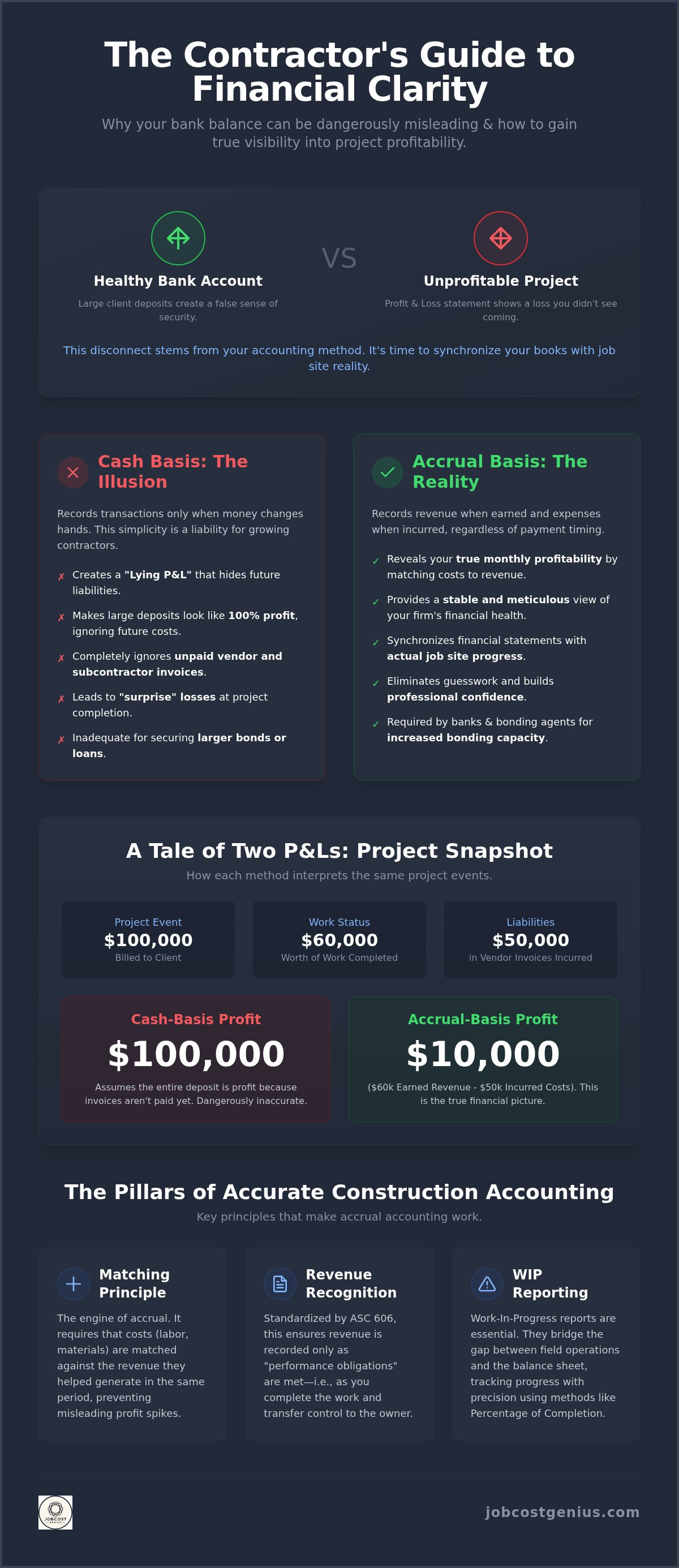
Accrual accounting for contractors is the process of recording income when it's earned and expenses when they're incurred. This method stands in stark contrast to cash-basis accounting, which only tracks money as it enters or leaves your bank account. For a construction firm, the cash method is often a dangerous distraction. It creates a "false sense of security" when a large mobilization deposit arrives, even though that money is technically a liability until the work is performed. Accrual accounting provides a more stable and meticulous view of your firm's financial health.
The 2026 financial standards for mid-sized construction firms demand a higher level of accuracy than ever before. Banks and bonding companies have moved away from accepting "soft" numbers. They require a rigorous synchronization of your physical job site progress with your balance sheet. Understanding the difference between "billing" and "earning" is central to this transition. Billing is simply an administrative action of sending an invoice. Earning is the actual fulfillment of a contract's scope. If you've billed $100,000 but only completed $60,000 worth of work, accrual accounting ensures your reports reflect that you haven't yet "earned" that remaining $40,000.
The Matching Principle in Construction
The matching principle is the engine of accrual accounting. It requires that labor, material, and subcontractor costs incurred in a specific period must be matched against the revenue they helped generate in that same period. If your crew spends 400 hours on a foundation in Week 1, those labor costs must appear on the same monthly statement as the progress revenue for that foundation. This prevents misleading "profit spikes" where one month looks incredibly profitable simply because you haven't yet paid the vendors for the work completed. It relies heavily on a disciplined accounts payable process to recognize true project costs the moment the work is finished, not just when the check is cut.
Revenue Recognition Standards (ASC 606)
Modern GAAP rules, specifically ASC 606, have standardized how contractors recognize revenue. This framework uses a five-step model to ensure revenue is only recorded as performance obligations are met. It starts with identifying the contract and price, then moves to allocating that price across specific project milestones. For a contractor, this means revenue is recognized over time as you transfer control of the asset to the owner. Generalist bookkeepers often miss these nuances. They may fail to identify separate performance obligations within a single contract, which can lead to non-compliance and skewed financial statements. Specialized expertise is required to manage these industry-specific rules and maintain foundational strength in your reporting.
Accrual vs. Cash Basis: Why Your P&L Might Be Lying
Cash-basis accounting is often the starting point for new businesses because it's simple to track. You record money when it hits the bank and expenses when you pay the bills. However, for a growing construction firm, this simplicity is a liability. It creates a false sense of security that can lead to catastrophic financial decisions. Accrual accounting for contractors provides the real-time visibility you need into project liabilities and earned income. It ensures that your profit and loss statement reflects the physical work completed on-site rather than the arbitrary timing of bank transactions.
The 2026 financial landscape requires contractors to be more strategic about their tax liability and bonding capacity. Banks and bonding agents almost exclusively require accrual-based financial statements because they provide a transparent view of a company's obligations. While cash accounting might show a high bank balance, it fails to reveal the mountain of debt owed to subcontractors or material suppliers. Transitioning to accrual accounting is a foundational step for any firm looking to move beyond small residential jobs into high-stakes commercial or government contracts.
As firms scale into these larger contracts, maintaining administrative and statutory compliance becomes equally paramount. For those operating in Southeast Asia, utilizing professional company secretary services Malaysia ensures that your corporate governance remains as robust as your financial reporting.
The Danger of the Cash Basis "Lying P&L"
In construction, projects are often front-loaded with deposits and mobilization fees. Under cash accounting, these large deposits appear as pure profit the moment they're received. This leads to an inflated sense of success while the actual work hasn't even begun. For instance, a cash-basis report completely ignores $50,000 in vendor invoices sitting on a desk simply because the checks haven't been cut yet. This disconnect creates an emotional toll on business owners who face "surprise" losses at the end of a project. You think you're ahead for months, only to realize in the final phase that the project was never actually profitable.
Accrual as a Requirement for Growth
Growth brings complexity that cash accounting cannot handle. The IRS mandates specific gross receipt thresholds that force mid-sized contractors to switch to the accrual method for tax reporting. Beyond compliance, accrual accounting is the only way to produce accurate WIP reporting, which is the industry standard for measuring project health. This data is essential when bidding on larger commercial projects where owners demand proof of financial stability. If you're ready to professionalize your back office, partnering with a specialized construction financial expert can help you navigate this transition with precision. Moving to accrual accounting prepares your firm for the scrutiny of lenders and ensures you're never guessing about your true bonding capacity.
Percentage of Completion: The Gold Standard for Builders
Accrual accounting for contractors reaches its full potential through the Percentage of Completion (POC) method. While simple accrual tracks when you owe money or are owed money, POC measures how much profit you've actually earned based on the physical progress of a job. It's the most accurate way to reflect the financial reality of long-term projects that span multiple months or fiscal years. By recognizing revenue and gross profit in proportion to the work performed, you eliminate the volatility that plagues cash-basis firms.
The Cost-to-Cost formula is the industry standard for determining this progress. It's a straightforward calculation that provides mathematical certainty to your reporting:
- Actual Costs Incurred to Date: Total labor, materials, and sub-costs already recorded in your ledger.
- Total Estimated Costs at Completion (EAC): Your most current projection of what the entire job will cost.
- Calculation: Divide actual costs by the EAC to find your percentage of completion.
This method is far superior to the Completed Contract method, which only recognizes profit when a job is 100% finished. Waiting until the end of a project to see if you made money is a reactive strategy that leads to missed opportunities for course correction. POC requires a disciplined approach to updating your EAC regularly. If your estimated costs rise mid-project, your earned revenue must adjust immediately to reflect that new reality. This level of meticulousness ensures your financial statements are a reliable management tool rather than just a historical record.
Integrating WIP with Accrual Data
Your accrual entries are the raw data that feeds your Work-in-Progress (WIP) schedule. Without accurate accruals, your WIP report is fundamentally flawed. This integration allows you to identify overbilling and underbilling with precision. If your billings exceed your earned revenue, you have a liability on your balance sheet called "Billings in Excess of Costs." Conversely, if you've done more work than you've billed, you must record "Costs in Excess of Billings" as an asset. Maintaining this balance is essential for protecting your cash flow and proving your operational stability to bonding agents.
The Impact of Change Orders on Accrual
Unapproved change orders are a common source of friction between the field and the ledger. If you incur costs for a change order but haven't officially recorded the revenue, your project's profitability will appear lower than it actually is. Best practices for accrual accounting for contractors suggest recording change order revenue only when it's "probable" that the client will pay and the amount can be reasonably estimated. This requires a clean audit trail and constant communication between project managers and the accounting team. Properly managing these entries prevents skewed profit margins and ensures your monthly statements remain an accurate source of truth.
Implementing Accrual Accounting: A Practical Roadmap
Transitioning to accrual accounting for contractors requires more than a simple software toggle. It's a fundamental shift in how your field and office teams communicate. This roadmap provides a structured path to achieving financial clarity and operational stability. By following these steps, you transform your books into a reliable management tool that reflects the physical reality of your projects.
Step 1: Establish a Construction-Specific Chart of Accounts. Your ledger must separate direct project costs from general overhead with meticulous detail. This includes dedicated accounts for labor, materials, equipment, and subcontractor expenses. A generic chart of accounts fails to provide the granular data needed for accurate job costing.
Step 2: Implement a Rigorous Cutoff Process. At the end of each month, ensure all costs incurred are recorded, even if the physical vendor invoice hasn't arrived. You must account for accrued liabilities, such as labor hours worked but not yet paid. This prevents you from understating your liabilities and overstating your monthly profit.
Step 3: Train Field Staff. Financial accuracy starts on the job site. Project managers and foremen must submit daily reports, timecards, and packing slips promptly. When the field team understands how their data impacts the company's bonding capacity, they become better partners in the accounting process.
Step 4: Monthly Reconciliation. Compare your job cost reports to your general ledger. Every dollar spent in the field must match a dollar recorded in your accounting system. This discipline ensures that your project managers and your controller are looking at the same set of facts.
Step 5: Review the WIP Report. This is the final step of the month-end close. Use it to verify that your earned revenue matches your project progress. If the numbers don't align, investigate the source of the disconnect before finalizing your statements.
Field-to-Office Data Workflows
The "shoebox of receipts" mentality is a major barrier to accrual accuracy. Successful contractors standardize the collection of packing slips, timecards, and subcontractor pay applications. Using tools like Procore financials integration automates this data flow, ensuring field information reaches the accounting team without manual re-entry. This synchronization reduces errors and provides the meticulousness required for 2026 reporting standards. It eliminates the administrative overwhelm that often leads to lagging financial statements.
Choosing the Right Tech Stack
General accounting software often lacks the depth needed for complex project tracking. Your tech stack must include robust job-costing modules that link specific expenses to individual projects. Integrated technology reduces manual accrual entries by automatically mapping field data to the correct ledger accounts. This automation allows your team to focus on analysis rather than data entry. If you're ready to professionalize your reporting, our Growth Plan provides the specialized support needed to build a resilient financial infrastructure.
Achieving Financial Confidence with JobCost Genius
Accrual accounting for contractors is more than a reporting method; it's a strategic advantage that requires specialized oversight. While generalist bookkeepers might understand the basics of a ledger, they often struggle with the nuances of construction-specific accruals. They may miss the critical timing of material deliveries or the complexities of subcontractor retainage. JobCost Genius bridges this gap by providing a team with 20+ years of industry experience. We manage the intricate math behind WIP and POC reporting, ensuring your financial statements are accurate and reliable every month. This specialized focus transforms your books from a lagging record into a forward-thinking management tool.
We offer three distinct paths to financial clarity designed to meet you where you are today. Our Starter Plan is perfect for firms establishing their first rigorous accounting workflows. The Growth Plan introduces advanced reporting and Procore integrations to help you scale effectively. For firms with complex, multi-state operations, our Premium Plan provides comprehensive, high-tier oversight. With tiered pricing starting at $800/month, we provide the foundational strength necessary for sustainable growth. This structured approach allows you to move from administrative overwhelm to a state of organized financial calm. You can stop guessing about your profitability and start making decisions based on verified data.
Beyond Basic Bookkeeping
Construction financial management goes far beyond simple data entry. We specialize in fixing overbilling on WIP reports to prevent profit fade and protect your future cash flow. Our monthly financial reviews provide a structured forum to discuss project health with experts who speak your language. We analyze your earned revenue versus your billings to identify potential profit gaps before they impact your bottom line. This level of meticulousness ensures your books are always bank-ready, which is essential for maintaining your bonding capacity and securing future loans. We act as a disciplined partner deeply invested in your operational success.
Ready to Scale Your Construction Business?
Scaling a construction business is impossible without a clear view of your project health. Our team acts as your virtual back office, handling the administrative heavy lifting so you can stay focused on what happens at the job site. We provide the stability and expertise of a seasoned industry veteran, acting as a reliable and strategic guide for your firm's growth. We transform your financial data from a source of anxiety into a source of professional confidence. By establishing a solid financial infrastructure today, you prepare your firm for the larger, more lucrative contracts of tomorrow. Schedule a consultation to see how our Growth Plan can stabilize your cash flow.
Building a Foundation for Financial Clarity
Transitioning to a more sophisticated reporting model is a strategic investment in your company's longevity. By synchronizing your project progress with your financial statements, you eliminate the "lying P&L" and gain the visibility needed to scale. We've explored how the Percentage of Completion method and a disciplined month-end close provide the mathematical certainty that banks and bonding agents demand. Mastering accrual accounting for contractors is the most critical step toward professionalizing your back office and protecting your hard-earned margins.
You don't have to manage this transition alone. Our team brings 20+ years of construction industry experience and specialized Procore integration expertise to every partnership. We offer transparent tiered pricing starting at $800/month to ensure growing firms have access to expert-led WIP reporting. It's time to replace administrative overwhelm with organized financial calm and professional confidence.
Get Started with a Professional Construction Financial Health Checkup
Your path to a more profitable and predictable future starts with foundational financial strength. We're here to help you build it.
Frequently Asked Questions
Is accrual accounting required by the IRS for all contractors?
Accrual accounting isn't required for every contractor; however, the IRS mandates its use once a business exceeds specific gross receipts thresholds. For the 2026 tax year, firms with average annual gross receipts above a certain limit must switch to the accrual method for tax reporting. Even if your firm falls below this threshold, many choose this method to maintain better visibility into project profitability and meet lender requirements.
Can I switch from cash to accrual accounting in the middle of the year?
You typically can't switch accounting methods in the middle of a fiscal year without significant administrative effort and IRS approval. Most contractors make the transition at the beginning of a new tax year to ensure a clean cutoff. This timing allows your team to establish a fresh opening balance sheet and align all new project entries with the accrual method from day one.
What is the biggest advantage of accrual accounting for a small construction firm?
The primary advantage is the ability to see your true project profitability by matching expenses to the revenue they generated. Instead of seeing profit spikes based on when you get paid, you see a steady reflection of work completed. This visibility helps small firms avoid cash flow crises that occur when large deposits are mistaken for earned profit.
How does accrual accounting help with construction bonding?
Surety companies and banks almost exclusively require accrual-based financial statements to evaluate your bonding capacity. Implementing accrual accounting for contractors provides a transparent view of your current liabilities and earned income, which gives bond agents confidence in your firm's stability. It proves you have a disciplined back office capable of tracking complex project obligations accurately.
Does accrual accounting make my tax preparation more expensive?
While the initial setup and monthly maintenance of accrual books may require more time from a specialist, it often reduces long-term costs by preventing expensive financial errors. Having "bank-ready" books throughout the year streamlines the year-end tax preparation process. Most contractors find that the increased financial clarity and better bonding capacity far outweigh any incremental increase in administrative fees.
What is the difference between accrual accounting and job costing?
Accrual accounting is the overarching method of recording financial transactions, while job costing is the specific practice of assigning those transactions to individual projects. You need both to maintain a healthy business. Accrual ensures the timing of your entries is correct, while job costing ensures every labor hour and material purchase is tracked against a specific contract's budget.
Do I need specialized software to use the accrual method?
You don't strictly need specialized software, but using a platform with construction-specific modules makes accrual accounting for contractors significantly more manageable. General software often lacks the built-in logic required for complex WIP schedules and percentage of completion calculations. Integrated tools reduce manual data entry and help ensure your field data flows seamlessly into your general ledger.
How often should I review my accrual-based financial statements?
You should review your accrual-based statements at the end of every month as part of your standard close process. This monthly cadence allows you to identify overbilling or underbilling issues before they become unmanageable. Regular reviews ensure that your project managers and accounting team remain aligned on the physical and financial progress of every active job.


