

Why does your bank account feel empty when your job site is busier than ever? It's a common, frustrating paradox in the construction industry. You're hitting milestones and moving material, yet the cash flow simply isn't reflecting the hard work your crew puts in every day. If you need underbilling on WIP reports help, you likely realize that your production speed has outpaced your invoicing. This gap isn't just an accounting lag; it's effectively an interest-free loan you're giving to your clients at the expense of your own operational stability.
We understand the administrative overwhelm that comes with technical terms like "Percentage of Completion" or "excess costs." This guide will help you identify the specific triggers of underbilling and provide a clear path to resolve them. You'll learn how to protect your cash flow and transform your WIP report into a precision tool for profitability. We will explore how to sync your billing cycles with field production, improve your standing with bonding agents, and ensure your financial reporting reflects the true health of your business as we move into 2026.
Key Takeaways
- Define underbilling as "Costs in Excess of Billings" and understand how the Percentage of Completion (POC) method serves as the foundation for your financial reporting.
- Identify how communication gaps and unapproved change orders create profit leaks that require underbilling on WIP reports help to identify and resolve.
- Recognize the hidden cost of underbilling, which functions as an interest-free loan to your clients and directly reduces your available working capital.
- Execute a recovery plan by auditing completion percentages with field supervisors and aggressively billing all approved project milestones.
- Utilize specialized oversight through the JobCost Genius Growth or Premium plans to maintain clean WIP reports and strengthen your standing with bonding agents.
Understanding Underbilling: Why Your WIP Report Shows Revenue You Haven’t Billed
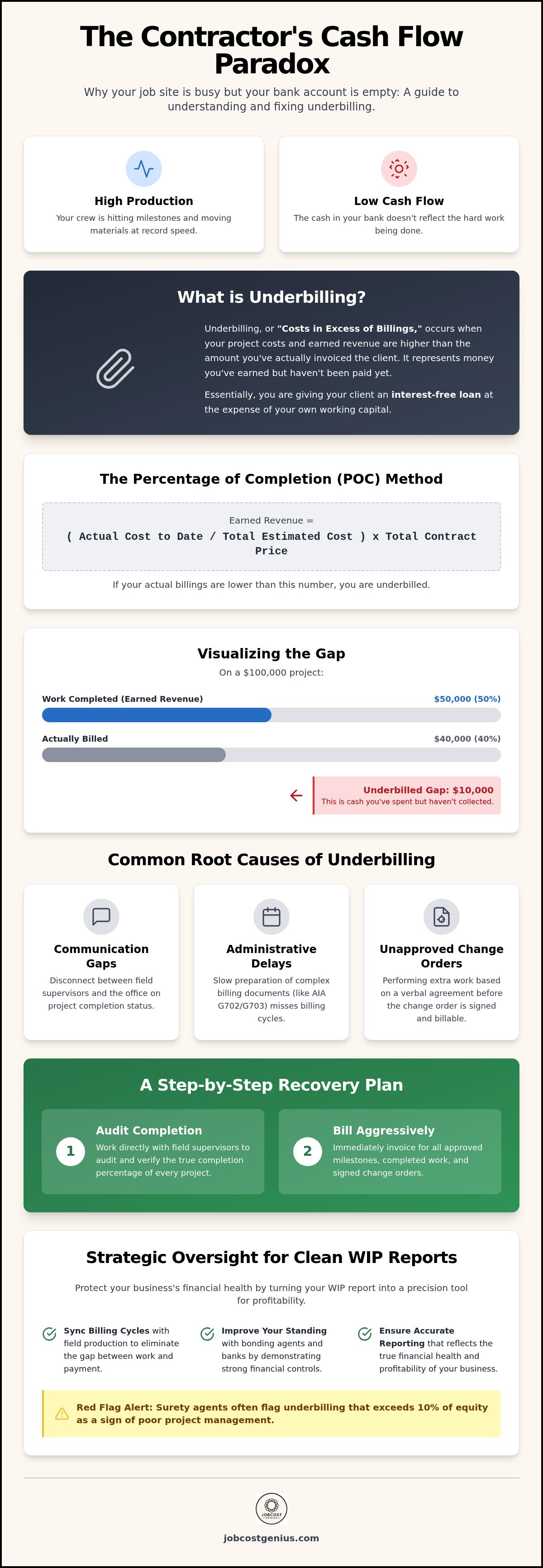
Underbilling occurs when your project costs and recognized earnings exceed your actual billings. In the accounting world, this is formally labeled as "Costs in Excess of Billings." While it technically sits on your balance sheet as an asset, the reality on the job site often feels quite different. It represents revenue you've earned through labor and materials but haven't yet requested from the client. Contractors who need underbilling on WIP reports help often find themselves in a cash crunch because they're financing the project's progress out of their own pockets.
This entire process relies on the Percentage of Completion (POC) method. This foundational accounting principle calculates revenue based on the portion of the project you've actually finished. If you've spent half your budget, you've earned half the contract value. When your invoices don't match that percentage, an underbilled state is created. This "earned but unbilled" revenue is a significant red flag. It indicates that your administrative billing cycle is lagging behind your field production, creating a gap that can swallow your operating capital.
The Anatomy of an Underbilled Project
To identify this gap, you must look at the specific math driving your WIP report. The formula is straightforward: (Actual Cost to Date / Total Estimated Cost) x Total Contract Price. This calculation determines your "Earned Revenue." If your actual billings are lower than this number, you are underbilled.
Consider a project with a $100,000 contract price. If your field crew has completed 50% of the work but the office has only billed for 40%, you have $10,000 in underbillings. On paper, this is an asset because it's money owed to you. In practice, it functions like a liability to your cash flow. You've already paid the labor and material costs for that extra 10% of work, but that cash hasn't returned to your bank account.
Underbilling vs. Overbilling: The Balancing Act
Maintaining financial health requires a delicate balance between underbilling and its counterpart, overbilling. While underbilling means you're behind on invoicing, overbilling occurs when you've billed for more work than you've actually performed. You can learn more about managing the opposite side of the coin in our guide on Fixing Overbilling on WIP Reports: A Contractor’s Guide.
In the construction industry, slight overbilling is generally considered safer. It provides a cash cushion that helps cover mobilization costs and project overhead. The "sweet spot" is a state where your billing closely tracks your production, perhaps leaning slightly toward overbilling to protect your liquidity. When underbilling becomes a trend across multiple jobs, it signals operational weakness that can damage your bonding capacity and bank trust as we head into 2026. Surety agents often flag underbilling that exceeds 10% of equity as a sign of poor project management.
The Root Causes of Underbilling: Why Construction Projects Fall Behind
Underbilling rarely stems from a single accounting error. It's usually the result of operational friction between the job site and the front office. If you're looking for underbilling on WIP reports help, you need to look past the spreadsheets and into your daily field operations. Often, project managers are so focused on hitting production milestones that they neglect the administrative requirements necessary to trigger an invoice. This disconnect ensures that while work is being performed, the financial recognition of that work remains stuck in a bottleneck.
Administrative delays also play a significant role. Preparing complex AIA G702 or G703 documents requires precise data from the field. If a project manager misses a billing deadline by even 24 hours, that revenue may not be billable until the following month. This creates a massive gap where costs continue to accumulate while the corresponding revenue sits idle. If you're struggling to bridge this gap, professional construction bookkeeping can provide the oversight needed to catch these leaks before they impact your liquidity.
The Change Order Dilemma
Performing work before a change order is signed is perhaps the most common trap for contractors. To keep a project on schedule, field crews often proceed with extra work based on a verbal agreement. Because the contract value hasn't been officially updated in your system, you can't bill for the work. However, the labor and material costs are still hitting your ledger. This creates "scope creep" without a corresponding increase in your billable contract total. To fix this, your WIP report should clearly track "pending" change orders separately from "approved" ones. This visibility allows you to see exactly how much cash is tied up in unsigned agreements.
Inaccurate Estimates and "Profit Fade"
Inaccurate cost-to-complete estimates can skew your entire percentage of completion. If your total estimated costs are too low, your project will appear more complete than it actually is. This leads to a false sense of security until the end of the project when the remaining costs exceed the remaining contract value. This phenomenon, known as "profit fade," is often preceded by chronic underbilling. You can find more detail on managing these projections in our WIP Reporting for Construction: The Definitive 2026 Guide. When you consistently underestimate the final cost, your WIP report will show you've earned revenue that you'll never actually be able to bill, leading to a painful year-end adjustment.
The Financial Impact: How Underbilling Acts as an Interest-Free Loan
Underbilling is more than a reporting lag; it's a direct drain on your company's liquidity. Every dollar categorized as "Costs in Excess of Billings" represents cash you've already spent on labor, subcontractors, and materials. By failing to bill for that work immediately, you're effectively providing your client with an interest-free loan. Contractors who need underbilling on WIP reports help often find themselves in a paradox where they're busier than ever but lack the cash to cover next week's payroll. This self-financing model severely limits your working capital and prevents you from bidding on larger, more lucrative projects.
Beyond the immediate cash crunch, chronic underbilling creates a dangerous psychological dynamic with your clients. When you bill slowly, owners get used to a specific, lower cash-outflow. If you try to "catch up" later with a massive invoice for work completed months ago, it often triggers billing disputes or legal snags. Revenue that remains unbilled is also significantly harder to collect if a project hits a snag or the owner faces their own financial troubles. Without a formal invoice, your claim to that earned revenue is much harder to enforce.
Bonding Capacity and Surety Concerns
Sureties view underbilling with extreme skepticism because they see it as a sign of management weakness. When a bonding agent analyzes your financial statements, they often subtract a portion of your underbillings from your working capital. They typically follow the "10% Rule," where underbilling exceeding 10% of your company's equity triggers immediate alarm bells. To a surety, consistent underbilling suggests a lack of internal control or an inability to manage project schedules. They view it as a signal that you may not truly understand your costs or that you're too disorganized to invoice for your progress.
Cash Flow vs. Accrual Profit
It's entirely possible to show a healthy profit on your P&L while your bank account is nearly empty. This is the "profitable but broke" trap that catches many growing contractors. While your income statement shows you've earned the money, your WIP report reveals that the cash hasn't actually arrived. This is why a deep understanding of accrual accounting for contractors is vital for long-term survival. Without the ability to distinguish between paper profit and actual liquidity, you risk making major business decisions based on revenue that hasn't yet materialized. Maintaining this clarity is the only way to ensure your business remains operationally stable through 2026.
A Step-by-Step Recovery Plan: How to Correct Underbilling
Correcting a broken WIP report requires more than just moving numbers; it demands a systematic audit of your operational habits. If you need underbilling on WIP reports help, start by aggressively processing every pending, approved change order. Any work performed without a formal signature is a direct drain on your cash flow. You should also implement a weekly "WIP Review" meeting. Bringing accounting and project management together ensures that billing milestones are never missed. Additionally, review your vendor payment terms to align your "cash out" to subcontractors with your "cash in" from the owner. For future project phases, negotiate "front-loaded" billing schedules that allow you to bill for mobilization and early-stage materials immediately.
Reconciling Field Reports with Accounting
The gap between the field and the office is where underbilling thrives. Project managers must verify "Percent Complete" against physical progress every week. Watch for "sandbagging," where costs are intentionally delayed or hidden to make a job’s performance look better than it is. This practice creates a false sense of security and leads to massive underbillings on your financial statements. Use a monthly reconciliation process to verify that labor hours spent match the original estimate and that all material deliveries have been invoiced to the client. Catching these discrepancies before the month-end close ensures your WIP report remains an accurate reflection of reality.
Accelerating the Billing Cycle
Speed is your best defense against underbilling. Streamline your AIA G702 and G703 preparation by using integrated software that pulls data directly from your job costs. Don't overlook the "stored materials" clause in your contracts. Billing for materials sitting in your warehouse or on-site, even before they are installed, significantly reduces your underbilled position. Effective construction accounts receivable management is the final piece of the recovery puzzle. It ensures that once the invoice is sent, the cash actually arrives. If your internal team is overwhelmed by these technical requirements, JobCost Genius provides the specialized WIP reporting needed to clean up your reports and restore your bank trust.
Strategic Oversight: How JobCost Genius Optimizes Your WIP Reporting
Achieving financial clarity requires more than just a software subscription; it requires a partner who understands the nuances of the construction industry. JobCost Genius serves as that specialized guide. We move beyond simple data entry to provide the technical oversight necessary to prevent profit gaps. If you need underbilling on WIP reports help, our team analyzes your project data to identify exactly where billing lags are occurring. We ensure your financial reporting isn't just a historical record but a forward-looking strategy for growth. This level of precision is the cornerstone of our 2026 Construction Accounting Guide for Small Firms.
Our Growth Plan and Premium Plan are designed specifically for contractors who have outgrown basic bookkeeping services. These tiers offer deep-dive WIP analysis that bridges the gap between field production and office administration. By leveraging specialized Procore Financials Integration and Buildertrend expertise, we sync your project management data with your ledger in real-time. This synchronization eliminates the communication bottlenecks that lead to unbilled change orders and inaccurate cost-to-complete estimates. With over 20 years of industry experience, our professionals provide the stability your business needs to scale with confidence.
Beyond Basic Bookkeeping
A generalist bookkeeper often lacks the industry-specific knowledge to spot the subtle red flags of underbilling. They might see a project as "on budget" without realizing that the billing cycle is three weeks behind the actual labor spend. JobCost Genius provides proactive reporting that highlights these discrepancies before they become cash flow crises. Our specialized oversight transforms administrative overwhelm into a state of organized calm. We provide the meticulous tracking required to satisfy bonding agents and build long-term bank trust. You receive a structured solution that links every job site action to a tangible financial result.
Ready for a WIP Health Check?
It's time to stop providing interest-free loans to your clients at the expense of your own working capital. You can regain control of your cash flow with a tiered plan tailored to your operation's size and complexity. Our services start at $800 per month for dedicated construction oversight, ensuring that even smaller firms have access to elite-level financial management. Don't wait for a year-end audit to discover that your profits have faded away. Take the first step toward foundational strength and operational efficiency today. Let JobCost Genius Fix Your WIP Reporting and secure your company's financial future.
Securing Your Financial Foundation for 2026
Underbilling is a silent drain on your company's liquidity. It's essentially an interest-free loan that compromises your working capital and bonding capacity. By auditing your completion percentages and accelerating your billing cycles, you can stop self-financing your clients' projects. If you need underbilling on WIP reports help, moving from administrative overwhelm to organized calm is possible with the right strategic partner.
JobCost Genius offers specialized construction bookkeeping with deep expertise in Procore and Sage 300 CRE integrations. We provide dedicated support for national construction firms, ensuring your WIP reports are precision tools for profitability. Our tiered plans start at $800 per month, offering the professional oversight needed to clean up complex financial gaps and maintain bank trust. Stop self-financing your projects—Get expert WIP help from JobCost Genius. Your hard work in the field deserves a financial reporting system that protects your bottom line and fuels your future growth.
Frequently Asked Questions
Is underbilling always a bad thing in construction?
Underbilling isn't always a sign of failure, but it's rarely ideal for your cash flow. It often occurs naturally at the beginning of a month when costs are recorded before the next billing cycle. However, if the trend persists, it indicates you're financing the client's project. This drains your liquidity and signals operational inefficiency to external partners like banks and sureties.
How do I calculate underbilling on my WIP report?
You calculate underbilling by subtracting your total billings from your earned revenue. First, determine your percentage of completion by dividing actual costs to date by your total estimated costs. Multiply this percentage by the total contract price to find your earned revenue. If this number is higher than what you've actually invoiced, the difference is your underbilled amount.
What is the difference between underbilling and a loss on a project?
Underbilling is a timing issue where revenue is earned but not yet invoiced, appearing as an asset on your balance sheet. A loss occurs when the total cost to complete a project exceeds the total contract value. While underbilling represents money you expect to collect, a loss represents a permanent reduction in your company's equity and profit.
Why do sureties care so much about underbilling?
Sureties view underbilling as a red flag for poor project management or inaccurate estimating. If your underbilling exceeds 10% of your equity, it suggests you aren't in control of your project milestones. They worry that "costs in excess of billings" might actually be hidden losses or uncollectible change orders, which increases their risk when providing bonds.
Can underbilling lead to a tax liability?
Yes, underbilling can create a tax liability because the IRS typically requires contractors to use the Percentage of Completion method. You're taxed on the revenue you've earned, regardless of whether you've actually sent an invoice or received the cash. This can create a difficult situation where you owe taxes on money that isn't even in your bank account yet.
How often should I update my WIP report to catch underbilling?
You should update your WIP report at least once a month during your close process. However, high-growth firms often benefit from weekly updates to catch billing lags in real-time. If you find yourself frequently needing underbilling on WIP reports help, increasing the frequency of your reviews allows you to address unapproved change orders before they become major cash flow drains.
What should I do if my client refuses to pay for work that is underbilled?
Immediately stop work on any disputed scope and review your contract's notice provisions. Underbilled work often relates to verbal change orders that haven't been formalized. You must document the costs incurred and present a formal change order for signature. If the client continues to refuse payment, consult with legal counsel to protect your lien rights before the revenue becomes uncollectible.
How does underbilling affect my balance sheet?
Underbilling appears on your balance sheet as a current asset, usually labeled as "Costs in Excess of Billings." While it increases your total assets, it's a non-cash asset that doesn't help pay your immediate bills. If this asset grows too large relative to your cash reserves, it indicates that your business is over-leveraged and lacks the liquidity needed for daily operations.


