

Why does a project that looks healthy on paper in June suddenly show a major margin loss by the time you're demobilizing in October? This phenomenon, known as profit fade, often stems from a fundamental disconnect between field expenses and office bookkeeping. You likely already know that manual spreadsheets and delayed data entry are the primary enemies of your bottom line. Relying on professional construction job cost tracking services is no longer just a luxury; it's a structural necessity for maintaining project profitability in a high-stakes market.
We understand the administrative overwhelm that comes with inaccurate WIP reports and the constant pressure to maintain bonding capacity. This guide will show you how to master the mechanics of job cost tracking to stabilize your cash flow and gain total financial visibility across every project. We'll explore how seamless Procore integrations and real-time reporting can transform your financial operations from a source of stress into a competitive advantage.
Key Takeaways
- Learn to distinguish between passive expense tracking and active cost management to stop profit fade before it erodes your project margins.
- Discover how a standardized cost code structure and Schedule of Values (SOV) create a seamless link between field production and office billing.
- Understand why software alone is insufficient and how professional construction job cost tracking services provide the expert oversight needed for audit-ready financials.
- Identify the five essential steps to implement a robust tracking system, including digital field data capture and unified account charts.
- Explore how specialized WIP reporting and tiered service plans can increase your firm's bonding capacity and overall bankability.
Defining Construction Job Cost Tracking: Beyond Simple Bookkeeping
Construction job cost tracking is the disciplined process of assigning every project expense, from a single box of nails to a week of heavy equipment rental, to a specific cost code. It's much more than just recording that money was spent. It's about knowing exactly where and why it was spent in relation to your original estimate. Foundational job costing principles require this level of granularity to move from passive tracking to active cost management.
Passive tracking merely tells you what happened after the project is finished and the bank account is empty. Active management allows you to course-correct in the middle of a build. Professional construction job cost tracking services bridge this gap by providing the oversight needed to catch variances before they become permanent losses. The goal is a real-time view of project health. This ensures you aren't waiting until the final check to see if you actually made a profit.
The High Stakes of Profit Fade
Profit fade is the gradual decrease in estimated gross profit as a project progresses. It often starts with minor data entry errors or missed field expenses that compound over months. By the time a project hits 90% completion, these small gaps can aggregate into a massive financial shortfall. Utilizing consistent WIP reporting is the only reliable way to identify these trends early. Without these insights, you're essentially flying blind until the close-out audit, where it's too late to recover lost margins.
Why Generalist Bookkeepers Struggle with Construction
Generalist accounting software and bookkeepers often lack the tools to handle the nuances of the construction industry. They might record a payroll total, but they often fail to capture the true labor burden, including workers' comp codes and multi-state tax complexities. If a field team forgets to submit a single Time and Materials (T&M) ticket, the office remains unaware of the mounting cost until the vendor sends a late invoice. Specialized construction job cost tracking services implement an industry-specific chart of accounts that mirrors the physical workflow of the job site. This ensures every dollar is accounted for, regardless of how complex the payroll or procurement process becomes.
The Essential Components of a Job Costing Workflow
A successful workflow isn't just about data entry; it's about building a hierarchy of financial truth. A robust cost code structure serves as the backbone of this system. By standardizing how you categorize labor, materials, and subcontractors across every project, you create a baseline for historical comparison. This level of Construction Project Cost Control allows you to see exactly where a project is deviating from the original estimate in real-time. Without this standardization, your reports are merely a collection of disconnected numbers.
Hourly wages are only part of the financial story. You must calculate the true labor burden, which includes taxes, insurance, benefits, and union dues. If you only track the base rate, your project health reports will be fundamentally flawed and your margins will suffer. High-quality construction job cost tracking services ensure these hidden costs are baked into your daily reports. This precision allows you to understand the "fully loaded" cost of every hour spent on site.
Retention management is another critical component that many generalist bookkeepers overlook. Most commercial contracts hold back 5% to 10% of every payment application. If you don't track these funds specifically, it's easy to lose sight of significant capital. Proper tracking ensures that this money eventually hits your bank account instead of getting lost in the administrative shuffle. Implementing these components requires meticulous attention to detail that generalists often miss. If your team is struggling to maintain this level of oversight, our Growth Plan can provide the specialized support needed to stabilize your financial infrastructure.
Mastering the Schedule of Values (SOV)
Your SOV is the bridge between your internal budget and your external billing milestones. It must satisfy the project owner's requirements while remaining granular enough for your own internal analysis. A well-constructed SOV is essential for effective construction accounts receivable management. When these values are inaccurate or misaligned with project progress, you'll face constant payment application rejections. This leads to cash flow bottlenecks that can stall a project before it even hits the halfway mark.
Tracking Committed Costs and Change Orders
Committed costs are financial obligations that haven't been invoiced yet, such as signed subcontracts and open purchase orders. If you only look at paid invoices, you aren't seeing your true liability. Change orders present an even greater risk to your profitability. They often "leak" profit when they aren't captured immediately in the job cost system. A job cost report is incomplete without accounting for pending change orders. Professional construction job cost tracking services ensure these pending items are always visible, giving you a comprehensive view of your total financial exposure.
Technology vs. Talent: Why Software Alone Isn't a Cost Tracking Service
Investing in high-end software is a common response to financial disorganization. Many firms believe that a new subscription will automatically fix their margin issues. However, software is merely a tool; it isn't a strategy. SaaS-only solutions provide the digital infrastructure, but they don't provide the discipline required for accurate reporting. Without a managed approach, you face the "Garbage In, Garbage Out" risk. If the data from the field is flawed, your expensive dashboard will only help you make bad decisions faster.
A Procore Financials integration is a powerful asset for any firm, yet it requires constant expert oversight to remain accurate. Professional construction job cost tracking services provide the human intelligence layer that automated platforms lack. We ensure that cost codes stay consistent and that field data actually aligns with your general ledger. This oversight prevents the field-to-office gap where site expenses and office books tell two different stories.
The Role of a Construction Financial Consultant
Software can generate a report, but it cannot interpret the nuances of a complex WIP statement. A specialized consultant looks beyond the numbers to identify overbilling and underbilling risks that could threaten your bonding capacity. They understand that software can't fix a broken "pay-when-paid" cash flow cycle or handle the intricacies of certified payroll compliance. Having a "human-in-the-loop" for data verification ensures that your financials are audit-ready and reflect the actual physical progress of the work.
Bridging Field Data and Financial Statements
The disconnect between daily logs and monthly financial reporting is a primary driver of profit fade. Relying on project managers to manage the books in the field is a high-risk strategy. Their focus is on production and safety, not accounting precision. When financial reporting becomes an afterthought for the field team, reconciliation becomes a nightmare for the office. Specialized construction job cost tracking services synchronize these daily activities with your long-term goals. This structured oversight ensures your construction cash flow remains stable even as you take on larger, more complex projects. By removing the administrative burden from your builders, you allow them to focus on what they do best: finishing jobs on time and under budget.
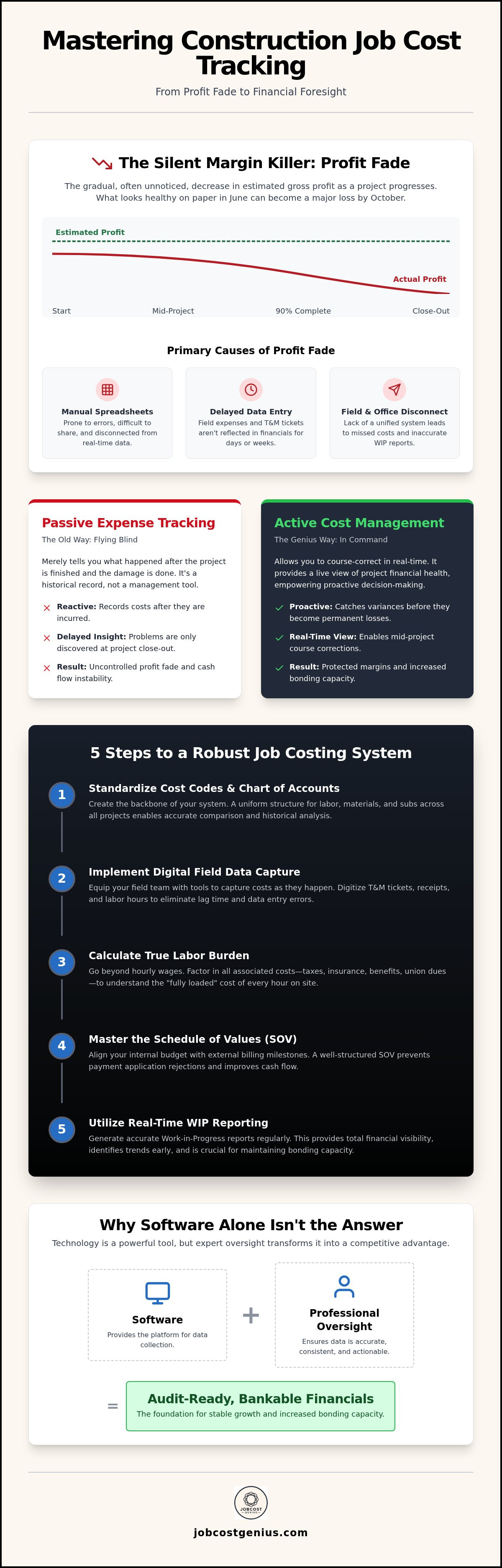
5 Steps to Implement a Robust Job Cost Tracking System
Moving from reactive bookkeeping to proactive financial management requires a methodical approach. A robust system doesn't happen by accident; it's built on a foundation of consistency and accountability. By following a structured implementation plan, you can eliminate the data lag that leads to profit fade. This process ensures that your construction job cost tracking services provide the actionable insights you need to protect your margins.
Step 1: Standardizing Your Data Foundation
Consistency is the bedrock of accurate reporting. You must use the same cost codes for estimating that you use for actual tracking in the field. If your teams speak different financial languages, your reports will never align. Utilizing the CSI MasterFormat is an industry standard that helps organize your job costs into logical, predictable categories. Contractors should limit cost codes to those that actually influence decision-making to avoid overwhelming the field team with unnecessary administrative bloat.
Once your codes are set, you must implement a digital field data capture system for labor and materials. Relying on paper tickets or memory is a high-risk strategy that leads to missing expenses. Digital entry ensures that every hour worked and every yard of concrete poured is recorded immediately. This real-time data entry is the only way to achieve true financial visibility before a project concludes.
Step 3: The Weekly Field-Office Sync
Establish a firm weekly deadline for all field logs to be submitted and reviewed by the office. A Friday afternoon cutoff ensures that the previous week's activities are fresh in everyone's mind. During this sync, you must address "orphan" costs that don't have an assigned cost code. These unallocated expenses are often where profit leaks begin. It's also the ideal time to verify material deliveries against purchase orders in real-time. This verification prevents vendor overcharges and ensures that you only pay for what was actually received on-site.
The fourth step involves generating monthly WIP reports to identify overbilling and underbilling trends. These reports act as an early warning system for profit fade, allowing you to adjust field operations before the budget is exhausted. Finally, perform a "Post-Mortem" cost analysis after every project close-out. Compare your final actuals against the original estimate to identify where your bidding was off. This feedback loop is essential for improving the accuracy of future estimates and overall firm bankability. If you need help establishing these workflows, our Starter Plan provides the foundational oversight required to get your systems on track.
Scaling Your Firm with Professional JobCost Genius Oversight
Scaling a construction company requires more than just winning larger bids; it requires a financial infrastructure that can withstand increased complexity. JobCost Genius provides this framework through our Starter, Growth, and Premium plans. Each tier is designed to meet your firm where it is today while preparing you for the opportunities of tomorrow. These construction job cost tracking services move you away from reactive "firefighting" and toward a proactive management style where decisions are based on data rather than instinct.
Clean, audit-ready financials are the primary currency of growth in this industry. When you present professional WIP reporting to sureties and lenders, you demonstrate a level of control that generalists simply cannot match. This transparency increases your bonding capacity and improves your overall bankability. You gain the peace of mind that comes from knowing your financial statements are accurate, compliant, and ready for review every single month.
The ROI of Specialized Construction Bookkeeping
Specialized bookkeeping often pays for itself through improved operational efficiency. For example, reducing your Days Sales Outstanding (DSO) through more aggressive billing and precise tracking can significantly boost your liquid capital. Catching underbilling early prevents the sudden cash crunches that stall projects and damage vendor relationships. Outsourcing these critical tasks to a specialist is also far more cost-effective than hiring a full-time construction controller. You get the expertise of a veteran team without the heavy overhead of a C-suite salary.
Ready to Master Your Job Costs?
The path to financial clarity is a combination of clean data, robust software, and expert oversight. We don't just set up the tools; we provide the veteran insight needed to interpret the results and protect your bottom line. Transitioning to a managed system allows your team to focus on production while we handle the technical compliance and financial reporting. Getting started is straightforward. We begin with a comprehensive back-office audit to identify current gaps in your workflow and create a roadmap for your success. Get a custom quote for your construction job cost tracking today.
Mastering the Financial Lifecycle of Your Projects
Construction is a high-stakes, low-margin industry where a single missed expense or a delayed report can jeopardize an entire year of growth. Relying on generalist bookkeeping or unmanaged software leaves your firm vulnerable to profit fade and bonding issues. True financial visibility depends on active cost management, standardized data foundations, and a seamless bridge between field production and office financials. Professional construction job cost tracking services provide the foundational strength needed to transform your back office into a strategic asset.
JobCost Genius brings over 20 years of veteran industry experience to your team. We offer specialized Procore and Sage 300 CRE integration support to ensure your field data matches your general ledger every time. Our tiered plans start at $800 per month, delivering the meticulous oversight required for audit-ready financials and improved bankability. It's time to replace administrative overwhelm with organized calm and predictable margins. Streamline your project profitability with JobCost Genius and gain the total financial visibility you need to build a more resilient firm.
Frequently Asked Questions
What is the difference between job costing and general bookkeeping?
General bookkeeping tracks the high-level financial health of your entire company, focusing on broad categories like office rent and utilities. In contrast, job costing assigns every project expense to a specific cost code. This granular approach allows contractors to see which specific activities are profitable and which are exceeding the budget. It provides a level of project-specific detail that general ledgers miss, allowing for more precise bidding and operational adjustments.
How do I choose the right cost codes for my construction projects?
You should select cost codes based on the specific activities that drive your project costs and influence your bidding process. Most firms adopt the CSI MasterFormat as a standard starting point for organization. It's vital to use codes that your field team can easily understand and apply to daily logs. Limit your list to essential categories; too many codes lead to data entry errors, while too few prevent you from identifying specific profit leaks.
Why is my job cost report different from my Profit and Loss statement?
A Profit and Loss statement tracks total revenue and expenses for a specific period, whereas a job cost report tracks cumulative costs for a project's entire lifecycle. Differences often arise due to timing issues or unallocated overhead that doesn't appear in project-specific reports. Additionally, job cost reports include committed costs like subcontracts that haven't been invoiced yet. Professional construction job cost tracking services help reconcile these two views to ensure your overall financial health is accurate.
Can I track job costs accurately using just QuickBooks?
You can perform basic tracking in QuickBooks, but the software often lacks the industry-specific depth required for complex labor burden and WIP reporting. QuickBooks is excellent for general accounting, yet it struggles to bridge the gap between field production and office financials. For accurate results, most firms integrate QuickBooks with specialized field apps. This ensures that every hour and material ticket is captured and coded correctly before it hits the general ledger.
How does overbilling on a WIP report affect my project tracking?
Overbilling occurs when your billings exceed the actual costs incurred plus earned profit, creating a liability on your balance sheet. While it provides a temporary cash flow boost, it can mask underlying project issues and lead to a cash crunch during the job's final stages. Accurate tracking ensures you recognize when you're borrowing from future project phases. This visibility is essential for maintaining bonding capacity and preventing a sudden, unexplained drop in your project margins.
What is the best way to track equipment costs across multiple jobs?
The most effective method is to establish an internal rental rate for each piece of equipment based on its ownership and maintenance costs. You then charge this rate to specific project cost codes based on daily usage logs. This approach ensures that the project budget reflects the true cost of machinery rather than just fuel and repairs. Tracking these hours allows you to recover depreciation costs and accurately bid for future projects that require heavy equipment.
How often should I review my job cost reports?
You should review high-level job cost summaries weekly and conduct a deep-dive analysis at the end of every month. Weekly reviews allow project managers to catch field errors or material overruns before they compound. Monthly reviews are necessary for generating accurate WIP reports and assessing overall firm profitability. Consistent oversight transforms your financial data from a historical record into a proactive management tool that protects your bottom line throughout the project.
What are 'committed costs' and why do they matter for project health?
Committed costs represent financial obligations you've already made, such as signed subcontracts or open purchase orders, even if you haven't received an invoice yet. They matter because they represent money that is already spent in your budget. If you only track paid invoices, you'll have a false sense of project profitability. Including committed costs in your construction job cost tracking services provides a realistic view of your remaining budget and total financial exposure.


