

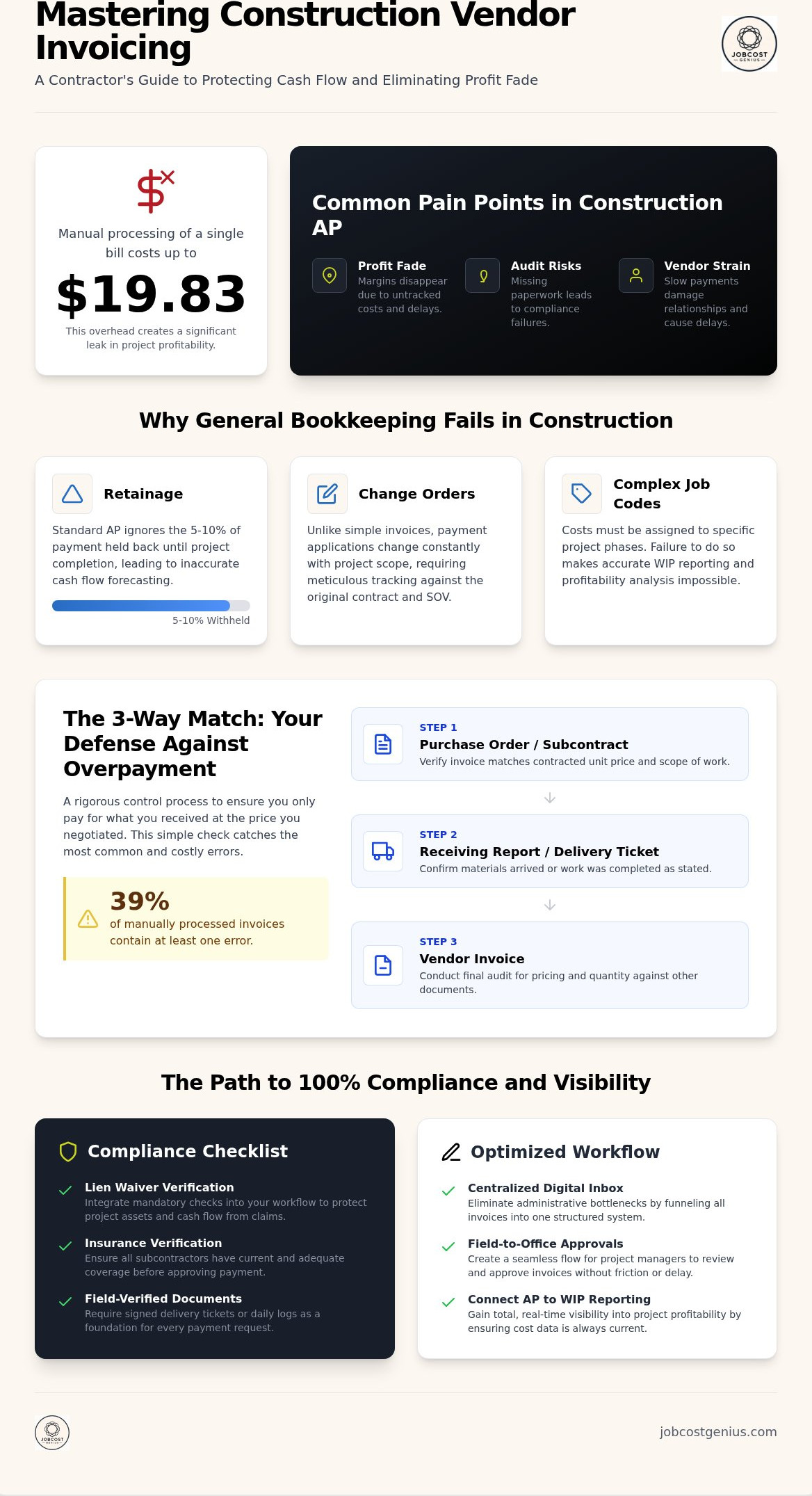
Did you know that manually handling a single bill can cost your firm up to $19.83? When you multiply that by hundreds of subcontractors and suppliers, your overhead isn't just a line item; it's a leak in your project's profitability. You already know that managing construction vendor invoice processing is more than just data entry. It's a high-stakes balancing act of verifying field work, tracking down missing lien waivers, and preventing the "profit fade" that happens when job costs aren't captured in real time. The administrative overwhelm is real, and the fear of a failed audit or a disgruntled vendor keeps many owners up at night.
This guide will transform that chaos into a disciplined, professional-grade workflow. We'll provide you with a definitive checklist designed to protect your cash flow and ensure every dollar spent is accounted for and compliant. By the end of this article, you'll have a roadmap for mastering the complexities of contractor accounts payable. We’ll walk through the essential steps of the three-way match, digital lien waiver management, and the integration strategies needed to achieve 100% compliance and real-time cost visibility.
Key Takeaways
- Learn why general bookkeeping often fails to capture construction-specific nuances like retainage, change orders, and complex job codes.
- Establish a rigorous three-way match process to ensure your firm only pays for verified materials and subcontracted labor.
- Protect your cash flow by integrating mandatory lien waiver and insurance verification into your construction vendor invoice processing workflow.
- Discover how a centralized digital inbox and a structured triage system can eliminate administrative bottlenecks and field-to-office friction.
- Connect your accounts payable data to real-time WIP reporting to gain total visibility into project profitability and prevent profit fade.
The Fundamentals of Construction Vendor Invoice Processing
In the construction industry, accounts payable is the financial engine that keeps projects moving forward. Effective construction vendor invoice processing involves much more than just entering data into a ledger. It's the systematic process of receiving, verifying, and paying for every piece of material and hour of subcontracted labor. Unlike standard retail businesses, construction AP is tied directly to project milestones and specific contractual obligations. It's a risk-management function that ensures every dollar spent aligns with the work actually performed on the job site.
Standard bookkeepers often struggle with the industry's unique demands. They might overlook retainage, which is the portion of a payment, often 5% to 10%, held back until project completion to ensure quality. They may also fail to link costs to specific job codes, making it impossible to see if a project is actually profitable. This lack of detail leads to "profit fade," where margins slowly disappear because costs weren't tracked accurately from the start. A specialized accounts payable process is required to manage these complexities.
Every payment must have a clear foundation. You need field-verified documentation, such as signed delivery tickets or daily logs, to back up every request for payment. Without this paper trail, you risk paying for materials that never arrived or labor that hasn't been completed. Efficiency also impacts your bottom line. Slow processing doesn't just frustrate vendors; it costs you money. You miss out on early-pay discounts and risk incurring standard late fees, which typically sit at 1.5% per month. Strained relationships with reliable suppliers can lead to delivery delays that stall your entire site.
Invoices vs. Payment Applications: Knowing the Difference
Vendor invoices are usually straightforward bills for supplies like lumber or concrete. Payment applications, however, are complex requests for progress payments. They often use standard formats like the G702 and G703, which require a detailed breakdown of work completed to date. These documents demand a more rigorous review because they involve percentage-of-completion calculations and retainage accounting. You can't treat a $50,000 progress billing with the same casual review you'd give a utility bill.
The Role of the Schedule of Values (SOV)
The SOV is your financial North Star. It lists every work item and its assigned value, serving as the benchmark for all future billings. When you review an invoice, you must check line items against the original SOV to ensure accuracy. This prevents "front-loading," a tactic where vendors bill for more work than they've finished to improve their own cash flow at your expense. Accurate tracking here is essential for reliable WIP reporting for construction companies.
The 3-Way Match: A Checklist for Data Integrity
Data integrity is the backbone of your financial health. While many software providers claim automation solves everything, construction requires a human layer of verification that generic tools often ignore. The 3-way match is your primary defense against overpayment. It's a rigorous control process where you compare three distinct documents to ensure you only pay for what you received at the price you negotiated. To optimize these procurement outcomes and ensure your initial agreements are as favorable as possible, many firms partner with RightCostIQ for professional RFP management and negotiation assistance. With approximately 39% of manually processed invoices containing at least one error, this audit phase is where you catch overbillings before they hit your bank account.
- Step 1: The Purchase Order (PO) or Subcontract Agreement. Verify that the invoice matches the contracted unit price and the agreed-upon scope of work.
- Step 2: The Receiving Report or Field Delivery Ticket. Confirm that the materials actually arrived on-site or that the subcontractor completed the stated phase of labor.
- Step 3: The Vendor Invoice. Conduct a final audit for pricing and quantity accuracy against the first two documents.
Catching red flags early prevents profit fade. Look for "service dates" that fall outside your project schedule; this often indicates a vendor is billing the wrong job. Duplicate invoices are another common risk in high-volume environments. Adhering to proper invoice requirements ensures your team captures tax IDs and correct job codes immediately. Assigning costs to the right project phase at the moment of entry is vital for accurate reporting. If you're struggling to keep up with these manual checks, the team at JobCost Genius can help you implement these professional controls.
Verifying Field Deliveries and Work Progress
Site supervisors must be your eyes in the field. Every delivery needs a signed ticket, and progress billings should ideally include "photo proof" to validate work-in-place claims. If the field report shows 50% completion but the invoice claims 75%, you must stop the process. This discrepancy is a clear signal to pause payment until the field and office data align. Creating a standard field ticket process for site supervisors ensures that the construction vendor invoice processing workflow isn't based on guesswork.
Managing Change Order Invoices
Never process an invoice for extra work without an approved, signed change order already in your system. Tracking unapproved change orders is a fast track to losing money and creating legal friction. Keep base contract billing separate from extra-work billing to ensure your job costing remains clean. This separation makes it easier to track the profitability of specific project phases and ensures that your WIP reporting for construction companies remains accurate throughout the project lifecycle.
The Compliance Checklist: Lien Waivers and Insurance
Compliance is the shield for your company's assets. In construction vendor invoice processing, a single missing document can lead to double payment or a legal lien on the property. You must verify that every subcontractor has provided a signed lien waiver and possesses active insurance coverage before a check is cut. This isn't just administrative red tape. It's a fundamental requirement of the AIA billing process that protects owners and general contractors alike.
Retainage management is equally critical. Most contracts specify a 5% to 10% holdback on every progress payment. This ensures the subcontractor remains motivated to finish punch-list items at the project's end. Additionally, stay aware of state-specific billing regulations. Twelve states have statutory requirements for lien waiver templates that you must follow to ensure the documents are legally enforceable. In states like Georgia or Mississippi, these waivers may even require notarization to be valid.
A Conditional Lien Waiver is a document that becomes valid only upon the actual receipt of payment.
Mastering Subcontractor Lien Waivers
Understanding the four types of lien releases is essential. Partial waivers cover specific progress payments, while final waivers release all claims once the project is finished. You should also distinguish between conditional and unconditional versions to protect your cash flow. Implementing a "Waiver for Check" exchange protocol ensures you never release funds without a signed document in hand. This level of meticulousness is why professional construction accounts receivable management depends so heavily on clean, verified lien releases.
Tracking Retainage and Insurance Expirations
Retainage isn't free money. It's a liability that belongs on your balance sheet. You must record it accurately to avoid inflating your perceived cash on hand. Managing insurance is just as vital. If a subcontractor's Workers' Comp or General Liability insurance expires mid-project, you could be held liable for on-site accidents. Common baselines require $1,000,000 per occurrence for general liability. Set up automated alerts to flag expiring certificates at least 30 days in advance. This proactive approach prevents stop-work orders and protects your project timeline. The final release occurs only after you've reconciled all retainage and verified every final lien waiver at project close.
Optimizing the Field-to-Office Approval Workflow
A streamlined approval workflow is the difference between a profitable project and one plagued by profit fade. Without a structured path, invoices sit on desks, early-pay discounts vanish, and vendors become frustrated. Professional construction vendor invoice processing requires a clear, five-step hierarchy that moves documents from the site to the general ledger with minimal friction. This structure ensures that every bill is scrutinized by the right person at the right time.
- Step 1: Centralized Capture. Redirecting all vendor invoices to a single digital inbox eliminates the "lost in the mail" syndrome. It stops invoices from being trapped in a project manager's truck or an overflowing email account.
- Step 2: Initial Triage. Bookkeeping performs a preliminary review for basic compliance. They verify tax IDs, check for duplicate invoice numbers, and ensure preliminary job codes are assigned before the PM ever sees the bill.
- Step 3: Field Review. The Project Manager (PM) approves the work. They confirm the quality of materials delivered and verify that the percentage of work completed matches the billing.
- Step 4: Executive Approval. Final sign-offs are reserved for large disbursements or sensitive vendor accounts. This step maintains tight fiscal control over significant cash outflows.
- Step 5: Payment Execution. Strategic timing is key. You must balance the need to maximize cash flow with the goal of maintaining vendor trust and securing early-pay discounts.
Reducing Bottlenecks in the Approval Chain
Senior management shouldn't be bogged down by small material bills. Setting "threshold approvals" allows invoices under a specific dollar amount to bypass high-level review, significantly speeding up the payment cycle. Mobile-friendly approval tools are also essential for PMs who spend their days on-site rather than behind a desk. Professional Procore financials integration services bridge this data gap, allowing field approvals to sync instantly with office records without the need for manual hand-offs.
Integrating AP with Job Costing Systems
Manual entry is a relic of the past that invites human error and data silos. Moving to a direct sync with your ERP or accounting software ensures your budget reflects expenses the moment they're approved. Real-time tracking allows you to see the impact of an invoice on your project's health immediately. Every dollar spent must be reflected in your construction job cost tracking services to maintain accurate margins. If your current workflow feels broken, partner with JobCost Genius to professionalize your accounts payable and regain financial clarity.
How JobCost Genius Transforms Your Accounts Payable
Generalist bookkeepers often view accounts payable as a simple task of paying bills on time. In our industry, that narrow perspective is dangerous. Professional construction vendor invoice processing requires an understanding of retainage, complex job costing, and the specific compliance risks that generalists frequently overlook. At JobCost Genius, we bring over 20 years of industry experience to the table. We don't just enter data; we act as a specialized filter that ensures every dollar leaving your business is verified and legitimate.
Our approach provides the financial oversight necessary to scale your operations. By linking your daily invoice data directly to WIP reporting for construction companies, we give you a real-time view of your project health. You'll no longer have to wait until the end of the month to see if a project is slipping into the red. Whether you are starting with our Starter Plan or scaling into our Growth Plan as your vendor volume increases, our systems adapt to your needs. This scalability ensures that your back office remains a foundation for growth rather than a bottleneck.
Strategic AP Management for Cash Flow Stability
Keeping cash in your business is a strategic priority. We help you manage vendor terms effectively, ensuring you take advantage of early-pay discounts while timing larger disbursements to maintain optimal liquidity. Our team also focuses on audit-proofing your records. We maintain digital document retention for every invoice, lien waiver, and delivery ticket. This meticulous construction vendor invoice processing provides peace of mind, knowing that your records are clean and compliant. Professional oversight is your best defense against overbilling and the fraud risks that often plague unmonitored approval chains.
Next Steps: Strengthening Your Back Office
Beyond internal financial controls, establishing a strong corporate credit profile can help your firm secure more favorable terms with suppliers; to get started, check out The CEO Creative for a step-by-step guide on obtaining your D-U-N-S number.
It's time to evaluate your current AP process for "leaks" and inefficiencies. If your project managers are spending hours on paperwork or your vendors are constantly calling about late payments, your system is failing. Effective construction accounting for small firms requires a partner who understands the "messy" middle of project financials. We invite you to book a consultation to see how our specialized AP management fits your specific business model. Let us transform your administrative overwhelm into financial clarity so you can focus on building.
Building a Foundation for Financial Clarity
Mastering construction vendor invoice processing is the key to protecting your margins and maintaining project momentum. By implementing a rigorous three-way match and a standardized compliance checklist, you move beyond simple data entry into true risk management. You've learned how a disciplined approval workflow prevents profit fade and ensures that every payment is backed by field-verified documentation. These steps aren't just administrative tasks; they're essential controls that safeguard your cash flow and vendor relationships.
JobCost Genius provides the specialized construction AP/AR management you need to transition from overwhelm to organization. We offer expert WIP reporting integration and full support for Procore and Sage integrations, ensuring your back office remains audit-proof and scalable. Stop letting paperwork leaks drain your profitability. Ready to stop the paperwork headache? Explore JobCost Genius Bookkeeping Plans. You've built the structures; let us help you build a more stable and profitable financial future.
Frequently Asked Questions
What is the most common mistake in construction vendor invoice processing?
The most common mistake is failing to verify that the invoiced materials actually arrived on-site or that the labor was performed to specification. Without a rigorous 3-way match, firms often pay for incomplete work or duplicate billings. This oversight in construction vendor invoice processing directly leads to profit fade. Establishing a "no ticket, no payment" policy is the most effective way to prevent these costly administrative errors.
How does retainage work on a subcontractor invoice?
Retainage is a portion of the contract price, typically 5% to 10%, that you withhold from a subcontractor's progress payment until the job is satisfactorily completed. You record this as a liability on your balance sheet rather than immediate profit. It serves as a financial incentive for the subcontractor to finish punch-list items. Managing these holdbacks accurately requires specialized bookkeeping to ensure funds are released only after final lien waivers are signed.
Do I really need a lien waiver for every single payment?
Yes, you should require a signed lien waiver for every single progress payment to protect your company from double payment and legal encumbrances. A lien waiver confirms that the vendor has been paid and waives their right to file a mechanic's lien against the property for that specific amount. In twelve states, you must use specific statutory forms to ensure the waiver is legally enforceable, making consistency a vital part of your compliance strategy.
What is the difference between an invoice and a payment application?
A standard invoice is typically used for materials and supplies, while a payment application is a more complex request for progress payments on a subcontract. Payment applications often use the G702/G703 format to detail work-in-place and retainage calculations. While a material invoice might only require a delivery ticket for verification, a pay app requires a thorough review of the schedule of values and percentage-of-completion data to ensure accuracy.
How can I speed up my invoice approval process without losing control?
You can speed up approvals by implementing a centralized digital inbox and setting "threshold approvals" for smaller, recurring expenses. Redirecting all vendor documents to one location prevents bills from getting lost in the field. Thresholds allow project managers to approve minor invoices without waiting for executive sign-off. This approach maintains high-level control over large disbursements while removing bottlenecks for the high-volume, low-dollar transactions that often stall your construction vendor invoice processing workflow.
Should I use a general bookkeeper or a construction specialist for AP?
You should always choose a construction specialist for accounts payable because generalists often overlook industry-specific requirements like retainage and job costing. A specialist understands how to audit a G703 continuation sheet and verify insurance compliance. Generalist bookkeepers may pay an invoice that lacks a lien waiver or fail to code costs to the correct project phase. This expertise is essential for keeping your financial records audit-proof and your projects profitable.
What documents should accompany a construction invoice for it to be considered "complete"?
A complete construction invoice package must include the bill itself, a signed field delivery ticket or receiving report, and a current lien waiver. For subcontractors, you should also verify that their General Liability and Workers' Comp insurance certificates are active. Some firms also require "photo proof" of work progress for larger progress billings. Without these supporting documents, your office cannot perform the 3-way match required to protect your firm's cash flow.
How does invoice processing affect my WIP (Work in Progress) report?
Invoice processing is the primary data source for your WIP report; if your AP is inaccurate, your project profitability data will be flawed. Timely processing ensures that actual costs are recorded as they occur, rather than weeks after the work is finished. This real-time visibility allows you to identify budget overruns early and adjust your operations before they impact your final margins. Accurate job coding during the entry phase is what makes professional reporting possible.


