

Hiring a full-time office manager to sit in your trailer might feel like the safest way to control your finances, but that "safety" often comes with a $100,000 price tag and a lack of specialized reporting. Most contractors believe proximity is the best way to get answers quickly. However, you've likely noticed that proximity doesn't guarantee accuracy, especially when profit fade starts eating into your margins because of delayed job costing. Choosing between in-house vs outsourced construction bookkeeping isn't just about managing payroll; it's about whether you have the financial intelligence to scale your business.
You need real-time visibility into your project health, not reports that arrive three weeks after the concrete is poured. This guide breaks down the true operational impact of both models to help you decide which path protects your margins in 2026. We'll examine the fully loaded costs of internal staff, the necessity of automated WIP reporting, and how specialized integrations like Procore Financials are redefining what it means to be an organized, profitable builder.
Key Takeaways
- Calculate the "fully loaded" cost of an internal hire, which often exceeds $100,000 annually when factoring in benefits, taxes, and office overhead.
- Analyze the operational impact of in-house vs outsourced construction bookkeeping to ensure your choice provides the real-time WIP reporting needed to stop profit fade.
- Avoid the risks of hiring a generalist by prioritizing a construction-specific Chart of Accounts that captures project-level intelligence.
- Leverage modern technology stacks, such as Procore Financials integration, to eliminate manual data entry and synchronize field operations with office financials.
- Identify the strategic revenue milestones that dictate when to scale from a tiered service plan to a dedicated internal accounting department.
The Unique Complexity of Construction Bookkeeping
Construction accounting operates on a completely different plane than standard retail or service-based bookkeeping. While a retail shop tracks simple inventory and immediate sales, a construction firm manages long-term contracts, fluctuating material costs, and complex labor requirements across multiple jobsites. The Unique Complexity of Construction Bookkeeping stems from the need to recognize revenue over time rather than at the point of sale. Job Costing is the systematic process of assigning all direct and indirect project expenses to specific jobs to determine their true profitability. Without this granular focus, you're essentially flying blind, unable to see which projects are actually contributing to your bottom line.
When evaluating in-house vs outsourced construction bookkeeping, many owners realize that a generalist bookkeeper often misses the nuances of the industry. Retention tracking, where a portion of your payment is held until project completion, can create massive cash flow gaps if not managed meticulously. Similarly, AIA billing requires a level of precision in progress reporting that standard accounting software isn't built to handle. These layers of complexity require a specialist who understands how to protect your margins from the start of a bid to the final walkthrough.
Beyond Data Entry: Tracking Every Project Dollar
Standard Profit and Loss statements often provide a distorted view of a contractor's actual financial health. A healthy bank balance doesn't always mean you're profitable; it might just mean you've received a large deposit for a job you haven't started yet. This is why WIP reporting for construction companies is vital. It reconciles your billings with the actual costs incurred, preventing the "profit fade" that occurs when expenses outpace progress. You must also account for the true labor burden, which includes workers' comp, payroll taxes, and benefits, to ensure your project-specific indirect costs don't erode your expected margins.
Compliance Hurdles: Certified Payroll and 1099s
Publicly funded projects introduce a level of oversight that can overwhelm an under-equipped office. Certified payroll reports require weekly submissions detailing every employee's hours and wages to ensure compliance with prevailing wage laws. The choice between in-house vs outsourced construction bookkeeping often hinges on these compliance risks. Misclassifying a subcontractor can lead to aggressive tax penalties and audits that stall your operations. Specialized oversight ensures that your 1099s are accurate and your labor reporting is bulletproof, allowing you to focus on the build rather than the paperwork.
Financial Comparison: The Hidden Costs of an In-House Hire
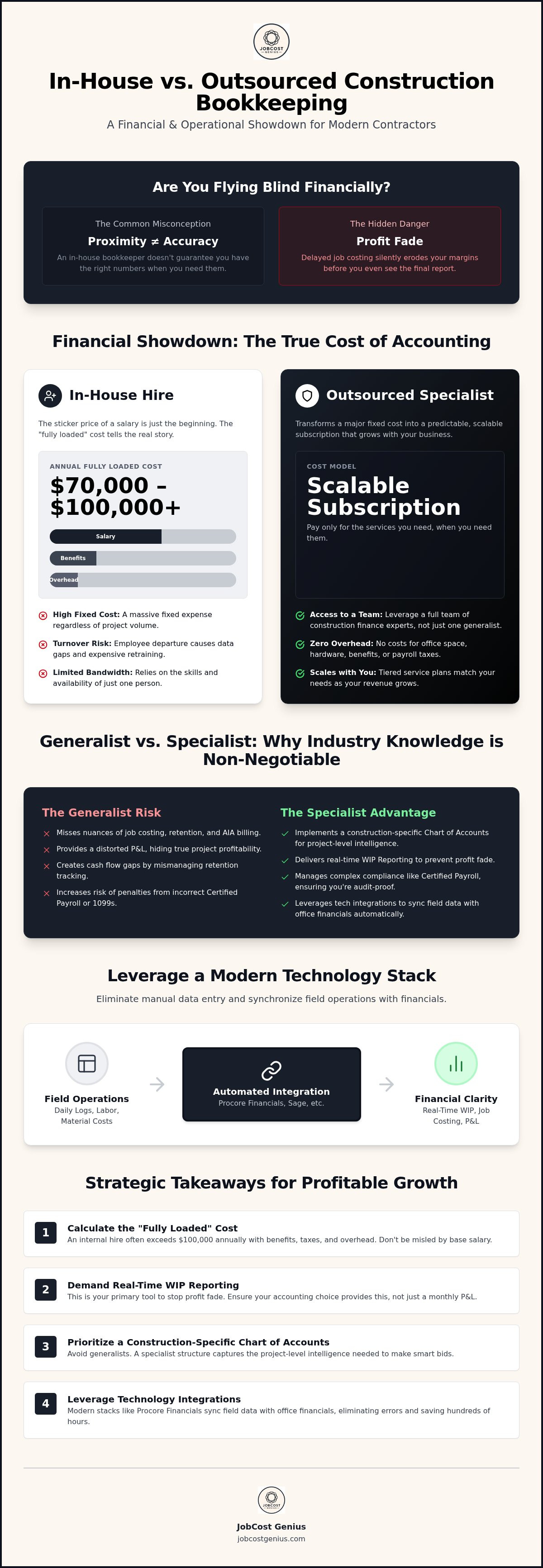
When evaluating in-house vs outsourced construction bookkeeping, the sticker price of a base salary is often misleading. In 2026, the average annual pay for a construction bookkeeper is $50,573, while more senior construction accounting professionals earn an average of $74,485. However, these base figures don't represent the true financial burden on your firm. A Financial Comparison: In-House vs. Outsourced reveals that the fully loaded cost of an employee typically ranges between $70,000 and $100,000 annually once you factor in the necessary administrative support and infrastructure.
Beyond the paycheck, you must account for "invisible" overhead that erodes project margins. Providing an in-house hire with dedicated office space, high-performance hardware, and specialized software subscriptions adds up quickly. For instance, Sage 300 subscriptions can cost approximately $150 per user monthly, while Procore pricing for mid-size contractors often ranges from $15,000 to $30,000 per year. These are fixed expenses that don't shrink if your project volume dips. Furthermore, when a key employee leaves, turnover in-house leads to massive data gaps and retraining costs that can stall your financial momentum for months.
Salary vs. Subscription: A Side-by-Side Look
Choosing a subscription model transforms a massive fixed expense into a predictable, scalable cost. While an in-house hire requires a 25% to 35% markup for benefits and a 7.65% FICA tax contribution, an outsourced partner operates on a flat monthly fee. This model allows you to access a full team of specialists rather than relying on the limited bandwidth of one person. Tiered plans, such as those offered by JobCost Genius, provide access to construction-specific expertise for a fraction of a single salary. If you're looking to establish a solid foundation without the friction of hiring, starting with a Starter Plan offers professional oversight and foundational financial clarity.
The Cost of Accuracy and Error Reduction
Inaccurate financial data is more than an administrative headache; it's a direct threat to your project margins. A single "bad" WIP report or a missed overbilling can result in thousands of dollars in profit fade that you may never recover. Standardized processes in an outsourced model can reduce error rates by up to 80% because they utilize multiple review layers. Unlike a solo in-house bookkeeper who might overlook their own mistakes, an outsourced team provides built-in checks and balances. This disciplined approach ensures that your financial reporting remains a reliable strategic guide for every project you bid on and execute.
Generalist vs. Specialist: Why Industry Knowledge is Non-Negotiable
Hiring a generalist bookkeeper for a construction firm is a common mistake that often leads to financial catastrophe. A generalist understands debits and credits, but they rarely grasp the intricacies of progress billings, burden rates, or over/under billings. When weighing in-house vs outsourced construction bookkeeping, you aren't just choosing a person to enter data; you're choosing the depth of industry intelligence behind your reporting. A specialized partner ensures that your financial foundation is built to withstand the unique pressures of the construction cycle.
The most critical component of this foundation is the Construction Chart of Accounts. A standard setup from a generalist often lacks the granularity needed for effective job costing. Without specific codes for labor, materials, subcontractors, and equipment, you cannot accurately track where your money is going. A specialist identifies "profit fade" early by monitoring these cost codes against your original estimates. This proactive oversight allows you to course-correct before a project's potential profit evaporates into thin air.
Some owners worry that an external partner lacks the visibility of a local hire. This is a misconception. In reality, a specialized outsourced team often provides better visibility through structured, cloud-based reporting than an in-house bookkeeper with a cluttered desk. You get a clean, digital dashboard of your project health that you can access from the field or the office, ensuring your data is always current and actionable.
The Generalist Pitfall: Mismanaged Retainage and Accruals
Generalists often treat retainage as standard Accounts Receivable. This leads to major cash flow shocks when you realize that 10% of your contract value is locked away for months. Specialized firms utilize accrual-based accounting to reflect the true timing of costs and earnings. This approach is essential for long-term contract accuracy and compliance with the latest 2026 tax standards. By bridging the field-to-office communication gap, specialists ensure that every change order and delivery ticket is accounted for in real-time.
Strategic Guidance: From Bookkeeper to Financial Partner
Your bookkeeping should do more than just look back at last month's transactions. It should act as a strategic guide that looks forward at your project health. JobCost Genius serves as a seasoned industry veteran for your leadership team, providing the organized calm necessary to make high-stakes decisions. We help you benchmark your performance against national industry standards, giving you the clarity to scale without the friction of administrative overwhelm. This partnership transforms your back office from a cost center into a strategic asset for growth.
Integrating Technology: Procore, Sage, and Field-to-Office Sync
Modern construction firms no longer rely on paper timecards or disorganized folders of receipts. The shift toward integrated tech stacks has transformed financial management from a reactive chore into a real-time strategic advantage. When comparing in-house vs outsourced construction bookkeeping, the ability to manage complex software integrations becomes a deciding factor. An outsourced specialist doesn't just record history; they build the digital infrastructure that connects your field operations to your financial statements. Manual spreadsheets are the #1 threat to construction scaling because they create silos of inaccurate, outdated information.
A "clean" tech stack reduces manual data entry errors by centralizing project data. Integrated management platforms now hold over 27% of the market share for a reason: they provide the "Anywhere Access" owners need to make decisions from a jobsite trailer or a truck. Procore financials integration services bridge the gap between project managers and the office, ensuring that every committed cost and change order is reflected in your accounting software immediately. This connectivity eliminates the administrative lag that often leads to profit fade.
Procore and Buildertrend: Managing the Field Data
Your field teams should focus on production, not accounting. They need simple tools that feed directly into the primary accounting system without requiring double-entry. An outsourced specialist manages the complex mapping between Procore and QuickBooks or Sage, ensuring that cost codes align perfectly across both platforms. This technical oversight saves your staff hours of administrative time every week and ensures that your project managers are looking at the same numbers as your bookkeeper. By automating these data flows, you reduce the risk of human error that typically plagues manual entry models.
Real-Time Reporting: The CEO’s Dashboard
A CEO needs a dashboard that reflects the current project health, not a report that is three weeks old. Clean monthly financial statements should provide an immediate view of your cash position, overbillings, and underbillings. Automated AP/AR workflows allow for faster payment applications, which keeps your subcontractors happy and your projects moving. Technology also allows you to track change orders and their impact on the bottom line in real-time, preventing the "surprise" costs that often emerge at the end of a project. Discover how our Procore Financials Integration can provide the clarity you need to protect your project margins.
Strategic Scaling: Choosing the Right Model for Your Growth
Scaling a construction business requires a financial foundation that expands alongside your project volume. The decision regarding in-house vs outsourced construction bookkeeping often hinges on your annual revenue and the complexity of your labor force. For most firms, establishing a full internal accounting department only becomes financially viable once revenue surpasses the $10 million mark. Below this threshold, the fully loaded cost of a senior controller often consumes too much of your overhead, making a tiered outsourced model a more agile and strategic choice.
Growth requires different levels of oversight at different stages. A Starter Plan provides the essential foundation for new contractors who need clean books for the first time. As you hire crews and take on larger contracts, the Growth Plan introduces advanced job costing and payroll management. For established firms with high transaction volumes, a Premium Plan offers enterprise-level oversight. This tiered approach allows you to pay for the expertise you need today without the friction of hiring staff you aren't ready to support.
The Hybrid Approach: Keeping Admin, Outsourcing Strategy
Many mid-sized firms find success by maintaining a part-time on-site admin for daily paperwork while outsourcing the strategic heavy lifting. This hybrid model ensures delivery tickets and timecards are collected locally while a specialist handles the complex WIP schedules and financial reporting. Professional construction accounting for small firms is often the deciding factor in securing larger bonding limits and bank loans. Moving from a disorganized in-house system to a structured outsourced model provides the organized calm necessary to bid on more ambitious projects.
Final Checklist: Hiring vs. Outsourcing Decision
Before you commit to your next financial hire, ask yourself these five critical questions:
- Does our current bookkeeper understand the difference between overbillings and actual profit?
- Are our WIP reports accurate enough to satisfy a bonding agent today?
- Can we afford the $100,000 fully loaded cost of a specialized in-house hire?
- How would our operations be impacted if our only bookkeeper left tomorrow?
- Is our current reporting providing a forward-looking strategy or just a history lesson?
The choice you make regarding in-house vs outsourced construction bookkeeping today will directly impact your bonding capacity and project margins tomorrow. Accurate, specialist-led reporting builds the foundational strength lenders and sureties look for. If you're ready to eliminate administrative overwhelm and gain true financial clarity, it's time to Explore JobCost Genius Plans and secure your firm's future.
Protecting Your Project Margins through Strategic Financial Management
The decision between in-house vs outsourced construction bookkeeping ultimately shapes your firm's ability to scale without losing control of project costs. While physical proximity is often mistaken for financial control, true clarity comes from specialized industry expertise and integrated technology. By prioritizing accurate WIP reporting and seamless data flow between the field and the office, you eliminate the "profit fade" that often stalls growth for mid-sized contractors.
JobCost Genius brings over 20 years of industry-specific experience directly to your leadership team. Our services include specialized WIP reporting as a standard component, alongside seamless Procore and QuickBooks integrations to ensure your project data remains actionable and precise. It's time to move beyond administrative overwhelm and build a foundation for long-term profitability and increased bonding capacity. Get Started with a Construction-Specific Financial Strategy today and gain the organized calm your business deserves.
Frequently Asked Questions
Will I lose control of my financial data if I outsource my bookkeeping?
You maintain full ownership and 24/7 access to your financial records through secure, cloud-hosted platforms. Outsourcing actually increases transparency because your data is kept in a standardized, digital format rather than living in a single employee's head or a locked desk drawer. You can review your project health and cash position from any device at any time.
How much does outsourced construction bookkeeping typically cost compared to a salary?
Outsourced services are significantly more cost-effective than the $70,000 to $100,000 fully loaded cost required for a specialized in-house hire. You avoid expensive overhead like health insurance, payroll taxes, and office equipment. A firm like Skyplex Management allows you to convert a high fixed expense into a predictable, scalable fee that aligns with your current project volume.
Can an outsourced firm handle my specific software like Procore or Sage?
Specialized firms are often more proficient in industry-specific tools than generalist hires. We focus specifically on Procore Financials Integration to ensure your field data flows seamlessly into your accounting system without manual double-entry. This technical expertise eliminates the steep learning curve and training costs associated with bringing a new in-house person up to speed.
What is the difference between a general bookkeeper and a construction specialist?
A generalist tracks simple income and expenses, while a specialist manages the unique complexities of the build cycle like retention, AIA progress billings, and labor burdens. When evaluating in-house vs outsourced construction bookkeeping, the specialist’s ability to identify profit fade before it ruins a project is a critical differentiator. They understand how to structure your books to satisfy bonding agents and lenders.
How often will I receive financial reports and project updates?
You receive comprehensive financial statements and project updates on a monthly recurring basis. Our more advanced plans provide deeper insights into your WIP Reporting to ensure you always know your true cash position. This consistent communication rhythm builds the financial clarity needed to make high-stakes bidding decisions with total professional confidence.
Do I still need an internal person to handle daily office tasks?
Many growing firms utilize a hybrid model where a part-time admin handles on-site tasks like collecting physical delivery tickets or organizing field paperwork. The outsourced team then handles the strategic heavy lifting, such as reconciliations, job costing, and complex reporting. This approach allows your internal staff to focus on operations while we ensure your financial infrastructure remains bulletproof.
How does outsourcing help with certified payroll and compliance?
Outsourcing provides a dedicated layer of oversight for the strict reporting requirements of federal and state-funded projects. We manage the intricacies of certified payroll and ensure your subcontractors are properly classified to avoid aggressive tax penalties or audit red flags. This disciplined approach protects your firm from the regulatory hurdles that often overwhelm a solo in-house bookkeeper.
Can JobCost Genius help fix my current messy books or WIP reports?
We specialize in cleaning up historical data and establishing a proper Construction Chart of Accounts for firms in distress. Whether your current records are inaccurate or your job costing is non-existent, we can reconstruct your books to provide a clear picture of your project health. We transform your administrative overwhelm into a state of organized calm and foundational financial strength.


