

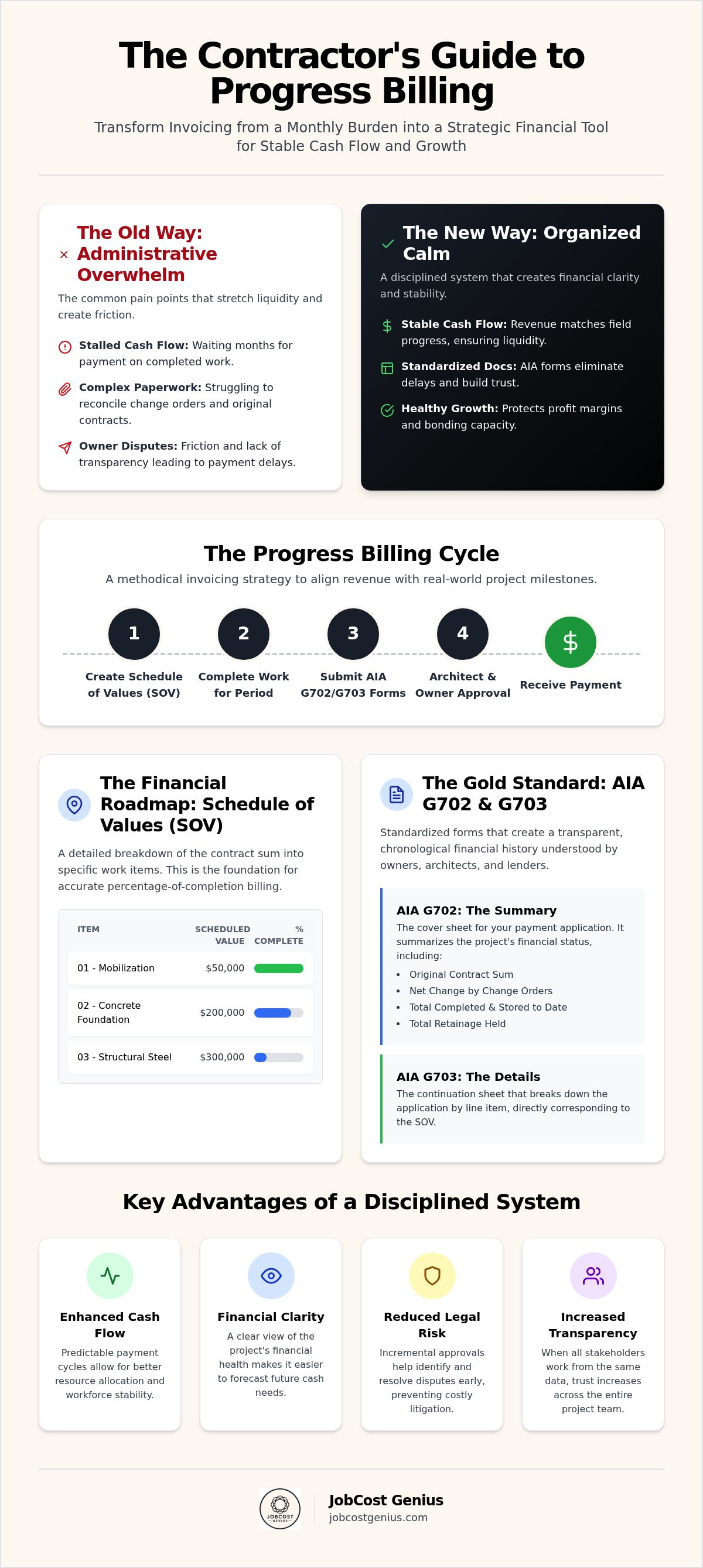
What if your invoicing process functioned as a strategic financial tool rather than a monthly administrative burden? Most contractors accept slow payment cycles and complex AIA forms as an unavoidable cost of doing business. You likely recognize the stress of watching cash flow stall while waiting for approvals on percentage-of-completion claims or struggling to reconcile change orders with the original contract. It is a common pain point that often leads to unnecessary friction with project owners and stretches your liquidity thin.
This 2026 guide will show you how to implement accurate progress billing for construction projects to stabilize your cash flow and maintain total financial clarity. By mastering standardized AIA G702 and G703 workflows, you can transform administrative overwhelm into a state of organized calm. We will explore how to navigate new regulatory shifts, such as California’s 5% retainage cap and Louisiana’s updated prompt payment windows, while ensuring your financial reports match real-world project milestones. You'll learn the exact steps to accelerate your payment cycles and keep your bonding capacity healthy through professional, disciplined billing practices that protect your profit margins.
Key Takeaways
- Progress billing for construction projects allows you to invoice for work as it is completed, ensuring your revenue matches your actual field progress.
- Standardize your documentation using AIA G702 and G703 forms to eliminate administrative delays and reduce project owner disputes.
- Develop a meticulous Schedule of Values to serve as a financial roadmap, ensuring every work item is accurately allocated and billed throughout the project lifecycle.
- Proactively manage retention and change orders to safeguard your net profit and maintain a healthy bonding capacity for future growth.
- Transition from administrative overwhelm to organized calm by leveraging construction-specific financial oversight and WIP reporting.
Understanding Progress Billing for Construction Projects
Progress billing for construction projects is a methodical invoicing strategy where you bill for work completed during a specific window, usually monthly. This approach is the standard for commercial and long-term residential projects because it mirrors the physical reality of the job site. Instead of waiting for a final milestone that might be months away, you realize revenue as you create value. This alignment is critical for maintaining the liquidity needed to manage high-overhead costs like specialized labor and equipment rentals.
Professional progress billing protects your firm from the dangerous cycles of front-loading or under-billing. While front-loading might seem like a quick way to improve cash flow, it often triggers suspicion from project owners and lenders, potentially damaging your long-term reputation. Under-billing is equally risky, as it forces your business to act as an interest-free bank for the developer. A disciplined billing structure ensures that your revenue recognition remains accurate and your balance sheet stays strong.
The Mechanics of Percentage-of-Completion
The percentage-of-completion method is the foundation of construction revenue recognition. This accounting principle allows you to record revenue based on the portion of the contract that's been fulfilled. To maintain accuracy, you must distinguish between work installed and stored materials. Stored materials often require proof of insurance or bonding before an owner will release funds. This level of detail ensures your billing integrity stays intact. Accurate cost-to-complete estimates are vital here. Without them, you risk losing sight of your actual margins as the project nears the finish line. Most successful firms use a detailed Schedule of Values (SOV) to track these percentages against specific line items, ensuring every dollar is accounted for from mobilization to closeout.
Benefits of Standardized Progress Invoicing
Standardizing your invoicing cycle does more than just move paper; it secures your firm's financial foundation. Regular, predictable payment cycles allow for better resource allocation and workforce stability. When your billing is consistent, your administrative team spends less time chasing payments and more time on strategic growth.
- Financial Clarity: Standardized billing provides a clear view of your project's financial health at any given moment, making it easier to forecast future cash needs.
- Enhanced Transparency: When general contractors, subcontractors, and owners all work from the same progress data, trust increases across the entire project team.
- Reduced Legal Risk: Incremental approvals mean that potential disputes are identified and resolved early. This significantly lowers the risk of lien filings or costly litigation at the end of the project.
By using a standardized framework, you ensure that your financial reports match real-world project progress. This meticulousness is what separates a struggling contractor from a disciplined, profitable enterprise. It transforms the billing process from a source of stress into a reliable engine for project success.
The AIA G702 and G703 Framework: Why It Matters
AIA billing documents represent the gold standard for financial transparency in the construction industry. Developed by the American Institute of Architects, these standardized forms provide a structured language that owners, architects, and lenders all understand. When you implement progress billing for construction projects using this framework, you move away from arbitrary invoicing and toward a system of verified accountability. Most commercial lenders and institutional owners mandate these specific formats because they provide a clear, chronological history of the project's financial health.
The G702 Application and Certificate for Payment serves as the summary cover sheet. It tracks the original contract sum, total value of change orders, and the exact amount of retainage held to date. This document requires formal certification from the architect and often requires a notary seal to be valid. While private contracts have some flexibility, the rigorous standards of these forms align with the principles found in the Federal Acquisition Regulation for Progress Payments, which sets the benchmark for high-stakes financial reporting. Utilizing this framework ensures that your payment applications are beyond reproach during a financial audit or project dispute.
Supporting the G702 is the G703 Continuation Sheet. This document breaks down the entire contract into a detailed Schedule of Values. It tracks every line item's progress, distinguishing between work completed in previous periods and work finished during the current cycle. This level of granularity prevents payment delays by showing exactly where every dollar is being allocated.
AIA Billing Services for Contractors: Outsourcing the Complexity
Managing the administrative burden of AIA documents can quickly lead to burnout for small to mid-sized firms. Professional AIA billing services for contractors specialize in maintaining this compliance, ensuring that every continuation sheet is balanced and every lien waiver is attached. These experts handle the meticulous notary requirements and ensure that your documentation meets the specific preferences of the project architect. If you find yourself struggling to keep up with the monthly billing cycle, choosing a Growth Plan can provide the specialized oversight needed to maintain your cash flow without the overhead of additional on-site staff.
Common AIA Billing Mistakes to Avoid
Even small errors in an AIA application can result in a rejected payment, causing a cascade of cash flow issues. One of the most frequent mistakes is a math error in the "Balance to Finish" column, which must reconcile perfectly with the remaining work and stored materials. Inconsistent reporting of change orders is another common pitfall. If a change order is not formally executed and added to the G703, the architect will likely strike that line item from your request. Additionally, contractors often fail to account for previously certified payments correctly, leading to over-billing claims that can damage professional relationships and delay funding for weeks.
Building a Solid Schedule of Values (SOV) for Accurate Billing
The Schedule of Values (SOV) acts as the financial roadmap for your entire project. It is a strategic breakdown of the total contract sum into specific work items. When you implement progress billing for construction projects, the SOV serves as the baseline for every payment application you submit. A well-constructed SOV ensures that you are paid fairly for work completed while providing the owner with the transparency they need to approve funds. It transforms a massive contract into a series of manageable, billable milestones.
Strategic allocation of costs is essential. Some contractors attempt to "front-load" the SOV by assigning higher values to early-stage tasks like mobilization or site clearing. While this improves immediate cash flow, it often draws scrutiny from savvy architects and lenders. A balanced SOV is usually the safer path to maintaining professional trust. To ensure your billing remains consistent across your books, your SOV must align with your internal construction chart of accounts. This synchronization allows for easier job costing and prevents the administrative headache of reconciling different sets of data at month-end.
Structuring Your SOV for Project Clarity
Granularity is your best defense against payment delays. You should break down line items into labor, materials, and equipment. This level of detail allows you to track progress with precision. If your SOV is too broad, you risk underbilling for work that is nearly finished but doesn't meet a vague milestone. This often leads to profit fade, where your actual costs outpace your billed revenue. By aligning your SOV with the project schedule, you create a predictable rhythm that ensures your billing keeps pace with the field crew's production.
Stored Materials: How to Bill for Items Not Yet Installed
Billing for stored materials is a powerful way to protect your liquidity, especially when facing long lead times or volatile pricing. You can typically bill for materials stored on-site or in a bonded warehouse before they are installed. However, this requires meticulous documentation. You must provide bills of sale, proof of insurance, and often photographs to verify the materials exist and are protected. These items appear as current assets on your balance sheet. Correctly tracking stored materials prevents you from financing the project's supply chain out of your own pocket. It ensures that your progress billing for construction projects reflects the total value you have committed to the job site, not just the pieces already bolted into place.
Managing Retention and Change Orders in the Billing Cycle
Retention, or retainage, is a standard practice where a project owner withholds a portion of each payment until the project reaches substantial completion. While it serves as a performance guarantee for the owner, it significantly impacts your liquidity. Standard retention usually ranges from 5% to 10% of the total contract value. Effectively managing this in your progress billing for construction projects is the difference between a thriving business and one that is technically profitable but cash-poor. You must track these amounts with precision to ensure your cash flow remains predictable.
Integrating retention into your billing cycle requires meticulous oversight. If your accounting system doesn't accurately reflect these withheld funds, you risk reporting "paper profits" that don't exist in your bank account. This is particularly dangerous during high-retention phases of a project. By fixing overbilling on WIP reports, you ensure that your financial health reflects reality rather than inflated estimates. This clarity allows you to manage your operating capital with confidence, even when a significant portion of your revenue is held back by the owner.
Tracking Retention for Long-Term Profitability
You must account for retention as a separate receivable on your balance sheet to maintain a clear financial picture. This ensures that these funds aren't confused with standard aging accounts receivable. Uncollected retention often represents the contractor’s entire profit margin for the job. As the project nears the finish line, your focus must shift to the "release of retention." This process involves final inspections and the submission of all required closeout documentation. Proactive management here prevents the common scenario where a project is physically finished but the final 10% of the contract remains unpaid for months due to administrative loose ends.
Integrating Change Orders Without Delay
Change orders are a frequent source of billing friction. You should never bill for unapproved change orders on an AIA form, as this is a guaranteed way to have your entire payment application rejected. The workflow must be seamless: once a field change is authorized, it must immediately transition into a billing line item on your G703 Continuation Sheet. Delays in this process lead to profit fade because you're spending money in the field that isn't yet reflected in your billing cycle. Utilizing a Procore financials integration automates this transition, ensuring that field data and office billing are always in sync. This synchronization eliminates the manual entry errors that often stall payment approvals.
If your team is struggling to keep these complex variables organized, our WIP Reporting services can provide the professional oversight needed to protect your margins.
Optimizing Cash Flow with Professional Financial Oversight
The transition from administrative overwhelm to organized calm begins when you treat your financial department as a strategic asset rather than a back-office necessity. Many contractors rely on generalist bookkeepers who understand basic accounting but lack the specialized knowledge required for progress billing for construction projects. A specialist understands the nuances of overbilling, underbilling, and the complex relationship between the field’s physical progress and the office’s financial reporting. This industry-specific expertise ensures that your billing cycle remains a steady engine for growth.
For firms managing enterprise-level tech stacks and high-volume projects, the Premium Plan provides the sophisticated oversight needed to navigate complex billing environments. This level of support is designed for contractors who require meticulous tracking across multiple large-scale contracts. By leveraging specialized knowledge, you can ensure that every application for payment is technically perfect, reducing the likelihood of owner disputes and improving your firm's reputation for financial reliability.
Field-to-Office Sync: The Future of Progress Billing
In the 2026 construction landscape, the "billing gap" between work performed and invoices sent can quietly erode your profit margins. Mobile-first field reporting has become an essential tool for closing this gap. When your field crews provide real-time updates, that data feeds directly into your billing cycle. This connectivity allows your team to generate accurate payment applications the moment a milestone is reached. Automated AR management further fast-tracks these applications, ensuring that your firm is not acting as an interest-free lender for your clients. This synchronized workflow transforms progress billing for construction projects from a reactive chore into a proactive financial strategy.
Scalable Solutions for Growing Contractors
Every construction firm has unique financial needs based on its current stage of growth. Our Starter Plan is designed for newer firms establishing their first Schedule of Values, providing the foundational strength needed to bill correctly from day one. As your business expands, the Growth Plan offers advanced features for managing scaling teams and multiple active progress bills simultaneously. This tiered approach ensures you have the right level of support at every phase of your journey.
Investing in professional financial oversight is also a direct investment in your company’s bonding capacity. Sureties and lenders look for disciplined financial reporting and consistent cash flow as indicators of a healthy, low-risk business. When your financial reports match real-world project progress with precision, you gain the credibility needed to secure larger contracts and scale your operations. Real-time data doesn't just help you bill; it empowers you to make better bidding decisions and identify which projects are truly driving your bottom line.
Securing Your Financial Foundation for 2026
Mastering your financial workflows is no longer just an administrative task; it's a competitive necessity in an increasingly selective market. By standardizing your AIA G702 and G703 forms and building a meticulous Schedule of Values, you protect your firm from cash flow gaps and profit fade. These practices ensure that your billing remains a true reflection of your field progress, providing the transparency that lenders and owners demand. Implementing disciplined progress billing for construction projects transforms your back office from a source of stress into a scalable engine for growth.
You don't have to manage these technical complexities alone. With over 20 years of industry experience, our team provides specialized WIP and AIA reporting expertise to keep your projects on track. We offer seamless Procore and Sage 300 CRE integration support to bridge the gap between your field data and financial reports. Let JobCost Genius handle your AIA billing and financial reporting so you can focus on the physical build. Your path to organized calm and financial clarity starts with professional, expert-led oversight.
Frequently Asked Questions
What is the most common mistake in progress billing for construction?
The most frequent error is a failure to reconcile the "Balance to Finish" column on the continuation sheet. This often occurs when change orders aren't properly integrated or when math errors cascade across billing periods. These inconsistencies lead to immediate rejections by architects or lenders. Maintaining a disciplined review process ensures your applications remain accurate and your cash flow stays predictable throughout the project lifecycle.
How do I calculate the percentage of completion for an AIA G702 form?
You calculate the percentage of completion by dividing the total value of work performed and materials stored to date by the total scheduled value of that specific line item. This figure must reflect the physical reality on the job site. Most contractors use a detailed Schedule of Values to track these increments. Accurate calculations are essential for revenue recognition and ensuring your billing aligns with actual project milestones.
Can I use standard QuickBooks invoices for progress billing on commercial jobs?
Standard QuickBooks invoices usually lack the detail required for progress billing for construction projects. Most commercial owners and lenders mandate the AIA G702 and G703 formats. These documents provide a comprehensive summary of the contract sum, retainage, and change orders that a standard invoice cannot accommodate. While QuickBooks tracks the data, you often need specialized software or services to generate the necessary compliance documentation for funding.
What is the difference between AIA G702 and G703?
The G702 is the Application and Certificate for Payment, serving as the summary cover sheet for the entire billing period. It highlights the overall contract status and requires a notary seal. The G703 is the Continuation Sheet, which provides a granular breakdown of each line item from your Schedule of Values. Together, they offer a complete financial picture that allows architects to verify work before certifying payment for the contractor.
How does progress billing affect my Work in Progress (WIP) report?
Progress billing serves as the "Actual Billed" component of your WIP report. When your billing exceeds the costs incurred relative to the contract value, you are overbilled. If your billing lags behind your costs, you are underbilled. Accurate billing ensures your WIP report correctly identifies profit fade or cash flow surpluses. This visibility allows you to make informed adjustments to your operations before a project reaches completion.
When should I bill for stored materials in a progress application?
You should bill for stored materials when they are securely located on-site or in a bonded warehouse. You must provide supporting documentation, such as invoices and proof of insurance, to verify the value and protection of these assets. Billing for materials before installation helps offset the costs of long-lead items. It ensures your progress billing for construction projects reflects the full value you have committed to the project site.
What happens if the owner or architect disagrees with my percentage of completion?
If an architect disagrees with your claim, they will typically modify the "Amount Certified" on the G702 form. This results in a payment that is less than your requested application. To avoid this, you should provide clear documentation, such as field reports or photos, to support your percentage-of-completion claims. Early communication regarding project milestones often prevents these disputes from stalling your monthly cash flow and damaging professional trust.
How do I manage retention on a progress bill?
You manage retention by calculating the specified percentage, usually 5% to 10%, against the total work completed and stored materials to date. This amount is subtracted from your gross billing to determine the net amount due. You must track this cumulative total on your G702 summary. Proper management ensures that these funds are clearly identified on your balance sheet as a separate receivable until the project closeout.


