

Why did your last profitable project end with a bank balance lower than your initial estimates predicted? If you're discovering profit fade only after the punch list is complete, you're likely relying on historical data rather than forward-looking insights. Most owners feel the constant pressure of field data that never quite matches the office financials. It's a frustrating cycle that stalls growth and limits your ability to secure larger contracts. Understanding the fundamental shift between construction accounting vs bookkeeping is the first step toward reclaiming control over your project margins.
You already know that keeping clean records is essential for basic compliance. However, a generalist bookkeeper often lacks the specialized knowledge to handle complex retention or Work in Progress (WIP) reporting. This guide promises to clarify how moving beyond basic record-keeping into strategic financial oversight protects your bottom line and helps you scale with confidence. We'll explore the critical differences that lead to real-time project health visibility and increased bonding capacity. You'll learn how to establish a seamless field-to-office data flow that turns your financial department into a strategic asset rather than a back-office burden.
Key Takeaways
- Understand the fundamental shift in construction accounting vs bookkeeping to transition from tracking historical costs to managing proactive project health.
- Implement specialized Work in Progress (WIP) reporting to gain real-time visibility into overbillings and protect your final margins.
- Consider tiered service models like the Starter Plan as a cost-effective alternative to in-house staffing for firms scaling beyond basic spreadsheets.
- Ensure your tech stack, including Procore Financials, is properly integrated to maintain a seamless data flow between the field and the office.
- Vet financial partners based on their specific mastery of construction-specific concepts like retention, cost codes, and job costing.
The Critical Difference Between General Bookkeeping and Construction Financial Oversight
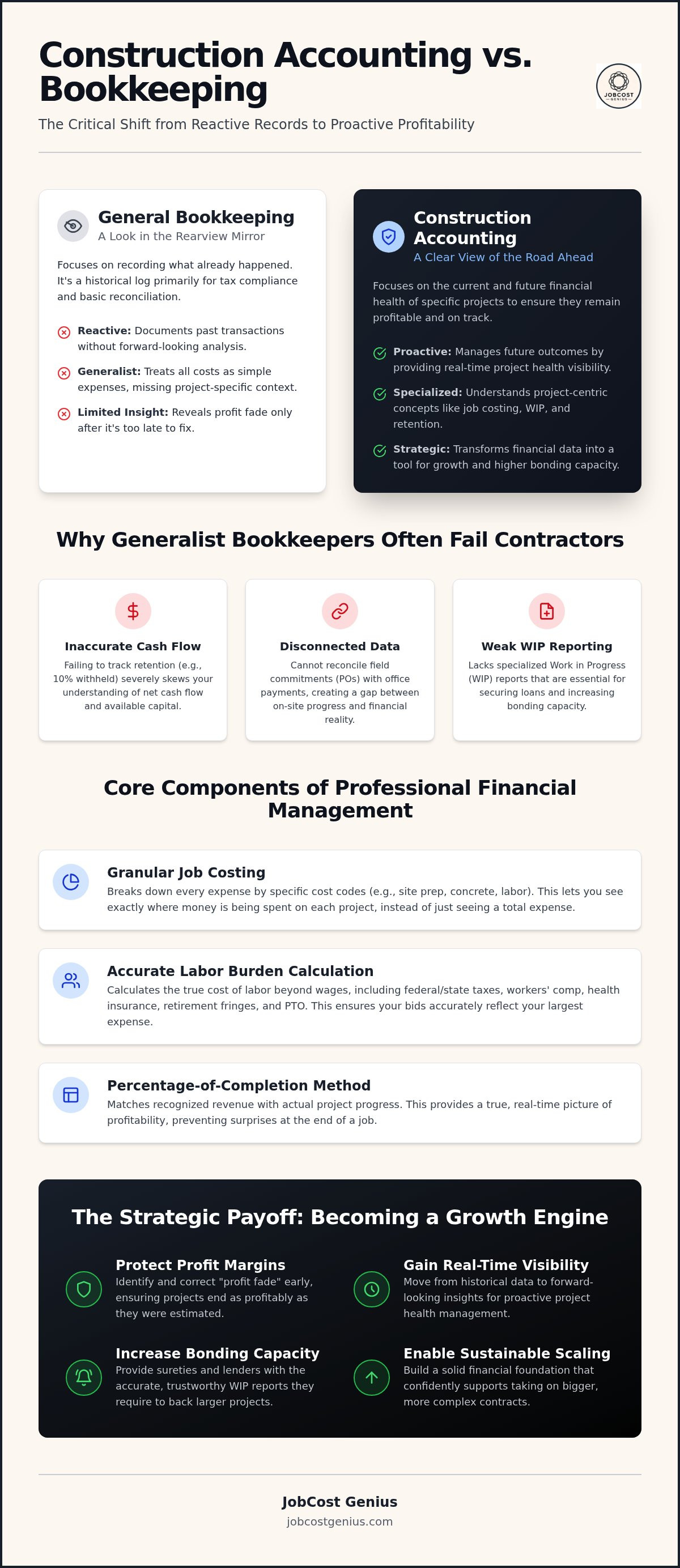
General bookkeeping records what happened. It's a historical log designed for tax compliance and basic bank reconciliation. While necessary, it's a reactive process. Construction financial oversight, however, is proactive. It focuses on the current health of specific projects to ensure they remain profitable. The primary difference in construction accounting vs bookkeeping lies in the shift from recording history to managing the future. This distinction is what separates firms that merely survive from those that scale sustainably.
Construction is uniquely project-centric. Unlike a retail store with steady inventory, a construction firm manages multiple temporary businesses simultaneously. Each project has its own budget, timeline, and risk profile. Generalist accounting models often break because they treat every dollar spent as a simple expense rather than a job-specific investment. This creates a disconnect between the profit shown on a balance sheet and the actual cash available in the bank. Without project-based data, you're essentially flying blind until the job is complete.
Why Generalist Bookkeepers Often Fail Contractors
Generalists typically miss the technical nuances that define the industry. They often fail to track retention properly, which can severely skew your understanding of net cash flow. If 10% of your payment is withheld until the end of the project, your books must reflect that reality accurately. Generalists also struggle to reconcile field commitments with office payments. They see an invoice, but they don't see the underlying purchase order or subcontract agreement. This gap makes it impossible to provide the kind of construction accounting for small firms that lenders and sureties actually trust. Without this specialized lens, your financials won't support your growth goals.
The "Past vs. Future" Framework
Standard bookkeeping tells you what you spent last month. Specialized oversight tells you how much money you'll have left when the job is done. This forward-looking approach is vital for identifying "profit fade." By the time a generalist bookkeeper notices a project is losing money, the opportunity to fix it has usually passed. According to this Construction Accounting Overview, specialized methods like the percentage-of-completion method are necessary to match revenue with actual progress. This ensures that your financial statements reflect the true state of your operations.
Using specialized data doesn't just protect your current margins; it builds your future. Accurate, project-specific reporting is the key to securing higher bonding limits. Sureties want to see that you have a firm grip on your Work in Progress (WIP). They need to know you can predict your outcomes with precision. When you move beyond simple bookkeeping, you transform your financial data from a tax requirement into a strategic growth engine. It's the difference between looking in the rearview mirror and having a clear view of the road ahead.
Core Components of Professional Construction Financial Management
Professional financial management in this sector goes far beyond simple data entry. It requires a deep understanding of how project costs interact with your overall company health. When evaluating construction accounting vs bookkeeping, the core components usually involve granular tracking that a generalist simply isn't equipped to handle. It's about granular control. These elements provide the structural integrity your business needs to remain solvent during lean periods and profitable during growth spurts.
Effective management starts with job costing. This involves breaking down every expense, from labor to materials and equipment, by specific cost codes. It's not enough to know you spent $50,000 on a project; you must know that $12,000 went to site prep and $8,000 to concrete. This level of detail allows you to analyze labor burden, which includes:
- Federal and state unemployment taxes.
- Workers' compensation insurance premiums.
- Health insurance and retirement fringes.
- Paid time off and specialized training costs.
This level of detail ensures you're calculating the "true cost" of a crew hour. Many firms find that their estimated margins disappear because they haven't accurately accounted for these hidden costs. As noted in this University Financial Management Course, mastering these fundamentals is essential for any contractor looking to move into the commercial space.
The Power of Accurate WIP Reporting
The Work in Progress (WIP) report is the most critical document in your financial arsenal. It serves as a monthly truth-teller that identifies overbillings and underbillings before they become a crisis. Implementing WIP reporting for construction companies prevents the common trap of cash flow surprises, where a bank balance looks healthy only because you've billed ahead of your actual costs. By utilizing monthly percentage-of-completion analysis, you can spot margin erosion early and make the necessary course corrections to protect your profit.
Payroll and Compliance Oversight
Managing a construction workforce involves layers of compliance that generalist bookkeepers often overlook. This includes the complexities of prevailing wage payroll processing for contractors, where reporting errors can lead to massive fines. You also have to handle union fringes, certified payroll, and 1099 compliance for various subcontractors. These administrative burdens can quickly become overwhelming without a partner who understands the stakes. If you're feeling bogged down by these requirements, our Growth Plan provides the specialized support needed to ensure your compliance remains bulletproof while you focus on the field.
Finally, professional management handles AIA billing and retention tracking. Commercial projects often involve complex invoicing cycles where a portion of your payment is withheld. Tracking this retention over the life of a multi-year project is a specialized skill. In the debate of construction accounting vs bookkeeping, it's clear that only the former provides the meticulous oversight required to manage these long-term receivables and ensure you actually collect every dollar you've earned.
Evaluating Service Tiers: Guide for Scaling Contractors
Scaling a construction firm requires a financial structure that matches your project volume. Many owners find themselves caught between the limitations of DIY spreadsheets and the high overhead of a full-time controller. Tiered service models solve this problem. They provide specialized expertise at a fraction of the cost of in-house staffing. When you evaluate construction accounting vs bookkeeping, the decision usually depends on the complexity of your jobs and your current revenue goals.
For firms moving away from manual entry, the Starter Plan offers foundational support. It ensures your records are clean and your bank accounts are reconciled accurately. As your firm grows, the Growth Plan introduces enhanced reporting for companies managing multiple crews and higher project values. Finally, the Premium Plan provides full-scale financial oversight for enterprise-level operations. These tiers allow you to pay for the specific level of expertise you need today while maintaining a clear path for future expansion.
When to Move Beyond Basic Bookkeeping
The signs that you've outgrown a generalist are often expensive. You might notice missed retention payments, or you may face unexpected bonding denials because your reports lack depth. Many firms hit a functional wall at the $1M revenue threshold. At this stage, basic record-keeping is no longer sufficient to protect your project margins. You need data that helps you anticipate problems rather than just documenting them after they occur.
Consider the cost-benefit analysis. A specialized service starting at $800 per month provides immediate access to industry veterans who understand your specific challenges. In contrast, a competent in-house employee often requires a salary of $60,000 or more, plus benefits and taxes. Moving to a specialized partner ensures you get expert-level results without the administrative burden of a full-time hire. It's a strategic move that preserves your cash flow while significantly improving your financial accuracy.
Premium Oversight as a Strategic Advantage
Scaling into multi-year projects requires a higher level of construction business financial oversight. This isn't just about balancing books; it's about strategic guidance. Premium tiers often include monthly meetings to review project profitability in detail. This ensures that you aren't just looking at the past, but actively planning for the next phase of your business. When weighing the merits of construction accounting vs bookkeeping, the ability to forecast future performance is often the deciding factor for ambitious contractors.
These strategic meetings act as a guide for your firm's leadership. You can use high-level reporting to drive better bidding and markup strategies. Instead of guessing at your overhead, you'll have hard data to justify your numbers. This level of insight allows you to take on larger, more complex contracts with the confidence that your margins are protected. It turns your financial department from a back-office necessity into a powerful competitive advantage.
The Tech Stack Sync: Field-to-Office Integration as a Service
Software alone doesn't solve financial inaccuracy. It's a common misconception that buying a subscription fixes the "Garbage In, Garbage Out" problem. In the context of construction accounting vs bookkeeping, the real value lies in the human oversight that ensures your tech stack actually works for you. A specialized partner manages the data bridge between your field supervisors and your general ledger. This ensures that commitments, change orders, and subcontracts sync perfectly without manual errors. Without this layer of expertise, your software just becomes an expensive way to record bad information.
Automated workflows reduce double-entry. This saves time and eliminates administrative friction. When your systems are properly synced, you gain a real-time view of your liabilities. You no longer have to wait for month-end reports to see where a project stands. This technical precision is what allows your firm to operate with enterprise-level efficiency regardless of its size. A true financial partner ensures that:
- Field commitments match office purchase orders.
- Change orders are approved and billed before costs are incurred.
- Subcontractor invoices are reconciled against actual progress.
- Administrative errors are caught at the point of entry.
Maximizing Procore and Sage Integrations
Many firms struggle with disconnected data. Field teams use one tool while the office uses another, leading to constant friction. Our Procore financials integration services bridge this gap. This empowers project managers to make decisions based on actual financial data rather than guesswork. For those using legacy systems, we provide expert Sage 300 CRE bookkeeping support to maintain continuity. Having a single source of truth between the field and the office is essential for maintaining project momentum.
Alternatives and Modernization
As we move toward 2026, modernization is essential for survival. Some firms find that residential-focused tools don't offer enough depth for complex commercial work or heavy civil projects. We help you explore Buildertrend bookkeeping alternatives that provide better financial oversight. The goal is to establish a system where everyone looks at the same numbers. This future-proofs your firm against shifting industry standards and more stringent reporting requirements. You need a tech stack that grows with your ambitions, not one that holds you back.
Ready to sync your systems and eliminate data silos? Schedule a strategic consultation to optimize your tech stack today.
Selecting Your Partner: The Contractor’s Vetting Checklist
Choosing a financial partner is a long-term commitment that impacts your firm's stability and growth. It requires more than just checking a box for tax compliance. When you weigh the merits of construction accounting vs bookkeeping, you must look for a partner who acts as a strategic extension of your team. A generalist might keep your books balanced, but they won't help you navigate the nuances of a multi-million dollar contract. You need an expert who understands the high-stakes nature of your specific field.
Start your evaluation by testing for industry-specific knowledge. Can the firm explain the difference between an overbilling and a change order without hesitation? If they can't, they won't be able to protect your margins effectively. Software proficiency is equally vital. Ensure they have certified experience with your specific tech stack, whether you rely on Procore or Sage. Ask about their reporting cadence. You shouldn't have to beg for data; WIP reports should be delivered monthly as a standard part of their oversight. Finally, consider scalability. Your partner must be able to handle your payroll with ease as your headcount grows from 5 to 50 employees.
Questions to Ask During a Discovery Call
The discovery call is your opportunity to peel back the curtain on a provider's expertise. Don't settle for vague promises of "accuracy." Instead, ask targeted questions that force them to demonstrate their technical mastery. Use these three queries to vet their construction-specific capabilities:
- "How do you handle retention tracking on long-term contracts to ensure it doesn't disappear from our cash flow projections?"
- "What is your specific process for reconciling field commitments with my bank accounts to prevent overpayment?"
- "Can you provide a sample WIP report that my surety agent will actually accept for bonding purposes?"
Setting the Partnership for Success
Clear boundaries are the foundation of a successful relationship. You must define responsibilities for AP, AR, and payroll early in the process. This prevents tasks from falling through the cracks and ensures total accountability. A professional partner will provide a structured onboarding process. During the first 30 days, expect a deep dive into your current systems to clean up legacy data and establish a single version of the truth. This methodical approach builds the trust necessary for long-term financial clarity.
Ready to protect your margins and gain total visibility into your project health? Explore JobCost Genius Service Plans to find the right level of oversight for your firm's next phase of growth.
Protect Your Margins and Scale with Confidence
Transitioning from reactive record-keeping to proactive financial oversight is a critical move for any scaling contractor. You've seen how the debate of construction accounting vs bookkeeping isn't just about terminology; it's about having the data to predict your firm's future. It's about control. By implementing specialized WIP reporting and job costing, you eliminate the profit fade that stalls growth. You no longer have to guess if a project is making money.
JobCost Genius acts as your strategic guide, bringing over 20 years of industry experience to your back office. Our team provides specialized Procore and Sage integration support to ensure your field data flows seamlessly into your financials. With tiered plans starting at $800 per month, you gain expert-level oversight without the overhead of a full-time hire. It's time to build a foundation for long-term success.
Get Started with a JobCost Genius Financial Plan and gain the financial clarity your hard work deserves.
Frequently Asked Questions
What is the main difference between construction bookkeeping and accounting?
The primary distinction in construction accounting vs bookkeeping is the focus on project future versus financial history. Bookkeeping involves the daily entry of invoices and receipts for compliance. Accounting provides the strategic oversight needed to manage overbillings, underbillings, and project profitability. It transforms raw data into actionable insights that help you anticipate cash flow needs before they become a crisis on the job site.
How much do specialized construction financial services cost?
Our tiered service plans start at $800 per month. This investment is designed to protect your project margins and provide specialized financial oversight that a generalist cannot offer. Pricing scales based on the complexity of your operations, with the Growth and Premium Plans providing deeper levels of reporting and integration support. This cost-effective model allows you to access 20 years of industry expertise without the high overhead of a full-time in-house controller.
Does JobCost Genius handle my annual income tax filings?
No, we do not provide income tax filing services. Our focus remains exclusively on specialized construction bookkeeping and financial oversight. We maintain your records to a high standard throughout the year, ensuring your CPA has a clean, accurate set of books ready for tax season. This allows us to dedicate our full attention to your project-level financial health and margin protection rather than general tax preparation.
Why does my generalist bookkeeper struggle with WIP reporting?
Generalist bookkeepers often lack the technical training required to manage percentage-of-completion accounting. They typically record revenue when it is billed rather than when it is earned. This leads to inaccurate financial statements that hide profit fade until a project is finished. Specialized WIP reporting requires a deep understanding of cost codes, retention tracking, and estimated costs to complete, which are concepts specific to the construction industry and rarely used in general businesses.
Can you help us set up our Procore Financials integration?
Yes, we provide specialized Procore Financials Integration support to bridge the gap between your field data and office financials. We ensure that commitments, change orders, and subcontracts sync correctly with your general ledger. This eliminates the need for double-entry and reduces the risk of administrative errors. Our goal is to create a single source of truth that empowers your project managers with real-time financial visibility into every job.
How does specialized financial oversight help me get more bonding?
Surety agents and lenders prioritize financial transparency when evaluating your bonding capacity. They look for accurate Work in Progress (WIP) reports that demonstrate your ability to track overbillings and underbillings precisely. By providing these detailed reports, you prove that you have a firm grip on your project costs and future liabilities. This high level of financial organization builds the trust necessary to secure higher bonding limits for larger, more complex contracts.
Do I need to change my current software to work with you?
You likely don't need to change your existing software. We are proficient in industry-standard tools like Sage 300 CRE and Procore. Our team specializes in optimizing your current tech stack to ensure better data flow and more accurate reporting. We focus on integrating your field and office tools so you can maintain continuity while benefiting from our specialized oversight and industry-specific workflows that improve your bottom line.
What is labor burden and why should I track it?
Labor burden represents the true cost of an employee beyond their hourly wage. It includes payroll taxes, workers' compensation insurance, health benefits, and retirement fringes. Tracking this metric is essential because it allows you to calculate your actual job costs with precision. If you only account for wages in your estimates, you'll likely see your margins disappear. Understanding your burden rate ensures your bids are accurate and your projects remain profitable.


