

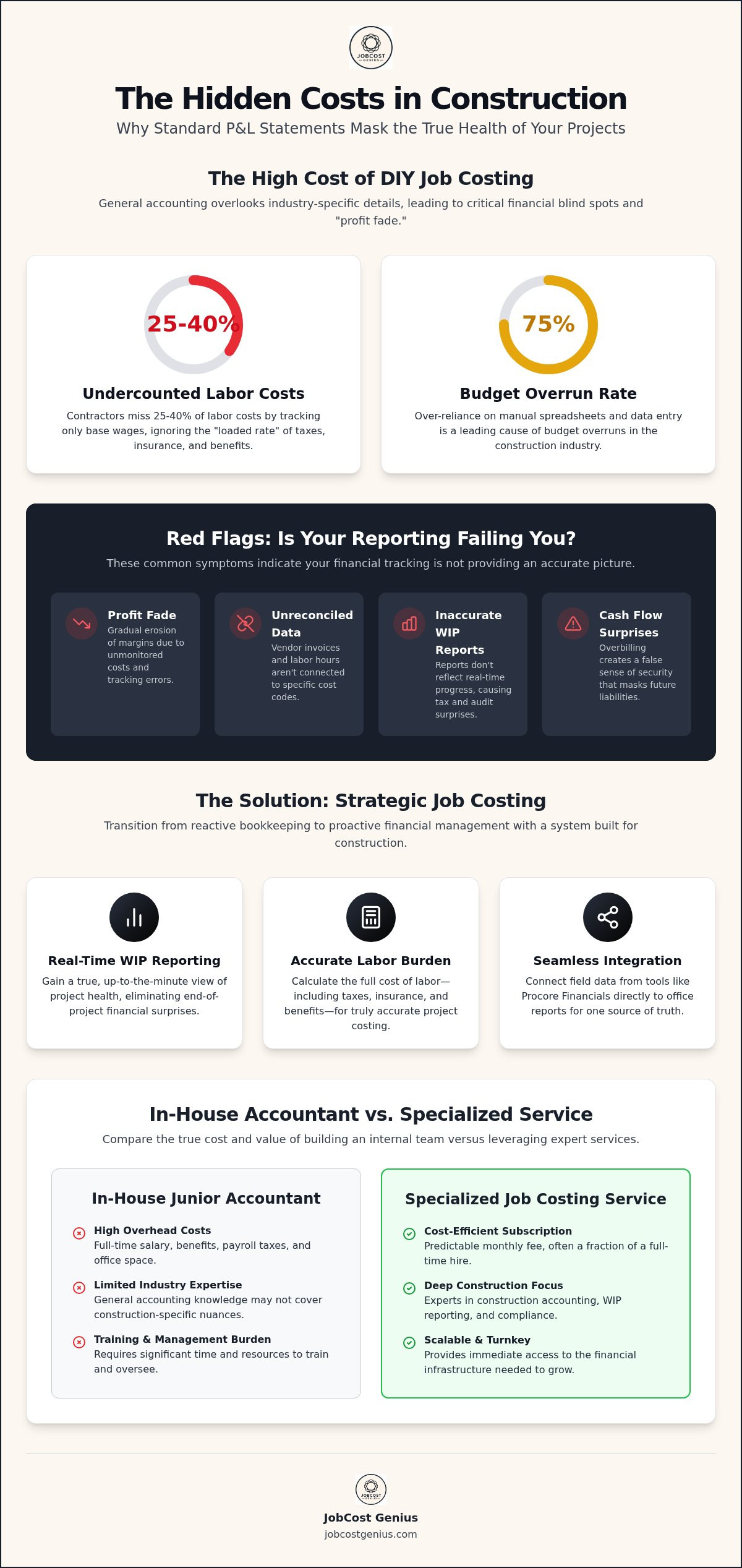
Did you know that contractors often undercount their labor costs by 25% to 40% simply by overlooking the "loaded" rate of taxes and benefits? It's a common trap that turns a seemingly profitable project into a break-even struggle. You likely started your firm to build great things, not to spend your nights untangling unreliable P&L statements or chasing down vendor invoices. While many small business owners find success by outsourcing to Thank Heavens Bookkeeping for their professional financial management, builders often feel a constant sense of administrative overwhelm as they try to reconcile field data with office financials. Utilizing professional job costing services for builders transforms this chaos into a disciplined, organized system that reflects the true health of your projects in real time.
This guide reveals how to fix messy WIP reports and protect your hard-earned margins from overbilling surprises. We'll outline the strategic infrastructure needed to move beyond manual spreadsheets, which often lead to 75% budget overrun rates. You will learn how to integrate field data seamlessly using tools like Procore Financials, giving you the clarity to bid on larger, more complex projects with total confidence. From managing the new $2,000 1099-NEC threshold to mastering overhead allocation, this is your roadmap to scaling a construction firm built on foundational financial strength.
Key Takeaways
- Identify why standard P&L statements often mask "profit fade" and how to transition toward project-specific cost tracking that reflects true margins.
- Understand how specialized job costing services for builders provide real-time transaction categorization and WIP reporting to eliminate end-of-project financial surprises.
- Compare the cost-efficiency of professional service subscriptions against the high overhead of hiring in-house junior accountants.
- Learn to evaluate providers based on their ability to integrate field data via Procore Financials, ensuring office reports match site reality.
- Discover how tiered solutions like the Starter and Growth Plans provide the scalable financial infrastructure needed to bid on larger, more complex contracts.
Why Your P&L is Lying: The High Cost of DIY Job Costing
A standard Profit and Loss statement tells you if the company is solvent, but it rarely tells you if a specific project is actually making money. Job costing is the systematic process of assigning every dollar of material, labor, and overhead to a specific project rather than dumping them into general company-wide accounts. Without this granular view, you're essentially flying blind. You might see a healthy bank balance today while a project is quietly hemorrhaging cash in the background. Specialized job costing services for builders exist to bridge this gap, ensuring that your financial data reflects job-site reality instead of just bank transactions.
Generalist bookkeepers often lack the industry-specific knowledge to handle construction nuances. They might record a subcontractor payment but miss the nuances of retention or fail to calculate the true labor burden. Industry data shows that contractors often undercount labor costs by 25% to 40% when they only track base wages. A generalist won't catch that your "loaded" rate is missing payroll taxes, insurance, and benefits. This oversight leads to "bank balance accounting," where you feel successful because there is cash in the bank, even if that cash is actually committed to future vendor payments or unbilled liabilities. Moving away from this habit requires a disciplined shift toward accrual-based project oversight.
The Difference Between Bookkeeping and Strategic Job Costing
Standard bookkeeping tracks where your money went; strategic job costing explains why it went there. While a bookkeeper reconciles the bank, a job costing expert analyzes project phases to see where you're over-budget before it's too late to course-correct. Implementing accrual accounting for contractors provides a more accurate view of project health by matching revenue with the actual expenses incurred during the same period. This level of detail allows a JobCost Genius to transform raw transaction data into actionable insights. You stop guessing about your profitability and start making decisions based on hard, project-specific data.
Common Red Flags in Your Current Reporting
Watch for specific indicators that your reporting is failing you. Consistent overbilling often creates a false sense of security while masking future cash flow shortages. You might also notice unexplained variances between your initial project estimates and the actual spend on materials or labor. These gaps usually stem from manual data entry, which is known to lead to a 75% budget overrun rate in the construction industry. Other red flags include:
- Unreconciled vendor invoices that appear weeks after a project phase is closed.
- Labor hours that aren't allocated to specific cost codes or project phases.
- Inaccurate WIP reports that lead to surprises during tax season or bank audits.
Profit Fade is the gradual erosion of project margins caused by unmonitored indirect costs and tracking errors that accumulate over the life of a build.
Anatomy of Professional Job Costing Services for Builders
Professional job costing services for builders provide a level of technical depth that standard accounting firms simply cannot match. They implement a structured system where every single transaction is categorized by cost code and project phase in real time. This allows you to follow best practices in construction job costing by aligning field activities with office ledgers immediately. Beyond simple categorization, these services calculate the full labor burden for every man-hour. This includes payroll taxes, workers' compensation insurance, and benefits. It ensures that the cost of your crew reflects the true expense to the business, not just the hourly rate on their paychecks. Effective AP management also becomes a profit center. By prioritizing early-pay discounts and maintaining clean vendor relationships, the service often pays for itself through recovered margins and avoided late fees.
WIP Reporting: The Heart of the Service
A core component of these specialized services is WIP reporting for construction companies. This report provides a monthly snapshot of whether you are overbilled or underbilled across all active jobs. Identifying underbilling on WIP reports early is critical; it prevents you from financing a client's project with your own cash flow. This requires a tight "Field to Office" feedback loop where site expenses are captured daily. When your financials are this organized, preparing monthly statements for lenders or sureties becomes a routine task rather than a stressful scramble. Partnering with a specialized construction bookkeeping guide ensures these reports remain accurate as your project volume scales.
Payroll and Compliance Integration
Compliance in 2026 requires meticulous attention to detail, especially with the updated 1099-NEC filing threshold of $2,000 per contractor. Professional job costing services for builders manage this complexity by integrating payroll directly with project tracking. This automation allocates labor costs to the correct job in real-time, which is essential for accurate workers' comp audits and preventing premium overpayments. For builders handling government or prevailing wage contracts, these services provide certified payroll reporting. This ensures you stay compliant with federal and state regulations without the administrative burden of manual entry. Precise job coding means your labor data is always audit-ready, protecting you from the heavy penalties associated with misclassification or reporting errors.
The Great Debate: In-House Cost Accountant vs. Specialized Services
Choosing between an in-house cost accountant and partnering with specialized job costing services for builders involves a clear look at your firm's long-term goals. A junior cost accountant in 2026 typically commands a salary starting at $65,000. Once you factor in benefits, payroll taxes, and training, the true cost often exceeds $85,000 per year. For many mid-sized firms, this is a significant overhead burden for a single point of failure. If that employee takes a vacation or decides to leave, your project visibility vanishes overnight. A professional service provides a collective pool of industry experience that no single hire can replicate. You gain the insights of seasoned veterans who have seen every possible construction financial scenario.
Software overhead is another often-overlooked expense. Maintaining licenses for QuickBooks Enterprise, Procore, or Sage 100 Contractor adds thousands to your annual operating budget. When you hire internally, you also assume the responsibility for software implementation and troubleshooting. Most specialized services include access to these tools or manage the integration on your behalf, ensuring your tech stack works for you rather than against you. This shift allows you to focus on building while experts handle the technical infrastructure behind your numbers.
Evaluating the Total Cost of Ownership (TCO)
The total cost of ownership for internal staff includes hidden expenses like office space, hardware, and the management time required for oversight. You aren't just paying a salary; you are paying for the infrastructure to support that person. Job costing services for builders eliminate these peripheral costs by providing a turnkey solution. Scalability is a major advantage here. As your project volume grows, offerings like the Growth Plan allow you to increase your financial oversight without the friction of recruiting and onboarding new employees. You get enterprise-level reporting and stability without the enterprise-level payroll.
When Does It Make Sense to Stay In-House?
Massive firms with revenue exceeding $50 million often require an internal team to handle the sheer volume of daily transactions. However, even these large companies frequently adopt a hybrid model. They use an on-site administrator for basic document collection and an external service for high-level analysis and compliance. This setup ensures that your most critical financial data is reviewed by an objective third party. External experts are particularly effective at fixing overbilling on WIP reports. They provide the unbiased clarity needed to identify profit gaps that internal staff might miss due to daily office pressures or project manager influence.
Evaluation Framework: 5 Questions to Ask a Job Costing Provider
Selecting a partner for job costing services for builders requires more than checking for basic accounting knowledge. You need a specialist who understands the unique volatility of construction financials. A generalist firm might manage your books, but they often lack the technical depth to handle complex cost codes, retention, and multi-year project cycles. Ask these five questions to ensure your provider is a strategic asset rather than just a data entry service:
- Do you specialize exclusively in construction? Generalists often miss industry-specific nuances like labor burden and specific insurance requirements.
- How do you handle 'Field to Office' data flow? They should have a proven process for syncing site data directly with your accounting software.
- What is your specific process for calculating true labor burden? A professional must include taxes, insurance, and benefits in every man-hour tracked.
- Can you provide a sample WIP report? Ensure they can clearly show overbilling and underbilling across all active projects.
- What is your communication rhythm? You need a defined schedule for monthly financial reviews to discuss project health and overhead.
Technical Competency and Software Stack
Your provider must integrate seamlessly with your project management tools to be effective. A modern firm should demonstrate expertise in Procore Financials Integration or Buildertrend to eliminate the risk of manual double-entry. Field to Office Sync is the automated transfer of site-level costs to the general ledger. This ensures that the numbers your project managers see in the field match what is reported in the office. Relying on monthly data entry is a recipe for disaster in 2026. Research indicates that manual data entry leads to a 75% budget overrun rate, making automated syncs a necessity for survival. Daily or weekly updates are essential for accurate job costing; otherwise, you are trying to manage your budget using a rearview mirror.
Reporting Frequency and Strategic Support
A "once-a-year" check-in from a traditional CPA is insufficient for project-based businesses. Construction moves too quickly for annual reviews to provide any defensive value. You need a partner who delivers consistent, monthly reporting that you can actually use. Expected deliverables should include monthly P&Ls, Balance Sheets, and Project-by-Project Profitability reports. These documents must arrive early enough in the month to allow for course correction on active builds. A regular "Financial Health Checkup" helps identify overhead leaks and ensures your pricing models remain competitive as market conditions shift. High-quality job costing services for builders provide the objective data needed to bid on larger, more complex projects with total confidence. To see how these insights can protect your margins, explore our specialized construction reporting plans.
Scaling with Confidence: The JobCost Genius Approach
JobCost Genius provides a structured pathway for builders at every stage of their business journey. Whether you are a custom home builder or a commercial contractor, our job costing services for builders offer the financial infrastructure required to scale without losing sight of your margins. We offer tiered solutions designed to grow alongside your firm. The Starter Plan serves as a foundational alternative to an expensive in-house hire, providing essential job costing for contractors establishing their first professional financial systems. As your volume increases, the Growth Plan expands oversight across multiple job sites and larger teams. For firms requiring enterprise-grade support, the Premium Plan delivers deep Procore Financials Integration and sophisticated reporting tailored for complex project environments. This professional reporting does more than just organize your office; it builds immediate credibility with banks and bonding agents who require transparent, accurate data to approve higher credit limits.
Procore Financials Integration: Field to Office Sync
Our Procore Financials Integration creates a seamless bridge between your site activities and your financial ledger. By eliminating double entry, field data flows directly into your financial statements without manual intervention. This allows for real-time budget tracking where you can identify a cost overrun on Tuesday instead of discovering it three weeks later when the bills finally arrive. You stop reacting to past mistakes and start managing future outcomes. We also provide custom formatting for AIA billing and complex construction compliance, ensuring your progress payments are processed without administrative friction. This integration ensures that every dollar spent on-site is accounted for in the office immediately, providing a single source of truth for your entire operation.
Your Partner in Financial Clarity
We move your business from a state of administrative overwhelm to organized calm. JobCost Genius acts as a seasoned industry veteran on your executive team, providing the strategic guidance typically reserved for massive corporations. With over 20 years of industry experience, we understand the specific pressures of the construction cycle. Specialized job costing services for builders provide the meticulousness needed to protect your profit margins while you focus on the physical build. You gain the confidence to pursue more complex projects, knowing your financial foundation is solid and your reporting is audit-ready. Ready to see your real numbers? Explore our Job Costing Plans.
Take Control of Your Project Profitability
We've explored how transitioning from bank balance accounting to a disciplined job costing system protects your margins. You now understand the technical difference between standard bookkeeping and specialized WIP reporting that identifies underbilling before it impacts your cash flow. Relying on specialized job costing services for builders ensures that your labor burden is accurately calculated and your tech stack remains a strategic asset. With over 20 years of industry experience, JobCost Genius provides the stability and meticulousness needed to scale your firm.
Our team acts as experts in Procore Financials Integration, helping you bridge the gap between field activities and executive oversight. It's time to replace administrative overwhelm with financial clarity and organized calm. Take the first step toward securing your firm's future today. Schedule a Financial Health Checkup with JobCost Genius. You've built a strong business; now it's time to build a financial foundation that matches your craftsmanship.
Frequently Asked Questions
What are job costing services for builders?
Job costing services for builders are specialized financial management solutions that track every dollar of material, labor, and overhead to specific projects rather than a general company account. These services provide granular visibility into project profitability by categorizing transactions in real time. This allows contractors to see exactly where they are making or losing money on every job site, moving beyond simple bank balance accounting.
How much do construction job costing services typically cost in 2026?
Pricing for these services typically scales with the complexity of your operations and the software required for your tech stack. While generic accounting software like QuickBooks Online Plus starts at $115 per month, specialized construction platforms like Procore or Sage 100 Contractor involve higher monthly fees and implementation costs. Professional service providers often offer tiered plans to match the specific project volume and reporting needs of your firm.
Can job costing services help with my WIP reporting?
Specialized services provide comprehensive WIP reporting as a standard deliverable to ensure your projects remain on track. They help you identify underbilling or overbilling issues by comparing actual costs against estimated budgets in real time. This oversight prevents the profit fade that occurs when indirect costs or unbilled labor accumulate unnoticed. Accurate WIP reports are essential for maintaining steady cash flow throughout the construction cycle, and you can find more guidance on this topic at okieaccounting.com.
Do I need to change my accounting software to use a job costing service?
You don't always need to switch software, but your current system must support project-based tracking to be effective. Most professional services work within existing platforms like QuickBooks Enterprise or Sage. However, they may recommend integrating specialized tools to improve the field to office data flow. This ensures your site expenses sync automatically with your general ledger without the risks associated with manual double entry.
What is the difference between a construction bookkeeper and a general bookkeeper?
A construction bookkeeper understands industry-specific nuances like retention, AIA billing, and prevailing wage requirements that a generalist often misses. They focus on project-level profitability rather than just company-wide solvency. Utilizing specialized job costing services for builders ensures that your financial data reflects the unique complexities of the trades. This expertise is critical for managing the high-stakes financial environment where small errors lead to significant losses.
How do job costing services handle labor burden and payroll?
These services calculate the full labor burden by including payroll taxes, insurance, and benefits in every man-hour tracked on a project. This provides a loaded labor rate that reflects the true cost of your crew on the job site. They also manage compliance with the 2026 1099-NEC threshold of $2,000, ensuring your subcontractor reporting remains accurate and audit-ready throughout the fiscal year.
Will a job costing service help me get a higher bonding limit?
Providing clean, professional financial statements and accurate WIP reports builds significant trust with bonding agents and sureties. When your financial data is organized and transparent, agents can see that you have a firm grasp on your project margins. This level of professional oversight often leads to higher credit limits. It gives lenders the confidence to support your firm as you bid on larger, more complex contracts.
What happens if I already use Procore or Buildertrend?
If you already use Procore or Buildertrend, a specialized service will optimize these tools to ensure your field data flows correctly into your office financials. They act as experts in Procore Financials Integration, managing the technical setup so you don't have to. This ensures that the budget tracking your project managers see in the field matches the actual spend recorded in your accounting ledger every day.


