

What if the very growth you worked so hard to achieve is actually what’s quietly eroding your profit margins? For many firms, the transition from small-scale projects to a high-volume pipeline reveals the hidden cracks in traditional accounting methods. Managing growing construction company bookkeeping requires moving past simple data entry and toward a system of predictive financial oversight. You likely feel the strain of profit fade on long-term jobs or the frustration of cash flow gaps caused by sluggish AIA billing cycles. It's a common pressure point for contractors who excel in the field but find the back-office complexity a constant hurdle to scaling.
We understand that you need more than just a balance sheet; you need a roadmap for sustainable expansion. This guide will show you how to upgrade your financial infrastructure to support rapid growth while maintaining total visibility into project health. We'll explore how to implement reliable WIP reporting for bonding, integrate field tech with your office books, and leverage 2026 tax updates like the new $2,000 1099-NEC threshold. By the end of this article, you’ll have a clear strategy to turn your financial data into a powerful tool for strategic decision-making.
Key Takeaways
- Learn why generalist bookkeeping fails as you scale and how to transition from cash-basis records to enterprise-level financial systems.
- Master the essential pillars of growing construction company bookkeeping, including Work in Progress (WIP) reporting to secure bonding and project visibility.
- Evaluate the total cost of ownership for internal staff versus specialized outsourcing to mitigate the "single point of failure" risk in your office.
- Discover how to bridge the gap between field and office by integrating Procore Financials with your accounting software for real-time project health data.
- Understand the 90-day roadmap for transitioning to professional oversight and how structured service plans provide the foundational strength needed for expansion.
The Growth Wall: Why General Bookkeeping Fails Scaling Contractors
Many contractors hit an invisible ceiling where revenue increases but profit vanishes. This phenomenon, often called the "Growth Wall," occurs when your financial infrastructure remains stuck in "handyman" mode while your operations demand enterprise-level precision. Transitioning your growing construction company bookkeeping from simple record-keeping to professional financial oversight is the only way to scale without losing control of your margins. It's the difference between looking in the rearview mirror and having a clear view of the road ahead.
The most dangerous habit during this phase is falling into the "bank balance trap." Relying on your current cash position to judge company health is a recipe for disaster. In construction, a flush bank account often represents advance payments for future liabilities, not realized profit. Without specialized oversight, you risk spending "profit" that actually belongs to your subcontractors or material suppliers. Specialized systems prevent administrative overwhelm by organizing these obligations before they become crises.
Cash-basis accounting further complicates this by hiding the true health of your projects. It fails to account for retention, which can represent your entire profit margin on a job. Professional systems move beyond simple income and expense tracking. They provide a real-time view of your liabilities and earned revenue, ensuring you don't overextend your resources on a project that's already underwater.
The Problem with Generalist Bookkeepers
Generalist bookkeepers are excellent at balancing books for a retail shop or a law firm, but they often struggle with the unique complexities of the job site. They frequently miss industry-specific nuances like labor burden, which includes the true cost of an employee beyond their hourly wage. If your bookkeeper doesn't understand the "language of the field," such as RFIs, change orders, and purchase orders, your financial data will always be one step behind reality. A local tax preparer is focused on year-end compliance; you need a partner like McConnell Bookkeeping who is focused on daily operational accuracy through monthly reconciliations and accurate financial statements.
Signs You Have Outgrown Your Current System
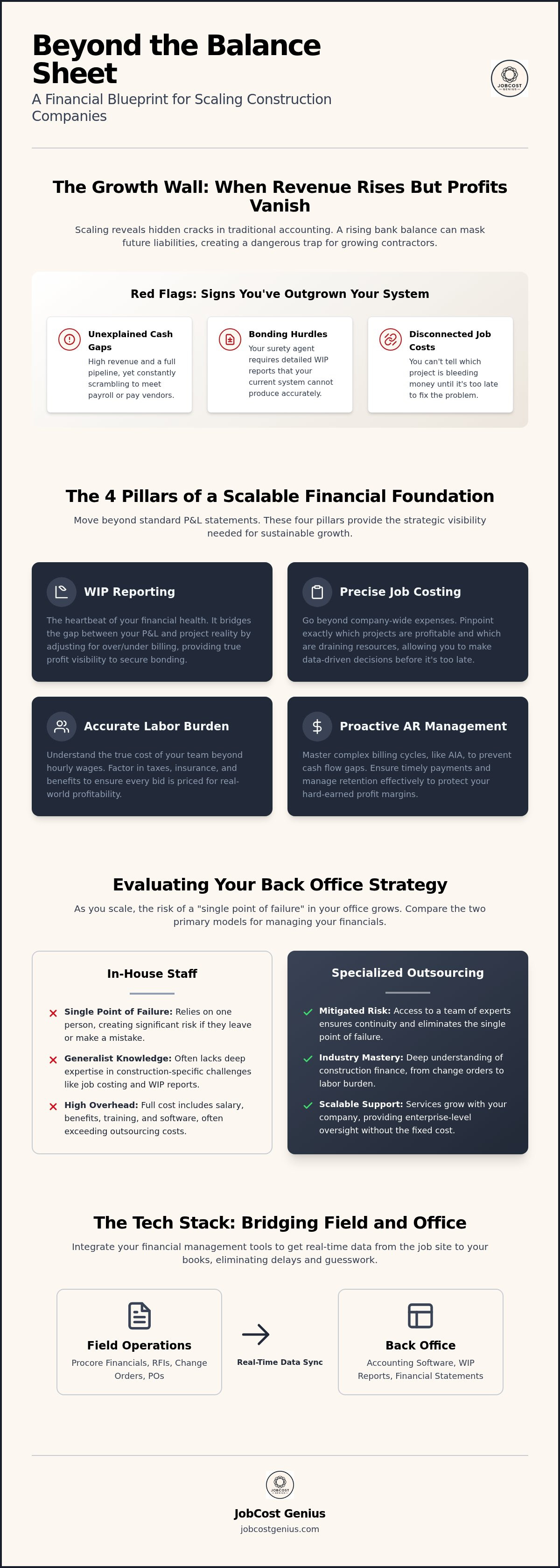
Recognizing the need for change before a crisis occurs is vital for a growing construction company bookkeeping strategy. Look for these red flags:
- Unexplained cash flow gaps: You have high revenue and a full pipeline, yet you're constantly scrambling to meet payroll or pay vendors.
- Bonding hurdles: Your surety agent or banker is asking for detailed WIP reports that your current system cannot produce accurately.
- Disconnected job costs: You can see total company expenses, but you can't tell exactly which project is bleeding money until it's too late to fix it.
When these signs appear, your current administrative setup is no longer supporting your growth. It's becoming a liability that threatens your ability to bid on larger, more profitable contracts.
Essential Financial Pillars for Growing Construction Company Bookkeeping
Standard financial statements like the Profit and Loss (P&L) often provide a misleading view of a contractor's health. They show cash movement but ignore the critical timing of revenue recognition. For a firm navigating the complexities of expansion, the pillars of growing construction company bookkeeping must include specialized reports that account for these nuances. Without these foundational elements, you're bidding in the dark and risking the stability of your entire operation.
Professional financial oversight focuses on four key areas: WIP reporting, precise job costing, labor burden accuracy, and proactive AR management. These aren't just administrative tasks; they're strategic assets that allow you to identify profit fade before it's too late. Establishing these pillars transforms your back office from a cost center into a source of competitive advantage.
Mastering the WIP Report in 2026
The Work in Progress (WIP) report is the heartbeat of your financial health. It bridges the gap between your P&L and the reality of your project status by adjusting for overbilling and underbilling. If you've billed $200,000 but only earned $150,000 based on the percentage of completion, your books will show a false profit unless adjusted. This visibility is vital for identifying cash flow risks early. Mastering WIP reporting for construction companies is also a non-negotiable requirement for securing the bonding and banking relationships necessary for larger 2026 contracts.
The Science of Precise Job Costing
Scaling requires tracking every nail, hour, and dollar back to its specific project with meticulous detail. This process involves more than just direct expenses. It requires the sophisticated allocation of indirect costs and overhead to ensure every bid is grounded in historical reality. Accurate job costing also ensures that change orders are captured and billed immediately. If a change order isn't reflected in your books, that revenue is effectively lost. Many firms utilize specialized construction job costing services to ensure their margins remain protected as project complexity increases.
Your labor burden is the true cost of your workforce, including payroll taxes, workers' comp, and benefits. In 2026, with the industry facing a massive labor shortage, knowing your exact burden is vital for profitable bidding. Finally, disciplined Accounts Receivable (AR) management ensures your cash flow keeps pace with your project velocity. Fast-tracking the payment application process, particularly for AIA billing cycles, prevents the cash gaps that often derail expansion. If your current financial setup feels fragile, it might be time to explore how a specialized growth partner can solidify your foundation.
Evaluating In-House vs. Outsourced Construction Bookkeeping
Deciding between a full-time hire and a specialized partner is a pivotal moment for any expanding firm. As your project volume increases, the complexity of growing construction company bookkeeping often outpaces the capabilities of a single office manager. While hiring in-house feels like it offers more control, it frequently creates a "single point of failure." If your only bookkeeper leaves, they take years of institutional knowledge and critical project data with them, leaving your operations paralyzed during the search for a replacement. This vulnerability is a risk most scaling contractors can't afford to take.
Outsourcing provides a scalable alternative that flexes with your workload. Instead of paying for 40 hours of a clerk's time, you gain access to a team of specialists for a fraction of the cost. This model ensures that your financial reporting remains consistent even during seasonal peaks or staff transitions. It transforms the back office from a fixed overhead expense into a variable cost that aligns with your current revenue. Partnering with a professional financial partner ensures your infrastructure grows at the same pace as your field operations.
The Hidden Costs of In-House Staff
The true Total Cost of Ownership (TCO) for a full-time employee extends far beyond their base salary. You must account for employer-side taxes, health insurance, 401(k) contributions, and specialized software seat licenses. In the 2026 labor market, the Associated Builders and Contractors report a need for nearly 500,000 new workers, making the cost of turnover and retraining exceptionally high. Finding someone who understands growing construction company bookkeeping and complex compliance, such as prevailing wage payroll processing for contractors, is both difficult and expensive. When you factor in the physical office space and equipment required, the financial burden often outweighs the benefits of an on-site presence.
Why Specialized Outsourcing Wins for Growth
Specialized partners provide immediate access to high-level tech stacks, including Procore and Sage, without the steep learning curve or implementation fees. They bring third-party objectivity to your financial reporting, ensuring that your WIP and job costing data aren't skewed by internal optimism. This level of professional oversight allows you to focus on high-value activities: bidding on new contracts and managing crews in the field. You get the organized calm of an enterprise-grade finance department while maintaining the agility of a lean construction firm. This strategic shift moves your business away from reactive data entry and toward proactive financial management.
The Construction Tech Stack: Integrating Field to Office
Manual data entry is the enemy of scale. If your office staff spends hours re-keying data from field spreadsheets, your profitability is leaking through administrative friction. Integrating your field operations with your financial core is the hallmark of professional growing construction company bookkeeping. It creates a single source of truth that ensures your project managers and bookkeepers are looking at the same numbers in real time. This synchronization eliminates the lag between site activity and financial reporting, providing the organized calm necessary for rapid expansion.
Real-time visibility allows field teams to see exactly how their daily decisions impact the bottom line. When your tech stack is unified, every material purchase and labor hour is captured at the source. This transparency prevents the late-project surprises that often erode margins on complex jobs. It moves your firm away from reactive accounting and toward proactive project management.
Procore Financials Integration Roadmap
Procore Financials is the gold standard for firms outgrowing entry-level tools. A successful integration follows a logical 4-step sequence: mapping your Chart of Accounts to Procore Cost Codes, syncing vendor records, automating commitments, and establishing a real-time flow for change orders. This setup ensures that commitments made in the field are instantly reflected in your office books without double-entry. Field managers gain the ability to view budget versus actuals independently. They no longer need to wait for weekly reports to know if a specific cost code is trending over budget.
Modernizing Payroll for Growing Teams
As your team expands, payroll complexity multiplies. You're likely managing a mix of W2 employees and subcontractors across multiple job sites. In 2026, the One Big Beautiful Bill Act (OBBBA) increased the 1099-NEC reporting threshold to $2,000, adding a new layer to your compliance checklist. Properly handling construction payroll for 1099 workers alongside your standard workforce requires automated time-tracking systems that allocate labor costs to specific jobs automatically. This level of automation is vital as you expand into new territories where multi-state tax compliance can quickly overwhelm a manual system.
Automating vendor invoice processing further reduces office friction. By using OCR technology to scan and route invoices for approval, you ensure your project costs are captured the moment they occur. This foundational strength allows your back office to handle a higher volume of projects without increasing headcount. If your current software feels like a bottleneck, we can help you implement a seamless Procore Financials integration to unify your office and field data.
Choosing the Right Growth Partner: The JobCost Genius Framework
Scaling your back office requires more than just a software subscription; it requires a disciplined framework that evolves alongside your project pipeline. As you move beyond the initial stages of business, growing construction company bookkeeping must shift from simple record-keeping to strategic financial management. This transition often begins with moving from our Starter Plan to the Growth Plan. This shift is designed for contractors who have outgrown basic ledgers and now require the sophisticated reporting necessary to satisfy surety agents and secure larger commercial contracts. We don't just balance your books; we build the financial infrastructure that supports your next five years of expansion.
Your first 90 days of professional oversight involve a meticulous audit of your current systems and a cleanup of your historical data. We establish a steady, predictable rhythm of reporting that transforms administrative overwhelm into organized calm. During this phase, we map your field operations to your financial core, ensuring that every commitment and change order is captured with precision. By the end of this period, you'll have a clear view of your project health and a reliable baseline for future bidding. We act as a strategic guide, providing the expert-led support you need to make high-stakes decisions with professional confidence.
The JobCost Genius Growth Plan Advantage
Our Growth Plan is specifically engineered for firms that are ready to professionalize their financial oversight. This tier includes specialized WIP reporting, which is the heartbeat of construction accounting. These reports provide the transparency that banks and bonding agents demand, showing exactly where your cash is tied up and how much profit you've truly earned. We provide dedicated support for construction accounting for small firms that are actively scaling their operations. This monthly recurring service ensures your books remain compliant with 2026 regulations while giving you real-time visibility into your labor burden and job costing accuracy.
Ready to Scale with Confidence?
In a high-risk industry like construction, financial clarity isn't a luxury; it's a survival requirement. The difference between a profitable year and a devastating loss often comes down to the quality of your data. JobCost Genius acts as a seamless extension of your project management team, allowing you to focus on the field while we handle the complexities of the office. We provide the meticulousness and industry-specific knowledge that generalist bookkeepers simply can't match. If you're ready to stop guessing and start growing based on reliable financial facts, it's time to professionalize your back office. Schedule your JobCost Genius consultation today and take the first step toward enterprise-level success.
Building a Foundation for Sustainable Expansion
Scaling a construction firm requires a shift from reactive data entry to proactive financial management. By mastering the essential pillars of Work in Progress (WIP) reporting and integrating field data through tools like Procore Financials, you eliminate the "bank balance trap" that stalls so many firms. Professional growing construction company bookkeeping ensures you have the real-time visibility needed to protect your margins on every project. You've worked hard to build your reputation in the field; your back office should reflect that same level of expertise and meticulousness.
With over 20 years of industry experience, JobCost Genius provides the specialized oversight required to secure bonding and manage complex payroll compliance. Our team of WIP and Procore integration experts acts as a strategic partner, offering tiered plans starting at $800 per month to fit your current needs and future goals. Don't let administrative overwhelm hold your business back from its full potential. It's time to trade uncertainty for organized calm. Upgrade your financial oversight with the JobCost Genius Growth Plan and start building with total financial clarity today.
Frequently Asked Questions
What is the difference between general bookkeeping and construction bookkeeping?
Managing growing construction company bookkeeping requires tracking costs at the individual job level rather than just the company level. General bookkeeping often misses industry-specific nuances like retention tracking, labor burden, and Work in Progress (WIP) reporting. Construction-specific systems ensure that every dollar spent is tied to a specific project, which allows for accurate job costing and more competitive bidding on future contracts.
How much does specialized construction bookkeeping cost for a growing firm?
Our professional oversight is structured to scale with your business volume. We offer tiered service levels, including our Starter, Growth, and Premium plans, with pricing starting at $800 per month. This model allows you to access enterprise-grade financial expertise without the high overhead of a full-time, in-house controller. It's a predictable investment that aligns with your current project load and revenue.
Can you help with Procore financials integration if I already use QuickBooks?
Yes, we are specialists in Procore Financials Integration for contractors using QuickBooks. We map your existing Chart of Accounts to Procore Cost Codes to ensure data flows seamlessly between the field and the office. This synchronization eliminates double-entry for commitments and change orders. It provides your project managers with real-time budget visibility while keeping your accounting records pristine and accurate.
Why do I need a WIP report if my P&L shows I am making money?
A standard Profit and Loss statement only shows what you've billed, not necessarily what you've earned. A WIP report is the heartbeat of your financial health because it adjusts for overbilling and underbilling. Without this report, you might think you're profitable when you've actually spent advance payments on future liabilities. It's a vital tool for maintaining cash flow and satisfying bonding requirements.
How do you handle certified payroll for federal or prevailing wage jobs?
We manage the complex compliance tracking and reporting required for certified payroll. This includes accurately calculating labor burden and ensuring your filings meet federal or state prevailing wage standards. Our team handles the administrative heavy lifting so you don't have to worry about the penalties associated with reporting errors. We ensure your payroll data is audit-ready and compliant with all project requirements.
What happens to my books if I scale from 5 to 50 employees quickly?
Scaling from 5 to 50 employees requires a robust system for growing construction company bookkeeping that handles increased payroll complexity. We implement automated workflows and time-tracking integrations that scale alongside your workforce. Our systems manage multi-state compliance and labor cost allocation without a significant increase in administrative friction. This allows you to focus on managing your crews while we maintain your financial stability.
Do you provide tax filing services for construction companies?
No, we do not provide income tax filing services. Our expertise is focused on specialized daily financial oversight, WIP reporting, and project-level accounting. We maintain your books to the highest professional standards throughout the year. This ensures that your tax preparer receives clean, accurate data, which often results in lower accounting fees and more efficient tax planning during the filing season. To explore how a full-service firm can assist with these higher-level strategies, you can discover Business Wise and their decades of business advisory experience.
Can you help fix overbilling issues on my current financial reports?
Yes, we can analyze your current billing cycles and project costs to identify and correct overbilling or underbilling issues. We perform a thorough cleanup of your historical data to ensure your reports reflect the actual stage of project completion. This process restores the integrity of your financial statements. It provides a reliable foundation for securing bonding and making strategic decisions about your company's future growth.


