

The $45 per hour you pay your lead carpenter is a lie. By the time you account for FICA, FUTA, SUTA, workers' comp, and health insurance, that hourly rate has likely ballooned by 30% or more. Many contractors watch their profit margins evaporate because they fail to account for the invisible weight of labor burden. If you're tired of high revenue years that result in zero net profit, it's time to refine your approach to construction job costing services. You need a system that tracks every penny before it leaves your bank account.
You already know that accurate bidding is the only way to stay solvent in this high stakes industry. It's frustrating to finish a project on schedule only to realize the hidden overhead ate your entire margin. This guide provides the exact 2026 formula to calculate your true labor costs, ensuring every bid you submit is grounded in financial reality. We'll break down the specific tax rates and insurance variables you need to track to transform your administrative overwhelm into organized clarity. You'll gain a repeatable framework to protect your profitability and stabilize your firm's foundational strength.
Key Takeaways
- Identify the "Base Wage Trap" and understand why gross hourly rates fail to reflect the true cost of your field crew.
- Catalog essential mandatory costs, including FICA, FUTA, SUTA, and Workers' Compensation insurance, to build a comprehensive burden profile.
- Utilize professional construction job costing services to replace "phantom profits" with accurate, data-driven financial reporting.
- Follow a structured, step-by-step template to calculate burdened hourly rates that protect your project margins from hidden overhead.
- Learn how to integrate labor burden calculations into automated software like Procore to maintain real-time visibility and scale your operations.
Beyond the Base Wage: What is Construction Labor Burden?
Labor burden represents the true price of keeping a worker on your job site. While the gross hourly wage is the most visible number, it's only the starting point for accurate financial management. A standard Labor burden definition includes every dollar a company spends to employ an individual, covering payroll taxes, workers' compensation premiums, health insurance, and retirement contributions. It's the total cost of employment that exists beyond the base pay rate.
Falling into the "Base Wage Trap" is a primary reason why many firms struggle despite a full project pipeline. If you bid a job at $35 per hour because that's what you pay your lead carpenter, you've already lost money. You haven't accounted for the additional 30% to 50% in overhead that follows every hour worked. Specialized construction job costing services solve this specific problem by identifying these hidden figures before they erode your cash flow. Ignoring these costs leads to project failure because your estimated margins don't reflect the actual cash leaving your bank account.
The Difference Between Pay Rate and Billable Rate
The pay rate is the gross amount listed on an employee's paycheck. It's the simple number used for basic payroll processing. Conversely, the billable rate is the amount you charge the client to ensure the company remains profitable. Labor burden sits directly in the center of these two figures. It acts as the bridge that converts a raw labor expense into a fully realized cost of goods sold. Without a precise burden calculation, your billable rate is essentially a guess. This lack of precision puts your entire project margin at risk and creates a false sense of financial security.
Why Generalist Accountants Often Miss the Mark
Generalist accountants often view labor as a monolithic expense category. They might group all payroll costs together, which obscures the profitability of individual projects. In the construction industry, labor is an asset that must be tracked against specific tasks and job codes. Generalists frequently overlook industry-specific variables like fluctuating workers' compensation rates for different trades or the nuances of union fringes. This is why construction accounting for small firms requires a specialized focus on labor burden. It ensures that every insurance premium and tax obligation is allocated to the correct project.
Utilizing professional construction job costing services allows you to see the real-time impact of labor on your bottom line. When you distinguish between direct labor costs and burdened labor costs, you gain the ability to spot "phantom profits" before they become a liability. This level of detail transforms administrative guesswork into financial clarity, allowing you to bid with confidence and protect your foundational strength.
The Anatomy of a Burden Rate: Mandatory and Optional Costs
Constructing a precise burden rate requires a granular examination of your financial ledger. It's a calculation that moves beyond simple percentages to account for every dollar that leaves the firm as a direct result of employment. While every business owner recognizes gross wages, the true cost of labor includes a mix of mandatory statutory obligations and optional benefits designed to retain top talent. Accurate construction job costing services help you categorize these expenses so you can see exactly how they impact your project's bottom line.
Payroll Taxes and Mandatory Contributions
Employer side tax responsibilities remain a significant component of the burden. In 2026, you must account for FICA (Social Security and Medicare), which stays at a combined 7.65% for the employer. Federal Unemployment Tax (FUTA) generally adds another 0.6% on the first $7,000 of wages, provided state credits apply. However, State Unemployment Tax (SUTA) is where many contractors lose track. These rates vary based on your company's experience rating; a history of frequent layoffs can drive this percentage significantly higher. To accurately Calculate Wage Rate adjustments, you must first pin down these fixed statutory percentages. This process becomes even more complex when handling prevailing wage payroll processing for contractors on federal projects, where fringe benefit requirements are strictly mandated by law.
Insurance and Safety Equipment Costs
Insurance is not a flat expense in the construction world. Workers' Compensation premiums are calculated based on specific job classifications, meaning a roofer carries a much higher burden than a site supervisor. You must also allocate general liability insurance per labor hour to understand the true cost of field operations. Beyond premiums, the burden includes the tangible costs of safety. Personal Protective Equipment (PPE), specialized safety training, and even the depreciation of small tools used by the crew must be factored into the hourly rate. If you feel overwhelmed by these variables, choosing the right financial reporting partner can help you automate these allocations and maintain your foundational strength.
1099 Workers vs. W2 Employees
It's a common misconception that 1099 independent contractors carry no labor burden. While you don't pay FICA or SUTA for these workers, they still involve administrative costs and often require specific insurance certificates that must be tracked. The financial risk of misclassification is severe, often resulting in heavy penalties and back tax obligations that can bankrupt a small firm. You should consult a construction payroll for 1099 workers guide to ensure your compliance strategy is sound. Using construction job costing services ensures that whether you use employees or subs, the cost to the project is fully visible and accurately represented in your WIP reports.
The Hidden Cost of Underestimation: Burdened vs. Unburdened Rates
Consider a 1,000-hour project. If you bid using an unburdened rate of $40 per hour, your estimated labor cost is $40,000. However, once you apply a standard 35% burden rate, the actual cost jumps to $54,000. That $14,000 difference isn't just a rounding error; it's often the entire net profit margin for the job. Underestimating these costs creates "phantom profits" on your monthly Profit and Loss statement. Your reports might show a healthy margin, but when the quarterly tax payments and workers' comp audits arrive, the cash simply isn't there.
Accurate construction job costing services bridge the gap between your project reports and your bank reconciliations. If your labor costs are underrepresented, your overhead allocation will be fundamentally flawed. You'll end up over-allocating profit to jobs that are actually draining your resources. This visibility is essential for maintaining the financial health of your firm and ensuring your bank balance reflects your reported success.
Impact on WIP Reporting and Cash Flow
Inaccurate labor data is the most common cause of massive swings in over/underbilling. Your WIP reporting for construction companies is only as reliable as the burden rates you feed into it. If you use unburdened wages, you'll likely overbill the client based on a false sense of project completion costs. This creates a dangerous cash flow situation where you've spent the "profit" before you've even paid the associated payroll taxes. Knowing your true burdened rate allows you to predict weekly cash outflows with precision, ensuring you never face a Friday payroll shortfall.
Bidding with Confidence
Mastering your burdened rate changes the way you look at every estimate. It allows you to set a hard minimum project margin based on actual expenses rather than industry averages. This is vital when comparing labor-intensive jobs, like finish carpentry, to material-intensive projects, like site grading. When you know your true break-even point, you gain the psychological advantage of knowing exactly when to walk away from a bad deal.
This meticulous approach to construction job costing services ensures your firm grows on a foundation of real profitability, not just high volume. You can submit bids with the confidence that every hour worked contributes to your bottom line. By removing the guesswork from your labor costs, you transform your administrative burden into a strategic asset.
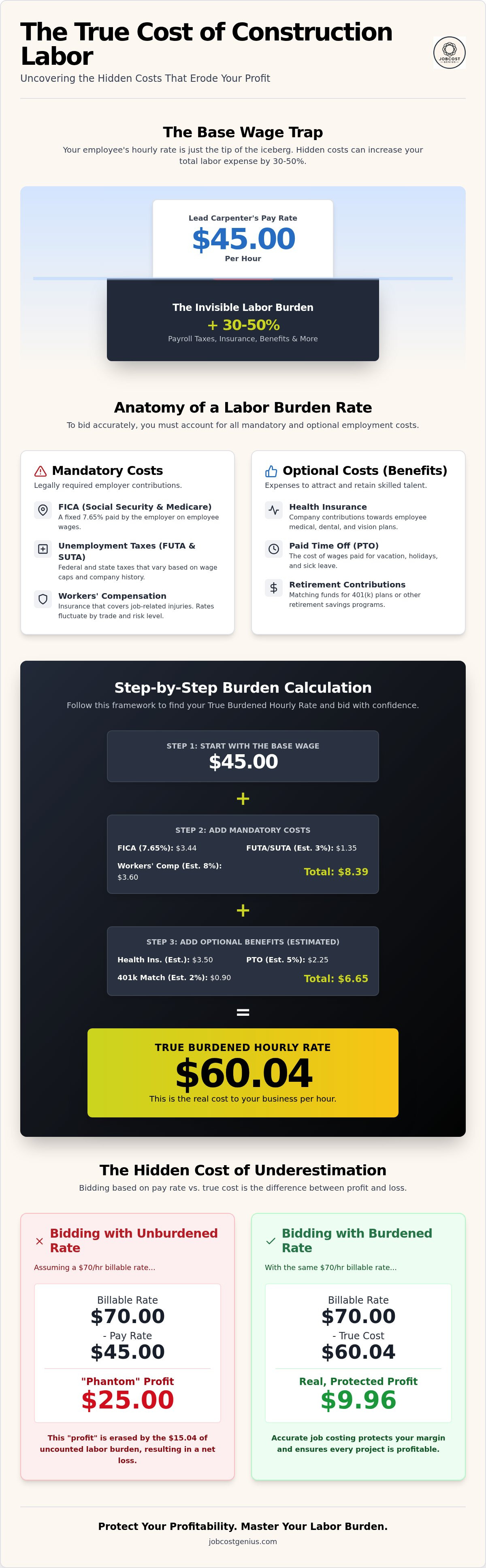
Step-by-Step Construction Labor Burden Calculation Template
Calculating a true burden rate requires moving beyond estimates and into hard data. To achieve financial clarity, follow this five-step template to determine exactly what each crew member costs your firm per hour. This level of precision is the cornerstone of effective construction job costing services and protects your project margins from unexpected erosion. The math is simple, but the impact on your profitability is profound.
- Step 1: Determine the total annual hours worked by subtracting all non-productive time (vacation, sick leave, holidays) from the standard work year.
- Step 2: Calculate the total annual gross pay for the employee based on their base hourly rate.
- Step 3: Sum all annual mandatory and optional employer-paid costs, including payroll taxes, insurance, and benefits.
- Step 4: Divide the total annual costs by the total annual productive hours worked to find the "Burden per Hour."
- Step 5: Add the Burden per Hour to the base hourly wage to arrive at the "Fully Burdened Rate."
Calculating Total Annual Hours
The standard work year consists of 2,080 hours, yet no employee is productive for that entire duration. To find your actual billable baseline, you must subtract non-working hours such as holidays, sick leave, and vacation time. If a carpenter receives two weeks of vacation and six holidays, your total annual hours drop to 1,920. You should also account for non-billable time spent in safety meetings or shop maintenance. Overtime complicates this math. While it increases gross pay, it may actually lower your burden percentage since fixed costs like health insurance premiums remain static regardless of extra hours worked.
Aggregating Employer-Paid Expenses
Once you have your hour count, create a comprehensive checklist of every dollar spent on an employee beyond their wage. This includes mandatory taxes like FICA and SUTA, alongside optional benefit premiums such as health insurance and 401k matches. You must also allocate annual insurance premiums, like general liability and workers' comp, down to the individual employee level based on their specific trade risk. In your burden worksheet, you should use a formula that sums the total of FICA, FUTA, SUTA, workers' comp premiums, and health insurance costs to arrive at your total annual employer-paid burden. If this manual tracking feels like a bottleneck, you can partner with a specialized accounting team to automate these complex calculations.
Utilizing these construction job costing services allows you to move from guesswork to a state of organized calm. When you know your fully burdened rate, you can bid with the confidence that every hour worked is contributing to your foundational strength. This systematic approach ensures that hidden overhead never surprises you at the end of a project.
Mastering Labor Burden for Scalable Growth
Scaling a construction firm requires more than just a larger crew. It demands a sophisticated financial infrastructure that evolves alongside your headcount. As your team grows, your labor burden percentage often changes due to economies of scale. While some fixed costs like administrative overhead might decrease on a per-hour basis, other variables like workers' compensation tiers or benefit package complexities can increase. Professional construction job costing services provide the oversight needed to navigate these shifts without sacrificing your profit margins. Accuracy at scale is only possible when your systems are built to handle complexity.
Leveraging Technology for Accuracy
Manual spreadsheets are the enemy of scalable growth. They are prone to human error and fail to provide the real-time visibility required for modern project management. Transitioning to automated bookkeeping systems allows you to track burden in real-time, syncing field data directly with your office financials. Software integrations like Procore Financials Integration or Sage 300 CRE ensure that every hour logged on-site is immediately reflected in your job costing reports. JobCost Genius specializes in these integrations, helping firms transition seamlessly from our Starter Plan to more robust Growth Plan options as their operational needs expand. This technological foundation ensures your financial data is always audit-ready and accurate.
Next Steps for Your Financial Infrastructure
Maintaining an accurate burden rate isn't a "set it and forget it" task. You should conduct a quarterly "Burden Audit" to adjust for changes in SUTA rates, insurance premium renewals, or new tax legislation. These adjustments are vital for keeping your bidding competitive and your WIP reporting reliable. Consulting with a construction-specific bookkeeper helps you determine which service tier fits your current volume and growth trajectory. We focus on the specialized math of the industry so you can focus on the build.
Whether you need basic oversight or comprehensive construction job costing services, the goal is to transform your administrative overwhelm into a state of organized calm. Precision in your labor costs is the difference between a business that survives and one that thrives. Ready to stop guessing and start growing with confidence? Explore our construction bookkeeping plans to find the right fit for your firm's infrastructure.
Securing Your Firm’s Financial Future
Identifying your true labor burden is the first step toward reclaiming your project margins. By moving beyond base wages and accounting for every tax, insurance premium, and benefit, you replace administrative guesswork with financial clarity. This meticulous approach ensures your bids are competitive and your cash flow remains stable as you scale. You've learned that precision in these calculations isn't just an accounting task; it's a strategic necessity for long term survival.
JobCost Genius provides the technical expertise to manage these variables through specialized construction job costing services. With our national reach and deep knowledge of Procore and Sage integrations, we help you master your WIP reporting and eliminate financial uncertainty. We focus on the specialized math of the industry so you can stay focused on the job site. It's time to transform your administrative overwhelm into a state of organized clarity.
Get a Specialized Financial Health Checkup for Your Firm to ensure your infrastructure is as solid as your projects. You have the skills to build; we have the tools to help you grow profitably. Start bidding with absolute confidence today.
Frequently Asked Questions
What is a typical labor burden percentage in construction?
A typical labor burden percentage in the construction industry generally ranges between 30% and 50% of the base wage. This figure fluctuates based on your specific trade, 2026 state tax requirements, and the depth of your benefit packages. High-risk trades like roofing often see higher percentages due to increased workers' compensation premiums. Understanding this range is essential for accurate bidding and the long term financial health of your firm.
Is labor burden the same as overhead?
Labor burden is not the same as general overhead. While overhead covers indirect costs like office rent and administrative salaries, labor burden is a direct job cost specifically tied to field personnel. It represents the "cost of goods sold" for your labor. Specialized construction job costing services ensure these costs are allocated to specific projects rather than being buried in your general ledger. This distinction is vital for maintaining accurate project margins.
How often should I recalculate my construction labor burden?
You should recalculate your construction labor burden at least quarterly to account for shifting tax rates and insurance premium adjustments. Major changes, such as hiring a large group of new employees or renewing your workers' compensation policy, should trigger an immediate review. Regular audits prevent "phantom profits" from appearing on your P&L. Keeping these rates current ensures your estimates reflect your actual operational costs in real time.
Can I use the same burden rate for all my employees?
Using a single burden rate for all employees is a mistake because costs vary significantly by job classification and salary. A site supervisor carries a different insurance risk and tax profile than a laborer. Additionally, fixed costs like health insurance premiums represent a larger percentage of a lower wage earner's total cost. Accurate construction job costing services require individual or trade-specific burden rates to maintain the integrity of your project data.
Does labor burden include the cost of tools and vehicles?
Small tools, uniforms, and vehicle allowances can be included in your labor burden if these expenses are directly required for an employee to perform field duties. These are often categorized as "other labor costs." Including these items provides a more comprehensive view of the true hourly cost of your crew. However, large equipment depreciation is typically handled as a separate equipment cost rather than a component of the individual's burden rate.
How does labor burden affect my workers' compensation premiums?
Labor burden doesn't affect your premiums; rather, your workers' compensation premiums are a primary component of the labor burden calculation. Premiums are based on your payroll totals and trade classifications. As your payroll grows or your experience modifier changes, your labor burden percentage will shift accordingly. Accurately tracking these costs allows you to see the direct financial impact of safety performance on your project profitability.
Should I include overtime in my labor burden calculation?
Overtime must be included in your burden calculations, but be aware that it often lowers your overall burden percentage. While the tax portion of the burden increases with higher wages, fixed costs like health insurance and cell phone stipends are spread over more hours. This "dilution" means your burdened rate during overtime isn't simply 1.5 times your standard burdened rate. Analyzing these nuances is critical for maintaining bidding accuracy on accelerated schedules.
Is labor burden tax deductible for my construction business?
Business owners can generally deduct the individual components that make up labor burden, such as employer paid taxes and insurance premiums. These costs are part of your total labor expense on your federal tax return. Properly categorizing these as job costs rather than general administrative expenses helps you track your true taxable income. You should consult with a construction-specific financial professional to ensure all deductions are maximized and compliant with current regulations.


