

What if the hours your team spends wrestling with WH-347 forms were actually the key to unlocking your firm's hidden profitability? It's a common frustration in the public works sector. You likely feel the pressure of fluctuating rates and the constant fear of contract funds being withheld due to a simple reporting oversight. Utilizing professional prevailing wage compliance services can shift this dynamic. It moves your business from administrative overwhelm to a state of organized financial clarity.
This guide will teach you how to master the latest Davis-Bacon complexities and protect your firm from costly penalties. You'll learn to transform your reporting requirements into a source of accurate labor burden data that sharpens your future bids. We'll examine the July 2026 threshold changes for HVAC contractors, the mandatory transition to the updated WH-347 form, and the strategic benefits of integrating your payroll with systems like Procore Financials to ensure 100% compliance on every project.
Key Takeaways
- Learn how to navigate the 2026 WH-347 requirements and identify correct wage determinations to prevent contract funds from being withheld.
- Discover why specialized prevailing wage compliance services provide a level of expert oversight that standalone software often lacks for complex construction firms.
- Understand how to link weekly payroll data directly to WIP reporting and labor burden analysis to improve the accuracy of your future project bidding.
- Explore the benefits of Procore Financials integration to eliminate manual data entry and keep your records audit-ready at all times.
- Identify the right service tier to scale your operations while maintaining total compliance on every public works project you undertake.
What is Certified Payroll Reporting in 2026?
Certified payroll is a weekly compliance requirement for any contractor working on federally funded or assisted public works projects. It centers on Form WH-347, a detailed document submitted to the Department of Labor (DOL) that tracks every hour worked and every dollar paid. Unlike standard payroll, which focuses on net pay and tax withholding, certified payroll acts as a legal "standard of proof." It confirms that you've met specific wage and fringe benefit requirements for every trade on your job site. In 2026, the demand for digital transparency has reached new heights. The DOL now prioritizes electronic submissions and real-time data verification, making manual entry a significant liability for growing firms. Using professional prevailing wage compliance services helps bridge the gap between simple bookkeeping and the rigorous documentation required by federal law.
The Davis-Bacon and Related Acts (DBRA) Framework
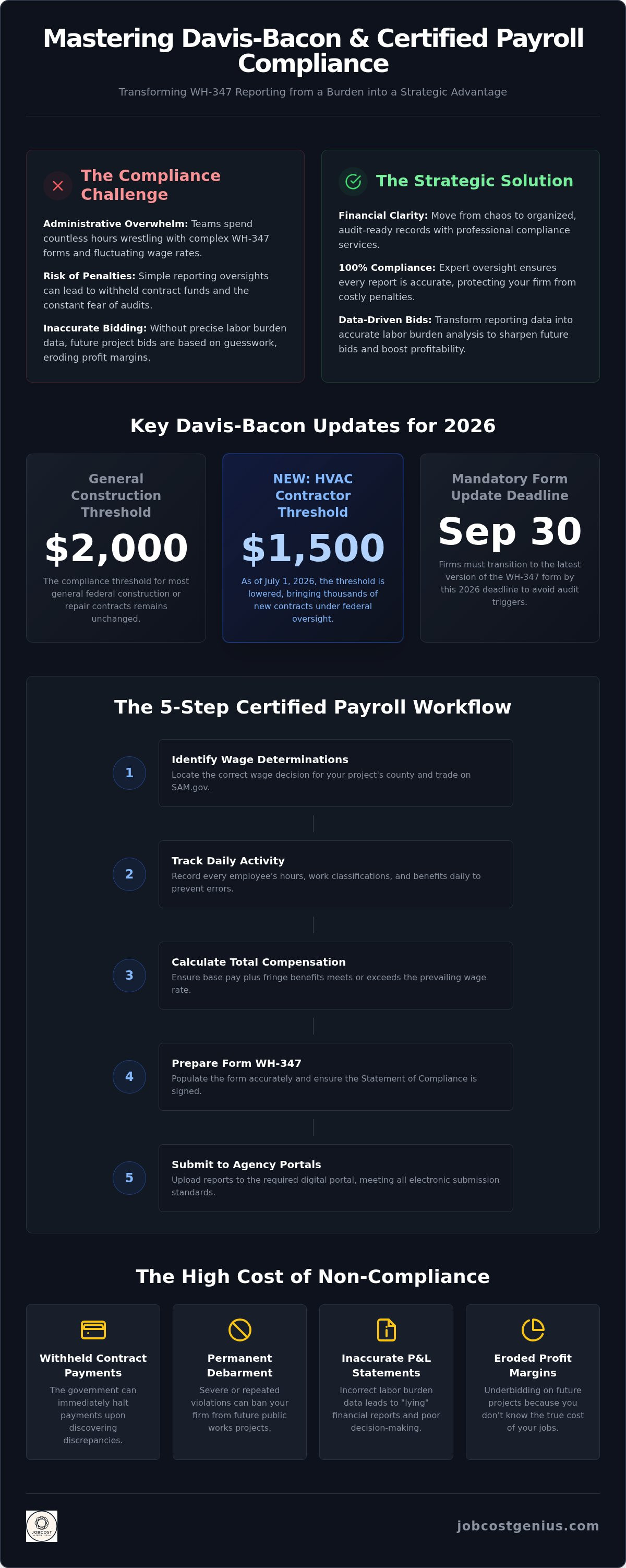
The Davis-Bacon Act establishes the legal baseline for most public works. For general federal construction or repair contracts, the compliance threshold remains at $2,000. However, as of July 1, 2026, the DOL lowered the threshold specifically for HVAC contractors to $1,500. This shift brings thousands of additional contracts under federal oversight. The government determines these prevailing wage rates based on geographic regions, meaning your labor costs can fluctuate between neighboring counties. The DBRA serves as the regulatory foundation for federal construction projects, requiring contractors to pay local prevailing wages and fringe benefits to ensure fair competition and labor standards. Keeping pace with these regional updates is a full-time task that requires meticulous attention to detail.
Consequences of Non-Compliance and Reporting Errors
The stakes for reporting errors are higher than ever in 2026. If the DOL identifies discrepancies in your WH-347 filings, the government can withhold contract payments immediately. Severe or repeated violations may lead to permanent debarment, effectively banning your firm from bidding on future public works projects. Current audit triggers often include missing the September 30, 2026, deadline for transitioning to the latest version of the WH-347 form or failing to account for specific fringe benefit credits. Beyond legal risks, inaccurate reporting creates "lying" profit and loss statements. If your labor burden isn't tracked correctly through prevailing wage compliance services, you won't know the true cost of your jobs. This leads to underbidding and eroded margins on future projects.
How to File Certified Payroll Reports: A Step-by-Step Process
Filing certified payroll isn't just about cutting checks; it's a rigorous documentation cycle that requires precision from the first day on site. To ensure 100% accuracy, your firm should follow a structured five-step workflow. This process maintains the integrity of your project data and keeps you in good standing with contracting agencies.
- Step 1: Identify Wage Determinations. Locate the specific wage decision for your project's county and trade on SAM.gov. These prevailing wage requirements are often locked into the contract at the time of the award.
- Step 2: Track Daily Activity. Record every employee's hours, work classifications, and fringe benefits daily. Waiting until the end of the week leads to errors that can trigger audits.
- Step 3: Calculate Total Compensation. Ensure the combination of base hourly pay and fringe benefits meets or exceeds the required rate. If you don't offer a qualifying benefits plan, you must pay the difference as cash on the paycheck.
- Step 4: Prepare Form WH-347. Populate the form with worker details, including social security numbers and tax withholdings. The "Statement of Compliance" on page two must be signed by an authorized company official.
- Step 5: Submit to Agency Portals. Upload your reports to the required digital portal, such as the DOL's electronic submission system or state-specific platforms.
Essential Components of Form WH-347
Correct worker classification is the most scrutinized part of the WH-347. You must distinguish between journeymen and apprentices. Apprentices only qualify for lower rates if they are enrolled in a program registered with the DOL or a recognized state agency. Maintaining the correct ratio of apprentices to journeymen is vital; exceeding that ratio means paying full journeyman wages to everyone. Partnering with prevailing wage compliance services helps you monitor these ratios in real time, preventing costly back-pay liabilities.
Managing 1099 Workers on Public Works Projects
The government heavily scrutinizes "independent contractor" status on certified jobs. In most cases, if a worker is performing manual labor on a public works site, they must be reported on the certified payroll as an employee, regardless of their 1099 status elsewhere. This is a common pitfall that leads to debarment. For a deeper look at these requirements, see our guide on prevailing wage payroll processing for contractors. If you're feeling overwhelmed by these regulations, the experts at JobCost Genius can help streamline your reporting through specialized prevailing wage compliance services.
Software vs. Managed Services: Choosing the Right Reporting Path
Many contractors assume that buying a subscription to automated software solves the compliance puzzle. This is often a costly misconception. Software is an engine; it still requires high-quality fuel to run correctly. The "garbage in, garbage out" principle applies heavily to certified payroll reporting. If a field supervisor enters the wrong work classification or fails to track apprentice hours accurately, the software will simply generate a non-compliant report. Relying on prevailing wage compliance services with managed oversight ensures that an expert eye reviews the data before it ever reaches the submission portal.
Evaluating your tech stack is the first step toward administrative efficiency. Whether you use QuickBooks, Sage 300 CRE, or specialized construction platforms, the software should serve your workflow rather than dictate it. Managed services provide a layer of human intelligence that software lacks, such as identifying when a state-level threshold change overrides federal requirements. This expert oversight transforms your payroll from a weekly chore into a strategic asset for project visibility.
Procore Financials and Field-to-Office Sync
Bridging the gap between the job site and the accounting office is the biggest hurdle for growing firms. When your field team uses Procore to track time, but your office team manually re-enters that data into your accounting software, the risk of human error skyrockets. A seamless Procore financials integration services setup eliminates this redundancy. It creates a single source of truth, allowing for real-time visibility into labor costs without the administrative lag that often leads to reporting delays.
The Role of a Certified Payroll Professional (CPP)
General payroll expertise doesn't translate well to the specialized world of public works construction. A general bookkeeper might understand tax withholdings but likely lacks deep knowledge of Davis-Bacon thresholds or fringe benefit calculations. A dedicated partner provides strategic value that software alone cannot replicate. Choosing outsourced bookkeeping for construction firms gives you access to professionals with over 20 years of industry experience. These experts act as a safeguard, protecting your business from the debarment risks and financial penalties that follow reporting errors.
In-house processing often seems cheaper on paper until you factor in the cost of errors, audits, and continuous staff training. Specialized prevailing wage compliance services offer a predictable cost structure that scales with your project volume. This strategic outsourcing allows your team to focus on project execution while we handle the meticulous task of maintaining compliance and financial clarity.
The Strategic Advantage: Linking Payroll to Job Costing and WIP
Certified payroll is often viewed as a weekly administrative hurdle, but it is actually your firm's most granular data source for real-time job costing. Every entry on a WH-347 form represents a verified labor cost that should feed directly into your financial management system. When you use specialized prevailing wage compliance services, you aren't just filing reports; you're capturing the precise data needed to measure project health. This integration allows you to identify overbilling and underbilling risks before they impact your cash flow. It moves your accounting from a reactive state to a proactive strategic guide.
Labor Burden and Project Profitability
Understanding your true labor burden is essential for maintaining margins on public works projects. This figure goes far beyond the base hourly rate. It includes payroll taxes, workers' compensation insurance, and the specific fringe benefits required by wage determinations. Ignoring these variables leads to significant profit leaks. If you calculate your labor costs based on standard private-sector rates while paying prevailing wages, your project's profitability will be an illusion. Accurate labor burden tracking allows you to fix underbilling on your financial statements, ensuring you're compensated for the true cost of every hour worked on the job site.
WIP Reporting: The Ultimate Construction Health Check
The accuracy of your financial statements depends entirely on the quality of your payroll data. In construction accounting, the percentage-of-completion method is the standard. If your reported hours are inaccurate, your calculation of "percent complete" will be wrong, leading to financial statements that effectively lie to you about your company's health. Reliable prevailing wage compliance services ensure that every hour is classified correctly, providing the foundation for a dependable WIP reporting for construction companies framework. This clarity is what allows seasoned veterans to spot project slippage early and correct course before the budget is exhausted.
Using this verified data also sharpens your future project bids. When you know exactly what a journeyman electrician costs your firm after all burden and compliance factors are applied, you can bid with confidence rather than guesswork. This precision is what separates profitable growing firms from those struggling with administrative overwhelm. To see how these insights can transform your project visibility, explore our specialized WIP reporting and labor burden analysis services designed for the unique needs of construction contractors.
Scaling with JobCost Genius: Specialized Compliance Services
JobCost Genius acts as more than an external vendor; we serve as a strategic guide for firms navigating the high-stakes world of public works. Our team brings over 20 years of specialized industry experience to your back office. We understand that certified payroll is just one component of your financial health. By offering comprehensive prevailing wage compliance services, we transform administrative overwhelm into a state of organized clarity. This meticulous approach ensures that your firm remains eligible for the most lucrative federal contracts while protecting your bottom line from avoidable penalties.
Our Tiered Service Plans for Construction Firms
We recognize that a one-size-fits-all approach doesn't work in construction. Our service tiers are designed to provide the exact level of support your firm requires at its current stage of growth. This structure allows you to scale your compliance infrastructure without overextending your resources.
- Starter Plan: This tier provides essential bookkeeping and compliance support for growing teams. It's the perfect foundation for contractors moving into the public sector who need to ensure their initial filings are flawless.
- Growth Plan: As your project portfolio expands, so do your reporting obligations. This plan offers more robust oversight and handles the increased complexity of multiple wage determinations and larger crews.
- Premium Plan: Our enterprise-level solution provides full-scale financial oversight. This includes advanced prevailing wage compliance services, accounts payable management, and deep integrations with platforms like Procore Financials.
Specialized construction bookkeeping is a foundational investment rather than a simple administrative expense. It provides the labor burden data and WIP reporting accuracy discussed in previous sections. This data is what allows you to bid more competitively and manage your cash flow with total confidence. By outsourcing these high-stakes tasks, you eliminate the need for expensive in-house training and the risks associated with staff turnover.
Next Steps: Securing Your Compliance Infrastructure
The first step toward financial clarity is identifying the hidden gaps in your current reporting. We recommend starting with a financial health checkup to evaluate your existing payroll workflows and audit risks. This process highlights where manual entry might be causing profit leaks or compliance vulnerabilities. Transitioning your payroll to our managed service is a steady, deliberate process. We focus on a seamless field-to-office sync that respects your team's current pace while introducing the discipline of expert oversight.
Don't let the weight of WH-347 data entry or fluctuating wage rates stall your firm's progress. Our seasoned veterans are ready to provide the stability and precision your business deserves. Ready to focus on building? Let our experts handle your certified payroll reporting so you can get back to the job site with peace of mind.
Securing Your Future in Public Works Construction
Navigating the 2026 regulatory landscape requires more than just automated software; it demands a deep understanding of how labor burden impacts your total project health. By linking your weekly reporting to strategic WIP analysis, you move beyond administrative overwhelm and gain a competitive edge in future bidding. Professional prevailing wage compliance services ensure your firm meets the latest WH-347 standards while maintaining the meticulous financial records that federal agencies demand. This level of oversight protects your firm from debarment and ensures that every public works project contributes to your long-term stability.
With 20+ years of construction industry experience and specialized Procore and Sage integration support, JobCost Genius provides the national compliance coverage your firm needs to scale. We act as a disciplined partner to transform complex payroll data into actionable financial clarity. Get a Specialized Payroll Compliance Quote to see how our expertise can strengthen your firm's infrastructure. Your business deserves the confidence that comes from expert-led management. Let's build a compliant and profitable future together.
Frequently Asked Questions
What is the difference between prevailing wage and certified payroll?
Prevailing wage refers to the specific hourly rate, including fringe benefits, required for a trade in a specific geographic location. Certified payroll is the actual reporting process and documentation used to prove those wages were paid. While prevailing wage is the standard you must meet, certified payroll is the weekly submission of Form WH-347 that confirms your compliance. Utilizing prevailing wage compliance services ensures these two distinct requirements align perfectly.
Do I need to submit certified payroll reports if I have no work performed that week?
Yes, most federal and state agencies require "no work" reports to maintain a continuous sequence of payroll numbers. If your contract specifies weekly reporting, you must submit a report even if no employees were on site. These reports are typically numbered and marked "No Work Performed." Failing to submit these can lead to administrative delays or the withholding of contract funds because the agency can't verify the continuity of your compliance.
Can I use standard QuickBooks for certified payroll reporting?
Standard QuickBooks doesn't natively generate the specific Form WH-347 required for public works. While it tracks basic pay, it lacks the specialized fields for work classifications and fringe benefit credits needed for federal compliance. Most contractors using QuickBooks rely on third-party integrations or prevailing wage compliance services to bridge this gap. This managed approach prevents the "garbage in, garbage out" errors that often occur when trying to force general software into construction workflows.
How long must I retain certified payroll records for federal projects?
For federal projects under the Davis-Bacon Act, you must retain all certified payroll records for at least three years after the project is completed. This includes timecards, pay stubs, and evidence of fringe benefit payments. Some state-level projects or specific contract terms may require longer retention periods, sometimes up to five or seven years. Keeping these records organized and accessible is vital in case of a retrospective Department of Labor audit or a project dispute.
What happens if I misclassify a worker on a certified payroll report?
Misclassifying a worker, such as listing a journeyman as an apprentice, is a primary trigger for Department of Labor audits. If caught, you'll be required to pay the full back-pay difference to the employee immediately. You may also face significant financial penalties and interest. In severe cases, repeated misclassification can lead to debarment, which prevents your firm from bidding on any future public works contracts for a period of up to three years.
Are fringe benefits included in the prevailing wage calculation?
Yes, fringe benefits are a core part of the prevailing wage determination. The total rate is usually expressed as a base hourly wage plus a specific fringe benefit amount. You can satisfy the fringe portion by paying into a bona fide benefits plan, such as health insurance or a 401(k), or by paying the amount as cash on the employee's paycheck. Correctly documenting these credits is essential to avoid overpaying or failing an audit.
How does certified payroll impact my WIP (Work in Progress) reports?
Certified payroll provides the burdened labor data that makes your WIP reports accurate. Since these reports require a precise calculation of the percentage of completion, using unburdened or estimated labor costs will lead to financial statements that effectively lie to you. By linking your compliance data to your financial reporting, you can identify if a project is overbilled or underbilled. This clarity allows you to manage cash flow effectively and bid more accurately.
What is a WH-347 form and who is required to sign it?
Form WH-347 is the standard federal document used to report certified payroll data to the Department of Labor. It includes a detailed breakdown of hours, classifications, and withholdings for every worker on the project. The second page, known as the Statement of Compliance, must be signed by a company official or an authorized agent. This signature carries legal weight, certifying that the payroll information is correct and that's why accurate data entry is so vital.


