

What if the hourly rate you're using to bid jobs is the primary reason you're losing money? You've likely felt the sting of finishing a project on schedule, only to find that your expected profit has evaporated into thin air. It's a common frustration for contractors who manage their field teams effectively but struggle with administrative overwhelm when it comes to true overhead. To fix this, you must implement a precise labor burden calculation for contractors that accounts for more than just base wages.
We understand that tracking non-productive time or the 2026 Social Security wage base of $184,500 feels like a distraction from the actual build. However, mastering these numbers is the only way to transform your financial reporting from guesswork into a state of organized calm. This guide provides a clear, repeatable formula to determine your true hourly costs, accounting for the 7.65% FICA rate and rising healthcare expenses. You'll learn how to build accurate bids that protect your margins and ensure your WIP reports finally reflect your actual profitability.
Key Takeaways
- Understand why base wages are an incomplete metric and how unburdened bidding leads to projects that appear profitable but ultimately lose money.
- Identify the specific mandatory costs, including 2026 tax rates and rising insurance premiums, that define your true cost of employment.
- Master the step-by-step labor burden calculation for contractors to determine a reliable, fully burdened hourly rate for every field employee.
- Distinguish between project-specific labor burden and general company overhead to improve the precision and competitiveness of your project estimates.
- Learn how to integrate these figures into your bookkeeping workflow to produce accurate WIP reports that reflect your actual financial reality.
What is Labor Burden and Why Your Current Numbers are Lying
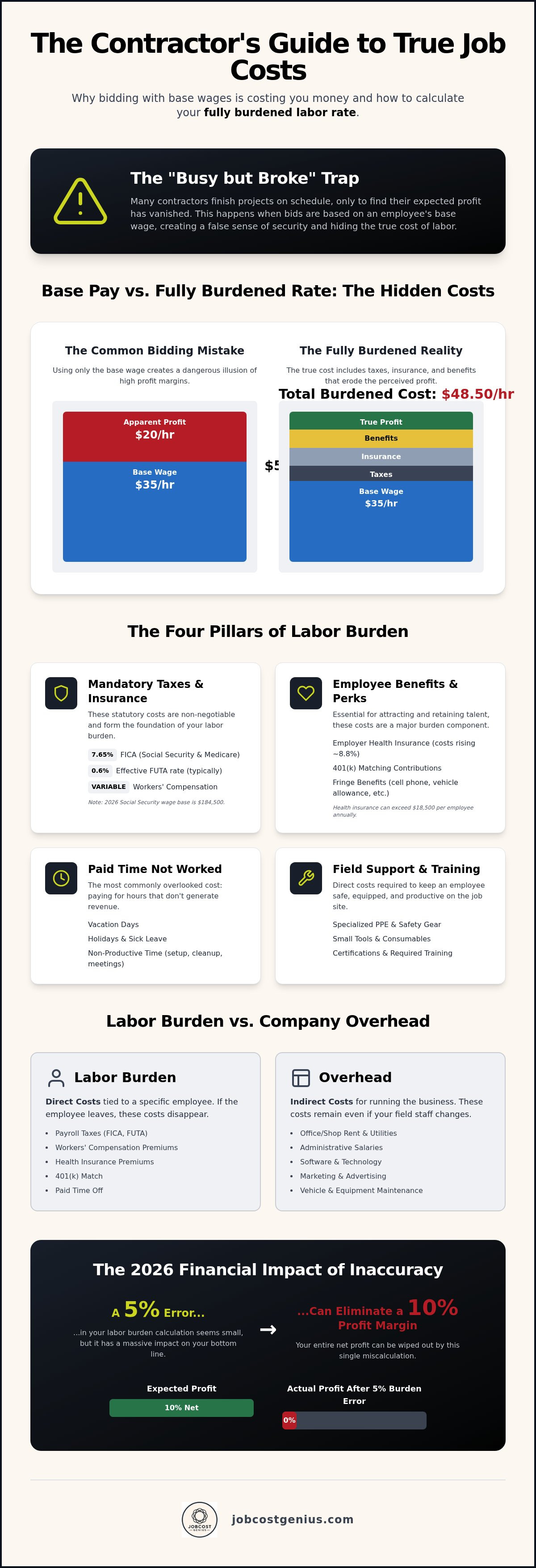
Many contractors fall into the "Busy but Broke" trap. They maintain full schedules and impressive revenue, yet their bank accounts remain stagnant at the end of the quarter. This usually happens because their project bids rely on "Direct Labor" costs, which only represent the gross wages paid to an employee. In reality, a precise labor burden calculation for contractors reveals a much higher figure. Labor burden encompasses every dollar spent to keep a worker on the job, including taxes, insurance, and non-productive time. Using a "check amount" for bidding isn't just inaccurate; it's a financial lie that hides the true cost of doing business.
The Difference Between Base Pay and Fully Burdened Rates
Using gross wages for estimates is a psychological trap that creates a false sense of security. When you see a $35 hourly rate on a payroll report, it's easy to assume a $55 billable rate leaves plenty of room for profit. However, a P&L statement often hides the "unburdened" reality by scattering labor-related costs across various expense categories. In a standard P&L, you might see "Wages" at the top, while the taxes and benefits that make up the rest of the cost are buried in administrative expenses. Generalist bookkeepers often miss these construction-specific nuances. They might treat workers' compensation or payroll taxes as general company overhead rather than direct project costs. This misclassification prevents you from seeing the "Fully Burdened Labor Rate," which is the only metric that accounts for the total business reality of every man-hour.
How Labor Burden Impacts Your Bottom Line in 2026
The 2026 market has made financial precision more critical than ever. With employer health insurance costs projected to rise by 8.8% this year and the Social Security wage base reaching $184,500, the margin for error is shrinking. FICA remains at 7.65%, but the compounding effect of rising benefit costs means your old multipliers are likely outdated. A 5% error in your labor burden calculation for contractors can effectively wipe out a 10% net profit margin. Because labor is often the largest variable expense in a project, even a small miscalculation scales into a massive deficit. Labor burden is the precise financial breakeven threshold for every man-hour worked, marking the point where you stop paying for the privilege of working and actually begin to generate profit.
The Four Pillars: What Costs Are Included in Labor Burden?
To achieve financial clarity, you must look beyond the hourly wage. Labor burden represents the total cost of keeping an employee in the field; it is the sum of every dollar spent to support their employment. While overhead covers company-wide costs like shop rent and office utilities, labor burden is specific to the individual worker. Understanding what costs are included in labor burden is the first step toward a more accurate labor burden calculation for contractors. These costs generally fall into four distinct categories, or pillars, each with its own level of volatility.
Mandatory Taxes and Insurance (The Non-Negotiables)
Statutory costs form the foundation of your labor burden. For 2026, the employer FICA tax rate is 7.65%, consisting of 6.2% for Social Security and 1.45% for Medicare. It is vital to track the Social Security wage base, which has risen to $184,500 for the 2026 tax year. Beyond FICA, you must account for FUTA, which remains at 6.0% on the first $7,000 of wages, typically reduced to an effective rate of 0.6% after state tax credits. Workers' compensation remains the most volatile component. While median rates for guaranteed cost plans fell 2.6% in early 2026, the increasing complexity of medical claims and mental health coverage means your specific trade risk and claims history can cause these numbers to fluctuate wildly during an audit.
Employee Benefits and Perks
Attracting talent in a competitive market often requires a robust benefits package. Employer health insurance costs are a significant driver of the 2026 labor burden, with projections showing an 8.8% increase this year. These costs are expected to exceed $18,500 per employee annually. Your calculation must also include 401(k) matching, life insurance, and "fringe" costs that are often overlooked. Items such as cell phone stipends, vehicle allowances, and specialized PPE are direct costs of employment. Union contractors face even stricter math, as collective bargaining agreements often mandate specific benefit contributions that differ significantly from non-union packages.
The Hidden Time Leak: Paid Time Not Worked
The most dangerous gap in job costing is the difference between a "Paid Hour" and a "Production Hour." You pay your crew for 40 hours a week, but they rarely spend all 40 hours performing billable work. This hidden pillar includes PTO, sick leave, and paid holidays. It also encompasses mandatory safety training and weekly tool-box talks. If your team spends two hours every week in safety meetings and shop maintenance, you've lost 5% of your production time before the first nail is driven. Accounting for these non-productive hours ensures your labor burden calculation for contractors reflects the actual time spent on project tasks. Managing these complexities is easier when you use specialized payroll management tailored for construction compliance.
Labor Burden vs. Overhead: Clearing the Confusion
Distinguishing between labor burden and overhead is essential for achieving long-term financial stability. Overhead represents the fixed costs required to keep your business operational regardless of project volume. This includes office rent, executive salaries, and marketing expenses. Labor burden is fundamentally different; it consists of costs that exist only because you have people performing production work in the field. Misclassifying these items leads to job costing that understates the true expense of a project. When your labor burden calculation for contractors is buried in company-wide overhead, you lose the ability to see which specific jobs are actually generating profit and which are silently draining your cash reserves.
Direct Labor Burden vs. Indirect Overhead
Properly identifying if a cost belongs in burden or overhead often comes down to the worker's physical location and role. If an employee is on-site and directly contributing to a project, their costs are part of the direct labor burden. This creates a specific challenge for the "Working Foreman" who splits time between production and management. You should track their hours meticulously; the time spent swinging a hammer is labor burden, while the time spent on administrative coordination may be overhead. Indirect labor, such as shop managers who support multiple crews, should generally be treated as overhead since their time isn't billable to a specific project. Effective categorization starts with building a construction chart of accounts that clearly separates these roles. Understanding how to calculate labor burden versus overhead ensures your financial statements provide a clear picture of project performance.
Allocating the Burden to Specific Projects
Once you've identified your burden costs, you must decide how to apply them to your bids. The "Burden Percent" method is a common approach where you apply a flat percentage to base wages. This works well for simplified job costing but lacks precision. For high-stakes projects, the "Hourly Rate" method is superior. This involves calculating a unique, fully burdened hourly rate for every individual or trade class. You should avoid using a company-wide average burden for all employees. A specialized electrician often carries a much higher burden than a general laborer due to specialized insurance and training requirements. Using one average rate for both will result in overbidding your simple jobs and losing money on your complex ones.
How to Calculate Labor Burden: A Step-by-Step Workflow
Transitioning from administrative overwhelm to financial clarity requires a methodical approach to your data. Before you begin the math, gather your most recent payroll records, insurance certificates, and benefit invoices. A precise labor burden calculation for contractors relies on actual costs, not industry averages or historical guesses. This workflow transforms those raw documents into a single, reliable figure that protects your project margins.
Step 1: Calculate Total Annual Paid Hours and Wages
Start with the base compensation for each employee. For a full-time worker, this is typically based on a 2,080-hour work year. However, you must distinguish between "Hours Paid" and "Hours Available for Work." You pay for 40 hours a week, but not every hour generates revenue. To find the true denominator, subtract PTO and holidays from the 2,080 standard work hours. If a laborer earns $25 per hour, their base annual wage is $52,000. This is your starting point, but it represents only a fraction of your total expenditure.
Step 2: Sum All Indirect Labor Costs
This phase involves totaling every dollar spent to support that worker beyond their paycheck. For 2026, you must include the 7.65% employer FICA contribution and the effective 0.6% FUTA tax. Add your specific SUTA rate and the premiums for workers' compensation and general liability. Next, include the rising cost of benefits. With average employer-sponsored health insurance expected to exceed $18,500 per employee this year, these "fringe" costs are often the heaviest part of the burden. Ensure you also account for the following:
- 401(k) matching and life insurance premiums.
- Annual costs for specialized PPE and safety gear.
- Mandatory safety training and certification fees.
- Vehicle allowances or cell phone stipends.
Step 3: Determine the Burdened Hourly Rate
The final step is the most critical: dividing your total costs by actual production hours. Use the formula: Total Cost / (Paid Hours - Non-Production Hours). If your $25/hour laborer costs the company a total of $82,280 annually after taxes and benefits, and they only perform 1,868 hours of billable work after subtracting PTO and safety meetings, their true cost is $44.05 per hour. This "Fully Burdened Labor Rate" is your actual breakeven point. You can convert this into a "Burden Percentage" by dividing the burden amount by the base wage, making it easier to apply during the estimating phase. For prevailing wage jobs or projects involving heavy overtime, you should recalculate these rates to account for the shift in tax and insurance exposure. If you find this process complex, our Growth Plan provides the structured support needed to automate these calculations and ensure your bidding is always accurate.
Integrating Labor Burden into Your Bookkeeping and WIP
A manual calculation on a napkin provides a useful snapshot. It is effectively useless if it isn’t integrated into your daily accounting workflow. To maintain project health, your labor burden must be a dynamic metric that updates alongside your payroll and project costs. This integration is the foundation of accurate WIP reporting for construction companies. Without burdened rates programmed into your software, your Work-in-Progress reports will consistently understate your actual costs. This leads to skewed profitability projections and dangerous cash flow gaps that only become apparent when it's too late to adjust your bidding strategy.
Automation Through Procore Financials Integration
Modern software solutions allow you to move beyond manual entry and spreadsheet errors. Leveraging Procore financials integration services allows you to bridge the gap between field time and office accounting. When your field team logs hours through a mobile app, the system should automatically apply your pre-calculated burden rates. This creates real-time visibility into project profitability. You no longer have to wait for a monthly audit to see if a job is underwater. Automating this process significantly reduces month-end surprises. It ensures that every hour of labor carries its full financial weight, including taxes and benefits, from the moment the timecard is approved. This level of synchronization transforms your labor burden calculation for contractors from a static estimate into a live management tool.
The Role of Outsourced Bookkeeping in Scaling
Managing the complexities of 2026 tax bases and insurance volatility is a demanding administrative task. For many growing businesses, outsourced bookkeeping for construction firms is the most efficient way to maintain this precision. Professional oversight ensures your burden rates are updated as health insurance premiums rise or workers' compensation rates fluctuate. This proactive management prevents the underbilling that often occurs when burden is neglected or treated as a fixed percentage. JobCost Genius acts as your strategic partner, managing these monthly adjustments through our Premium Plan or Growth Plan. We ensure your software reflects financial reality. By moving from a state of administrative overwhelm to one of financial clarity, you gain the confidence to bid larger projects with protected margins. Accurate reporting isn't just about compliance; it's about building a foundational strength that supports your company's long-term growth.
Take Command of Your Project Profitability
Mastering your true hourly costs is the only way to move from administrative overwhelm to organized calm. By implementing a precise labor burden calculation for contractors, you ensure that every bid accounts for the 2026 tax landscape and rising benefit costs. You've learned that treating labor burden as a dynamic metric, rather than a static estimate, is essential for accurate WIP reporting. This clarity allows you to stop guessing and start growing with confidence. Accurate data is the foundation of every successful build.
You don't have to manage these complex financial structures alone. JobCost Genius provides specialized construction-only expertise and WIP reporting mastery to help you scale. As Procore and Sage 300 CRE integration experts, we bridge the gap between your field data and financial reports. Get a Financial Health Checkup from JobCost Genius today to secure your foundational strength. It's time to build a business that is as resilient as the structures you create. Your path to financial clarity starts with a single step toward better data.
Frequently Asked Questions
Is labor burden the same as overhead in construction accounting?
No, labor burden and overhead serve different purposes in your financial reporting. Overhead includes fixed company-wide costs like office rent and administrative salaries that persist regardless of your current project volume. Conversely, labor burden consists of costs specifically tied to your production employees, such as payroll taxes and field insurance. Misclassifying these items obscures your true project margins and makes it difficult to produce accurate job costing.
How often should I recalculate my labor burden rates?
You should recalculate your rates at least twice a year to maintain financial accuracy. Significant changes often occur during insurance policy renewals or at the start of a new tax year when FICA and SUTA limits reset. For 2026, the Social Security wage base has increased to $184,500, which directly impacts your labor burden calculation for contractors. Regular updates prevent you from using outdated multipliers that could lead to underbidding on long-term projects.
What is a typical labor burden percentage for general contractors?
A typical labor burden percentage for general contractors usually ranges between 25% and 45% of base wages. This figure fluctuates based on your specific trade, insurance claims history, and the benefits you provide to your field team. High-risk trades often see percentages exceeding 50% due to elevated workers' compensation premiums. While industry averages provide a broad benchmark, relying on them instead of your actual company data often leads to inaccurate project estimates.
Are workers’ compensation premiums considered part of labor burden?
Yes, workers' compensation premiums are a foundational component of your labor burden. These costs are directly tied to every hour worked in the field and vary based on the specific risk classification of the task performed. Because these premiums are subject to annual audits, failing to include them in your burden rate will result in significant financial surprises. Accurately tracking these costs ensures your project bids reflect the total expense of employment.
Can I use a single labor burden rate for my entire crew?
Using a single labor burden rate for your entire crew is not recommended for high-precision job costing. Different employees often carry unique costs based on their trade classification, years of service, and benefit elections. For example, a specialized foreman may have a higher burden due to vehicle allowances and specialized training compared to a general laborer. Developing unique rates for different trade classes or individuals ensures your project estimates are grounded in financial reality.
How does overtime pay affect the labor burden calculation?
Overtime pay significantly alters your labor burden because it increases your exposure to payroll taxes and workers' compensation premiums. While some benefits like health insurance remain fixed regardless of hours worked, the statutory taxes are calculated as a percentage of the total gross pay. If your labor burden calculation for contractors doesn't account for these increased costs, your margins will shrink as project hours exceed the standard 40-hour work week.
What happens if I forget to include non-productive time in my burden?
Forgetting to include non-productive time results in an artificially low hourly rate that understates your true costs. You pay your crew for 40 hours, but they might only perform 36 hours of billable production after accounting for safety meetings and tool-box talks. If you don't adjust your denominator to reflect these actual production hours, you'll effectively pay for those non-productive hours out of your own profit margin on every job you bid.
Does labor burden include the cost of tools and small equipment?
Labor burden typically includes small tools, PPE, and safety gear provided specifically to an individual worker. These are direct costs required for the employee to perform their job safely and effectively. However, large equipment like excavators or company trucks are usually categorized as separate equipment costs or general company overhead. Including personal gear in your burden calculation ensures that the cost of equipping your field team is fully recovered through your project billing.


