
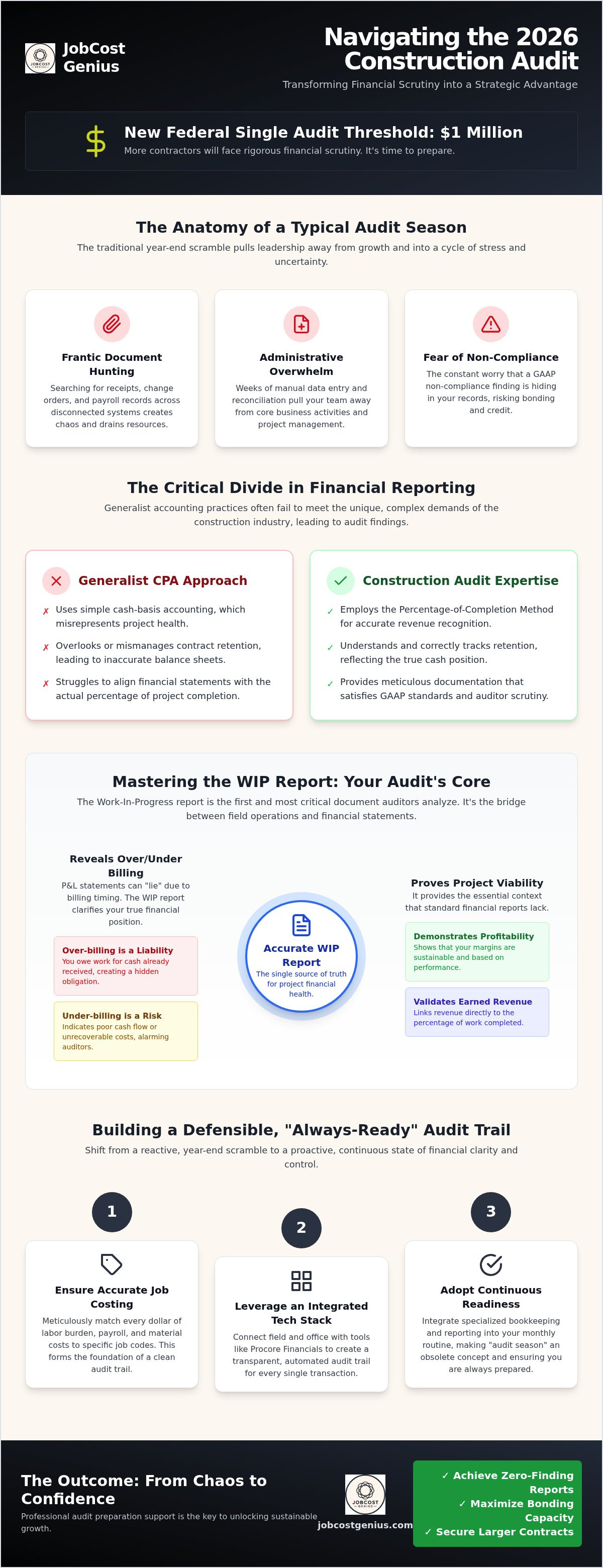
What if the next time an auditor requested your federal award expenditures, you didn't feel a pit in your stomach? With the single audit threshold now set at $1 million, more contractors are facing rigorous financial scrutiny in 2026. We understand the pressure. Audit season usually means weeks of administrative overwhelm, frantic document hunting, and the constant fear that a GAAP non-compliance finding is hiding in your WIP reports. It's an exhausting cycle that pulls you away from the job site and drains your leadership team. You deserve a back office that supports your growth rather than hindering it.
You can transform this high-stakes hurdle into a routine, stress-free event. Professional construction audit preparation support ensures your financial statements reflect true project health while maintaining a clean trail for regulators. By moving away from spreadsheets and toward structured data environments, you'll gain the financial clarity needed to satisfy even the most meticulous auditors. This guide explores how to leverage specialized WIP reporting and Procore integrations to achieve a zero-finding report and streamlined operations that last all year long.
Key Takeaways
- Understand why specialized revenue recognition rules and GAAP standards require a construction-specific approach that generalist accounting firms often overlook.
- Discover how professional construction audit preparation support transforms your WIP report into a reliable tool for proving earned revenue and project profitability.
- Learn the critical importance of matching labor burden and payroll allocations to specific job codes to satisfy auditor scrutiny of project-level expenses.
- Identify how a field-to-office tech stack, including Procore financials integration, creates a transparent and automated audit trail for every transaction.
- Shift from a stressful year-end scramble to an "always-ready" financial posture by integrating specialized bookkeeping into your monthly business routine.
Why Construction Financial Audits Require Specialized Preparation
Construction audit preparation is the systematic organization of project-based financial records to ensure total accuracy before an external review. It is not a simple year-end task. Instead, it's a continuous discipline that aligns your daily bookkeeping with strict industry standards. Many firms struggle because they treat this as a general administrative burden rather than a strategic financial asset. Professional construction audit preparation support provides the structure needed to move from administrative chaos to a state of organized financial clarity. This transition is official for any firm looking to scale.
The stakes are incredibly high for modern contractors. Banks and bonding companies view your audit report as the ultimate proof of your business's stability. A report filled with findings or adjustments can lead to reduced bonding capacity and higher interest rates on credit lines. When your financial records are disorganized, you risk more than just a bad grade; you risk the ability to bid on high-value projects. Specialized preparation ensures that your data is defensible, accurate, and ready for scrutiny at any moment; utilizing a specialized firm like לוי ושות' רואי חשבון (Levi and Co. CPA) for auditing and bookkeeping can provide the professional oversight needed to maintain these high standards.
The Difference Between General and Construction Audits
Generalist CPAs often struggle with the industry's unique demands. While standard retail or service businesses might use simple cash-basis accounting, contractors must utilize the percentage-of-completion method to reflect true project status. This requires a deep understanding of specialized construction accounting principles to properly recognize revenue based on project progress. Auditors focus heavily on your contract backlogs and overall project health to ensure you aren't over-billing or under-reporting costs. Retention tracking is another common hurdle. Generalists frequently overlook these held funds, leading to inaccurate balance sheets that don't reflect your true cash position.
The Role of GAAP in 2026 Construction Compliance
In 2026, GAAP compliance remains the gold standard for financial reliability. Current revenue recognition standards for long-term contracts require meticulous documentation of every project milestone and cost incurred. Accurate job costing serves as the foundation of a clean audit trail. When your labor burden and material costs are perfectly allocated, you demonstrate a level of control that inspires confidence in lenders. Clean audits don't just satisfy regulators. They directly impact your bottom line by proving your operational efficiency. By leveraging construction audit preparation support, you ensure that every transaction is mapped correctly, allowing you to secure larger, more profitable contracts with ease.
Mastering the WIP Report for Audit Accuracy
Auditors start their investigation with the Work in Progress (WIP) report because it's the most critical document in your financial arsenal. It provides a snapshot of every active project and reveals whether your profit margins are sustainable or just a result of aggressive billing. Effectively, the WIP report serves as the essential bridge between field-level project management and your formal financial statements. Without it, your balance sheet lacks the context needed to prove your company’s true value or operational health.
When you utilize professional WIP reporting for construction companies, you move beyond simple accounting. You create a system that proves revenue earned versus revenue billed based on the actual percentage of completion. This level of detail is exactly what organizations like the National Association of Construction Auditors look for when evaluating financial integrity. Comprehensive construction audit preparation support ensures that these reports are not just generated, but are technically sound and defensible under scrutiny.
Fixing Overbilling and Underbilling Discrepancies
Standard Profit and Loss statements often "lie" because of billing timing. If you bill ahead of your costs, your P&L looks artificially healthy; if you fall behind, it looks like you're losing money. Auditors scrutinize these discrepancies to find hidden liabilities. Overbilling represents a liability because you owe work for money already received. Conversely, significant underbilling is a major risk factor. It suggests you aren't managing your cash flow effectively or that you're incurring costs you can't actually bill. Reconciling your billed-to-date figures with actual costs incurred is the only way to present an honest financial picture that auditors will accept.
Quarterly WIP Reviews: The Proactive Approach
Waiting until year-end to adjust your WIP is a recipe for audit failure. Adopting monthly or quarterly WIP adjustments prevents the massive surprises that derail bonding applications and bank covenants. At JobCost Genius, we integrate WIP data directly into your monthly financial statements as part of our construction audit preparation support. This proactive stance ensures your numbers are always accurate. It builds trust with your surety agent and maximizes your bonding capacity. If you want to stop the year-end scramble, consider how our WIP reporting services can stabilize your back office. Consistent oversight is the best insurance against audit findings.
Ensuring Job Costing and Payroll Compliance for Auditors
Auditors prioritize payroll because it represents the highest risk for financial misstatement in a construction firm. Every hour logged must be defensible. Professional construction audit preparation support ensures that your labor burden is calculated correctly and allocated to the right project. If an auditor cannot trace a payroll expense directly to a specific job code, they may disqualify the cost, leading to significant adjustments on your financial statements. This scrutiny extends to the classification of 1099 workers versus W2 employees. Misclassifying subcontractors can trigger Department of Labor investigations alongside your financial audit, making precise record-keeping a non-negotiable requirement.
According to the NACA Professional Standards, auditors evaluate the internal controls governing these allocations. They look for a clear trail from the timecard to the general ledger. For firms involved in government-funded projects, the complexity increases significantly. You must ensure that prevailing wage payroll processing for contractors is handled with 100% accuracy to meet federal requirements. With the single audit threshold for federal awards now set at $1,000,000, more contractors are falling under this intense level of oversight in 2026.
Calculating Accurate Labor Burden
Labor burden is far more than just the hourly rate paid to a field worker. It includes employer-paid taxes, health benefits, retirement contributions, and workers' compensation insurance. If you only track raw wages, your job costs are artificially low, which skews your WIP report and profit recognition. Audit adjustments often stem from these hidden costs being improperly allocated or omitted entirely. To keep your job costing accurate, you must track FICA, FUTA, and SUTA taxes alongside general liability premiums and fringe benefits. When these figures are dialed in, your project profitability data remains beyond reproach.
Certified Payroll and Compliance Reporting
Certified payroll is a mandatory requirement for federal and state projects. It demands weekly reporting of every worker's hours, wages, and benefits to ensure compliance with the Davis-Bacon Act. Manual entry is the primary cause of failure in these audits. Automated payroll management reduces the risk of human error and ensures that your reports are generated directly from verified time data. Maintaining these records correctly prevents the heavy penalties and debarment risks associated with labor law violations. With expert construction audit preparation support, you can automate these complex workflows and enter audit season with total confidence.
Leveraging Tech Stacks to Automate Audit Trails
Technology serves as the backbone of modern audit readiness. In 2026, relying on manual data entry or disconnected spreadsheets is a liability that invites auditor scrutiny. Moving toward a structured communication channel and a common data environment (CDE) ensures that every project decision leaves a digital footprint. This shift creates a transparent, automated audit trail that links field activities directly to your general ledger. By implementing professional construction audit preparation support, you move your firm from a reactive scramble to a proactive, "always-ready" financial posture.
The most effective way to bridge the gap between project management and accounting is through Procore financials integration services. When your field team enters a commitment or a change order, that data should flow seamlessly into your accounting software without manual re-entry. This synchronization eliminates the discrepancies that often lead to audit findings. It ensures that the numbers your project managers see in the field match the reports your controller presents to the bank.
Integrating Procore with Your Accounting Software
Successful integration follows a disciplined 4-step process to ensure data integrity. First, you must establish a unified cost code structure that both the field and office teams use. Second, automate the sync of field-level commitments with office payables to prevent lag. Third, implement a strict approval workflow for change orders within the software. Finally, perform monthly reconciliations to catch any data drift. This real-time job costing provides auditors with instant access to verified data, significantly reducing the time they spend questioning your project totals. If you need help optimizing your field-to-office workflow, our team can help you integrate your construction tech stack for maximum compliance.
Digital Document Management and the Paperless Audit
Digital document management eliminates the "missing invoice" headache that plagues traditional audits. By attaching digital receipts, subcontracts, and insurance certificates directly to transactions in your accounting system, you provide immediate proof for every expense. This centralized data hub allows auditors to conduct much of their work remotely, reducing their on-site presence and the associated disruption to your team. Cloud-based storage also offers superior security and disaster recovery compared to physical files. When your documentation is organized and easily searchable, you demonstrate a level of professional control that builds immediate trust with any external auditor.
Scaling with Confidence: Professional Audit Preparation Support
Scaling a construction firm requires more than just winning bids; it requires a foundation of financial integrity. Generalist accounting firms often lack the technical depth to handle complex revenue recognition or labor burden allocations. This gap creates a risk for growing contractors. Choosing specialized construction audit preparation support becomes a competitive advantage. By partnering with experts who understand the nuances of the industry, you ensure your books are always defensible. Our outsourced bookkeeping for construction firms provides the continuous oversight needed to prevent year-end panic.
We offer tiered solutions designed to grow alongside your business. Whether you're a mid-sized firm needing the Starter Plan or a large-scale enterprise requiring the Premium Plan, our services adapt to your specific volume and complexity. This subscription-based model acts as an "always-ready" audit insurance policy. You stop viewing audit prep as a seasonal crisis and start seeing it as a strategic investment in your firm's foundational strength. This shift in perspective allows you to focus on project delivery while we maintain the financial clarity required by your lenders and bonding agents.
The JobCost Genius Approach to Financial Oversight
Our approach centers on meticulous monthly record-keeping and rigorous bank reconciliations. We don't just "do the books"; we manage the data that drives your business decisions. Each month, our team produces CEO-level financial dashboards and reports that provide a clear view of your project health. This partnership-oriented style transforms administrative overwhelm into a state of organized calm. You gain a trusted guide who understands the unique complexities of construction accounting better than any generalist. We handle the technical details of GAAP compliance and job costing so you can lead with confidence.
Next Steps: Securing Your 2026 Audit Readiness
Securing your financial future starts with a clear understanding of your current standing. We recommend beginning with a comprehensive financial health checkup to identify any existing gaps in your documentation or reporting. Transitioning from messy, manual books to our structured subscription model is a seamless process managed by our veteran team. We provide the national expertise you need to satisfy auditors across any jurisdiction. Don't wait for an audit notice to arrive before organizing your records. Take control of your back office now. Schedule your consultation with JobCost Genius today to build a more resilient, audit-ready construction firm.
Build Your Firm on a Foundation of Audit Readiness
Audit season doesn't have to be a period of administrative chaos and financial uncertainty. By shifting your focus toward proactive monthly oversight and leveraging specialized tech stacks, you create a business that is inherently defensible. You've learned how critical accurate WIP reporting and payroll compliance are for satisfying modern auditors. Now is the time to replace manual spreadsheets with streamlined, automated workflows that protect your bonding capacity and project profitability. Professional construction audit preparation support transforms your back office into a strategic asset rather than an administrative burden.
JobCost Genius brings over 20 years of construction industry experience to your team. As Procore financials integration experts, we ensure your field data perfectly matches your office records through specialized WIP reporting. You can lead your firm with the confidence that your financial statements are accurate, compliant, and ready for scrutiny at any moment. Get Audit-Ready with JobCost Genius and experience the clarity that comes from expert financial oversight. Your path to a stress-free audit starts with a single, strategic step forward today.
Frequently Asked Questions
What is construction audit preparation support?
Construction audit preparation support is the systematic organization of project-based financial records to ensure total accuracy before an external review. It involves aligning daily bookkeeping with industry standards like GAAP to create a defensible financial trail. Rather than a one-time scramble, this support provides continuous oversight of job costing and revenue recognition. This ensures that when auditors arrive, your records are already organized and compliant without disrupting your daily operations.
How far in advance should a contractor begin audit preparation?
You should begin preparation the first day of your fiscal year by maintaining a disciplined, monthly record-keeping routine. Waiting until the end of the year leads to administrative overwhelm and a higher risk of findings. A proactive, "always-ready" financial posture is the only way to ensure a clean report. By integrating specialized bookkeeping into your daily workflows, you transform audit preparation from a seasonal crisis into a standard part of your business infrastructure.
Why do auditors focus so heavily on the WIP report?
Auditors prioritize the Work in Progress (WIP) report because it proves whether your revenue earned matches what you've actually billed. It reveals the true health of your projects by identifying overbilling or underbilling discrepancies that a standard P&L might hide. Because the WIP report acts as the bridge between field-level project management and your formal financial statements, it's the most reliable tool for auditors to verify your company's profitability and stability.
Can generalist bookkeepers handle construction audit preparation?
Generalist bookkeepers often struggle with the unique complexities of construction accounting, such as the percentage-of-completion method and retention tracking. They don't always understand how to properly allocate labor burden or manage the nuances of certified payroll. Specialized construction audit preparation support is necessary because it accounts for these industry-specific rules. Professionals with deep construction experience ensure your books meet the rigorous standards that bonding companies and banks demand.
What are the most common audit findings for construction companies?
Generalist bookkeepers often struggle with the unique complexities of construction accounting, such as the percentage-of-completion method and retention tracking. They don't always understand how to properly allocate labor burden or manage the nuances of certified payroll. Specialized construction audit preparation support is necessary because it accounts for these industry-specific rules. Professionals with deep construction experience, such as Brown Hamilton Partners, ensure your books meet the rigorous standards that bonding companies and banks demand.
What are the most common audit findings for construction companies?
Procore integration creates a transparent, automated audit trail by syncing field-level commitments directly with your accounting software. This eliminates manual entry errors and ensures that project managers and the back office see the same data. When change orders or commitments are approved in the field, they flow seamlessly into your financial reports. This real-time synchronization provides auditors with instant access to verified data, significantly reducing the time they spend questioning your project totals.
What documents are required for a construction financial audit?
A standard construction audit requires a comprehensive set of documents, including your WIP reports, job cost ledgers, and certified payroll records. You must also provide signed subcontracts, insurance certificates, and proof of labor burden calculations. Digital versions of all receipts and vendor invoices should be attached directly to their corresponding transactions. Having these documents organized in a centralized data hub allows auditors to conduct much of their work remotely, minimizing the disruption to your operations.
How much does professional audit preparation support cost for contractors?
The cost of construction audit preparation support is typically integrated into ongoing financial management subscriptions. JobCost Genius provides tiered options, such as the Starter, Growth, and Premium plans, which scale with your firm's volume. This model ensures you have year-round readiness rather than facing a massive, one-time fee during audit season. Investing in a monthly subscription provides the "always-ready" insurance you need to maintain bonding capacity and achieve long-term financial clarity.


