

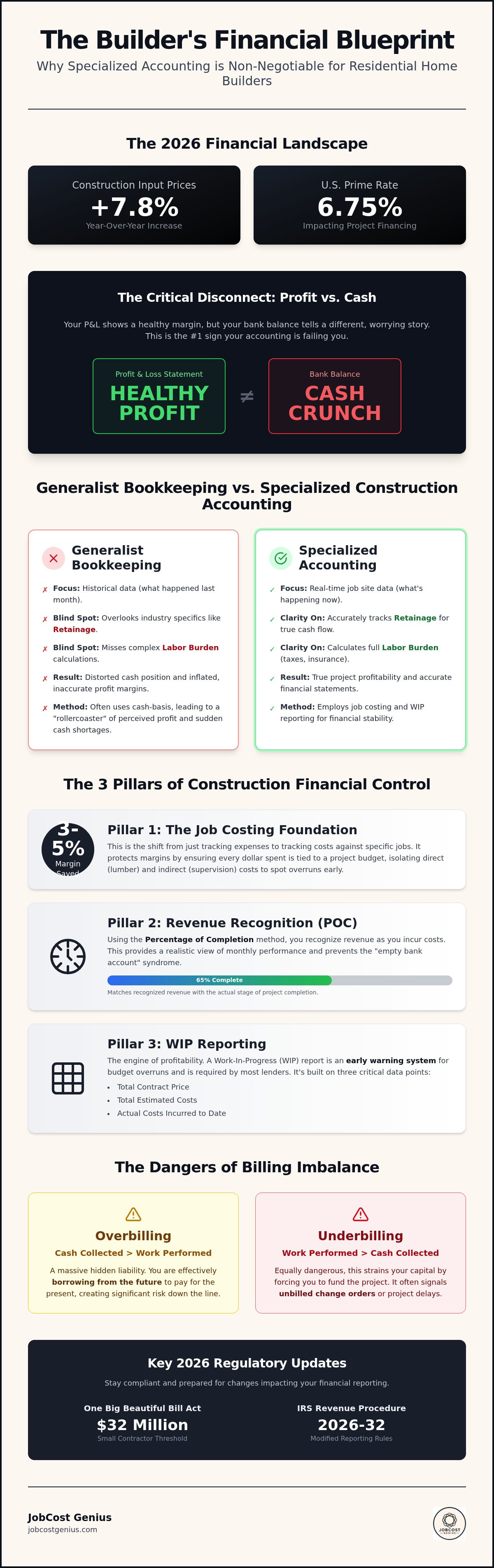
Why does your profit and loss statement show a healthy margin while your bank balance tells a completely different story? This disconnect often stems from relying on generalist bookkeepers who don't understand the complex nuances of retainage, job costing, or progress billings. Specialized accounting for residential home builders is no longer a luxury. It's the baseline for survival in a 2026 market where construction input prices have climbed 7.8% year-over-year and the U.S. Prime Rate sits at 6.75%.
You've likely felt the administrative overwhelm of inaccurate WIP reporting or the stress of tracking field expenses against tight project budgets. We'll show you how to transition from basic bookkeeping to project-centric financial oversight that secures your cash flow and prepares you for a stress-free tax season. This guide previews essential 2026 updates from the One Big Beautiful Bill Act, including the $32 million small contractor threshold and the critical IRS Revenue Procedure 2026-32 modifications that change how you report residential construction contracts. You will gain the clarity needed to protect your margins and scale your unit count with confidence.
Key Takeaways
- Identify why generalist bookkeepers often overlook industry-specific nuances like retainage and labor burden, which can lead to significant margin erosion.
- Learn how to implement specialized accounting for residential home builders to align project costs with recognized revenue and eliminate tax-time surprises.
- Master the mechanics of Work in Progress (WIP) reporting to serve as an early warning system for budget overruns before they impact your bottom line.
- Discover how to build a seamless field-to-office data pipeline by integrating project management software like Procore with your financial ledger.
- Transition from simple record-keeping to strategic financial forecasting to support a scalable back-office that grows with your unit count.
The Difference Between General Accounting and Residential Home Builder Accounting
General accounting tracks what happened in the past. Specialist accounting for residential home builders tracks what's happening right now on the job site. Most generalist bookkeepers view your business through a retail or service lens. They see rent and utilities but fail to account for retainage; this is the portion of a contract held back until project completion. This oversight distorts your true cash position. When you don't account for labor burden, including workers' comp and payroll taxes, your project margins are often much thinner than they appear on paper.
Operating on a cash basis creates a dangerous rollercoaster effect. You receive a large draw from a client and it feels like a windfall. Two weeks later, the invoices from your framing and plumbing subs arrive, and that perceived profit evaporates. This mismatch makes it impossible to know if you're actually making money on a specific lot. Mastering accounting for residential home builders requires moving away from simple expense tracking and adopting a system that recognizes the long-term nature of construction cycles.
Revenue Recognition: Timing is Everything
Builders must choose between the Completed Contract Method and the Percentage of Completion (POC) method. While the One Big Beautiful Bill Act of 2026 made POC optional for many residential projects, the underlying Construction accounting principles remain vital for financial clarity. POC allows you to recognize revenue as you incur costs, providing a realistic view of monthly performance. This prevents the empty bank account syndrome where your P&L shows profit but your cash is tied up in unbilled work or deposits that haven't been earned yet.
Revenue recognition needs also shift based on your business model. Pre-sale custom builds require rigorous draw management to stay ahead of vendor payments. Spec homes demand a focus on capitalized costs until the point of sale. Your accounting system must adapt to these cycles to ensure your financial statements reflect the reality of your inventory and current obligations.
The Job Costing Foundation
The shift from tracking expenses to tracking job costs is the foundation of margin protection. A generic Chart of Accounts won't cut it. You need a structure that isolates direct costs, like lumber and roofing, from indirect costs like site supervision and equipment maintenance. Many builders lose 3% to 5% of their margin simply because they don't properly allocate indirect costs to specific jobs. Check out our guide on Building a Construction Chart of Accounts: A Pro Guide to see how to structure your ledger for maximum visibility. This level of detail ensures that every dollar spent is tied to a specific project budget, allowing you to spot overruns before they become permanent losses.
Mastering WIP Reporting: The Heart of Residential Profitability
WIP reporting is the engine of specialized accounting for residential home builders. It ensures that your financial statements reflect the actual stage of completion for every home in your pipeline. Without this mechanism, you're essentially guessing your profitability until the final closing. A WIP report acts as an early warning system. It identifies budget overruns while you still have time to course-correct. Mastering accounting for residential home builders requires a shift from tracking bank balances to managing cost-to-complete ratios.
Lenders and bonding companies in 2026 have increased their scrutiny of construction firms. They require accurate WIP statements to verify that you aren't overextended or hiding losses in your current projects. This oversight is backed by best practices found in NAHB's guide to financial management. To build a reliable report, you must track three critical data points: the total contract price, your total estimated costs, and your actual costs incurred to date.
Identifying Overbilling and Underbilling
Overbilling occurs when you've collected more cash than the value of the work performed. While "front-loading" helps with immediate payroll, it creates a massive liability. You're effectively borrowing from the future to pay for the present. Underbilling is equally dangerous. It often signals that change orders aren't being tracked or that field expenses are sitting on a supervisor's desk instead of being entered into the system. For a deeper dive into these mechanics, see our WIP Reporting for Construction: The Definitive 2026 Guide.
Fixing the "Lying" P&L
A standard Profit and Loss statement often "lies" to residential builders. It might show a significant profit simply because a large draw hit the bank, even if you are falling behind on your cost-to-complete estimates. WIP adjustments correct these distortions at month-end by shifting unearned revenue to the balance sheet as a liability. This process provides the psychological benefit of seeing true net income instead of an inflated bank balance. You can stop managing by "gut feel" and start making decisions based on verified performance data.
WIP reporting is the bridge between project management and the balance sheet.
Maintaining this level of detail is difficult without a dedicated partner. Many builders use our specialized WIP reporting services to gain this visibility without the overhead of a full-time controller.
Evaluating Your Options: Software, In-House, or Specialized Services
Software like QuickBooks or Buildertrend is a powerful tool, but it's not a solution on its own. Many builders fall into the trap of thinking a subscription equals financial clarity. Without expert management, these systems often become repositories for messy, unusable data. Professional accounting for residential home builders requires someone who knows how to interpret the numbers, not just enter them into a ledger. You need a driver for the engine, not just a shiny dashboard.
The debate between hiring in-house or outsourcing often comes down to cost and complexity. A full-time controller can cost well over $100,000 annually, which is a heavy burden for a growing firm. Our Starter Plan begins at $800/month, offering a high-value alternative that provides professional-grade oversight without the massive overhead. This "fractional controller" model ensures your back-office scales alongside your unit count.
The Generalist vs. Specialist Comparison
A generalist bookkeeper might handle your payroll, but they'll likely struggle with industry-specific requirements like AIA billing or prevailing wage. Specialized accounting for residential home builders understands these nuances from day one. This specialized knowledge prevents costly errors during audits or bank draws; for instance, The Sphere Group identifies common red flags that can trigger tax audits, providing valuable context for builders aiming to maintain audit-ready records.
| Feature | General Bookkeeper | Construction Bookkeeper | JobCost Genius |
|---|---|---|---|
| WIP Reporting | Rarely Offered | Basic/Manual | Specialized & Included |
| Software Sync | Generic Entry | Varies | Procore/Buildertrend Expert |
| Industry Focus | Broad/Retail | Commercial/General | 20+ Years Residential |
Choosing the right partner means looking beyond basic data entry. You need a team that acts as a strategic guide for your operations. For a deeper dive into these options, read our Outsourced Bookkeeping for Construction: 2026 Guide.
The ROI of Financial Oversight
Bad data is expensive. Missed change orders alone can cost a builder 2% to 3% of their total project margin. When you factor in late fees and overpayment to subcontractors, the cost of an amateur back-office is staggering. Accurate books also improve your debt-to-equity ratio. This makes you more attractive to lenders, potentially lowering your borrowing costs in a high-interest environment where the U.S. Prime Rate sits at 6.75%.
When you interview a potential accounting partner, ask these three questions to gauge their expertise:
- How do you specifically handle retainage and labor burden in monthly reports?
- Can you explain the difference between overbilling and underbilling on my WIP statement?
- What is your process for integrating field data from Procore into the general ledger?
Procore Financials Integration
Bridging the gap between field commitments and office payments ensures that your office never pays an invoice that hasn't been field-approved. A robust integration allows your field budget to match the general ledger in real-time. This synchronization eliminates double entry and reduces the risk of overpaying subcontractors. Our Procore Financials Integration Services: Bridging the Field-to-Office Data Gap helps builders maintain this critical link without the administrative burden. It allows your project managers to focus on building while your accounting stays accurate.
Managing Accounts Payable and Subcontractors
Lien waiver management is a high-stakes component of the payment cycle. You need a system that automatically collects waivers before checks are released. It's also vital to track subcontractor insurance and compliance certificates to protect your business from liability. Automating these AP workflows prevents late-payment friction and ensures your vendors remain reliable partners. When your accounting for residential home builders includes automated compliance tracking, you reduce the risk of costly insurance gaps.
If you're struggling to sync your field operations with your books, our team can help. Explore our Procore Financials Integration to see how we streamline the data flow for growing builders.
Strategic Financial Oversight: Scaling Your Building Business
Many builders spend their time looking at the rearview mirror. They see what they spent last month, but they can't see the curve in the road ahead. Strategic accounting for residential home builders transforms your financial data from a history lesson into a forecasting tool. By analyzing historical job cost data, you can identify which floor plans or subcontractors consistently erode your margins. This allows you to bid with surgical precision on future projects. You're no longer just "busy"; you're building a profitable enterprise.
Transitioning to a CEO mindset requires a reliable financial dashboard you can actually trust. When your back-office is organized, you stop making decisions based on your current bank balance. You start making them based on projected cash flow and capacity. This shift is what separates a job-to-job operation from a scalable business that can survive market shifts. Monthly recurring bookkeeping provides the steady foundation needed to support this level of professional confidence. Having this level of financial clarity also makes it easier to secure funding when opportunities arise; for specialized real estate and commercial loans, check out JGL Capital LLC.
The "draw gap" is a silent killer in residential construction. It's the period between paying your vendors and receiving your next milestone payment. In 2026, with the U.S. Prime Rate at 6.75%, the cost of carrying that gap on a line of credit is higher than ever. Proper Construction Cash Flow Management: Strategies for Sustainable Growth in 2026 involves building a cash reserve that acts as a shock absorber. We recommend targeting a reserve that covers at least three months of fixed overhead to weather any sudden market fluctuations or permit delays.
How JobCost Genius Partners with Builders
We offer three distinct tiers to meet your business where it is today. Our Starter Plan provides specialized bookkeeping for $800/month, focusing on the essentials of AP/AR and payroll. The Growth Plan and Premium Plan offer deeper integration and more complex reporting for builders scaling their unit counts. During the first 90 days of our partnership, we focus on cleaning up your Chart of Accounts and establishing a rhythm for your WIP reporting. This foundation ensures you have the clarity needed to lead your company with confidence.
Our goal is to transform your administrative overwhelm into organized calm. We act as a strategic guide, ensuring your back-office is an asset rather than a liability. Schedule your financial clarity call with JobCost Genius today to see how we can help you secure your margins and scale your building business.
Secure Your Margins and Scale with Confidence
Transitioning to professional accounting for residential home builders is the most significant step you can take toward long-term stability. By implementing specialized WIP reporting and bridging the gap between your field operations and your office ledger, you transform your back-office from a cost center into a strategic asset. You no longer have to guess your profitability or fear tax-time surprises. Instead, you gain the clarity needed to navigate 2026 market fluctuations and bid with precision.
JobCost Genius brings over 20 years of construction finance experience to your team. As specialized WIP and Procore integration experts, we provide the meticulous oversight typically reserved for large-scale firms. Our tiered pricing structure ensures there is a plan for every stage of builder growth, allowing your administrative infrastructure to scale as your unit count rises. You don't have to manage the administrative overwhelm alone.
You've built the homes; now it's time to build the financial foundation your business deserves.
Frequently Asked Questions
How does residential accounting differ from commercial construction accounting?
Residential accounting typically involves higher transaction volumes with smaller individual draw amounts compared to commercial work. Revenue recognition needs often shift between custom pre-sale models and spec home inventory tracking. While commercial projects may span years, residential builds have shorter cycles that require precise land and interest allocation. You need a system that handles these unique inventory cycles without the heavy compliance overhead of commercial-grade reporting.
Can I use QuickBooks for my residential building business?
You can use QuickBooks, but it is not a "plug-and-play" solution for the construction industry. Standard configurations lack the built-in logic for job costing and WIP reporting. You must structure your Chart of Accounts specifically to capture direct and indirect costs. Most builders find that QuickBooks only provides clarity when it's managed by a professional who understands construction-specific workflows and software integrations.
What is the most common accounting mistake home builders make?
The most frequent error is managing a business based on the bank balance instead of accrual-based job costs. This creates a false sense of security when a large draw hits the bank, even if unpaid vendor invoices are pending. Without specialized accounting for residential home builders, you risk a cash crunch when those liabilities come due. Failing to track labor burden and retainage also distorts your true project margins.
How often should a residential builder review their WIP reports?
You should review your WIP reports at least once a month during your financial close. High-volume builders often benefit from bi-weekly reviews to catch budget overruns before they become permanent losses. Regular reviews allow you to spot underbilling or overbilling issues that impact your cash flow. This consistency ensures your project managers and office staff stay aligned on the actual cost-to-complete for every lot in your pipeline.
Do I need a CPA or a specialized construction bookkeeper?
You ideally need both, but they serve different functions. A CPA focuses on high-level tax strategy and year-end compliance. A specialized construction bookkeeper handles the daily mechanics of job costing, payroll, and WIP reporting. Relying on a generalist CPA for daily entries often results in messy data that lacks operational utility. A specialized partner ensures your books stay audit-ready while providing the real-time visibility needed for growth.
What software integrations are best for residential home builders in 2026?
The most effective tech stack for 2026 combines project management tools with a strong accounting ledger. We specialize in Procore Financials integration to bridge the gap between field commitments and office payments. Buildertrend is another reliable choice for residential firms. The key is ensuring these tools sync seamlessly with your ledger to eliminate double entry. This synchronization reduces human error and ensures your financial reporting remains accurate and timely.
How much should I expect to pay for specialized construction bookkeeping?
Pricing depends on the size of your firm and the complexity of your reporting needs. Our Starter Plan begins at $800 per month, offering a high-value alternative to hiring an expensive in-house controller. Growing firms may choose our Growth or Premium plans as their unit count and transaction volume increase. This tiered approach allows you to access expert-level oversight without the high overhead of on-site administrative staffing.
How does accurate accounting help with construction financing and bonding?
Lenders and bonding agents require financial transparency before approving credit lines or performance bonds. Accurate accounting for residential home builders provides the professional-grade WIP statements and balance sheets they demand. When you demonstrate a clear history of project profitability and a stable debt-to-equity ratio, you become a lower-risk borrower. This professional presentation often leads to better interest rates and higher bonding limits, which are essential for scaling.


